On this page
How to identify it
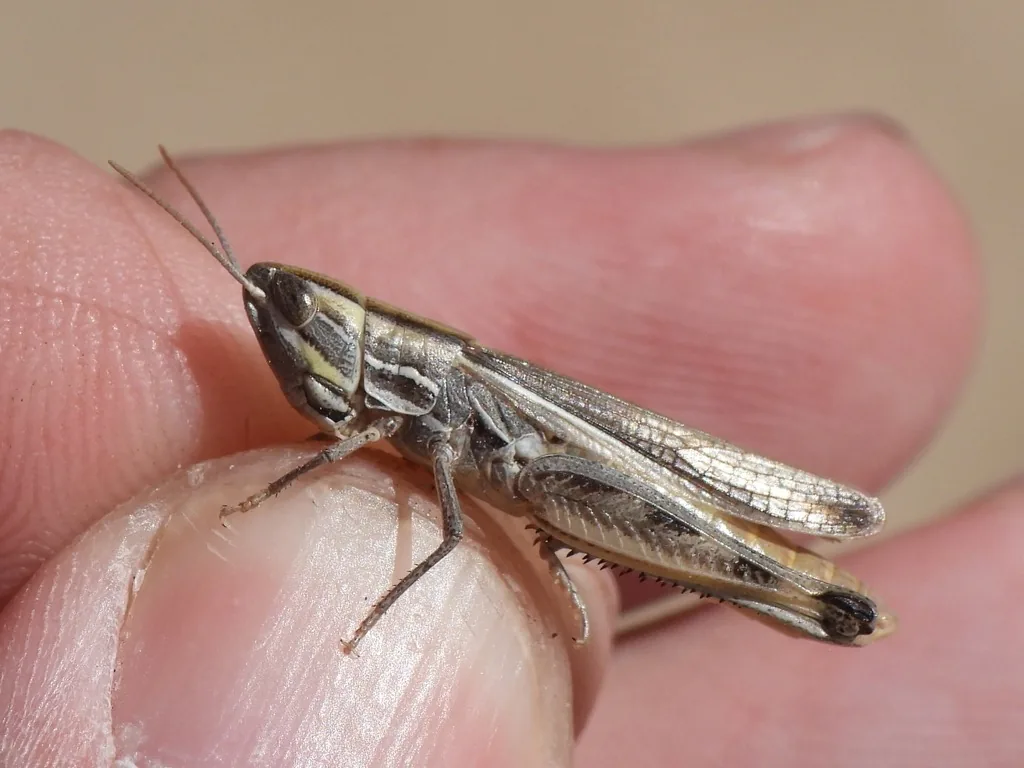
- A medium-sized, almost bullet-shaped grasshopper, cream colored and boldly striped with light and dark brown. Males are 17 to 21 mm long and females 21 to 26 mm.[1][2]
- Two chocolate-brown stripes run along the top of the head above the eyes and continue back onto the pronotum.[1]
- The hind shins are pale blue. The hind thigh has three dark brown bands and a dark knee.[1][2]
- The face is slanted and the antennae are flat and threadlike. The wings are long and extend past the abdomen; the hind wings are clear.[1][2][3]
Where it lives
Grasslands across western North America, with the largest numbers on mixed-grass and bunchgrass prairie. In Nebraska it has been recorded in the western two-thirds of the state and is most common in the western half.[1][2]
Biology and life cycle
It feeds almost only on grasses and sedges, chiefly blue grama, needleandthread, threadleaf sedge and needleleaf sedge, plus western wheatgrass, junegrass and other range grasses. It climbs the plant and feeds head-up, cutting off leaf pieces and holding them with its front feet; it rarely feeds on the ground.[1][2]
It hatches early, at about the same time as the bigheaded grasshopper, and hatching lasts four to five weeks. Nymphs roost on grass rather than the ground and in Wyoming take 50 to 56 days and five molts to mature. Adults are most common from early July to late August.[1][2]
A female climbs into the center of a needleandthread or threadleaf sedge clump and lays a tiny pod of about four eggs on a stem just below the soil. The pod's outer wall is made of grass fragments and soil, so it is easily missed when people sample for grasshopper eggs. There is one generation a year.[1]
Adults rest on the ground under grass at night and bask in the morning. In midsummer heat above about 90°F they climb small shrubs and rest a few inches up in the shade. Flushed adults fly fast, low and silently for a few feet and land with a zigzag.[1]
Damage and signs
- Feeding reduces forage. In cage tests on British Columbia grassland, each nymph per square yard cut needleandthread yield by 3.5 pounds per acre, and one young adult per square yard removed about a pound of forage per acre per day.[1]
- Densities usually run from under one to eight young adults per square yard. It can stay low for years and then climb along with the bigheaded, whitewhiskered and spotted-winged grasshoppers, adding to outbreaks those species dominate. Nebraska's guide calls its economic importance debatable.[1][2]
Health risk
It is a grass-feeding grasshopper, and the sources describe no health concerns for people.[1][2]
Control
Prevention
Weigh the forage value of the range against expected grasshopper losses before deciding on any control.[3]
Biological control
Predators, parasites and other enemies kill an average of about 6 percent of adults each day, and natural enemies contribute to grasshopper control every year.[1][3]
Pesticides
Bran baits work poorly against this species: in field tests only about 4 percent of a population fed on bran bait, and a bait only works on grasshoppers that eat it.[1][3]
Common questions
- What is the cream grasshopper with brown stripes and blue legs?
- On western rangeland it is likely the striped grasshopper. Its stripes, pale blue hind shins and bullet-shaped body make it easy to tell from other species.[1][2]
- Will grasshopper bait control striped grasshoppers?
- Not well. Field tests found that only about 4 percent of a striped grasshopper population would eat bran bait.[1]
Sources
- USDA Agricultural Research Service, Northern Plains Agricultural Research Laboratory, “Striped Grasshopper, Amphitornus coloradus (Thomas): species fact sheet, Grasshoppers: Their Biology, Identification and Management.” www.ars.usda.gov/plains-area/sidney-mt/northern-plains-agricultural-research-laboratory/pest-management-research/pmru-docs/grasshoppers-their-biology-identification-and-management/id-tools-apps/fact-sheets/gomphocerinae-subfamily/fs-striped/ (accessed 2026-11-09)
- University of Nebraska-Lincoln Extension, “The Grasshoppers (Orthoptera: Acrididae and Romaleidae) of Nebraska, EB3 (M. L. Brust, W. W. Hoback and R. J. Wright).” extensionpubs.unl.edu/publication/eb3/2009/pdf/view/eb3-2009.pdf (accessed 2026-11-09)
- Utah State University Extension, “Grasshoppers (E. Evans and E. Hodgson, June 2008).” extension.usu.edu/planthealth/research/grasshoppers (accessed 2026-11-09)
- iNaturalist, “Amphitornus coloradus taxon page (order and family).” www.inaturalist.org/taxa/213471 (accessed 2026-11-09)