On this page
How to identify it
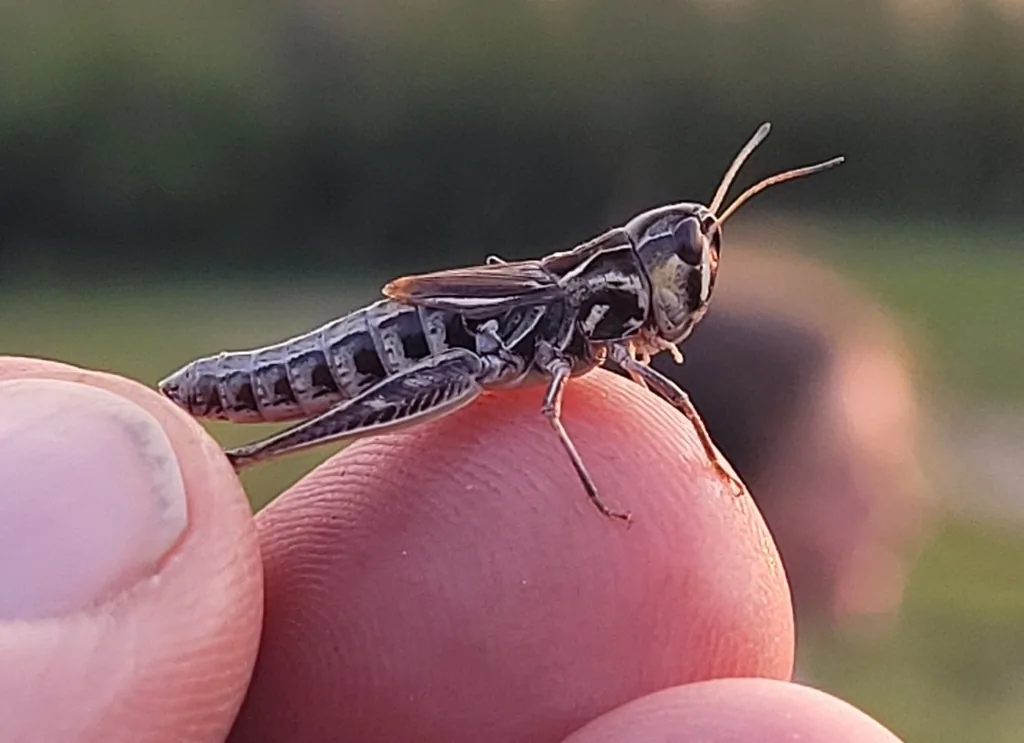
- The antennae are clubbed: the last six segments are enlarged and dark. This is its most distinctive feature.[1][2]
- A medium-sized slant-faced grasshopper, gray, gray-brown or green with darker markings. Males are 16 to 18 mm long and females 19 to 22 mm.[1][2]
- A dark streak runs from below the eye to the jaw, with a pale cream or tan band in front of it, and the side of the pronotum usually has a pale diagonal mark.[1]
- Females have short wings that do not reach the middle of the abdomen and cannot fly. Males may be short- or long-winged. The hind wings are clear and the hind shins light brown.[1][2]
Look-alikes
| Look-alike | How to tell them apart |
|---|---|
| Meadow grasshopper (Pseudochorthippus curtipennis) | Easily confused with the club-horned grasshopper, and the two often share mountain meadows. The meadow grasshopper's antennae are threadlike, thickening only slightly toward the tip instead of ending in a distinct club.[2][3] |
Where it lives
Grasslands of western Canada and the northern United States, reaching south in the mountains to Arizona and New Mexico. In Canada's prairie provinces it is the most widely distributed and abundant grassland grasshopper on dry, somewhat sandy ground south of the boreal forest. In Nebraska it is mostly limited to the northern half of the state.[1][2]
Biology and life cycle
It feeds on grasses and sedges such as western wheatgrass, prairie junegrass, Sandberg bluegrass, needleandthread and threadleaf sedge. Kentucky bluegrass is a favorite wherever it has moved in, and grass seeds are eaten heavily when they ripen.[1][2]
It hatches very early, around the first week of May in eastern Wyoming, about ten days ahead of the bigheaded grasshopper, and hatching lasts three to four weeks. Above timberline in Colorado it hatches in mid- to late June.[1]
Nymphs pass through only four stages and grow fast, reaching adulthood in about 30 days on the plains and 42 days in alpine meadows. Adults are most common from June into early August.[1][2]
Females lay small pods of five to eight eggs among the roots of grasses and sedges. On the plains there is one generation a year, but in alpine meadows the eggs spend two or possibly three winters in the soil.[1]
Males sing loudly by rubbing a hind leg against the wing, crawl a lot and make short flights. Females are slower and sit still on the ground for long periods.[1]
Damage and signs
- It is mainly a pest of grasses and sedges on mixed-grass and bunchgrass prairie and in mountain meadows. In parts of Canada it has reached 20 per square yard and severely damaged forage grasses, and a 1936 outbreak in Saskatchewan destroyed 300 acres of wheat seedlings.[1]
- In most places, though, its numbers stay modest: one to four adults per square yard in Wyoming mixed-grass prairie, and Nebraska's guide rates it unlikely to be of economic importance, though locally abundant.[1][2]
Health risk
It is a grass-feeding grasshopper, and the sources describe no health concerns for people.[1][2]
Control
Prevention
Expect it early. Nymphs appear in early May on the plains and adults emerge while grasses are still green, so any feeding damage comes in spring and early summer. In one case an outbreak followed an unusually wet year.[1]
Biological control
Predators do most of the work. Because it matures so early, birds, rodents, spiders and predatory insects usually cut its numbers to fewer than one per square yard by early summer.[1]
Common questions
- What is the small grasshopper with knobs on the ends of its antennae?
- That is the club-horned grasshopper. The last six segments of each antenna are enlarged and dark, forming a club that gives the species both its common and scientific names.[1]
- Why are there grasshoppers in my pasture so early in spring?
- The club-horned grasshopper is one of the earliest to hatch, starting in early May in eastern Wyoming, so its nymphs are often the first grasshoppers seen in northern grassland.[1]
Sources
- USDA Agricultural Research Service, Northern Plains Agricultural Research Laboratory, “Clubhorned Grasshopper, Aeropedellus clavatus (Thomas): species fact sheet, Grasshoppers: Their Biology, Identification and Management.” www.ars.usda.gov/plains-area/sidney-mt/northern-plains-agricultural-research-laboratory/pest-management-research/pmru-docs/grasshoppers-their-biology-identification-and-management/id-tools-apps/fact-sheets/gomphocerinae-subfamily/fs-clubhorned/ (accessed 2026-11-09)
- University of Nebraska-Lincoln Extension, “The Grasshoppers (Orthoptera: Acrididae and Romaleidae) of Nebraska, EB3 (M. L. Brust, W. W. Hoback and R. J. Wright).” extensionpubs.unl.edu/publication/eb3/2009/pdf/view/eb3-2009.pdf (accessed 2026-11-09)
- USDA Agricultural Research Service, Northern Plains Agricultural Research Laboratory, “Meadow Grasshopper, Chorthippus curtipennis (Harris): species fact sheet, Grasshoppers: Their Biology, Identification and Management.” www.ars.usda.gov/plains-area/sidney-mt/northern-plains-agricultural-research-laboratory/pest-management-research/pmru-docs/grasshoppers-their-biology-identification-and-management/id-tools-apps/fact-sheets/gomphocerinae-subfamily/fs-meadow/ (accessed 2026-11-09)
- iNaturalist, “Aeropedellus clavatus taxon page (order and family).” www.inaturalist.org/taxa/212574 (accessed 2026-11-09)