The short answer
- In an ordinary year, handpick the few you see and protect favorite crops with covers. Grasshoppers chew through cloth and plastic when hungry, so aluminum or other metal window screen holds up best.[1][3]
- The best time to act is spring and early summer, while the grasshoppers are small nymphs still bunched up in weedy, untilled hatching areas. Treatments there work far better than anything aimed at winged adults later.[3][2][6]
- Keep a strip of tall grass or lush plants around the garden and keep it green; it holds grasshoppers outside the beds. Mowing it or letting it dry sends them in.[1][3]
- A bran bait with carbaryl spread around the garden edge before grasshoppers arrive is the lower-risk insecticide option for bees, but it must be reapplied after rain or irrigation. In California, carbaryl now requires an applicator license.[1][3]
- Nosema locustae baits infect only young nymphs, act over weeks, and in field trials usually cut numbers by less than half. They won't rescue a garden that's already invaded.[2][1][10]
- Chickens, guinea hens and turkeys eat grasshoppers, but they also eat some garden plants, and in outbreak years even poultry are overwhelmed.[1][3]
- On western rangeland, outbreaks are handled area-wide. In 17 states, landowners can ask USDA APHIS for help through their State plant health director.[7][8]
Grasshoppers that damage gardens and range
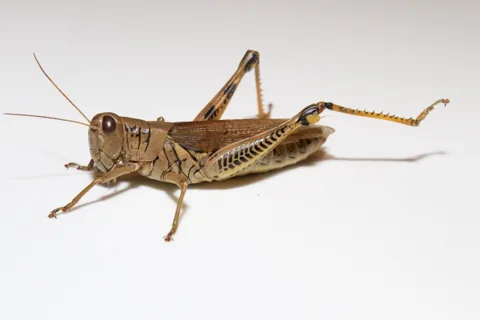 Grasshoppers
Acrididae (e.g., differential grasshopper, Melanoplus differentialis)
Grasshoppers are sporadic garden pests that build up in weedy, uncultivated land and move into yards as nearby vegetation dries out. The differential grasshopper is one of the common, large species that often shows up in gardens first.
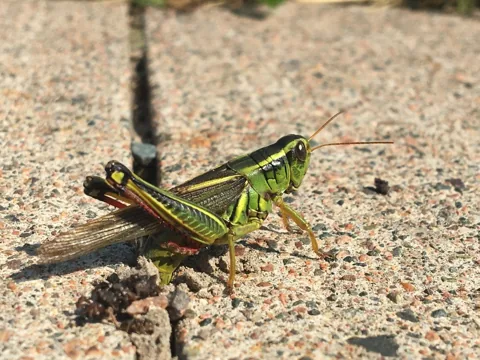 Twostriped Grasshopper
Melanoplus bivittatus
The twostriped grasshopper is a large grasshopper, one of the two largest of its genus in Nebraska, with two pale yellow stripes running from the head to the wing tips. It eats many kinds of plants, moves into gardens from weedy roadsides and empty lots, and in Colorado is often the most common grasshopper damaging gardens.
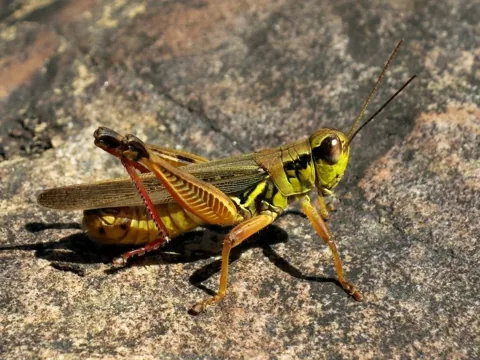 Red-Legged Grasshopper
Melanoplus femurrubrum
The red-legged grasshopper is a common, inch-long grasshopper with red hind legs that feeds on many garden plants and weeds.
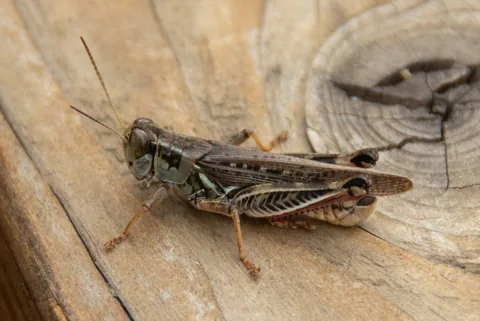 Migratory grasshopper
Melanoplus sanguinipes
The migratory grasshopper is a medium-sized, reddish-brown spur-throated grasshopper that causes more crop damage than any other grasshopper species in the United States, and Alberta calls it one of the most destructive pests in western Canada. Outbreaks that build on weedy rangeland and idle cropland can take off in swarms and land on crops, rangeland or city gardens miles away.
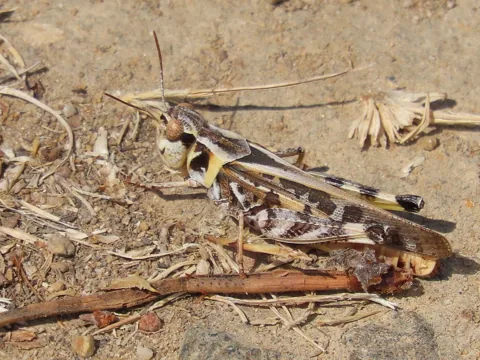 Clear-winged grasshopper
Camnula pellucida
The clear-winged grasshopper is a grassland grasshopper with mottled forewings and transparent hind wings. In much of its range it is a severe pest of small grains and grasses: it hatches early in the season from densely packed egg beds, and its nymphs can march in bands and its adults fly in swarms.
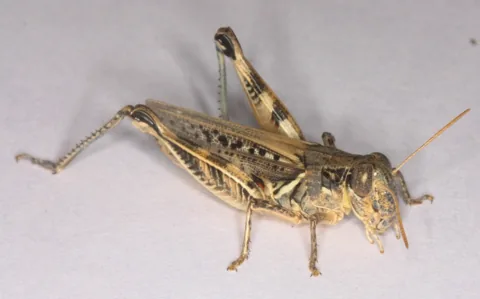 Devastating grasshopper
Melanoplus devastator
The devastating grasshopper is, with the valley grasshopper, the most widespread and destructive garden grasshopper in California. It breeds on foothill rangeland, and when an outbreak strips the range, bands of nymphs and flying swarms of adults head for the valleys and eat crops, orchards and home gardens. It is a minor pest in Oregon and Washington.
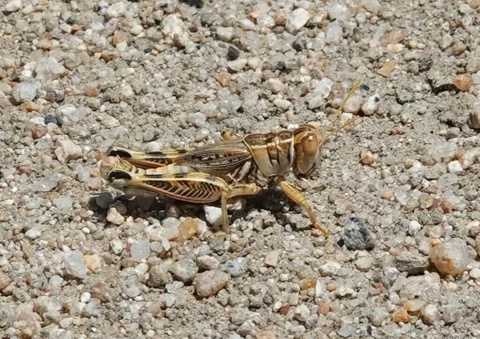 Valley grasshopper
Oedaleonotus enigma
The valley grasshopper is a large rangeland grasshopper of the western sagebrush and foothill country, easy to spot by the pale band along the front of its pronotum that looks like a clergyman's collar. It favors weeds, which can make it useful in small numbers, but outbreaks injure range forage and spill into crops. In California it and the devastating grasshopper are the most widespread and destructive grasshoppers in gardens.
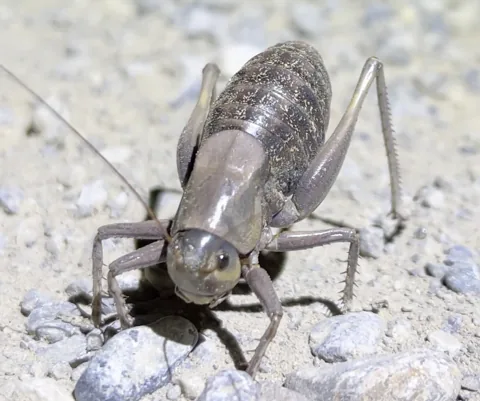 Mormon cricket
Anabrus simplex
The Mormon cricket is not a true cricket but a large, flightless shield-backed katydid of western rangelands. In outbreak years it forms huge bands that walk and hop across the land, eating forage, crops and garden vegetables in their path.
Why some years are so much worse
Grasshopper numbers swing from year to year. In most years garden damage is limited to a few weeks in early summer; in outbreak years they eat almost anything green for much longer. Basic identification is on our grasshopper profile; this section covers why the bad years come.[1][2][3]
- How often: UC IPM says severe outbreaks normally come only every 8 to 10 years and some last two or three years. University of Nebraska describes high populations for two to four years followed by low to moderate numbers for several years. USDA APHIS says larger outbreaks in western states occur every decade or so, with local populations rising and falling in between.[1][3][7]
- Weather, sources differ. UC IPM ties outbreaks to warm, moist springs that grow plenty of food in foothills and uncultivated land. Texas A&M and North Dakota State say outbreaks are usually preceded by several years of hot, dry summers and warm falls, and Utah State says grasshoppers benefit from warm, dry springs. APHIS says outbreak damage is worst during drought.[1][4][6][5][7]
- Why dry, warm weather helps them: Texas A&M says dry weather raises survival of nymphs and adults and warm autumns give females more time to feed and lay eggs. Cool, wet weather brings more disease and slows their development, North Dakota State says, and University of Nebraska says that extended cool weather below 65°F with rain just after hatch can starve young nymphs.[4][6][3]
- Egg numbers, sources differ: UC IPM says each pod holds 20 to more than 100 eggs, and Texas A&M says 20 to 120 eggs per pod, with a female laying an average of 200 eggs a season and sometimes 400. University of Nebraska counts 7 to 30 pods per female with 8 to 30 eggs each, typically about 100 eggs per female.[1][4][3]
- Late summer is the warning. Colorado State says the number of grasshoppers in late summer and early fall is a good indicator of trouble the next year.[2]
- Where it's worst: University of Nebraska says grasshopper damage is most frequent in areas with less than 25 inches of rain a year, and Utah State puts the heaviest injury in areas with 10 to 30 inches.[3][5]
Where your grasshoppers come from
Females lay their eggs in pods in the top couple of inches of dry, undisturbed soil: ditch banks, roadsides, fencerows, pastures, vacant lots and alfalfa or hay fields. Cultivated gardens are not a common egg-laying site, UC IPM says. Egg laying can be concentrated in spots with the right soil texture, slope and orientation, which Colorado State calls egg beds.[1][2][4][3]
- Hatch: eggs start hatching in late April or early May and peak around mid-June, according to Texas A&M and North Dakota State. North Dakota State says hatch runs over a 4 to 6 week period, and University of Nebraska says one species can hatch over a month or more.[4][6][3]
- Which come first: University of Nebraska says the twostriped grasshopper starts hatching about mid-May, the migratory grasshopper about a week later, and the redlegged and differential grasshoppers about three weeks after the twostriped.[3]
- Growth: nymphs molt five or six times and reach adulthood in 40 to 60 days, Texas A&M says; University of Nebraska says five to six weeks. Adults start laying eggs one to two weeks after maturing and live two to three months.[4][3][1]
- When they move in: University of Nebraska says adults are most likely to move into yards and gardens in July and August, and problems spike when nearby crops or grasslands mature or are harvested. Nymphs typically move downhill toward green plants, UC IPM says, and adults can fly 15 or more miles a day in swarms during migrations.[3][1]
- Which species: only a handful do most of the garden damage. University of Nebraska names the migratory, differential, twostriped and redlegged grasshoppers; Colorado State's list adds the clearwinged grasshopper, a grass feeder behind recent outbreaks in parts of Colorado; UC IPM names the devastating and valley grasshoppers in California.[3][2][1]
- Favorite and least favorite crops: lettuce, beans, sweet corn, carrots and onions are preferred; squash, peas and tomato leaves tend to be avoided.[1][2]
How many is too many?
Farm and ranch thresholds are based on grasshoppers per square yard. They are useful in a garden too, as a way to judge whether this is a normal year or an outbreak building.[4][6]
- Texas A&M's square-foot method: count the grasshoppers that hop or move within one square foot, take 15 to 20 paces, and count another. Make 18 counts, add them up and divide by two to get grasshoppers per square yard. If most are small nymphs under 1/2 inch, divide by three to get the adult equivalent.[4]
- North Dakota State's shortcut for dense populations: four 180-degree sweeps with a 15-inch sweep net equal the number of grasshoppers per square yard.[6]
- Thresholds: Texas A&M and North Dakota State give the same adult ratings. In a field, 8 to 14 adults per square yard is threatening and 15 to 28 severe; in field margins, 21 to 40 is threatening. North Dakota State also rates nymphs, with 30 to 45 per square yard threatening in a field and 50 to 75 in margins.[4][6]
- North Dakota State treats the threatening level as the action threshold.[6]
Protecting a garden in a bad year
University of Nebraska says grasshopper management can be practical when the area to protect is small and isolated, but protecting a garden from grasshoppers moving out of a large area of grassland or cropland may be impossible. These are the measures extension sources suggest, roughly from most to least work.[3][1]
- Screen the plants that matter most. Cones, screened boxes and floating row covers give some protection when numbers aren't high. Hungry grasshoppers eat through cloth or plastic and, in outbreak years, have been reported eating paper, paint, caulking and even fabric window screen. University of Nebraska says aluminum window screen is tough enough to resist them. Our row cover guide covers fabrics and anchoring.[1][3]
- Trap border: keep a border of tall grass or lush green plants around the garden to hold grasshoppers and divert them. UC IPM says don't mow it or let it dry out; University of Nebraska suggests zinnias or another lush flower, and notes the border can be sprayed to cut numbers.[1][3]
- Water the surroundings: University of Nebraska says irrigating the areas around the garden keeps that vegetation green, so grasshoppers don't move in as readily.[3]
- Mowing, sources differ. University of Nebraska says unmowed borders delay grasshoppers' move into the yard and garden, while Texas A&M recommends removing tall grass and weeds around plants you want to protect so the area is less attractive and birds can reach the grasshoppers more easily.[3][4]
- Choose crops for the year. University of Nebraska suggests early-maturing varieties or less-favored vegetables such as tomatoes and squash when a heavy year is expected, and says skipping the garden for a year may be the least frustrating answer to an extreme outbreak.[3]
- Handpick when numbers are low. UC IPM says squashing them is practical then; once a big migration reaches the garden, it says there's almost nothing that will protect the plants.[1]
- Trees and shrubs: University of Nebraska says defoliation of large trees matters little unless it repeats for more than one year, while small trees and shrubs suffer most. Colorado State notes grasshoppers resting on shelterbelt twigs can gnaw bark and kill small branches.[3][2]
Treating early, where they hatch
Every extension source agrees on timing: treat young nymphs while they are still concentrated in their hatching sites. Small grasshoppers are more susceptible to insecticides, fewer acres need treating, and they are killed before they can fly, migrate and lay eggs. Adults are very hard to control.[3][2][4][1]
- When: University of Nebraska says the best window is the third and fourth instars, when nymphs are 1/2 to 3/4 inch long, in mid to late June. Colorado State says breeding-site treatments often fit in May at lower elevations and early June higher up. North Dakota State says movement into fields normally begins as hoppers approach the third instar and treatments after adults appear are not effective.[3][2][6]
- Bait: carbaryl on wheat bran or pellets is the bait formulation University of Nebraska lists for yards and gardens. Spread it on bare soil or thin cover where grasshoppers find it, and reapply after rain or heavy dew. Utah State says baits work best when host plants are scarce, small or dried up, and kill mainly grasshoppers and other insects that eat them.[3][5][1]
- Sprays: University of Nebraska lists carbaryl, acephate, bifenthrin, cyfluthrin, esfenvalerate, malathion, permethrin, lambda-cyhalothrin and deltamethrin as active ingredients in yard and garden products. Check that the label covers the plants you're treating; Colorado State notes acephate is limited to non-edible plants and few products allow direct application to fruit and vegetables.[3][2]
- Expect short residual. Garden insecticides have only a few days of activity against grasshoppers and must be repeated while migration continues; follow the label's limit on how often.[1][3]
- Bees and water: carbaryl, cyfluthrin and other pyrethroid sprays are very toxic to bees, to grasshoppers' natural enemies and to aquatic life. Carbaryl as a bait is less hazardous to bees. UC IPM says to reserve insecticides for serious situations, ideally as baits around the edge before an invasion.[1]
- Partial coverage works on larger acreage. Colorado State says bands covering 50 percent of the area or less have controlled rangeland grasshoppers very well, because grasshoppers are mobile and move into the treated strips as they forage.[2][8]
- Team up. Colorado State says coordinated control among neighboring properties is much more successful than one landowner acting alone, and Utah State says a small rancher or homeowner acting alone is likely to see only temporary success.[2][5]
Nosema locustae bait: what the evidence shows
Nosema locustae is a protozoan parasite sold on wheat bran as a grasshopper bait. Its effects are limited to grasshoppers, which is its appeal. The catch is speed and strength.[2][3][9]
- Only young nymphs are susceptible. Colorado State says it can't be used effectively once adults are migrating, and University of Nebraska says spores must reach third- and fourth-instar nymphs in or near hatching areas.[2][3]
- It is slow. University of Nebraska says it may take an entire season to reduce populations, and Utah State says peak mortality comes 4 to 6 weeks after application. Texas A&M says the baits kill some nymphs but almost no adults and act too slowly to be useful for immediate control.[3][5][4]
- How much it kills, sources differ. Utah State says that under ideal conditions, timed to peak nymph emergence, it kills 50 to 70 percent of the population and infects 35 to 50 percent of survivors. In a two-year field test on plots totaling 780 hectares, infections typically rose from under 5 percent at week 4 to 10 to 15 percent by week 8, and population reductions were inconsistent and generally less than 50 percent.[5][10]
- Not every species picks it up. In that test, several rangeland species, including the clearwinged grasshopper, failed to acquire significant infection; UC IPM says it affects nymphs of certain species only and isn't likely to work in California home gardens.[10][1]
- More doesn't mean better. The same study found two annual applications and higher rates did not greatly raise infection, and the USDA grasshopper IPM handbook says higher doses won't necessarily give a matching drop in density.[10][9]
- It can still have a role. Infected females lay fewer eggs, and a research team cited in the USDA handbook recommends Nosema for environmentally sensitive rangeland where cost and quick kill are not the main concerns. A review of biological control lists it as one option in integrated programs.[9][5][11]
- Handling: the bait is perishable. Colorado State says to keep it refrigerated and check the expiration date.[2]
Chickens, guinea hens and turkeys
Poultry are the natural enemy a gardener can actually put to work. UC IPM calls chickens and guinea hens excellent grasshopper predators, and University of Nebraska says poultry, especially guinea hens and turkeys, may be the most practical natural enemy for yards and gardens.[1][3]
- They eat plants too. Both sources warn that poultry can damage some garden plants.[1][3]
- Limits, sources differ in emphasis. University of Nebraska says even poultry may be overwhelmed in outbreak years, and Texas A&M says birds, including turkeys, have little effect on large populations.[3][4]
- If you keep a flock, our chicken coop guide covers mites, lice and rodents around the coop. Check every product label for application instructions and safety precautions before using it in areas your birds use.[3]
Tilling egg beds and managing weedy ground
Egg pods survive winter well in undisturbed soil; Texas A&M calls them very resistant to moisture and cold. Disturbing the places where eggs are laid is one of the few ways to cut next year's numbers at the source.[4][3][2]
- Summer tillage: Texas A&M says grasshoppers prefer undisturbed soil for egg laying, so tilling cropland in mid to late summer discourages females. It notes tilling can dry the soil and add to erosion, which have to be weighed against grasshopper damage to the next crop.[4]
- Spring tillage: North Dakota State says summer fallow attracts egg-laying females and that spring tillage of those sites reduces successful emergence of nymphs.[6]
- Weedy, untilled areas: University of Nebraska says regular tillage or dense grass growth in vacant lots, ditches and poor pastures with mixed grass and broadleaf plants reduces grasshopper numbers.[3]
- Weed control: Texas A&M says keeping fallow ground free of summer weeds leaves hatching nymphs nothing to eat and makes the ground unattractive to egg-laying adults.[4]
- Where tillage isn't an option, such as Conservation Reserve Program land, Texas A&M says the vegetation can be shredded to reduce the food supply.[4]
- Your own beds probably aren't the source. UC IPM says cultivated gardens are not a common egg-laying site, so the ground worth disturbing is usually the untilled edge, ditch or lot nearby, often land you don't control.[1][3]
Rangeland outbreaks and the USDA APHIS program
On western rangeland, grasshoppers and Mormon crickets are a natural part of the ecosystem, but outbreaks strip forage, and some populations move into neighboring cropland. USDA APHIS runs the Rangeland Grasshopper and Mormon Cricket Suppression Program in 17 western states. Nearly 400 grasshopper species live in the western United States, and APHIS counts only 12 as pests.[7][8]
- How to ask: send an email or letter to your State plant health director. APHIS treats only on written request from whoever has jurisdiction over the land, and only after a site visit shows treatment is warranted, based on density per square yard, species, life stage and timing.[7][8]
- Who pays: on Federal and Tribal Trust rangeland APHIS pays 100 percent; on State land, 50 percent; on private rangeland, 33 percent, with the State or landowner paying the rest. Cost shares apply only when APHIS does the treatment.[8]
- Cropland is not covered. APHIS has no authority to treat private cropland, though it may treat federally managed rangeland right next to crops to keep grasshoppers from moving in.[8]
- How they treat: the preferred method is Reduced Agent and Area Treatments (RAATs), which alternate treated and skipped swaths so predators and parasites survive in the untreated strips. APHIS says it has used RAATs on about 99 percent of the acres it has treated since the early 2000s.[7][8]
- What they use: APHIS may use carbaryl, diflubenzuron, malathion or chlorantraniliprole, one product once a year per area. Most treatments use diflubenzuron, an insect growth regulator aimed at young grasshoppers, and the prime window in most western states is June and July.[7][8]
- Buffers: APHIS keeps 500 feet from water bodies for aerial liquid sprays, 200 feet for ground liquid and aerial bait, and 50 feet for ground bait.[8]
- Private landowners together: Utah State says that when grasshoppers exceed 8 per square yard over at least 10,000 contiguous acres of private rangeland, owners can join a cooperative program for state and federal help.[5]
- Roadsides: in North Dakota, state law lets townships and counties control grasshoppers in road rights of way, with written notice to landowners or tenants 3 days before treatment. North Dakota State says such programs reduce but don't eliminate the threat, and that farmers who don't manage their other hatching areas may be disappointed.[6]
Natural enemies and the dead grasshoppers on stems
Weather is the biggest natural control, especially cold, wet spells around hatch. Natural enemies add up over a season, but University of Nebraska says they are unlikely to stop grasshoppers moving into yards and gardens.[2][3]
- Grasshoppers found dead and stiff, clinging to the top of a stem, were killed by the fungus Entomophthora grylli, which makes infected insects climb before they die. Wet or humid weather favors it, and University of Nebraska notes its impact often isn't seen until late in the season.[2][4][3]
- Blister beetle larvae feed on grasshopper egg pods, and their populations cycle with their grasshopper hosts. Robber flies catch adults, and other flies develop as internal parasites.[2][1]
- Horsehair worms, nematodes up to 4 inches long, parasitize grasshoppers and crickets and become more numerous in outbreak years, but they need water to complete their life cycle, which limits them in dry areas.[3][4]
- Birds, notably horned larks and kestrels, eat many grasshoppers, and so do coyotes, Colorado State says.[2]
Common questions
- Why do I have so many grasshoppers this year?
- Numbers build over a few favorable years; sources link outbreaks to hot, dry summers and warm falls, though UC IPM points to warm, moist springs. Most garden grasshoppers hatch in nearby untilled ground and move in when it dries out.[4][6][1]
- What kills grasshoppers in the garden fastest?
- Handpicking when numbers are low. Insecticides work far better on small nymphs in their hatching sites than on adults in the garden, where sprays last only a few days and have to be repeated.[1][3]
- Does Nosema locustae bait work?
- Slowly and partly. It infects only young nymphs, takes weeks, and in a large two-year field test cut numbers inconsistently and generally by less than half. Utah State reports 50 to 70 percent mortality under ideal conditions.[2][10][5]
- Will row covers stop grasshoppers?
- Covers help when numbers aren't high, but hungry grasshoppers chew through fabric. Aluminum or other metal window screen holds up best.[1][3]
- Should I let chickens into the garden to eat grasshoppers?
- Chickens, guinea hens and turkeys eat plenty of grasshoppers but also damage some plants, and they can't keep up during an outbreak.[1][3][4]
- Can the government spray my grasshoppers?
- On western rangeland, yes, on request through your State plant health director, with APHIS paying part of the cost. APHIS doesn't treat private cropland.[7][8]
Photo credits
- Grasshoppers: (c) Brian Gratwicke, some rights reserved (CC BY) — via iNaturalist, CC BY 4.0
- Twostriped Grasshopper: Paul Manning, public domain (CC0), via iNaturalist
- Red-Legged Grasshopper: (c) Evan M. Raskin, some rights reserved (CC BY) — via iNaturalist, CC BY 4.0
- Migratory grasshopper: (c) Daniel Patterson, some rights reserved (CC BY) — via iNaturalist, CC BY 4.0
- Clear-winged grasshopper: (c) John Hibbard, some rights reserved (CC BY) — via iNaturalist, CC BY 4.0
- Devastating grasshopper: Scott Loarie, public domain (CC0), via iNaturalist
- Valley grasshopper: (c) nmoorhatch, some rights reserved (CC BY) — via iNaturalist, CC BY 4.0
- Mormon cricket: (c) Nicole Michel, some rights reserved (CC BY) — via iNaturalist, CC BY 4.0
Sources
- University of California Statewide IPM Program, “Pest Notes: Grasshoppers.” ipm.ucanr.edu/home-and-landscape/grasshoppers/ (accessed 2026-11-10)
- Colorado State University Extension, “Grasshopper Control in Gardens and Small Acreages, Fact Sheet 5.536.” extension.colostate.edu/topic-areas/insects/grasshopper-control-in-gardens-small-acreages-5-536/ (accessed 2026-11-10)
- University of Nebraska-Lincoln Extension, “A Guide to Grasshopper Control in Yards and Gardens, NebGuide G1633 (Hein, Campbell and Seymour).” extensionpubs.unl.edu/publication/g1633/2007/pdf/view/g1633-2007.pdf (accessed 2026-11-10)
- Texas A&M AgriLife Extension Service, “Grasshoppers and Their Control, E-209 (Patrick and Davis).” agrilifeextension.tamu.edu/wp-content/uploads/2025/06/Grasshoppers-Their-Control.pdf (accessed 2026-11-10)
- Utah State University Extension (copy hosted by Montana State University's Western Triangle Ag Research Center), “Grasshoppers, ENT-125-08 (Evans and Hodgson, 2008).” agresearch.montana.edu/wtarc/producerinfo/entomology-insect-ecology/Grasshoppers/UtahFactSheet.pdf (accessed 2026-11-10)
- North Dakota State University Extension, “North Dakota Field Crop Insect Management Guide, E1143-24 (grasshopper sections and roadside program).” www.ndsu.edu/agriculture/sites/default/files/2024-01/229706_Insect_Orig-web_colorCV.pdf (accessed 2026-11-10)
- USDA Animal and Plant Health Inspection Service, “Rangeland Grasshopper and Mormon Cricket.” www.aphis.usda.gov/plant-pests-diseases/ghmc (accessed 2026-11-10)
- USDA Animal and Plant Health Inspection Service, “FAQ: Grasshoppers and Mormon Crickets in Western States.” www.aphis.usda.gov/plant-pests-diseases/ghmc/grasshoppers-mormon-crickets-western-faqs (accessed 2026-11-10)
- USDA APHIS / Agricultural Research Service, “Grasshopper Integrated Pest Management User Handbook, chapter I.2: Nosema locustae (Streett).” ars.usda.gov/ARSUserFiles/30320505/grasshopper/Extras/PDFs/IPM%20Handbook/I2.pdf (accessed 2026-11-10)
- Memoirs of the Entomological Society of Canada (Cambridge University Press), “Johnson DL, Dolinski MG. Attempts to increase the prevalence and severity of infection of grasshoppers with the entomopathogen Nosema locustae by repeated field application. Mem Entomol Soc Can 1997;129(S171):391-400.” www.cambridge.org/core/journals/memoirs-of-the-entomological-society-of-canada/article/abs/attempts-to-increase-the-prevalence-and-severity-of-infection-of-grasshoppers-with-the-entomopathogen-nosema-locustae-canning-microsporida-nosematidae-by-repeated-field-application/ABA09FAF2108C94DEEE1F6E4406FF970 (accessed 2026-11-10)
- Annual Review of Entomology (PubMed 11112183), “Lomer CJ, Bateman RP, Johnson DL, Langewald J, Thomas M. Biological control of locusts and grasshoppers. Annu Rev Entomol 2001;46:667-702.” pubmed.ncbi.nlm.nih.gov/11112183/ (accessed 2026-11-10)