On this page
How to identify it
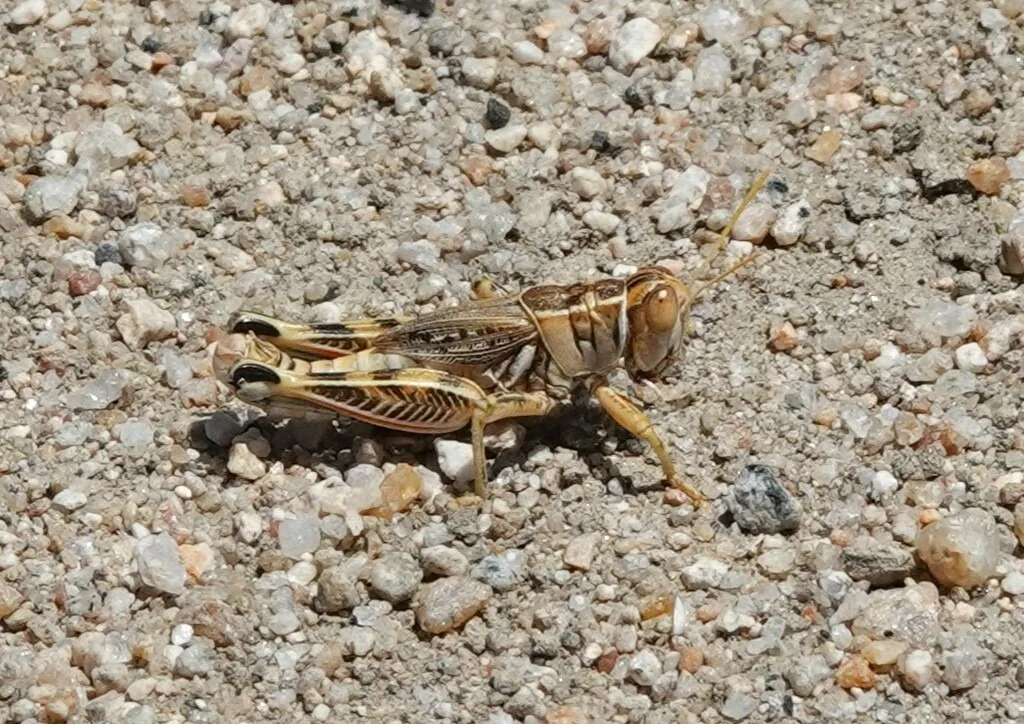
- A large, colorful spur-throated grasshopper. The front edge of the pronotum has a narrow white to cream band, like a clergyman's collar.[1]
- The hind thigh is marked with dark chevrons separated by light tan lines, with orange on its inner base and lower edge, and the hind shins are blue.[1]
- Wing length varies within a population. Long-winged adults can fly; short-winged adults have forewings at least as long as the pronotum and hind wings too short to use. In some years all adults are short-winged, while in others more than half are long-winged.[1]
- Nymphs are light tan with dark spots and a robust build, with a narrow cream stripe running from the head down the middle of the back.[1]
Look-alikes
| Look-alike | How to tell them apart |
|---|---|
| Devastating grasshopper (Melanoplus devastator) | Shares California foothill range with it. The devastating grasshopper always has long wings reaching past the abdomen and a row of conspicuous black spots on each forewing.[2][1] |
| Other Oedaleonotus species | Seven related species, mostly in California, have forewings shorter than the pronotum, usually narrow and set wide apart.[1] |
Where it lives
Western rangeland in sagebrush-grass and other semiarid plant communities, with hatching records from California, Nevada and Idaho. Abandoned farmland, Conservation Reserve Program land, and the foothills of California's coast ranges and Sierra Nevada are especially good places for it to build large populations. In California foothill grasshopper communities it often dominates valley and low foothill sites.[1][2]
Biology and life cycle
It eats mainly forbs and shrubs and some grass. Native foods include springparsley, balsamroot, big sagebrush and rabbitbrush, but it also feeds heavily on introduced weeds such as redstem filaree, tumble mustard, flixweed and downy brome, and on lichen. When the annual weeds dry in summer, big sagebrush becomes an important food.[1]
It roosts on Russian thistle but barely nibbles it. In drought it eats ground litter and dead or dying grasshoppers. Offered a potted rose and spearmint in a dry Idaho field, adults ate leaves from the edges, cut leaf stems, and fed on petals and flower bracts.[1]
Eggs overwinter well along in development and hatch early, starting in early April in California, Nevada and Idaho and continuing for a month or more. In cool spring weather the nymphs take 42 to 50 days and six stages to mature. Cooler rearing temperatures produced more long-winged adults.[1]
Females lay in bare ground beside shrubs and weeds, under low plants such as turkey mullein, and around rocks. The short, wide pods lie on their sides just under the surface and hold 16 to 22 olive tan eggs, and the hatching nymphs leave through the side of the pod.[1]
At a drought-stricken Idaho site, adults spent the night head-up on Russian thistle, came down to bask and feed in the morning, and climbed back up 4 to 7 inches into the plants when the soil surface reached 130°F.[1]
Damage and signs
- Outbreaks reach 20 or more adults per square yard and severely injure range forage. It is particularly hard on young grasses and legumes on newly reseeded range. Bands of nymphs and adults move from range and abandoned fields into irrigated alfalfa, cotton, grains and vegetables and cause serious damage; long-winged adults fly out of drying habitat.[1]
- In small numbers it may do some good by eating weeds that compete with forage plants, though neither the damage nor the benefit has been measured. Because it barely eats Russian thistle, the ARS sheet suggests that sugar beet and other plants in the goosefoot family may be essentially immune to it.[1]
Health risk
It is a plant feeder, and the sources report no bites, stings or disease. Insecticide sprays used on grasshoppers are very toxic to bees, natural enemies and aquatic life.[1][3]
Control
Prevention
In gardens near foothill range, a border of tall, green grass or lush plants can act as a trap crop that holds migrating grasshoppers; keep it watered and unmowed.[3]
Traps and physical control
Handpick grasshoppers when there are few, and protect plants with metal window screening, which hungry grasshoppers cannot chew through the way they can cloth or plastic covers.[3]
Biological control
Natural enemies can end outbreaks. In 1954 three species of Tachysphex digger wasps, which stock their nests with valley grasshopper nymphs, cut an Idaho population from 25 to 3 per square yard, and a tangle-veined fly parasitized up to 24 percent of grasshoppers in some years. Drought also ends outbreaks.[1]
Pesticides
Bait containing carbaryl, spread around the garden edge before grasshoppers arrive, works better than spraying once they have moved in and is less hazardous to bees. Follow the label.[3]
Common questions
- What grasshopper has a white collar behind its head?
- In the West, a large grasshopper with a narrow white to cream band along the front edge of the pronotum and blue hind shins is the valley grasshopper.[1]
- Why do some valley grasshoppers have short wings?
- Wing length varies with conditions. In lab tests cooler temperatures during development produced more long-winged adults, and long-winged adults are the ones that fly away when their habitat dries out.[1]
Sources
- USDA Agricultural Research Service, Northern Plains Agricultural Research Laboratory, “Valley Grasshopper, Oedaleonotus enigma (Scudder): species fact sheet, Grasshoppers: Their Biology, Identification and Management.” www.ars.usda.gov/plains-area/sidney-mt/northern-plains-agricultural-research-laboratory/pest-management-research/pmru-docs/grasshoppers-their-biology-identification-and-management/id-tools-apps/fact-sheets/melanoplinae-subfamily/fs-valley/ (accessed 2026-11-09)
- USDA Agricultural Research Service, Northern Plains Agricultural Research Laboratory, “Devastating Grasshopper, Melanoplus devastator Scudder: species fact sheet, Grasshoppers: Their Biology, Identification and Management.” www.ars.usda.gov/plains-area/sidney-mt/northern-plains-agricultural-research-laboratory/pest-management-research/pmru-docs/grasshoppers-their-biology-identification-and-management/id-tools-apps/fact-sheets/melanoplinae-subfamily/fs-devastating/ (accessed 2026-11-09)
- University of California Statewide IPM Program, “Grasshoppers (Home and Landscape).” ipm.ucanr.edu/home-and-landscape/grasshoppers/ (accessed 2026-11-09)
- iNaturalist, “Oedaleonotus enigma taxon page (order and family).” www.inaturalist.org/taxa/153314 (accessed 2026-11-09)