On this page
How to identify it
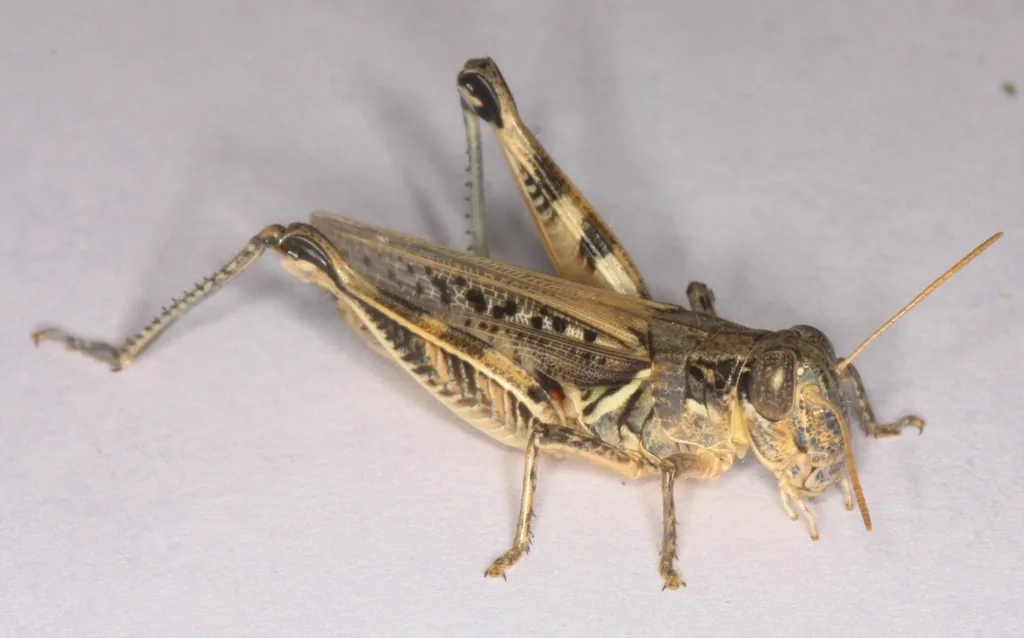
- A medium-sized grasshopper with long wings that reach past the tip of the abdomen. It is pale gray and tan with dark blotches, and the underside of the abdomen is pale greenish yellow.[1]
- Each forewing carries a row of conspicuous black spots. The hind thigh is patched pale or reddish tan and dark, and the hind shins are usually blue, though some are red; in one California population 15 percent of females and 3 percent of males had red shins.[1]
- It closely resembles the migratory grasshopper. Males can be told apart by their long, slender cerci and long furcula, small appendages at the tip of the abdomen.[1]
- Nymphs are pale yellow, tan or green, with a nearly vertical face and a broad ivory or pale tan crescent running from below the eye onto the side of the pronotum.[1]
Look-alikes
| Look-alike | How to tell them apart |
|---|---|
| Migratory grasshopper (Melanoplus sanguinipes) | A very close relative. Its first-stage nymphs are dark and heavily spotted with a faint crescent, older nymphs have a diagonal dark bar across the eye that devastating grasshopper nymphs lack, and the dark stripe on the hind thigh is broken by smaller light patches. In California it breeds in irrigated alfalfa and pasture, not foothill range.[1] |
Where it lives
Far western North America, mainly the Pacific Coast states, on semiarid rangeland of forbs and annual grasses from near sea level to over 5,000 feet. Populations are always present in California's coastal and Sierra Nevada foothills; it is a minor pest in Oregon and Washington.[1]
Biology and life cycle
Eggs hatch over a long stretch, from late April to late July. Nymphs go through six stages, and the earliest become adults by about July 1, while some stragglers are still nymphs in mid October.[1]
In spring, nymphs eat legumes, filaree, and brome and barley grasses. Once those dry, the grasshoppers get by on tougher green plants such as needlegrass, tarweeds and wild lettuce, and on grass seed, including seed that harvester ants have dropped on their mounds.[1]
Females hold off on laying through the summer. Shortening days in fall bring their eggs to maturity, and egg laying begins in late September, usually as fall rains start fresh plant growth. They lay in clusters, called egg beds, on well-drained gravelly hillocks, ridges and ravine banks; each pod holds 20 to 31 eggs.[1]
UC IPM notes that California grasshoppers lay their eggs in undisturbed ground such as grassy foothills, ditch banks, roadsides, fencerows and pastures; cultivated gardens are not a common egg-laying site.[2]
Populations can climb from harmless numbers to 100 per square yard in three years. In 1959 a fungal disease, Entomophaga grylli, killed up to 90 percent of some populations, and the disease and a drought ended a major outbreak.[1]
Damage and signs
- When range forage runs out, nymphs travel downhill along ravines toward green crops, often 5 miles or more, and adult swarms fly 15 or more miles a day. Swarms often land in grain stubble and spread from there into fruit and vegetable crops.[1][2]
- In the 1957 and 1958 outbreak, more than 3 and then 4.5 million acres of range were infested. The grasshoppers defoliated orchards and vineyards, destroyed barley, corn, beets, vegetables and family gardens, and gnawed the bark of young fruit trees and grapevines. Migrants have been seen eating citrus, stone fruit, almond, avocado, cabbage, tomato, beans, marigold and alfalfa, among others.[1]
- In gardens, grasshoppers favor young lettuce, beans, corn, carrots, onions and some annual flowers, and like squash and tomatoes least. Garden damage usually lasts a few weeks in early summer, right after range weeds dry up.[2]
Health risk
A plant-feeding grasshopper; the sources describe no bites, stings or disease risk. Insecticide sprays used against grasshoppers are very toxic to bees, natural enemies and aquatic life.[1][2]
Control
Prevention
Where migrations happen often, keep a border of tall grass or lush green plants around the garden as a trap crop to divert grasshoppers. Do not mow it or let it dry out, or the grasshoppers will move straight into the garden.[2]
Traps and physical control
When numbers are low, handpick them. Cones, screened boxes and other covers help if there are not too many; hungry grasshoppers chew through cloth or plastic row covers, so metal window screening works better.[2]
Biological control
Chickens and guinea hens eat grasshoppers but may also damage plants. Nosema locustae baits are slow and affect only some species, so they are unlikely to help in a California garden.[2]
Pesticides
Once a swarm reaches the garden, sprays do little and must be repeated. Carbaryl bait spread around the garden borders before the grasshoppers arrive is the better option, and it is less hazardous to bees than sprays. On range, the best time to treat is early in the season while the grasshoppers are still young nymphs in uncultivated areas. Read the label.[2]
Common questions
- Why do grasshoppers suddenly invade my California garden in early summer?
- When the foothill range dries out, devastating and valley grasshoppers move downhill toward green plants. Nymphs walk and hop, and adults can fly 15 or more miles a day in swarms.[1][2]
- Is the devastating grasshopper the same as the migratory grasshopper?
- They are close relatives, and genetic studies suggest they may even be the same species, but taxonomists keep them separate because of clear differences in structure, life history and range. In California the devastating grasshopper breeds in foothill range, while the migratory grasshopper breeds in irrigated alfalfa and pasture.[1]
Sources
- USDA Agricultural Research Service, Northern Plains Agricultural Research Laboratory, “Devastating Grasshopper, Melanoplus devastator Scudder: species fact sheet, Grasshoppers: Their Biology, Identification and Management.” www.ars.usda.gov/plains-area/sidney-mt/northern-plains-agricultural-research-laboratory/pest-management-research/pmru-docs/grasshoppers-their-biology-identification-and-management/id-tools-apps/fact-sheets/melanoplinae-subfamily/fs-devastating/ (accessed 2026-11-09)
- University of California Statewide IPM Program, “Grasshoppers (Home and Landscape).” ipm.ucanr.edu/home-and-landscape/grasshoppers/ (accessed 2026-11-09)
- iNaturalist, “Melanoplus devastator taxon page (order and family).” www.inaturalist.org/taxa/153313 (accessed 2026-11-09)