On this page
How to identify it
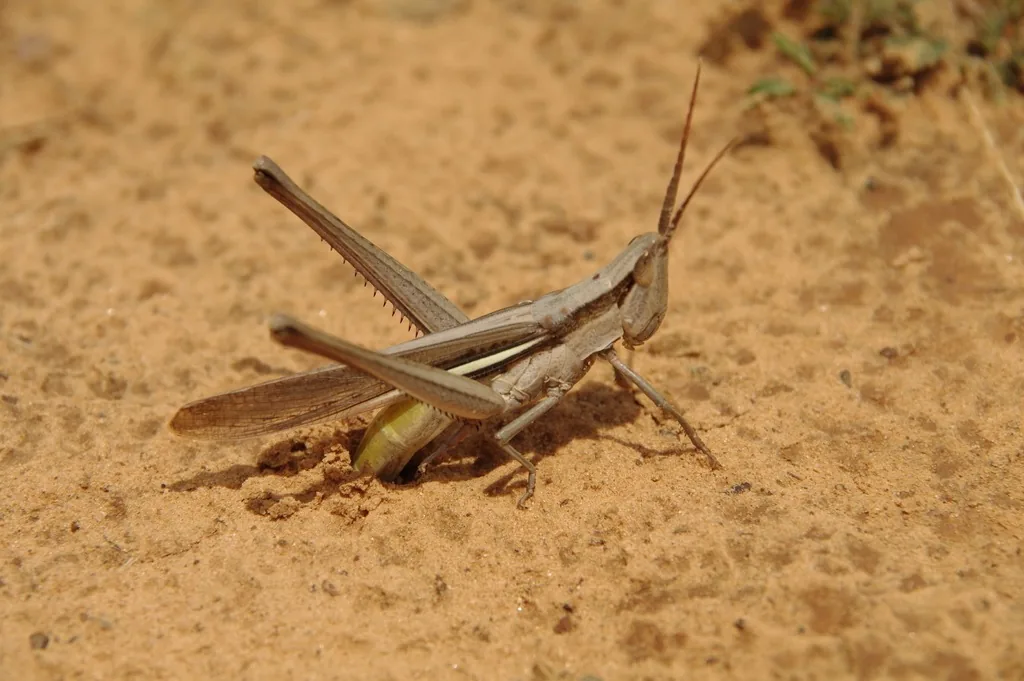
- It is relatively large, long and narrow, with a strongly slanted face and sword-shaped (ensiform) antennae; the Nebraska guide counts it among the state's 'toothpick' grasshoppers.[1][2]
- The body is tan to light brown or nearly light green, often densely spotted with brown, and the forewings are a darker brown.[1][2]
- A brown stripe starts behind each eye and runs along the side of the head onto the side of the pronotum.[1][2]
- There is a single white or ivory streak along each forewing, on its lower part.[1][2]
- Unlike some relatives, the top of the pronotum rounds off smoothly onto the sides with no side ridges, and its margin is cut by three grooves; there is no ivory stripe along the sides of the back of the head and the top of the pronotum.[1]
- The USDA ARS fact sheet describes the hind tibiae as orange, while the Nebraska guide gives them as light brown. The hind wings are clear.[1][2]
- Nebraska specimens measured 22 to 36 mm for males and 33 to 47 mm for females.[2]
Look-alikes
| Look-alike | How to tell them apart |
|---|---|
| Mermiria texana | Mermiria texana has an ivory stripe along the sides of the back of the head and the top of the pronotum, and two white streaks on each forewing, one above the base of the hind leg and one above the abdomen; the two-striped mermiria has one streak and no ivory stripe.[1] |
| Mermiria picta | Mermiria picta lacks both the ivory stripes and the forewing streak, and it has well-developed side ridges on the pronotum, which the two-striped mermiria lacks.[1] |
Where it lives
It is widely distributed in North America, with its center of distribution in the tallgrass prairie. It also lives in small stands of tall grasses within the mixedgrass, shortgrass, bunchgrass and desert prairies, and in lush midgrass stands. In Nebraska it occurs statewide in suitable habitat. In the West it overlaps with two similar species of its genus, and a fourth species lives along the Atlantic and Gulf coasts.[1][2]
Biology and life cycle
Its main habitat is tall grasses such as big bluestem, yellow indiangrass and switchgrass, often on slopes and hills.[1]
It feeds on grasses: 18 grass species plus threadleaf sedge have been recorded in its diet, including big, little and sand bluestem, sideoats, blue and hairy grama, prairie sandreed, western wheatgrass, tall and sand dropseed, needleandthread and bromes. In caged tests in Texas it chose Bermuda grass and prairie dropseed over big bluestem and silver beardgrass.[1][2]
It eats leaves from the edge in toward the midrib, leaving semi-elliptical bites, or cuts off and eats sections of narrow leaves; dropped pieces of leaf end up as litter on the ground. By the end of the season, sand bluestem stems can be stripped of nearly all their leaves.[1]
It is a late-hatching species: first-stage nymphs appear in early May in eastern Kansas and in early to mid June in eastern Wyoming, and hatching in one place can last two weeks or longer.[1]
Nymphs grow slowly, taking at least 40 days to mature; males go through four nymphal stages and females five.[1]
In Nebraska, nymphs are found in spring and adults are most common from mid-July to early September.[2]
Females lay eggs in bare ground near their host plants, 1 1/4 to 1 3/4 inches deep. Each mass holds 14 to 18 eggs with no pod wall, held together by spots of froth and topped by a froth plug about 1 1/4 inches long.[1]
It is a strong, agile flier with long wings. When flushed it flies silently for 2 to 12 feet, 9 to 36 inches above the ground, and usually lands back on vegetation.[1]
It spends most of its days and nights perched on grass. At night it rests head-up on leaves or stems 8 to 12 inches up, can bask for two to four hours after sunrise before feeding, and in one Nebraska Sandhills study spent 88 percent of daylight hours at rest and only 10 percent feeding.[1]
Populations fluctuate around low densities, rarely more than one adult per square yard, and food is not what limits them; regular burning, by people or lightning, maintains its grass habitat by holding back forbs and shrubs.[1]
Damage and signs
- It is a potentially damaging pest because it feeds on valuable forage grasses, and it occasionally reaches outbreak numbers, as it did in native grass pastures of eastern Kansas in 1939. One grasshopper eats about 3.4 grams (dry weight) of grass in its lifetime, more than the bigheaded grasshopper's 2.0 grams.[1]
- Even so, it rarely becomes a significant pest, because its densities usually stay light and the tallgrass prairie produces plenty of grass. The Nebraska guide likewise calls it potentially damaging to rangeland but notes it seldom reaches high densities.[1][2]
Health risk
It is a grass feeder; the ARS fact sheet and the Nebraska guide describe range-forage feeding only and mention no risk to people.[1][2]
Control
Prevention
Control is rarely needed. Its populations rarely exceed one adult per square yard, and both the ARS fact sheet and the Nebraska guide say it seldom reaches the high densities that would make it a significant pest.[1][2]
Common questions
- When are two-striped mermiria grasshoppers out?
- It hatches late. First nymphs appear in early May in eastern Kansas and in early to mid June in eastern Wyoming, and in Nebraska adults are most common from mid-July to early September.[1][2]
- Is the two-striped mermiria a pest?
- It can be. It feeds on valuable forage grasses and reached outbreak numbers in eastern Kansas pastures in 1939, but its densities usually stay light and tallgrass prairie produces plenty of grass, so it seldom becomes a significant pest.[1][2]
- Where does the two-striped mermiria lay its eggs?
- Females lay in bare ground near their host grasses, placing a mass of 14 to 18 eggs 1 1/4 to 1 3/4 inches deep. The mass has no pod wall; froth holds the eggs together, and a long froth plug sits above them.[1]
Sources
- USDA Agricultural Research Service, Northern Plains Agricultural Research Laboratory, “Twostriped Slantfaced Grasshopper, Mermiria bivittata (Serville): species fact sheet, Grasshoppers: Their Biology, Identification and Management.” www.ars.usda.gov/plains-area/sidney-mt/northern-plains-agricultural-research-laboratory/pest-management-research/pmru-docs/grasshoppers-their-biology-identification-and-management/id-tools-apps/fact-sheets/gomphocerinae-subfamily/fs-twostriped-slantfaced/ (accessed 2026-11-08)
- University of Nebraska-Lincoln Extension, “The Grasshoppers (Orthoptera: Acrididae and Romaleidae) of Nebraska, EB3 (M. L. Brust, W. W. Hoback and R. J. Wright).” extensionpubs.unl.edu/publication/eb3/2009/pdf/view/eb3-2009.pdf (accessed 2026-11-08)
- iNaturalist, “Mermiria bivittata taxon page (order and family).” www.inaturalist.org/taxa/133923 (accessed 2026-11-08)