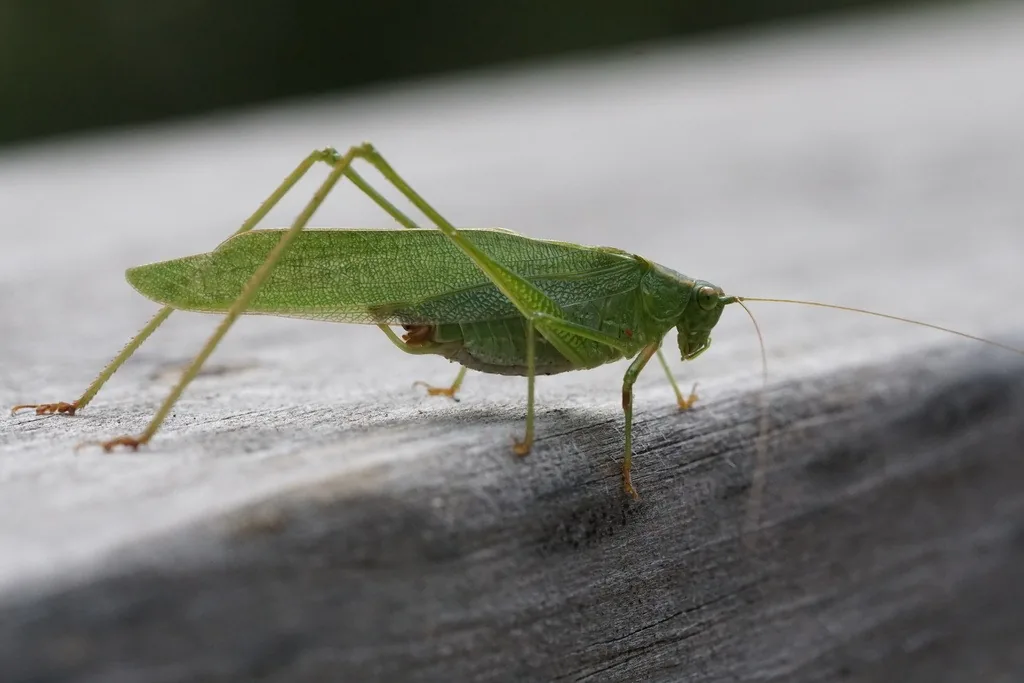
How to identify it
- Adults are fairly large, slender, leaf-mimicking insects, mostly green but sometimes brown or tan.[1]
- Their slender antennae are nearly as long as the body or longer.[1]
- Forktailed bush katydids are about 1-1/8 inches long; angularwinged and broadwinged katydids are larger with humped backs.[1]
- Nymphs are wingless, and some have black-and-white banded antennae.[1]
Look-alikes
| Look-alike | How to tell them apart |
|---|---|
| Grasshoppers | Grasshoppers are active by day and have shorter antennae; katydids rest by day and feed at night.[1] |
Where it lives
California alone has at least 74 katydid species.[1]
Biology and life cycle
They overwinter as eggs inserted in leaf edges or lined up in rows on twigs.[1]
Eggs hatch from late March through May, and adults appear in midsummer.[1]
Adults sometimes come to lights at night and are sluggish in cool early mornings.[1]
Damage and signs
Health risk
They feed on plants and fruit; UC IPM does not describe any risk to people.[1]
Control
Prevention
Usually no control is recommended on home fruit trees, since the damage is cosmetic and katydids are gone by the time scars show.[1]
Traps and physical control
Because they're rarely abundant, catch and dispose of the few you see, easiest on cool early mornings.[1]
Pesticides
Where scarring was unacceptable before, spinosad after petal fall is an option; don't spray while plants are flowering.[1]
Common questions
Sources
- University of California Statewide IPM Program, “Katydids (Pests in Gardens and Landscapes).” ipm.ucanr.edu/PMG/GARDEN/FRUIT/PESTS/katydids.html (accessed 2026-10-06)
- iNaturalist, “Scudderia furcata taxon page (order and family).” www.inaturalist.org/taxa/55957 (accessed 2026-10-06)