On this page
How to identify it
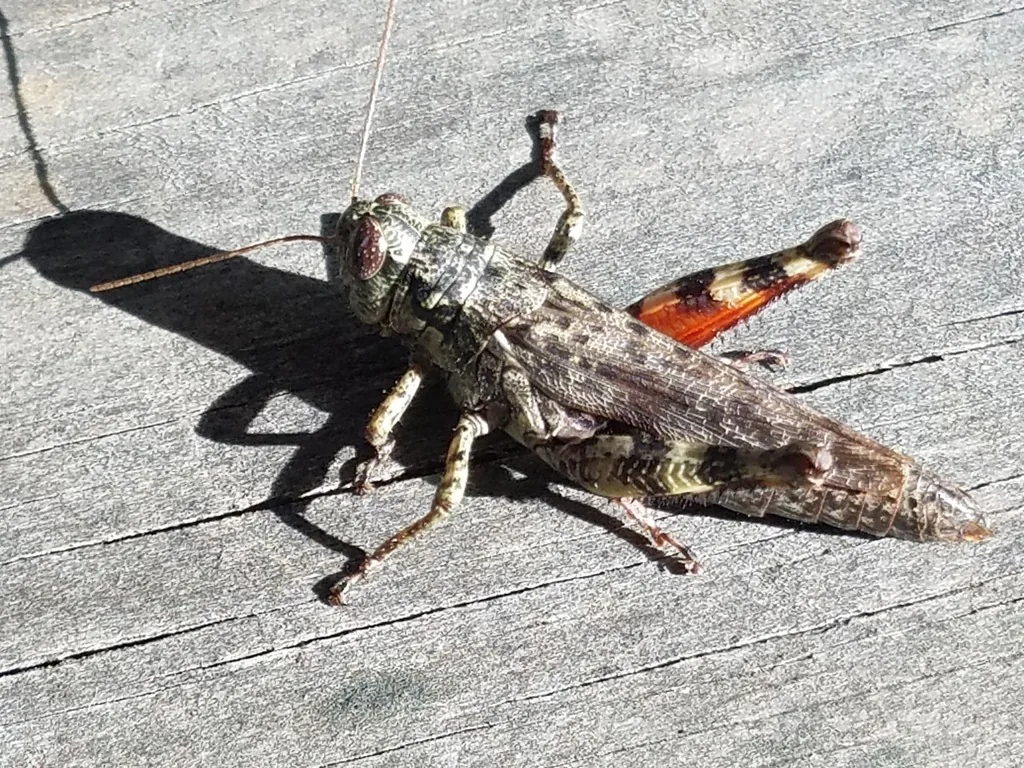
- It is mottled gray-brown or brownish gray with blackish flecks, and often yellowish underneath; some populations are tinted olive, rust, gray or tan.[1][2]
- The outer face of each hind femur is banded black and gray (three blackish bands), while the inner face is typically bright red.[1][2]
- The hind tibiae are usually red, less often gray.[2]
- Females are larger than males: MDC gives up to about 1 1/2 inches for females and about 1 inch for males, and Nebraska specimens measured 22 to 29 mm (females) and 18 to 24 mm (males).[1][2]
- Males have cerci (the small appendages at the tip of the abdomen) broadened at the end, shaped like flattened clubs or boots.[1][2]
Where it lives
It is widely distributed in North America. MDC reports it statewide in Missouri, while in Nebraska it is known from only two wooded sites in the southeast near the Missouri River and is generally rare where found.[1][2]
Biology and life cycle
Unlike most grasshoppers, which live in open grassy places, it lives in woodlands, both deciduous and pine.[1][2]
Sources differ on its food. MDC says it eats the leaves of trees and feeds up in the canopy; the Nebraska guide calls its diet unknown but notes it is most often associated with pines, tamarack, beech and oak.[1][2]
It is usually inactive during the day and most often rests on tree trunks, where its colors make it hard to spot; one sitting on a green leaf near the forest floor is easy to see.[2][1]
Females lay their eggs in bark crevices on tree trunks.[1]
Nymphs appear in spring, and in Nebraska adults are found from July to October.[2]
Damage and signs
- The Nebraska guide rates its economic importance as none.[2]
Health risk
It is a plant-feeding grasshopper; MDC and the Nebraska guide describe no risk to people.[1][2]
Control
Prevention
No control is needed: the Nebraska guide gives it no economic importance, and MDC describes it as a woodland grasshopper that eats tree leaves.[2][1]
Common questions
- Why is there a gray grasshopper on the side of my house in the woods?
- If it is mottled gray-brown with black-and-gray banded hind legs, it may be a pine tree spur-throat grasshopper. MDC notes that people who live in or near wooded areas may find one resting on a car or the side of the house.[1]
- Does it live only on pine trees?
- No. MDC finds it in both deciduous and pine woodlands, and the Nebraska guide associates it with pines, tamarack, beech and oak.[1][2]
- Why is it so hard to find in the woods?
- It usually rests motionless on tree trunks during the day, and its mottled, bark-like colors make it hard to detect there.[2][1]
Sources
- Missouri Department of Conservation, “Pine Tree Spur-Throat Grasshopper (Field Guide).” mdc.mo.gov/discover-nature/field-guide/pine-tree-spur-throat-grasshopper (accessed 2026-11-08)
- University of Nebraska-Lincoln Extension, “The Grasshoppers (Orthoptera: Acrididae and Romaleidae) of Nebraska, EB3 (M. L. Brust, W. W. Hoback and R. J. Wright).” extensionpubs.unl.edu/publication/eb3/2009/pdf/view/eb3-2009.pdf (accessed 2026-11-08)
- iNaturalist, “Melanoplus punctulatus taxon page (order and family).” www.inaturalist.org/taxa/224756 (accessed 2026-11-08)