On this page
How to identify it
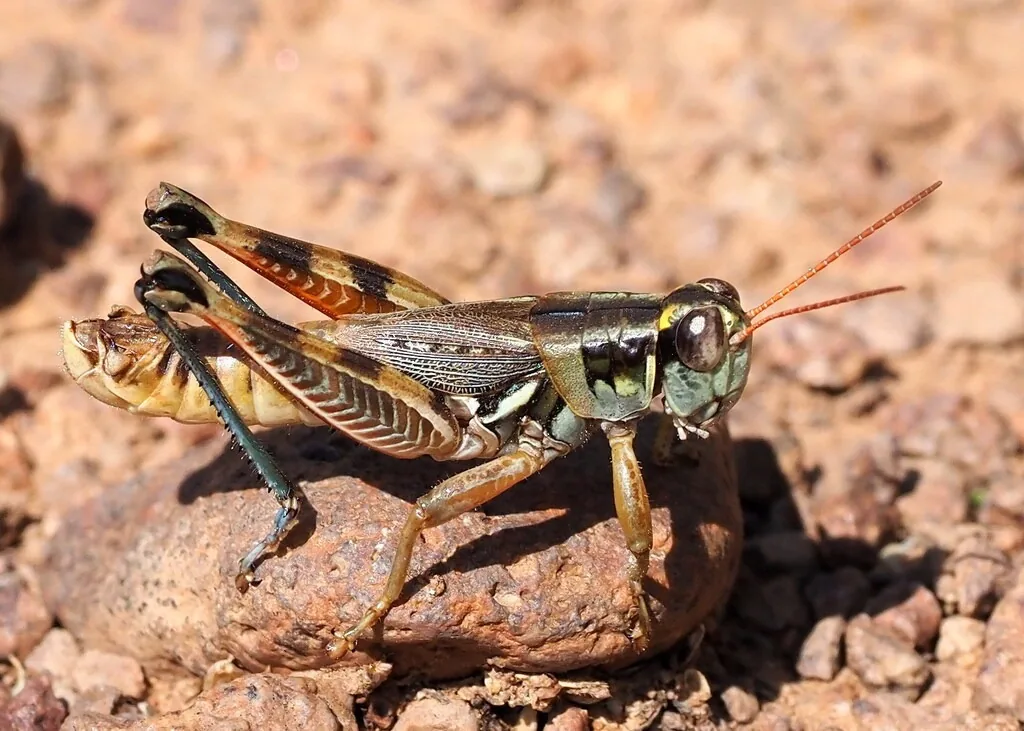
- A medium-sized spur-throated grasshopper, brown to greenish brown or dark green with darker and yellow markings. Males are 15 to 23 mm long and females 18 to 28 mm.[1][2]
- Most adults have short wings, about a third the length of the abdomen. Long-winged adults turn up now and then, and in one Arizona population nearly half were long-winged.[1][2]
- The hind shins are blue. The outer hind thigh carries diffuse dark bands or three dark marks along the top, and its lower edge is orange.[1][2]
- Nymphs have distinct yellow or tan stripes on the head and on the sides of the pronotum; the stripes are boldest in the youngest nymphs and fade as they grow.[1]
Look-alikes
| Look-alike | How to tell them apart |
|---|---|
| Russian thistle grasshopper (Aeoloplides turnbulli) | Lives on the same kochia and Russian thistle patches and also has blue shins. Its wings are longer, stopping only a few millimeters short of the abdomen tip or passing it, and the top of its pronotum shows pale side bands split by a broad dark band. Its nymphs are heavily spotted rather than striped.[3][1] |
Where it lives
Grasslands and desert shrublands across western North America, mostly where kochia, Russian thistle or native saltbush grow. In Nebraska it has been recorded across the western two-thirds of the state.[1][2]
Biology and life cycle
It feeds mostly on goosefoot-family plants: native saltbush, and especially the introduced weeds kochia and Russian thistle, plus lambsquarters. Grasshoppers from a weedy Nebraska pasture had eaten almost nothing but kochia. It also takes some grasses, and caged adults ate dandelion and young wheat, even choosing dandelion over kochia.[1][2]
Nymphs and adults spend their whole lives on the host plants, feeding, molting, mating and roosting there day and night. They climb up to bask after sunrise and shift lower or into shade when it gets very hot. Only egg-laying females come down to the ground.[1]
It hatches late, three to four weeks after the migratory grasshopper. In southeastern Colorado hatching began in late May or early June and continued for about five weeks; in Arizona's Chino Valley, where rain comes with the summer monsoon, hatching starts around early July.[1]
Nymphs pass through five stages. Adults appear in early July in southwestern Kansas and southeastern Colorado and are most common from late July into September. Egg pods hold about 18 to 25 eggs.[1][2]
Damage and signs
- On rangeland it does little damage to forage and can be beneficial, since it eats weedy forbs. It is usually a sign of disturbed, weedy land rather than good prairie.[1][2]
- Its numbers can get high. A kochia patch in Colorado held 91 nymphs per square yard, and large numbers have been reported in Colorado, Kansas, Nebraska, Oklahoma, Arizona and New Mexico. When the weeds along field borders dry up, these grasshoppers can move into alfalfa, wheat and other crops and cause severe damage, as happened in Colorado alfalfa in 1966.[1]
- Weedy city lots can serve as breeding sites, and grasshoppers from them may move into nearby vegetable and flower gardens.[1]
Health risk
It is a plant-feeding grasshopper, and the sources describe no health concerns for people.[1][2]
Control
Prevention
On rangeland it causes little forage loss, so it rarely calls for treatment there; weigh the forage value against the expected damage before deciding on any grasshopper control.[1][4]
Sanitation
Because it breeds in patches of kochia and Russian thistle, weedy lots, fence rows and roadsides next to gardens and crops are where infestations start. Checking these breeding areas early in the season can head off heavy movement into crops later on.[1][4]
Common questions
- Why are there so many grasshoppers in the kochia along my fence?
- Kochia and Russian thistle are the Lakin grasshopper's favorite food plants, and patches of them along roadsides, fence rows and weedy lots can hold dense populations that live right on the weeds.[1][2]
- Is the Lakin grasshopper good or bad?
- Both. On rangeland it mostly eats weeds and may be beneficial, but large numbers can move from drying weeds into alfalfa, wheat, vegetables and flower beds.[1][2]
Sources
- USDA Agricultural Research Service, Northern Plains Agricultural Research Laboratory, “Lakin Grasshopper, Melanoplus lakinus (Scudder): species fact sheet, Grasshoppers: Their Biology, Identification and Management.” www.ars.usda.gov/plains-area/sidney-mt/northern-plains-agricultural-research-laboratory/pest-management-research/pmru-docs/grasshoppers-their-biology-identification-and-management/id-tools-apps/fact-sheets/melanoplinae-subfamily/fs-lakin/ (accessed 2026-11-09)
- University of Nebraska-Lincoln Extension, “The Grasshoppers (Orthoptera: Acrididae and Romaleidae) of Nebraska, EB3 (M. L. Brust, W. W. Hoback and R. J. Wright).” extensionpubs.unl.edu/publication/eb3/2009/pdf/view/eb3-2009.pdf (accessed 2026-11-09)
- USDA Agricultural Research Service, Northern Plains Agricultural Research Laboratory, “Russianthistle Grasshopper, Aeoloplides turnbulli (Thomas): species fact sheet, Grasshoppers: Their Biology, Identification and Management.” www.ars.usda.gov/plains-area/sidney-mt/northern-plains-agricultural-research-laboratory/pest-management-research/pmru-docs/grasshoppers-their-biology-identification-and-management/id-tools-apps/fact-sheets/melanoplinae-subfamily/fs-russianthistle/ (accessed 2026-11-09)
- Utah State University Extension, “Grasshoppers (E. Evans and E. Hodgson, June 2008).” extension.usu.edu/planthealth/research/grasshoppers (accessed 2026-11-09)
- iNaturalist, “Melanoplus lakinus taxon page (order and family).” www.inaturalist.org/taxa/121335 (accessed 2026-11-09)