On this page
How to identify it
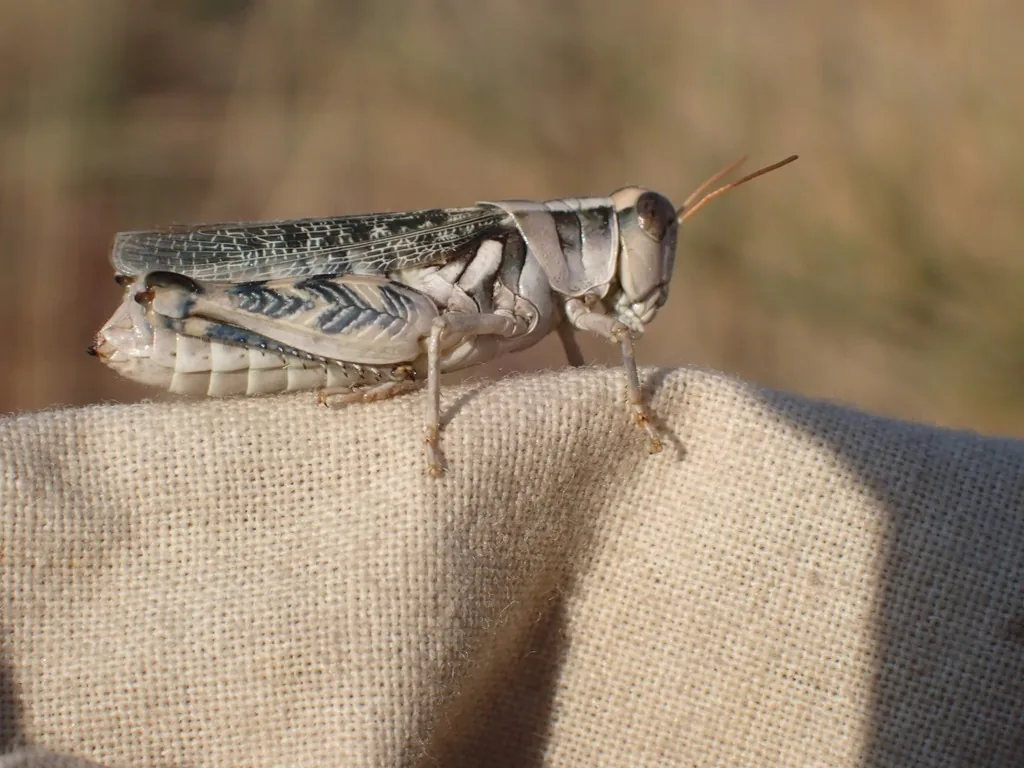
- A robust, medium-sized spur-throated grasshopper. Males are 18 to 20 mm long and females 19 to 25 mm. Color runs from shades of tan with dark markings to mostly greenish, and the antennae can be orange.[1][2]
- Pale bands run along each side of the top of the pronotum, separated by a broad dark band down the middle.[1]
- The outer hind thigh carries three distinctive dark marks or cross bars. The hind shins are blue, usually with a pale ring near the base. The hind wings are clear.[1][2]
- In the northern form the wings usually stop 2 to 4 mm short of the abdomen tip; the southern form has longer wings that pass the abdomen.[1]
- Nymphs are pale green, tan or gray and heavily spotted, and the top of the pronotum widens from front to back.[1]
Look-alikes
| Look-alike | How to tell them apart |
|---|---|
| Lakin grasshopper (Melanoplus lakinus) | Shares the same kochia and Russian thistle patches and also has blue shins. Lakin adults usually have much shorter wings, about a third the length of the abdomen, and Lakin nymphs have bold yellow or tan stripes on the head and pronotum.[3][2] |
Where it lives
Western North America from southern Canada to northern Mexico, in desert shrubland, alkali flats with saltbush and greasewood, and grassland or disturbed ground wherever goosefoot-family plants grow. In Nebraska it is generally limited to the western third of the state.[1][2]
Biology and life cycle
It feeds only on goosefoot-family plants (with rare nibbles on a few others): shrubs such as fourwing and Gardner saltbush, winterfat and greasewood, and the weeds kochia, Russian thistle and lambsquarters. It climbs to the growing tips to eat young leaves.[1][2]
It hatches early, from late April or early May on eastern Wyoming roadsides along with the twostriped grasshopper, and a week or two earlier in desert shrubland; hatching lasts four to five weeks. Nymphs need 50 to 60 days and five molts.[1]
Adults appear from mid- to late June and are most common from July into September; mating pairs are seen on host plants and on the ground in July and August. Gravid females come down to bare soil to lay eggs.[1][2]
In dense kochia or lambsquarters it spends nearly all day on the plants. Where plants are sparse it drops to bare ground to bask and move about, and when the soil surface tops 120°F it stands tall on its legs or retreats into shade.[1]
Damage and signs
- Outbreaks can be intense. Weed patches in farmyards have held 100 or more young adults per square yard, and it came to prominence in 1937 and was the dominant grasshopper from 1938 to 1941 in parts of the western Kansas and eastern Colorado wheat region, hatching along field edges where Russian thistle had grown the fall before. In western Kansas in 1938 it severely damaged sugar beets.[1]
- In desert shrubland, as in Wyoming's Big Horn Basin, outbreaks damage Gardner saltbush, fourwing saltbush and winterfat, valuable winter forage for livestock, especially sheep.[1]
- Where its weed hosts are plentiful it can be harmless to crops: during the Kansas outbreak, grasshoppers that moved into wheat did no damage because green Russian thistle was abundant. Nebraska's guide lists its economic importance as none and calls it possibly beneficial.[1][2]
Health risk
It is a plant-feeding grasshopper, and the sources describe no health concerns for people.[1][2]
Control
Sanitation
Dense populations develop where host weeds are abundant, such as farmyard weed patches, crop borders and disturbed land, and in Kansas the grasshoppers hatched along wheat field edges where Russian thistle had grown thickly the previous fall. These weedy borders are where to look first.[1]
Biological control
Disease can end outbreaks: in 1941 an epidemic struck a Kansas population in June after nymphs had reached 150 per square yard and brought the outbreak to a close.[1]
Common questions
- Is the Russian thistle grasshopper good or bad?
- It depends on what it is eating. On Russian thistle, kochia and lambsquarters it reduces weed growth and seed, but it can damage saltbush winter range and, in outbreaks, sugar beets.[1][2]
- Will Russian thistle grasshoppers eat my grass or wheat?
- It does not feed on grasses. During a Kansas outbreak, adults that moved into wheat fields caused no damage while green Russian thistle was available.[1]
Sources
- USDA Agricultural Research Service, Northern Plains Agricultural Research Laboratory, “Russianthistle Grasshopper, Aeoloplides turnbulli (Thomas): species fact sheet, Grasshoppers: Their Biology, Identification and Management.” www.ars.usda.gov/plains-area/sidney-mt/northern-plains-agricultural-research-laboratory/pest-management-research/pmru-docs/grasshoppers-their-biology-identification-and-management/id-tools-apps/fact-sheets/melanoplinae-subfamily/fs-russianthistle/ (accessed 2026-11-09)
- University of Nebraska-Lincoln Extension, “The Grasshoppers (Orthoptera: Acrididae and Romaleidae) of Nebraska, EB3 (M. L. Brust, W. W. Hoback and R. J. Wright).” extensionpubs.unl.edu/publication/eb3/2009/pdf/view/eb3-2009.pdf (accessed 2026-11-09)
- USDA Agricultural Research Service, Northern Plains Agricultural Research Laboratory, “Lakin Grasshopper, Melanoplus lakinus (Scudder): species fact sheet, Grasshoppers: Their Biology, Identification and Management.” www.ars.usda.gov/plains-area/sidney-mt/northern-plains-agricultural-research-laboratory/pest-management-research/pmru-docs/grasshoppers-their-biology-identification-and-management/id-tools-apps/fact-sheets/melanoplinae-subfamily/fs-lakin/ (accessed 2026-11-09)
- iNaturalist, “Aeoloplides turnbulli taxon page (order and family).” www.inaturalist.org/taxa/212569 (accessed 2026-11-09)