The short answer
- Squash bugs: check young plants daily from spring on, look under the leaves, and crush the bronze egg clusters. Drop nymphs and adults into soapy water, or lay boards on the soil and collect the bugs hiding under them each morning.[1][2]
- Squash vine borers: watch for the orange-and-black moth from late June (a yellow pan of soapy water catches them) and stop the larvae before they tunnel in, with row covers or well-timed sprays on the stem bases. Once a larva is inside, sprays don't reach it.[3][4]
- Use row covers sealed at the edges while plants are young, then take them off when flowers open so bees can pollinate. Squash and other cucurbits need insects for pollination.[3][1][5]
- If a vine borer gets in, slit the stem lengthwise, kill the larva, and mound moist soil over the cut so the vine can root. Burying a few nodes along each vine ahead of time helps the plant survive a girdled base.[3][4]
- Grow less-attacked crops where these pests are bad: butternut squash holds up to both, and cucumbers, melons and watermelons are usually not attacked by vine borers.[3][4][1][2]
- If you spray, time it: squash bug sprays work best on newly hatched nymphs; vine borer sprays go on the stem bases when vines start to run or moths first appear. Spray late in the day when flowers are closed to protect bees.[2][3]
- After harvest, pull and remove old vines and garden debris, and plant cucurbits somewhere else next year.[1][2][3][4]
Squash pest profiles
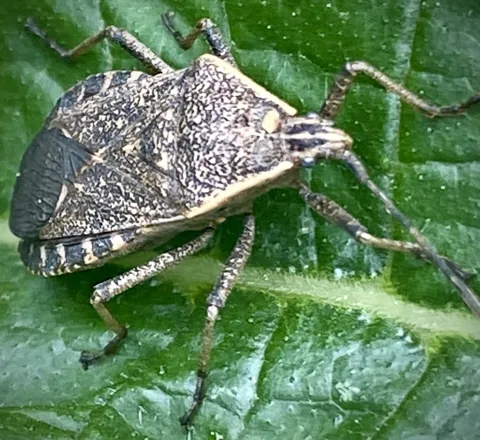 Squash Bug
Anasa tristis
The squash bug is a common vegetable garden pest that sucks sap from squash, pumpkins, melons and other cucurbits. Heavy feeding makes plants wilt and can kill young plants outright.
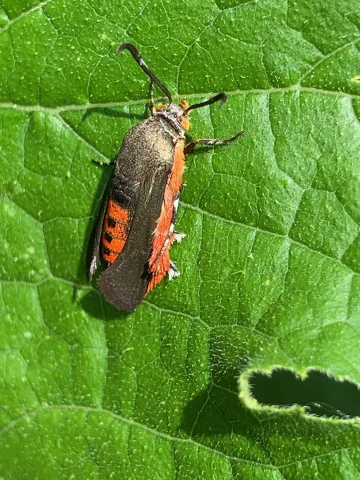 Squash Vine Borer
Eichlinia cucurbitae
The squash vine borer is a day-flying clearwing moth whose caterpillars feed inside the stems and crowns of summer squash, winter squash and pumpkins. A vine that wilts suddenly in midsummer is often the first sign, and in a bad year home gardens and small farms can lose the whole crop.
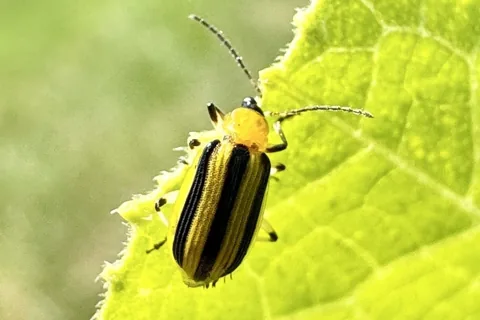 Striped Cucumber Beetle
Acalymma vittatum
Cucumber beetles are small yellow-and-black beetles that feed on squash, cucumbers, melons and other cucurbits. The striped cucumber beetle is the main concern because it can carry bacterial wilt into cucumbers and muskmelons.
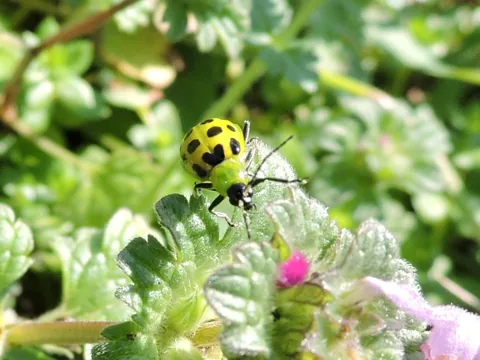 Spotted Cucumber Beetle
Diabrotica undecimpunctata
The spotted cucumber beetle, also called the southern corn rootworm, is a yellow-green beetle with 12 black spots. Adults feed on cucurbits and many other plants and can carry bacterial wilt into cucumbers and muskmelons.
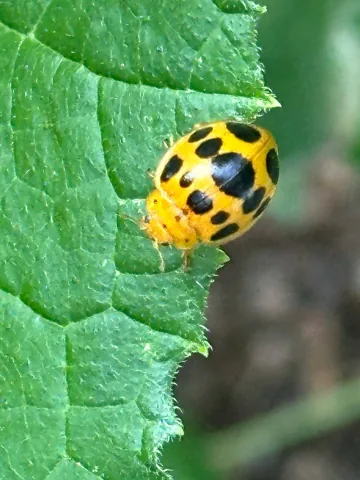 Squash Beetle
Epilachna borealis
The squash beetle is a plant-eating lady beetle. While most lady beetles hunt aphids and other small insects, adults and larvae of this one chew the leaves of squash, zucchini, cucumber and pumpkin.
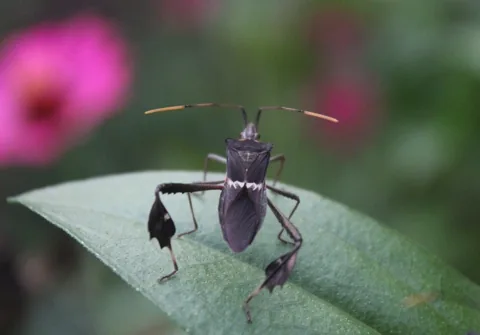 Leaffooted Bug
Leptoglossus zonatus
Leaffooted bugs are medium to large sap-feeding bugs named for the small leaf-like flaps on their hind legs. They pierce fruits, vegetables and nuts to feed, especially on the seeds, and gardeners most often find them on tomatoes and pomegranates.
Which pest is it?
Both pests make squash plants wilt, so start by looking at where the trouble is. Squash bug damage starts on the leaves and is caused by bugs you can see on the plant. Vine borer damage starts inside the stem near the base, and the larva is hidden.[1][3][4]
- Squash bugs: yellow spots on leaves that turn brown, then wilting. Bugs and egg clusters are on the undersides of leaves, around the crown and stems, and under clods and fruit. UC IPM calls the blackened, brittle wilting 'Anasa wilt'.[1][2][4]
- Squash vine borer: a long runner or a whole plant wilts suddenly in midsummer, and the vine usually dies beyond the point of attack. UMN says the wilting may show only in strong sun at first; a plant that is wilted in the morning deserves a close look.[4][3]
- The giveaway for a borer: holes near the base of the stem packed with moist, greenish or orange, sawdust-like frass. UKY calls this frass the best evidence of borer activity. Over time the base can go mushy or rot.[3][4]
- Bacterial wilt: UC IPM notes that squash bug wilting looks like bacterial wilt, a disease spread by cucumber beetles. Squash bug wilt comes from feeding, not from an infection, so look for the bugs themselves.[1]
- Look-alike bugs: stink bugs are wider and rounder than squash bugs and, per UC IPM, aren't pests of cucurbits. Leaffooted bugs, boxelder bugs and bordered plant bugs can also be mistaken for squash bugs.[1]
Squash bug: adults, nymphs and eggs
The squash bug, Anasa tristis, is a true bug that feeds with straw-like, piercing-sucking mouthparts. It goes after squash and pumpkins most, but other cucurbits, including cucumbers and melons, can be attacked. Squash bugs scatter and hide under leaves when disturbed.[1][2][4]
- Adults: flat-backed, about 5/8 inch long and a third as wide, dark gray to grayish brown. The edges of the abdomen have orange and brown stripes, and UC IPM suggests turning a bug over to see the orange-brown underside.[1][2]
- Eggs: about 1/16 inch long, oval or football-shaped, yellowish to bronze or brick red. They are laid in clusters on the undersides of leaves, often in the V between leaf veins, and sometimes on stems. Cluster sizes vary by source: about 20 (UMN), 12 or more (UKY), or 15 to 40 (UC IPM).[2][4][1]
- Nymphs: wingless and spider-like. UMN says young nymphs have a light green abdomen with black head and legs; UC IPM notes they are often dusted with a whitish powder. Older nymphs turn light gray to brownish gray with black legs, and later ones grow wing pads. Young nymphs feed together in groups.[2][1][4]
- Nymph size: 1/10 to 1/2 inch (UMN) or 3/16 to 1/2 inch (UC IPM) as they go through five stages.[2][1]
Squash bug timing
Adult squash bugs spend the winter in sheltered spots: under dead leaves, plant debris, rocks and wood, and around buildings. In spring they fly to young cucurbit plants to feed, mate and lay eggs. UKY says they start arriving in late May and early June in Kentucky, and UMN says females show up in early June in Minnesota and keep laying eggs through midsummer.[1][2][4]
- Egg hatch: sources give 5 to 10 days (UC IPM), 7 to 10 days (UMN) or one to two weeks (UKY).[1][2][4]
- Nymph to adult: four to six weeks per UC IPM and UMN; five to six weeks per UKY.[1][2][4]
- Generations: one a year in Minnesota, sometimes with a partial second; 2 to 3 a year in California.[2][1]
- All stages overlap, so eggs, nymphs and adults can all be on the plant at once through the season. In fall, after vines die, adults and nymphs bunch up on the fruit. Nymphs die when temperatures drop to freezing; adults move to shelter for the winter.[2][1]
- Most vulnerable: UMN says seedlings and plants in flower take the most harm from feeding. Big, sturdy plants tolerate more damage, while young plants can be killed.[2][1]
What squash bugs do to plants
Feeding drains water and nutrients from the leaves, which become speckled and turn yellow, then brown. Heavy feeding interrupts the flow of water through the plant, which collapses and wilts; small plants can die, and bigger ones lose runners. Squash bugs also feed on the undersides of fruit, which can make young fruit abort or grow misshapen, scar the skin, and let rot in where fruit sits on damp ground.[1][2][4]
- Cucurbit yellow vine disease: squash bugs carry the bacterium that causes it. UKY says melons, watermelons and pumpkins are susceptible, and infection early in the season can cause severe yield loss, so keeping bugs off young plants matters most. UC IPM says the disease is reported in the Midwest and East, and its prevalence in California isn't well known.[4][1][2]
- Which crops get hit hardest: in New York field trials from 2023 to 2025, squash bugs were consistently more abundant on Cucurbita squashes and pumpkins than on cucumber, melon or watermelon, and yellow vine disease and plant deaths were highest in Cucurbita too.[8]
- Nymphs matter: a 2025 Virginia study found zucchini plants that had their egg masses and nymphs removed by hand produced significantly more marketable fruit and fewer damaged fruit, and accumulated nymph counts tracked lost yield.[7]
Squash vine borer: moth, eggs and larvae
The squash vine borer is a clearwing moth. Unlike most moths it flies during the day, and it looks more like a wasp than a moth. UMN says the adults make a loud buzzing sound in flight. The larvae feed inside the vines and crowns of summer squash, winter squash and pumpkins, and UKY lists gourds too.[3][4]
- Moth: about 1/2 inch long with an orange abdomen marked with black dots, per UMN, which describes the front wings as metallic green and the hind wings as clear. UKY describes a stout dark gray moth with hairy red hind legs, opaque front wings, and clear hind wings with dark veins. The hind wings fold away at rest and can be hard to see.[3][4]
- Eggs: flat, brown and about 1/25 inch long, laid one at a time on leaf stalks, vines and the base of the plant.[3][4]
- Larvae: white or cream-colored with a brown head, growing to about 1 inch. One to several larvae can be in a single stem.[3][4]
- Pheromone traps: these lure male moths and can show when moths are flying in your area, but UMN says there are no thresholds tied to catches, and the lure also draws related moths, so check the ID.[3]
Squash vine borer timing
Vine borers spend the winter in the soil as full-grown larvae or pupae, 1 to 2 inches below the surface near where last year's host plants grew. Moths come out in early summer, about the time the plants begin to run. UMN gives late June or early July in Minnesota. UKY says flight starts around mid-June in Kentucky and continues through mid-August, with 1 to 2 generations a year there.[4][3]
- Egg hatch: about one week (UMN) or seven to 10 days (UKY). The new larva bores straight into the stem.[3][4]
- Feeding inside the stem: four to six weeks per UMN, or 14 to 30 days per UKY. The larva tunnels through the center of the stem and blocks water to the rest of the plant, then leaves to pupate in the soil until the next summer.[3][4]
- Degree days: UKY puts adult emergence at about 1000 degree days (base 50°F, counting from January 1) and suggests starting weekly checks for frass at 950 degree days.[4]
- Watching for moths: UMN suggests setting a yellow container of water with a drop of dish soap near the squash by late June and checking it at least once a day. The moths are drawn to yellow and drown in the water.[3]
Row covers, and when to take them off
A floating row cover over young plants keeps squash vine borer moths from laying eggs, and UC IPM recommends covers or plant cages where squash bugs have been a problem. The cover only works if it's sealed along every edge, because moths and bugs will crawl in underneath.[3][1][5]
- When to cover for vine borers: when plants start to vine, or for bush types in late June or early July, or when you first see the moths. UMN says to keep covers on for about two weeks after the first moth is seen.[3]
- Remove at bloom: squash and other cucurbits depend entirely on insects for pollination. UMN and UC IPM say to take covers off once the plants flower so bees can reach them. UKY says many growers remove them at flowering and put them back after the pollination period.[3][1][5]
- Don't cover last year's squash bed: vine borers overwinter in the soil near their host plants, so moths coming out of the ground can be trapped under the cover with your plants. Move cucurbits to a different spot, or skip a season.[3]
- Bumble bees under covers: UKY mentions that some growers place a commercial bumble bee colony under the cover for pollination, with mixed results; the colony may need shade and the plants need headroom.[5]
- Covers and squash bugs: in a field study on summer squash, early-season ventilated row covers alone neither reduced squash bug numbers nor raised yields. Covers are one layer of protection, not a full fix for squash bugs.[6]
Hands-on squash bug control
For a home garden, regular handwork does more than most sprays. UC IPM says handpicking plus softer products is likely to work as well as more toxic insecticides. Start in spring by looking for adults hiding under debris and near buildings, then check young plants for wilting, egg clusters and mating pairs.[1][2]
- Scrape and crush eggs: check the undersides of leaves and the stems, and scrape off or crush every egg cluster as soon as you find it. UMN suggests keeping count, since an average of one egg mass per plant is the point to consider treatment.[2][1]
- Soapy water: knock nymphs and adults into a pail of soapy water. UMN says this is practical only when a few plants are affected, since the bugs hide and move fast.[2]
- Board traps: lay boards or pieces of newspaper on the soil near the plants. Squash bugs gather under them at night; lift the boards each morning and destroy the bugs, by hand or with a vacuum.[2][1]
- Roll the fruit: as pumpkins and squash grow, turn them over now and then and crush any bugs underneath. Setting fruit on a small pedestal off the ground cuts down feeding and rot underneath.[1]
- Trellis vining types: UC IPM says squash bugs prefer to hide, feed and lay eggs low in thick bush foliage, so vining squash and melons grown on a trellis are less vulnerable.[1]
- Skip straw mulch where squash bugs are a steady, severe problem: UMN says it gives them shelter at night.[2]
- Keep plants vigorous with proper watering and fertilizer, since sturdy plants put up with more feeding.[2][1]
Saving a vine with a borer inside
Once a borer is in the stem, insecticides won't reach it. Home gardeners can try cutting it out, though UMN cautions you may not save the plant.[3][4]
- 1. As soon as you see wilting or fresh frass, use a sharp knife to cut a slit lengthwise along the affected stem, near the damage.[3][4]
- 2. Work carefully up the vine until you find the larva, or larvae, and kill each one with the tip of the knife or remove it.[3][4]
- 3. Cover the cut right away with moist soil and keep that spot well watered. New roots may grow along the buried stem.[3][4]
- 4. Bury nodes ahead of time: UKY says covering a few nodes along each vine with soil encourages roots there, which lessens the damage if a borer girdles the base.[4]
- 5. Pull and destroy plants that borers have killed, rather than leaving them in the bed.[3]
Varieties, planting dates and trap crops
Squash types differ in how much these pests bother them, and butternut comes out ahead for both in these sources.[3][4][1][2]
- For vine borers: butternut squash is less susceptible than Hubbard and acorn squash, per UMN, and UKY calls butternut somewhat resistant and Hubbard the most susceptible winter squash. Cucumbers, melons and watermelons are usually not attacked.[3][4]
- For squash bugs: UMN cites studies showing butternut and buttercup squash and sweet cheese pumpkins tolerate feeding better than other varieties. UC IPM lists Butternut, Royal Acorn and Sweet Cheese as more resistant.[2][1]
- Late summer squash: in Minnesota, UMN suggests a second planting of summer squash in early July, which matures after the moths have finished laying eggs.[3]
- Trap crop for squash bugs: UMN says studies show a perimeter planting of blue Hubbard squash can draw squash bugs out of the main crop. The trap crop still has to be managed, with thorough egg squashing or an insecticide.[2]
- Companion plants: in field trials on summer squash, white yarrow had few effects on squash bugs and feverfew reduced them inconsistently, so the researchers did not recommend either for commercial growers. See the trap crops and companion planting guide for what else the research shows.[6]
Natural enemies
Spiders, ground beetles, big-eyed bugs and lady beetles feed on squash bug eggs, nymphs and adults. The tachinid fly Trichopoda pennipes lays its eggs on squash bugs; its eggs show up on the undersides of the bugs. UC IPM says this fly has been introduced into California and may be in some gardens. An egg parasitoid wasp, Hadronotus pennsylvanicus, was found every sampling week on infested zucchini in a Virginia study.[1][7]
Insecticides: timing and bee safety
Insecticides are a backup for both pests, and timing decides whether they work. Squash bugs and vine borers are active while squash is flowering, and squash needs bees for pollination, so any spray has to be planned around them.[2][3][1]
- Squash bugs, when: UMN says insecticides normally aren't required for squash bugs. Sprays work best on freshly hatched nymphs, so watch egg clusters and treat shortly after nymphs hatch. Spray deep into the canopy and under leaves, where nymphs hide.[2][1]
- Squash bugs, what: insecticidal soap and neem oil work only on the smallest nymphs. UC IPM also lists azadirachtin, spinosad and pyrethrins as options that may work. Stronger insecticides are registered but can harm bees and other beneficial insects and, per UC IPM, aren't likely to beat handpicking plus softer products.[1]
- Kentucky's commercial advice: UKY tells growers fighting yellow vine disease to start sprays on overwintered adults as soon as plants are set out or emerge, with repeated sprays. That advice is aimed at commercial growers managing the disease.[4]
- Vine borers, when: the goal is to have the product on the stems when eggs hatch, before larvae bore in. Start when vines begin to run, or in late June to early July for bush types, or when the first moths show up. Once plants wilt, sprays won't help unless more eggs are still to hatch.[3][4]
- Vine borers, how: spray or dust the base of the stems. UMN says two applications manage most borers, with more at 7 to 10 day intervals through the end of July for thorough coverage; UKY recommends two applications 7 days apart, then keep watching. Sprays have to get through the leaves to the vines.[3][4]
- Vine borer actives: UMN lists carbaryl, permethrin, bifenthrin and esfenvalerate. Bacillus thuringiensis (Bt) doesn't work on vine borers, because it must be eaten and the larvae are protected inside the stem.[3]
- Protect bees: avoid broad-spectrum insecticides on flowering vines. If you must spray during bloom, do it late in the day or evening when bees are less active and flowers of some vine crops have closed, so the residue dries before bees return.[3][2][1]
- Labels: make sure the label lists the crop you're treating, follow its directions, and observe the days between application and harvest. The label is the law.[3][4]
Cleanup and rotation
- After harvest, pull old cucurbit vines. UKY says removing and composting vines keeps borers still inside from finishing their development; UC IPM says compost all vegetation or till it under thoroughly.[4][1]
- Clear rubbish, boards, plant debris and other cover where squash bugs can spend the winter, and keep field borders mowed. Remove debris during the season too.[1][2]
- Rotate: vine borers overwinter in the soil where last year's squash grew. Plant cucurbits in a different part of the garden, or skip a season, especially where borers were a problem.[3]
A season plan for squash
- 1. Before planting: pick a spot where cucurbits didn't grow last year, and choose butternut or other less-attacked types if these pests are regulars in your garden.[3][2][1]
- 2. At planting: cover young plants with a row cover sealed at the edges; set out boards for squash bugs; consider a blue Hubbard border as a squash bug trap crop.[3][1][2]
- 3. Late spring to midsummer: check young plants often (UC IPM says daily) and crush egg clusters; empty the boards each morning; put out a yellow soapy-water pan for vine borer moths.[1][2][3]
- 4. At bloom: take the covers off so bees can pollinate. Bury a few vine nodes.[3][5][4]
- 5. If you treat: time squash bug sprays for newly hatched nymphs and vine borer sprays for egg hatch at the stem bases, and spray in the evening.[2][3]
- 6. If a vine wilts with frass at the base: slit, remove the borer, bury the cut and water.[3][4]
- 7. After harvest: remove vines and debris, and rotate next year.[1][3][4]
Common questions
- What kills squash bugs instantly?
- Crushing them or dropping them into a pail of soapy water. Sprays are less reliable: soaps and neem oil only work on the smallest nymphs, and the bugs hide near the crown where sprays don't reach. Scraping egg clusters before they hatch saves the most work.[2][1]
- Why do my squash plants wilt even though I see no bugs?
- Check the base of the stem for holes with moist, sawdust-like frass. That points to a squash vine borer tunneling inside, which you won't see from outside. Wilting with no frass but with gray bugs under the leaves points to squash bugs.[3][4][1]
- Can I leave row covers on all season?
- Not on squash you want fruit from. Cucurbits depend on insects for pollination, so take covers off when the plants start to flower. Some growers replace them after pollination.[5][3]
- Which squash is resistant to squash vine borers?
- Butternut is the one sources name: UMN says it is less susceptible than Hubbard and acorn squash, and UKY calls it somewhat resistant. Cucumbers, melons and watermelons are usually not attacked.[3][4]
- Does Bt work on squash vine borers?
- No. Bt has to be eaten, and vine borer larvae bore into the stem right after hatching, where foliar sprays can't reach them.[3]
- Are squash bugs the same as stink bugs?
- No. They look alike and both smell when crushed, but stink bugs are wider and rounder, and UC IPM says they aren't pests of cucurbits in the garden.[1]
- When should I spray for squash vine borers?
- Before the larvae get into the stem: when vines start to run, or when you first see the moths, which is late June or early July in Minnesota and around mid-June in Kentucky. UKY times it at about 1000 degree days. Spray the stem bases in the evening to protect bees.[3][4]
Photo credits
- Squash Bug: Anne P, public domain (CC0), via iNaturalist
- Squash Vine Borer: (c) Zeke Blankenship, some rights reserved (CC BY) — via iNaturalist, CC BY 4.0
- Striped Cucumber Beetle: (c) L.J. Lamera, some rights reserved (CC BY) — via iNaturalist, CC BY 4.0
- Spotted Cucumber Beetle: (c) Sam Kieschnick, some rights reserved (CC BY) — via iNaturalist, CC BY 4.0
- Squash Beetle: Anne P, public domain (CC0), via iNaturalist
- Leaffooted Bug: (c) Ricard Busquets Reverte, some rights reserved (CC BY) — via iNaturalist, CC BY 4.0
Sources
- University of California Statewide IPM Program, “Pest Notes: Squash Bugs.” ipm.ucanr.edu/home-and-landscape/squash-bugs/ (accessed 2026-11-10)
- University of Minnesota Extension, “Squash bugs.” extension.umn.edu/yard-and-garden-insects/squash-bugs (accessed 2026-11-10)
- University of Minnesota Extension, “Squash vine borers.” extension.umn.edu/garden-and-home/yard-and-garden/yard-and-garden-insects/squash-vine-borers (accessed 2026-11-10)
- University of Kentucky Entomology, “ENTFACT-314: Squash Vine Borer and Squash Bug.” entomology.ca.uky.edu/ef314 (accessed 2026-11-10)
- University of Kentucky Entomology, “ENTFACT-322: Row Covers for Insect Management.” entomology.ca.uky.edu/files/ef322.pdf (accessed 2026-11-10)
- Pest Management Science, abstract via PubMed, “Kahn et al. 2017, Companion planting with white yarrow or with feverfew for squash bug management on summer squash.” pubmed.ncbi.nlm.nih.gov/27604891/ (accessed 2026-11-10)
- Journal of Economic Entomology, abstract via PubMed, “Boyle, Weber and Kuhar 2025, Nymphal abundance is best predictor of squash bug damage to zucchini.” pubmed.ncbi.nlm.nih.gov/40824223/ (accessed 2026-11-10)
- Plant Disease, abstract via PubMed, “Rodriguez-Herrera et al. 2026, Squash bug host preference is associated with cucurbit yellow vine disease incidence across cucurbit species.” pubmed.ncbi.nlm.nih.gov/42963872/ (accessed 2026-11-10)