The short answer
- Watch seedlings closely from the day they emerge or are transplanted. Young plants up to the third true leaf can be killed by feeding, and they're also the most easily infected with bacterial wilt.[1][4][7]
- Cover young plants with floating row cover, screens or cones until they flower, then uncover them so bees can pollinate.[2][1][4][8]
- Plant a few Blue Hubbard squash a week or two ahead of your other cucurbits as a trap crop, and kill the beetles that gather on it.[1][8][9][4]
- Kaolin clay sprayed on plants before beetles arrive deters feeding; it has to be reapplied after rain and on new growth.[1][8][4][7]
- In small gardens, knock beetles into a bucket of soapy water and mulch with thick straw around established plants.[1]
- If you spray, check that the label lists cucumber beetles and your crop, and spray early in the morning or in the evening, outside bee activity, to protect pollinators.[1][4][8]
- Pull out plants that wilt from bacterial wilt; they won't recover, and beetles feeding on them carry the bacterium to healthy plants.[1][2][9]
Cucumber beetles and garden allies
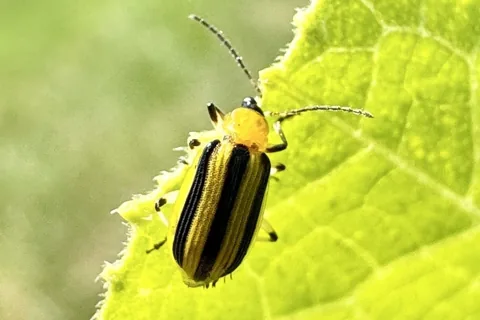 Striped Cucumber Beetle
Acalymma vittatum
Cucumber beetles are small yellow-and-black beetles that feed on squash, cucumbers, melons and other cucurbits. The striped cucumber beetle is the main concern because it can carry bacterial wilt into cucumbers and muskmelons.
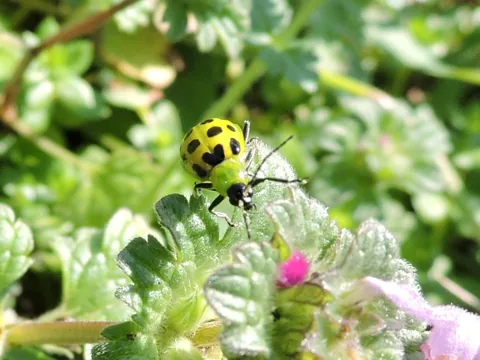 Spotted Cucumber Beetle
Diabrotica undecimpunctata
The spotted cucumber beetle, also called the southern corn rootworm, is a yellow-green beetle with 12 black spots. Adults feed on cucurbits and many other plants and can carry bacterial wilt into cucumbers and muskmelons.
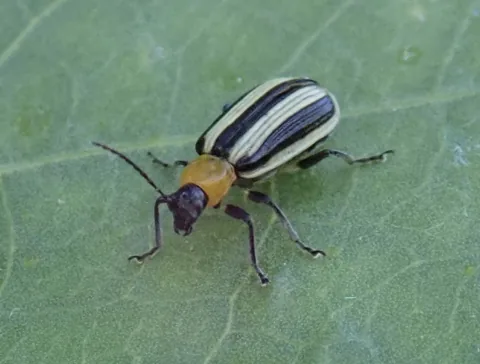 Western striped cucumber beetle
Acalymma trivittatum
The western striped cucumber beetle is a small yellowish orange beetle with three black stripes down its back. It feeds on cucurbits in western gardens and fields, and its larvae feed only on cucurbit roots.
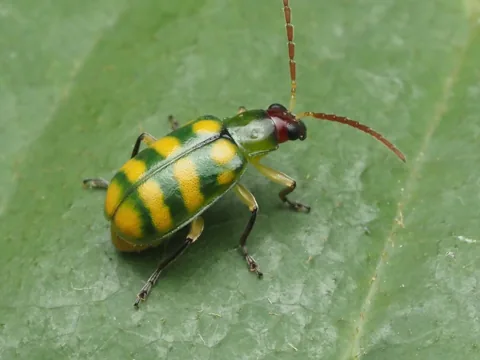 Banded Cucumber Beetle
Diabrotica balteata
The banded cucumber beetle is a leaf beetle native to the American tropics whose range has expanded into the southern United States. Adults chew leaves, flowers and pods of many crops, and the larvae feed on roots underground.
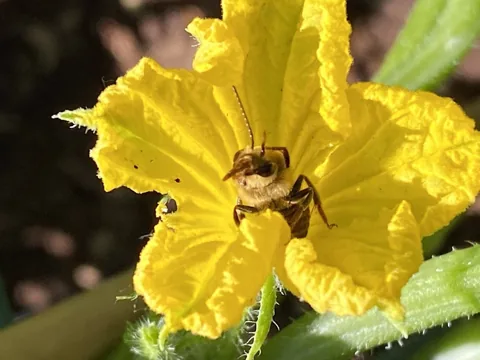 Squash Bees
Xenoglossa pruinosa (formerly Peponapis pruinosa)
Squash bees are native, solitary bees that collect pollen only from squash, pumpkin and gourd flowers, and they are usually the first bees in the blossoms at sunrise.
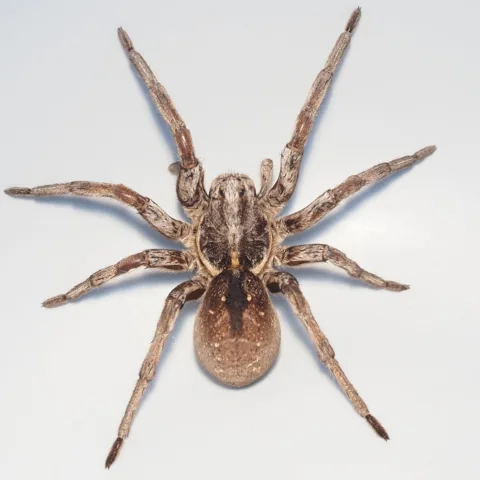 Carolina Wolf Spider
Hogna carolinensis
Wolf spiders are large hunting spiders that don't use webs; they wander into homes by accident, especially males searching for mates, and they don't persist indoors.
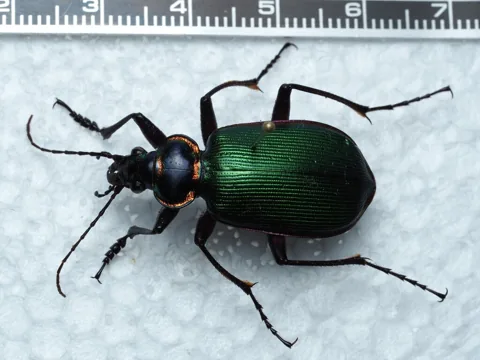 Ground Beetles
Family Carabidae (e.g., Calosoma scrutator, the fiery searcher)
Ground beetles are one of the largest groups of beetles in North America. They sometimes crawl indoors under doors or through small openings, but they prefer to live outside where prey is common, and outdoors they are valuable predators of garden pests.
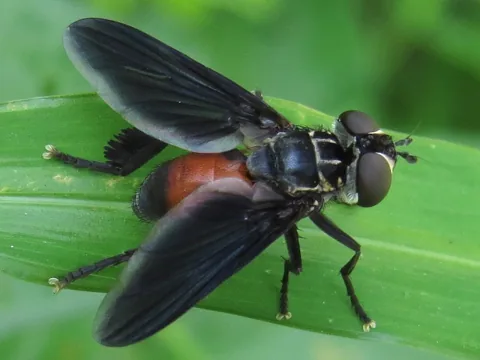 Tachinid Flies
Tachinidae (shown: Trichopoda pennipes)
Tachinids are the most important parasitic flies in biological control and one of the most diverse fly families. Their larvae develop inside caterpillars, beetles, true bugs and other insects, and kill them.
Which cucumber beetle do you have?
All the common species are about a quarter inch long, shiny, with a black head and long, threadlike antennae. Sources give slightly different sizes for the striped cucumber beetle: about 1/5 inch (Minnesota), 1/4 inch (Kentucky, Cornell) or about 7 mm (UMass).[3][1][2][8][4]
- Striped cucumber beetle (Acalymma vittatum): yellow wing covers with three black stripes running to the tip, a black head, and an orange or yellow area just behind the head. Cornell calls it the primary cucurbit pest in the northeastern United States and the key carrier of bacterial wilt. See the striped cucumber beetle profile.[1][4][8][2]
- Spotted cucumber beetle (Diabrotica undecimpunctata), also called the southern corn rootworm: similar size and color but with 12 black spots instead of stripes. Its larvae feed on the roots of corn and grasses rather than cucurbits. See the spotted cucumber beetle profile.[1][2][3][9]
- Western species: in California the western spotted cucumber beetle is the most abundant, and the western striped cucumber beetle (Acalymma trivittatum) is yellowish orange with three black stripes. UC IPM says cucumber beetles there may also attack ripening stone fruit. See the western striped cucumber beetle profile.[3]
- Look-alikes: the western corn rootworm also has stripes, but Kentucky says the striped cucumber beetle's stripes are straighter and the middle segment of its hind leg is yellow, not black. Lady beetles are sometimes mistaken for cucumber beetles; theirs are short, stubby antennae.[2][3]
- Signs on the plant: chewed seedlings and cotyledons, holes in leaves, and leaves and flowers with a lacy, webbed look. Cornell notes the beetles often feed in groups, sometimes hundreds at a time, and gather inside flowers.[8][3][1]
Bacterial wilt: why cucumbers and melons need more protection
Bacterial wilt is caused by the bacterium Erwinia tracheiphila. It survives winter in the gut of some striped cucumber beetles. In spring the beetles spread it through their droppings or contaminated mouthparts into feeding wounds, and the bacteria multiply in the plant's water-conducting tissue until it plugs up and the plant wilts. Beetles prefer to feed on infected plants, so a sick plant becomes a source for the rest of the patch.[2][8][5]
A 2015 research review describes spotted cucumber beetles as carriers too, and Lincoln University says both species carry the bacterium. Minnesota says spotted beetles are rarely seen early in the season and are usually too few to need treatment, so most advice centers on the striped beetle.[11][9][1]
- Most at risk: cucumbers and muskmelons (cantaloupe), and Cornell adds honeydew. Minnesota says this susceptibility keeps melons and cucumbers vulnerable to beetle feeding all season long.[2][8][1][5]
- Also at risk: UMass and Penn State include summer squash and zucchini, and UMass says wilt is becoming more important in pumpkin and squash. Lincoln University says zucchini, squash and pumpkin can be infected when beetle numbers are large.[4][7][5][9]
- Less at risk: watermelon is not susceptible (Kentucky, UMass) or is considered resistant (Penn State), and UMass rates winter squash, butternut and most pumpkins as less wilt-susceptible.[2][4][7][5]
- Symptoms: individual leaves droop first, then neighboring leaves and finally the whole vine. Affected parts may turn dark green before they wilt. Penn State says the whole plant usually dies within 7 to 14 days after symptoms start. Summer squash and pumpkins may wilt in midday heat and partly recover by morning before they collapse.[2][5][7]
- The stem test: cut a wilted stem and squeeze both cut ends. Sticky sap oozes out, and if you touch the ends together and pull them slowly apart, strings of sap show that bacteria are present. If the test is negative, look for other causes; our squash bug and squash vine borer guide covers two common ones.[2]
- No cure: Kentucky and Cornell say nothing saves an infected plant, and UMass says copper sprays are of no value against it. Pull infected plants promptly, before more beetles feed on them.[2][8][5][1]
- Resistant varieties are scarce. A research review notes few commercially available resistant cultivars, UMass says no resistance has been found in melon, and Penn State reports that Cornell lists a few cucumber varieties as tolerant or resistant.[11][5][7]
When to watch and how many beetles is too many
Striped cucumber beetles spend the winter as adults in leaf litter, field edges, fence rows and woods, and fly to cucurbits as soon as plants come up. Cornell says they emerge once average daily temperatures reach 55°F, often weeks before cucurbits are planted, and feed on other plants while they wait. UMass gives mid-June for New England, Minnesota the first week of June in the south of that state, and Lincoln University early to mid-May in mid-Missouri.[2][8][4][1][9]
Kentucky says there's usually a peak of beetle activity each spring lasting two to four weeks, and that this is the most important time to control them. UMass says beetles keep arriving for about two weeks.[2][4]
- Seedlings are the priority: Minnesota says plants in the cotyledon through third true-leaf stage can be killed by heavy feeding. Squash and pumpkins with four or more leaves tolerate some feeding; Penn State says plants become a bit more tolerant at 4 to 5 true leaves.[1][7]
- Check often: Lincoln University suggests two to three times a week while plants are small, then weekly. UMass says at least twice a week through the arrival period, looking at 25 or more plants on a farm.[9][4]
- Garden threshold (Minnesota): treat if you find two or more beetles per plant on 25 percent of your plants at the cotyledon stage. Once plants have two or three true leaves, treat when a plant is 25 percent defoliated.[1]
- Thresholds for wilt-susceptible crops are lower. For cucumbers and melons, Cornell and Minnesota use one beetle for every two seedlings and one per plant after that, and UMass applies one beetle per two plants to summer squash and zucchini too. For pumpkins and other squash, Cornell allows up to 5 beetles per plant after the 4-leaf stage, and Lincoln University 5 per plant for zucchini, squash and watermelon, so sources differ on zucchini.[8][1][4][9]
- Later in the season: a new generation of adults appears in midsummer to late summer. Minnesota says striped beetles seen later in the summer cause little or no damage and feeding on pollen and flowers doesn't reduce yield, but Kentucky and UMass note that feeding on melon rinds and other fruit can make it unmarketable.[1][2][4][7]
- Generations: Minnesota typically sees one generation a year, Cornell two in New York, Lincoln University two to three in Missouri, and UC IPM several a year for the western species.[1][8][9][3]
Row covers, screens and cones
Kentucky calls row covers, screens and cones over small plants effective ways to keep cucumber beetles off home plantings, and UC IPM says protective cloth over emerging plants may be the best strategy for most vegetable gardens. Our row cover guide covers fabrics, hoops and sealing the edges.[2][3][1]
- Put covers on as seedlings emerge or right after transplanting. Minnesota names early to mid-June for its area.[1]
- Use hoops so the fabric doesn't rub the plants. UMass notes covers also add early-season warmth.[4]
- Take covers off when plants start to flower. Most cucurbits need insects to carry pollen, and covers keep the bees out.[1][4][8][9]
- For muskmelons where wilt is common: in Iowa State trials, leaving spunbond row covers on for 10 days after flowering began, with the ends opened at bloom or bumble bee hives placed under the covers, suppressed bacterial wilt and raised yields in two field trials; in a third, all row-cover timings did equally well, and 2009 trials saw no wilt at all. The authors judged it cost-effective where wilt occurs in at least 50% of growing seasons.[10][7]
- Rotate where you plant cucurbits. Minnesota says crop rotation makes exclusion more effective, and UMass says beetle numbers can be very high close to last year's cucurbit crops.[1][4]
Trap crops: Blue Hubbard squash
Striped cucumber beetles prefer some cucurbits to others. UMass says they're more attracted to Cucurbita maxima squashes such as Blue Hubbard, buttercup and giant pumpkins than to zucchini, summer squash, butternut and most pumpkins. Penn State says Blue Hubbard contains high levels of cucurbitacin, a beetle attractant. Plant the attractive one first and the beetles gather there, where you can deal with them in one place. Our trap crop guide covers what research says about trap crops and companion planting generally.[4][7][8]
- Timing: Minnesota says to plant the trap crop a week or two before the rest of your cucurbits; Cornell and Lincoln University say two weeks. Lincoln University suggests setting out two-week-old Blue Hubbard transplants at the field edges or corners when you sow the main crop.[1][8][9]
- Placement: on farms UMass plants the trap crop in an unbroken ring around the main crop, and says rows of trap crop inside the field also work. In a garden, Lincoln University's edges or corners are the simple version.[4][9]
- Kill the beetles on it: a trap crop only collects beetles. Minnesota and UMass say to treat them once they build up on the trap plants; in the UMass trials, a trap border left unprotected was destroyed by feeding and beetles moved into the main crop through the gap.[1][4][6]
- Results: in UMass on-farm trials with butternut squash, a treated Blue Hubbard border protected the unsprayed main crop as well as conventional whole-field treatment did, and cut pesticide costs by over 90%.[6]
- Don't use a highly wilt-susceptible crop as the trap.[4]
Kaolin clay
Kaolin clay is a white clay sprayed on plants, where it leaves a white or chalky film on leaves and stems. It doesn't kill cucumber beetles; it deters them, and Cornell says it irritates and disorients beetles looking for host plants. It's approved for organic growing. See our kaolin clay page for the active ingredient.[4][7][8][1]
- Start early: Cornell says to apply it before beetles arrive and Minnesota before you see major feeding. UMass says to spray direct-seeded crops as soon as seedlings emerge if beetles are active.[8][1][4]
- Keep it on: rain washes it off and new leaves come up bare, so reapply after heavy rain and as plants grow. Penn State says organic growers typically apply it about twice a week early in the season.[8][4][7]
- Combine it with other steps: UMass and Penn State list it alongside row covers, trap crops and rotation rather than as a stand-alone fix.[4][7]
Handpicking, mulch, sticky traps and cleanup
These low-tech steps suit small plantings and add to covers or a trap crop.[1][9]
- Handpicking: with just a few plants, Minnesota says to swat beetles into a bucket of soapy water.[1]
- Straw mulch: once plants are established, thick straw around the base makes it harder for beetles to lay eggs.[1]
- Black plastic mulch: Cornell says it can reduce larval survival compared with bare soil, but only when temperatures get hot enough; Lincoln University notes it warms the soil and helps transplants grow.[8][9]
- Transplants: UMass says setting out transplants may get plants past the most vulnerable stage before beetles arrive.[4]
- Yellow sticky traps or tape: striped beetles are drawn to yellow. Lincoln University uses yellow sticky cards to tell when beetles arrive (they work better for striped than spotted beetles), and Penn State says some growers lower beetle numbers by hanging yellow sticky tape over the plants. The tape fills with other insects, so replace it periodically. Cornell warns that commercial lure-baited traps can also catch and kill pollinators.[9][7][8]
- Weeds: remove weeds in and around the garden, since adults may use them.[1]
- Cleanup: after harvest remove vines, unharvested fruit, leaf litter and debris where adults spend the winter.[1][9][7]
- Distance: Penn State says planting cucurbits as far as possible from last year's patch may reduce early infestations.[7][4]
Insecticides: timing, bees and what's labeled
Minnesota advises spraying only when thresholds are reached and checking that the label lists cucumber beetles, the crop you're treating and the days to wait before harvest. Many insecticides that kill cucumber beetles are also highly toxic to bees, and squash bees and bumble bees pollinate cucurbits, so timing matters as much as the product. See our page on protecting pollinators when spraying.[1][4][8]
- Spray at the right time of day: Minnesota says before 8 a.m. or after 6 p.m.; UMass says contact sprays work best in the evening because the beetles are most active between dusk and dawn. Cornell says sprays during flowering should be made at night when bees aren't foraging.[1][4][8]
- Target adults on the plants: eggs and larvae are in the soil at the base of the plant where sprays don't reach them.[4]
- Pyrethrins: an organic-approved contact insecticide that gives a short-term knockdown of adult beetles with no residual effect.[4][8]
- Spinosad: sources disagree. UMass says it isn't labeled for or effective against striped cucumber beetle, while Cornell lists spinosyns among the three organic options. Check the label for cucumber beetles before buying it for this.[4][8]
- Azadirachtin (neem) is labeled for striped cucumber beetle, according to UMass.[4]
- Systemic seed treatments and soil drenches (thiamethoxam, cyantraniliprole) are mostly farm tools. UMass says they protect plants for about 21 days during establishment and Minnesota says seed treatments give 2 to 3 weeks of protection. Kentucky says that on melon farms, contact insecticides must be reapplied repeatedly, sometimes twice a week at peak beetle activity. Neonicotinoids are highly toxic to bees, and UMass says higher residues turned up in pollen and nectar after foliar or irrigation-applied treatments during flowering.[4][1][8][2]
- Rotate chemical classes if you spray repeatedly, to slow resistance.[1]
Natural enemies and beneficial nematodes
Wolf spiders, harvestmen, ground beetles and lady beetles eat striped cucumber beetles, and Cornell cites work showing wolf spiders reduced beetle feeding and raised cucumber and squash yields in small plots. A tachinid fly and a braconid wasp parasitize the beetles, with parasitism rates up to 43% and 54% in some New York populations, though how much they reduce damage or wilt is unknown.[8][3]
- Beneficial (insect-infecting) nematodes target larvae in the soil. Cornell says applying them in early summer or early fall can reduce adult emergence. Penn State reports mixed results and says they may not control the next generation, and UMass doubts they can work because new adults keep flying in from field edges. See our beneficial nematodes guide.[8][7][4]
- Older plants can usually carry a fair number of beetles without serious harm, and UMass says broad-spectrum foliar insecticides should only be used before bloom.[3][1][4]
Common questions
- What is the best way to get rid of cucumber beetles in a garden?
- Combine exclusion and timing: cover seedlings with row cover until they bloom, plant an early Blue Hubbard squash to draw beetles away, handpick into soapy water, and clean up debris in fall. Spray only if counts pass the threshold, and spray early or late in the day.[1][2][3][4]
- Can a cucumber plant with bacterial wilt be saved?
- No. Kentucky and Cornell say there is no treatment once a plant is infected. Pull it out so beetles don't spread the bacteria to healthy plants, and protect the rest of the planting from beetles.[2][8][1]
- Does kaolin clay kill cucumber beetles?
- No. It's a physical deterrent that makes plants unattractive and confuses beetles looking for them. It works only if applied before beetles settle in and kept on through rain and new growth.[4][8][1]
- Do I need to protect pumpkins and winter squash too?
- Mainly while they're seedlings. Minnesota says pumpkins and winter squash tolerate a lot of leaf loss after the third true-leaf stage, though UMass says bacterial wilt is becoming more important in pumpkins and squash.[1][5]
- Why do cucumber beetles come back every year?
- Adults spend the winter in leaf litter and plant debris at the edges of gardens and fields and find cucurbits quickly in spring. Rotation and cleanup reduce numbers but don't stop beetles flying in.[2][4][7]
Photo credits
- Striped Cucumber Beetle: (c) L.J. Lamera, some rights reserved (CC BY) — via iNaturalist, CC BY 4.0
- Spotted Cucumber Beetle: (c) Sam Kieschnick, some rights reserved (CC BY) — via iNaturalist, CC BY 4.0
- Western striped cucumber beetle: (c) Cricket Raspet, some rights reserved (CC BY) — via iNaturalist, CC BY 4.0
- Banded Cucumber Beetle: Zygy, public domain (CC0), via iNaturalist
- Squash Bees: (c) Frances Oliver, some rights reserved (CC BY) — via iNaturalist, CC BY 4.0
- Carolina Wolf Spider: (c) Russell Pfau, some rights reserved (CC BY) — via iNaturalist, CC BY 4.0
- Ground Beetles: Brighton Lee, public domain (CC0), via iNaturalist
- Tachinid Flies: (c) Theo Rickert, some rights reserved (CC BY) — via iNaturalist, CC BY 4.0
Sources
- University of Minnesota Extension, “Cucumber beetles (M. Schuh, J. Hahn, S. Wold-Burkness).” extension.umn.edu/yard-and-garden-insects/cucumber-beetles (accessed 2026-11-10)
- University of Kentucky Entomology, “Cucumber Beetles, ENTFACT-311 (R. Bessin).” entomology.ca.uky.edu/ef311 (accessed 2026-11-10)
- University of California Statewide IPM Program, “Cucumber Beetles (Home and Landscape).” ipm.ucanr.edu/home-and-landscape/cucumber-beetles/ (accessed 2026-11-10)
- UMass Amherst Center for Agriculture, Food, and the Environment, “Striped Cucumber Beetle (vegetable fact sheet).” www.umass.edu/agriculture-food-environment/vegetable/fact-sheets/striped-cucumber-beetle (accessed 2026-11-10)
- UMass Amherst Center for Agriculture, Food, and the Environment, “Cucurbits, Bacterial Wilt (vegetable fact sheet).” ag.umass.edu/vegetable/fact-sheets/cucurbits-bacterial-wilt (accessed 2026-11-10)
- UMass Amherst Center for Agriculture, Food, and the Environment, “Using Perimeter Trap Crops to Manage Striped Cucumber Beetle and Bacterial Wilt (2007).” www.umass.edu/agriculture-food-environment/vegetable/research-reports/using-perimeter-trap-crops-to-manage-striped-cucumber-beetle-bacterial-wilt (accessed 2026-11-10)
- Penn State Extension, “Deterring Striped Cucumber Beetles in Organic Cucurbit Production Systems (T. Ford).” extension.psu.edu/deterring-striped-cucumber-beetles-in-organic-cucurbit-production-systems (accessed 2026-11-10)
- Cornell Integrated Pest Management, “Striped Cucumber Beetle (Acalymma vittatum), Vegetable IPM Fact Sheet (N. Murray, B. Nault, M. Zuefle, 2025).” cals.cornell.edu/integrated-pest-management/outreach-education/fact-sheets/striped-cucumber-beetle-acalymma-vittatum-vegetable-ipm-fact-sheet (accessed 2026-11-10)
- Lincoln University Cooperative Extension, “Cucumber Beetles in Missouri: Life Cycle, Monitoring and Management, FS 18-I-2017 (J. Pinero).” www.lincolnu.edu/_files/publications/cucumber-beetles-in-missouri-life-cycle,-monitoring-and-management-fs-18i2017.pdf (accessed 2026-11-10)
- Plant Disease (PubMed 30731905), “Rojas ES, Gleason ML, Batzer JC, Duffy M. Feasibility of delaying removal of row covers to suppress bacterial wilt of muskmelon (Cucumis melo). Plant Dis 2011;95(6):729-734.” pubmed.ncbi.nlm.nih.gov/30731905/ (accessed 2026-11-10)
- Plant Disease (PubMed 30699691), “Rojas ES et al. Bacterial wilt of cucurbits: resurrecting a classic pathosystem. Plant Dis 2015;99(5):564-574.” pubmed.ncbi.nlm.nih.gov/30699691/ (accessed 2026-11-10)