On this page
How to identify it
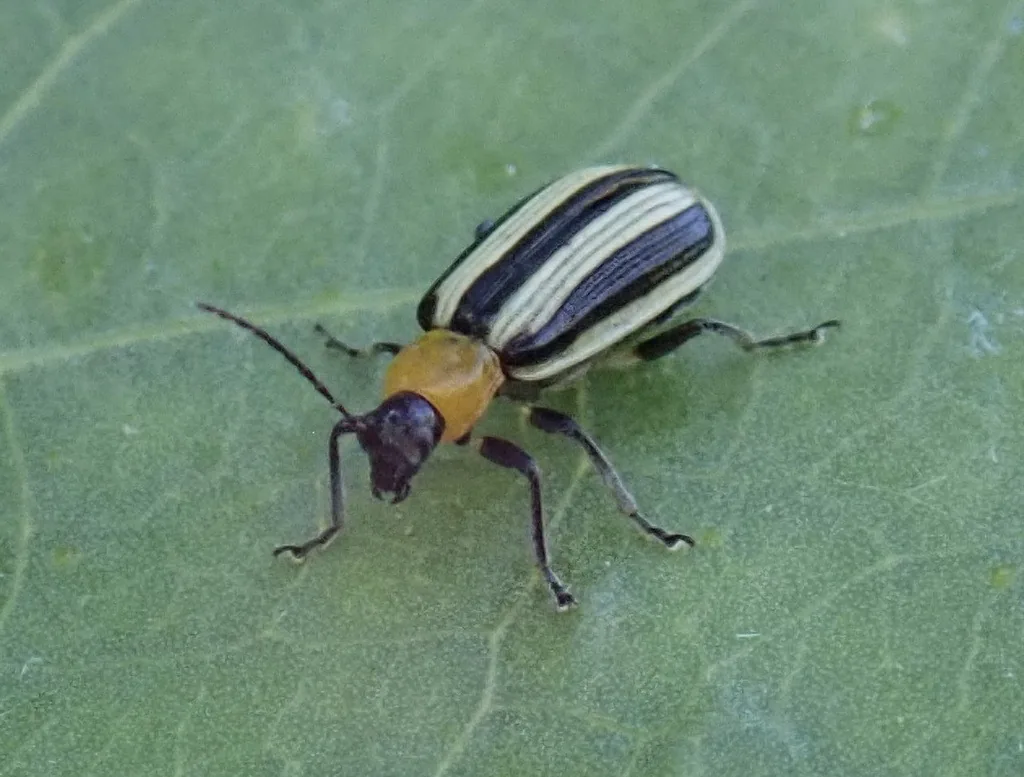
- Adults are shiny, with a black head and long antennae. UC IPM's garden page gives about 1/4 inch long, and its melon guidelines about 0.36 inch (9 mm) for cucumber beetles in general.[1][3]
- The wing covers are yellowish orange with three black stripes.[1][2]
- Larvae are whitish and slender with three pairs of short legs and a darker head and tail tip. They live in the soil.[1][2]
Look-alikes
| Look-alike | How to tell them apart |
|---|---|
| Western spotted cucumber beetle | Greenish yellow with black spots instead of stripes. Its larvae feed on the roots of many plants, including grasses, corn and legumes, not just cucurbits.[1][3] |
| Lady beetles | Lady beetles have short, stubby antennae. Cucumber beetles have long, threadlike ones.[1] |
| Striped cucumber beetle (eastern) | A close relative, Acalymma vittatum. Researchers found both species use the same male-produced aggregation scent, vittatalactone.[4] |
Where it lives
Found throughout California, where it and the western spotted cucumber beetle are major pests of cucurbits. The Pacific Northwest Insect Management Handbook also covers it as a cucumber pest, and USDA-ARS researchers trapped it in California with its pheromone.[3][2][4]
Biology and life cycle
Adults spend the winter in weedy areas and move into gardens and fields as soon as plants come up. They fly readily and can arrive from alfalfa, other crops and wild land.[1][3]
Females lay yellow orange eggs at the base of plants or in soil cracks. The Pacific Northwest handbook says eggs hatch in 7 to 10 days and larvae feed on roots for about three weeks before pupating in the soil, while UC IPM gives 2 to 6 weeks of root feeding.[1][2]
The Pacific Northwest handbook says a full life cycle takes 30 to 60 days, with new adults coming out about 2 weeks after pupation and starting on pollen.[2]
UC IPM puts the count at about three generations a year in California cucurbit fields. The Pacific Northwest handbook gives two generations a year there.[3][2]
The beetles like moisture and dislike heat, so melon fields draw them in hot weather, especially during and after an irrigation.[3]
Males release an aggregation pheromone called vittatalactone. In field tests a synthetic version drew both males and females to sticky traps in California.[4]
Damage and signs
- Adults chew small holes in leaves and flowers and may eat shoots, blossoms and soft fruit. In gardens they can also go after ripening stone fruit.[1][2]
- On melons, adults feed on the undersides of young fruit in hot weather and scar the skin. Smooth-skinned melons such as honeydew, crenshaw and casaba suffer most. Once the rind hardens, fruit is much less likely to be hit.[3]
- Feeding on the stems of young plants, followed by steady wind, can wipe out a stand.[3]
- The larvae feed only on cucurbit roots. Heavy infestations can damage the crop and can kill young plants.[1][3]
- Cucumber beetles can spread squash mosaic virus and cucumber mosaic virus, and wilts of cucurbits.[3][1]
Health risk
UC IPM and the Pacific Northwest handbook describe it only as a plant pest and list no health risk to people.[1][2]
Control
Prevention
Most older plants can carry a fair number of beetles without serious harm, so focus protection on seedlings. Late-season infestations matter little.[1][2][3]
Delaying planting until the beetles have dispersed and laid most of their eggs, and until warmer weather lets plants outgrow injury, can help.[2]
UC IPM suggests starting to look for beetles as soon as transplants go in or seedlings come up and continuing into fruiting. In commercial melons, treatment may be needed at an average of one beetle per plant while plants are seedlings up to 4 inches tall.[3]
Keep them out
Cover emerging plants with row covers or protective cloth and take it off once plants are big enough to tolerate some feeding. Row covers also help with late frost and hold in moisture.[1][2]
Biological control
General predators and a parasitic tachinid fly attack cucumber beetles, though natural enemies rarely keep numbers below damaging levels on farms.[1][3]
Pesticides
Sprays have to target the adults, because the larvae are on the roots where they cannot be reached. Home-use options in the Pacific Northwest handbook include neem oil (azadirachtin), pyrethrins and kaolin clay, which acts as a repellent. Pesticides can injure cucurbits, so spray only when the foliage is dry and follow the label.[3][2]
Where sources disagree
Generations: UC IPM's garden page says several a year and its melon guidelines about three in California, while the Pacific Northwest handbook gives two.[1][3][2]
Root feeding: about three weeks (Pacific Northwest handbook) against 2 to 6 weeks (UC IPM).[2][1]
What research says about baits and sprays
In UC Davis field trials on honeydew melons in 2008 and 2009, adding a cucurbitacin feeding-stimulant bait did not improve control of western striped or western spotted cucumber beetles with either spinosad or carbaryl.[5]
In those trials spinosad did not reduce beetle numbers or fruit damage in the field, even though it killed adults of both species in a lab test.[5]
Researchers suggest that slow-release forms of the beetle's pheromone, combined with cucurbitacin feeding stimulants, could one day allow more selective control.[4]
Common questions
- How do I tell striped from spotted cucumber beetles?
- The western striped cucumber beetle is yellowish orange with three black stripes. The western spotted cucumber beetle is greenish yellow with black spots.[1]
- Why are my squash seedlings collapsing?
- Adults chewing on the stems of young plants, followed by steady wind, can cause heavy stand losses, and striped cucumber beetle larvae feeding on the roots can kill young plants.[3]
- Do cucumber beetles spread disease?
- Yes. They can spread squash mosaic virus, cucumber mosaic virus and wilts in cucurbits.[3][1]
- Do beetle traps or baits work for cucumber beetles?
- Not reliably yet. A pheromone that draws both sexes has been identified and tested on sticky traps, but a cucurbitacin bait tested on melons did not improve insecticide control.[4][5]
Sources
- UC Statewide IPM Program, “Cucumber Beetles (Home and Landscape).” ipm.ucanr.edu/home-and-landscape/cucumber-beetles/ (accessed 2026-11-11)
- Pacific Northwest Pest Management Handbooks (Oregon State, Washington State and University of Idaho), “Cucumber-Cucumber beetle (Pacific Northwest Insect Management Handbook).” pnwhandbooks.org/insect/vegetable/vegetable-pests/hosts-pests/cucumber-cucumber-beetle (accessed 2026-11-11)
- UC Statewide IPM Program, “Cucumber Beetles (Cucurbits Pest Management Guidelines).” ipm.ucanr.edu/agriculture/cucurbits/cucumber-beetles/ (accessed 2026-11-11)
- Journal of Chemical Ecology, via PubMed, “Weber, Khrimian, Ramirez Bonilla, Grettenberger, Guzman and Haber (2023), Vittatalactone is the male-produced aggregation pheromone of the western striped cucumber beetle, Acalymma trivittatum.” pubmed.ncbi.nlm.nih.gov/37247012/ (accessed 2026-11-11)
- Journal of Economic Entomology, via PubMed, “Pedersen and Godfrey (2011), Evaluation of cucurbitacin-based gustatory stimulant to facilitate cucumber beetle (Coleoptera: Chrysomelidae) management with foliar insecticides in melons.” pubmed.ncbi.nlm.nih.gov/21882695/ (accessed 2026-11-11)
- iNaturalist, “Acalymma trivittatum taxon page (order and family).” www.inaturalist.org/taxa/243750 (accessed 2026-11-10)