On this page
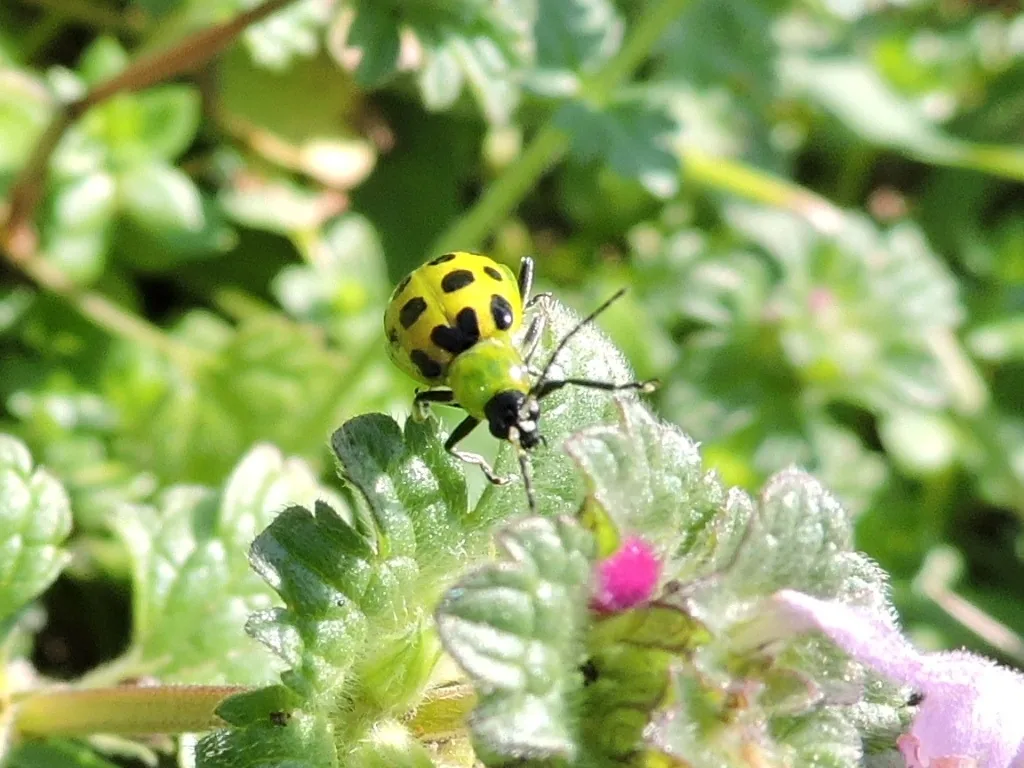
How to identify it
Look-alikes
| Look-alike | How to tell them apart |
|---|---|
| Striped cucumber beetle | Another cucurbit beetle; in Florida it is less common than the spotted cucumber beetle.[1] |
| Banded cucumber beetle | A related Diabrotica beetle more common in southern Florida.[1] |
Where it lives
A native beetle found across the United States from Mexico to Canada, most abundant and destructive in the South.[1]
Biology and life cycle
Unmated adults overwinter under leaves and debris near woods and buildings and become active above about 50 degrees F in spring.[1][2]
Females lay yellow eggs in clusters in the soil near hosts such as grasses, cucurbits and legumes; larvae feed on roots for two to four weeks.[1][2]
Damage and signs
- Adults chew roots, seedlings, flowers and leaves; feeding on young cucurbits can cause wilting and lower yields.[1][2]
- They spread the bacterium that causes bacterial wilt of cucurbits, a serious concern in the central and eastern United States.[1]
- Larvae bore into roots and stem bases and can badly damage small plants.[1]
Health risk
Control
Prevention
Use mulches and drip irrigation, avoid planting cucurbits next to beans, corn or grassy weeds, and plant attractive cucurbit trap crops two weeks before the main crop.[1][2]
Keep them out
Protect small plants with row covers, screens or cones.[1]
Pesticides
Organic options include kaolin clay, pyrethrum and spinosad; rotate modes of action and combine sprays with cultural and biological controls.[1]
Common questions
Sources
- University of Florida IFAS Extension (EDIS, Featured Creatures), “Spotted Cucumber Beetle, Diabrotica undecimpunctata howardi (EENY-572).” ask.ifas.ufl.edu/publication/IN1008 (accessed 2026-10-16)
- Utah State University Extension (Integrated Pest Management), “Spotted Cucumber Beetle (hemp pest fact sheet).” extension.usu.edu/planthealth/ipm/notes_ag/hemp-spotted-cucumber-beetle.php (accessed 2026-10-16)
- iNaturalist, “Diabrotica undecimpunctata taxon page (order and family).” www.inaturalist.org/taxa/55487 (accessed 2026-10-06)