The short answer
Nematode profiles
No photo yet
Root-Knot Nematodes
Meloidogyne spp. (most often M. incognita in South Carolina gardens)
Root-knot nematodes are microscopic roundworms in the soil that feed inside plant roots and make them swell into knots and galls, leaving tomatoes, okra, beans, squash and many other plants stunted and quick to wilt.
No photo yet
Foliar Nematodes
Aphelenchoides spp. (including A. fragariae and A. ritzemabosi)
Foliar nematodes are microscopic roundworms in the genus Aphelenchoides that live inside the leaves of hostas, ferns, anemones and hundreds of other plants, leaving yellow, then brown, patches and stripes bounded by the leaf veins.
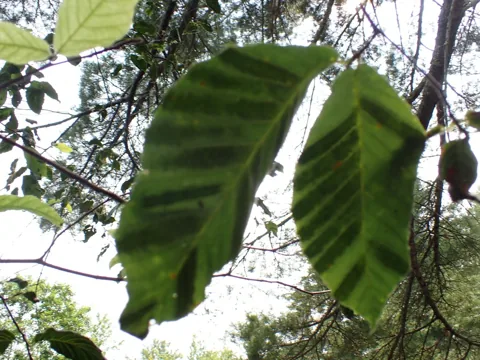 Beech Leaf Disease Nematode
Litylenchus crenatae subsp. mccannii
Beech leaf disease is caused by a microscopic, invasive leaf nematode, Litylenchus crenatae subsp. mccannii, that lives in the leaves and buds of beech trees, banding and distorting the leaves and killing buds until the tree declines.
No photo yet
Pinewood Nematode
Bursaphelenchus xylophilus
The pinewood nematode is a microscopic worm, about 1 mm long, that causes pine wilt: carried into pines by pine sawyer beetles, it multiplies in the resin canals and water-conducting tissue and can kill a susceptible pine within weeks to a few months.
Beech Leaf Disease Nematode
Litylenchus crenatae subsp. mccannii
Beech leaf disease is caused by a microscopic, invasive leaf nematode, Litylenchus crenatae subsp. mccannii, that lives in the leaves and buds of beech trees, banding and distorting the leaves and killing buds until the tree declines.
No photo yet
Pinewood Nematode
Bursaphelenchus xylophilus
The pinewood nematode is a microscopic worm, about 1 mm long, that causes pine wilt: carried into pines by pine sawyer beetles, it multiplies in the resin canals and water-conducting tissue and can kill a susceptible pine within weeks to a few months.
Root feeders: root-knot nematodes
Root-knot nematodes are the most damaging nematodes in gardens; the galls they cause on roots damage the roots' ability to carry water and nutrients, leaving plants stunted and quick to wilt.[1][2]
Leaf and bud feeders: foliar nematodes and beech leaf disease
Foliar nematodes live inside the leaves of hostas, ferns and many other plants, causing patches that start yellowish and turn brown, bounded by the leaf veins; they move in films of water and splashing rain or irrigation.[3]
- Beech leaf disease is caused by a leaf nematode that darkens the leaf tissue between the veins in bands, distorts the leaves and kills buds; it was first found near Cleveland, Ohio, in 2012 and has since spread across much of the Northeast.[4]
Wood feeders: the pinewood nematode
The pinewood nematode causes pine wilt: pine sawyer beetles carry it from infected trees to other pines in spring, and susceptible pines such as Scots pine can be killed quickly.[5]
What gardeners can do
Prevention matters most, because nematodes are hard to get rid of once they are established.[1][3]
- Start with clean plants, and avoid moving soil, infested plants or plant debris between gardens.[1][3]
- Wisconsin's plant disease clinic notes that no chemical products are available for foliar nematode control in home gardens.[3]
- Have a dying pine tested to confirm pine wilt, and remove infected pines promptly.[5]
Common questions
Photo credits
- Beech Leaf Disease Nematode: (c) Steven Lamonde, some rights reserved (CC BY) — via iNaturalist, CC BY 4.0
Sources
- University of California Statewide IPM Program, “Nematodes (Pest Notes, Home and Landscape).” ipm.ucanr.edu/home-and-landscape/nematodes/ (accessed 2026-10-17)
- Clemson Cooperative Extension, Home & Garden Information Center, “Root-Knot Nematodes in the Vegetable Garden (HGIC factsheet).” hgic.clemson.edu/factsheet/root-knot-nematodes-in-the-vegetable-garden/ (accessed 2026-10-17)
- University of Wisconsin-Madison Plant Disease Diagnostics Clinic, “Foliar Nematodes (UW Plant Disease Facts).” pddc.wisc.edu/wp-content/blogs.dir/39/files/Fact_Sheets/FC_PDF/Foliar_Nematodes.pdf (accessed 2026-10-17)
- Rutgers Cooperative Extension (NJAES), “Beech Leaf Disease & Management Options (Cooperative Extension Bulletin E376).” njaes.rutgers.edu/E376/ (accessed 2026-10-17)
- Penn State Extension, “Pine Wilt Disease.” extension.psu.edu/pine-wilt-disease (accessed 2026-10-17)