The short answer
- Start handpicking as soon as the first overwintered adults show up on young plants in spring. Knock adults and larvae into a bucket of soapy water and crush the yellow-orange egg clusters on the undersides of leaves.[1][3][4][8][10]
- Plant potatoes, eggplant and tomatoes somewhere other than where they grew last year, as far away as you can manage. The adults overwinter in the soil and mostly walk to their first meal.[1][4][2][8]
- Put row cover over the bed before any beetles appear, on ground that didn't grow these crops last year, and mulch between plants with a thick layer of straw.[1][2][4][8]
- Don't panic at some chewed leaves. Potatoes can lose a fair share of foliage before flowering without losing yield; the time to keep beetles off is flowering, when tubers start to form.[1][3][2][8][11]
- If you spray, hit small larvae right after the eggs hatch, and switch between insecticide groups. Repeating one product is how this beetle becomes resistant.[1][3][4][9]
Potato beetle profiles
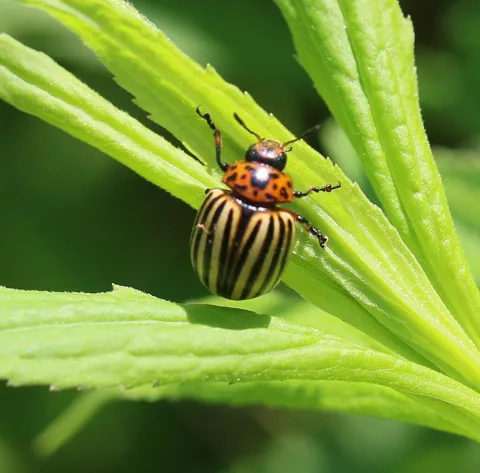 Colorado Potato Beetle
Leptinotarsa decemlineata
The Colorado potato beetle, the black and yellow-striped 'potato bug' of home gardens, is the most serious insect pest of potatoes. Adults and larvae eat the leaves of potatoes, eggplant and tomatoes and can strip plants completely.
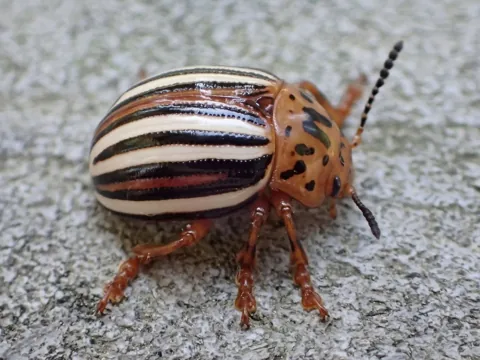 False potato beetle
Leptinotarsa juncta
The false potato beetle is a striped leaf beetle of the eastern United States that is easily mistaken for the Colorado potato beetle. It feeds mostly on horsenettle and related weeds, and although it can feed on potato, it cannot complete its life cycle on that crop.
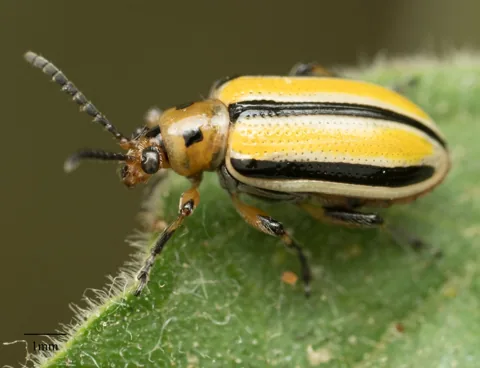 Threelined Potato Beetle
Lema daturaphila
Threelined potato beetles rarely matter on potatoes, but on tomatillos their frass-covered larvae can strip plants.
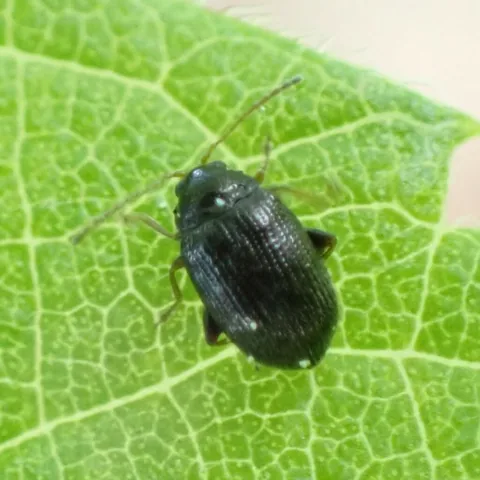 Potato flea beetle
Epitrix cucumeris
When eggplant, tomatoes or potatoes in the Northeast come up looking like they were hit with birdshot, the potato flea beetle is usually the one responsible. It overwinters in the leaf litter at the field edge, feeds on horse nettle and pokeweed in early spring, then moves into the crop and stays until August, with a second flush of summer adults from mid July to mid August. Potatoes and tomatoes often grow fast enough to outrun it; slow-starting eggplant seedlings do not, which is why UMass sets a threshold of just two beetles per newly set transplant.
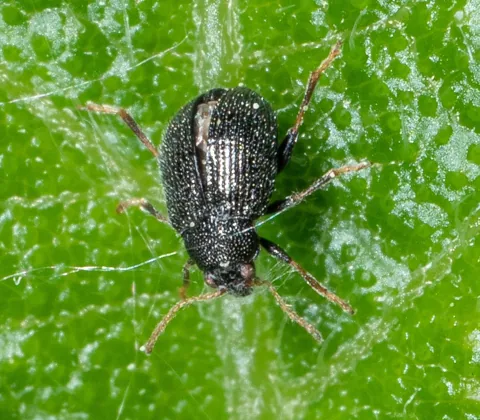 Eggplant flea beetle
Epitrix fuscula
Eggplant is a favorite host of several flea beetles, most of them in the genus Epitrix, and the eggplant flea beetle is the one named for the crop. It is a 2 mm black beetle that UMass says looks very much like the potato flea beetle but occurs farther south. The beetles are around all season, yet UC IPM says they matter most in the month after transplanting, when they can defoliate and kill young plants that a month later would tolerate them.
Make sure it's Colorado potato beetle
Adults are oval, rounded beetles with a yellow-orange area behind the head and cream to yellowish wing covers marked with 10 narrow black stripes, five on each wing cover. Sources give slightly different sizes: 3/8 inch long (Minnesota), 1/2 inch long by 3/8 inch wide (UMass), or an average of 9 mm long and 6 mm wide (Wisconsin).[1][4][2][8]
Eggs are bright yellow-orange ovals laid in clusters on the undersides of leaves. Young larvae are brick red with black heads; older ones turn pink, salmon or orange, look plump and humpbacked, and all have two rows of dark spots along each side.[1][2][3][8]
- False potato beetle looks almost the same. Kentucky entomologists separate them this way: false potato beetle larvae are paler and have a single row of dark spots on each side, and on the adult's wing covers the third and fourth black stripes merge at the tip. False potato beetles usually feed on horsenettle, black nightshade and ground cherry and can't complete their life cycle on potato. The same Kentucky article gives two more checks on adults: the third light-colored stripe is white on the Colorado potato beetle and orange on the false potato beetle, and the tiny punctures on the wing covers are scattered on the Colorado potato beetle but lined up in rows on the false one.[5]
- Lady beetle eggs are also yellow-orange clusters. UMass notes they are more yellow and slightly smaller (about 1mm) than Colorado potato beetle eggs (about 1.7 to 1.8mm), which are more orange. Leave lady beetle eggs alone; some lady beetles eat potato beetle eggs.[4][2][12]
- Holes but no larvae? Wisconsin's vegetable entomologists say potato flea beetles also feed on potato and eggplant leaves. Their damage looks like a shotgun pattern of many small holes, while Colorado potato beetles skeletonize leaves and later strip them, and the slow-moving larvae are usually close to their damage.[8]
How the beetle's year works (and where it's weak)
Adults spend the winter in the soil, 5 to 10 inches deep according to Minnesota Extension and up to 12 inches according to UMass, in and around old plantings, field edges, windbreaks and the brushy borders next to gardens. They come out in spring about the time potato plants emerge. Wisconsin gives a depth of 10 to 30 cm, often near trees or in grassy edges around gardens and fields.[1][4][8]
UMass describes the adults as slow and clumsy: they can fly once it's warm enough, but more often they walk to the nearest host plants. Minnesota Extension adds that they can't move very far, especially before temperatures reach 70 degrees Fahrenheit. That is why rotation and early handpicking work so well.[4][1]
- Egg clusters: sources give different sizes, from 10 to 30 eggs (Minnesota, Wisconsin, North Dakota) and about two dozen (Kentucky) to 20 to 35 (UMass) and 20 to 45 (Penn State). A female can lay up to 300 eggs (UMass), up to 350 (Minnesota), up to 500 (Penn State), 500 or more (Kentucky) or between 300 and 800 (Wisconsin).[1][8][9][3][4][2]
- Hatching takes four to nine days according to Kentucky and Wisconsin, about a week according to Penn State, 7 to 10 days according to UMass, and up to 2 weeks in Minnesota, depending on temperature.[3][8][2][4][1]
- Larvae go through four stages, which take two to three weeks according to Kentucky and Wisconsin and about two weeks according to Penn State. Minnesota Extension says they can finish in 10 days when average temperatures are in the mid-80s Fahrenheit but take over a month near 60 degrees. Full-grown larvae drop to the soil to pupate. New adults come out five to 10 days later according to Kentucky, after about a week according to Penn State, or after 10 to 14 days according to UMass and Wisconsin. Kentucky says the beetle can go from egg to adult in as little as 21 days, and Wisconsin gives 21 days at an optimal 83 degrees Fahrenheit.[3][8][2][1][4]
- Most areas get two generations a year: Kentucky reports two full and occasionally a partial third, Penn State two, UMass two in southern New England but only one in northern New England, Wisconsin typically two in south-central Wisconsin and one in the north, and Minnesota generally a second in the southern and central part of the state.[3][2][4][8][1]
- Adults that emerge late in summer feed for a few days, then burrow into the soil or fly to the edges of woodlots and hedgerows for the winter.[2][4]
How much damage is too much?
The biggest eaters are the full-grown larvae. The last larval stage does as much as 75 percent of the feeding damage according to Minnesota Extension, 85 percent according to UMass, so stopping larvae while they're small matters most. Wisconsin also puts most of the feeding on the third and fourth stages.[1][4][8]
Potatoes tolerate a fair amount of leaf loss at the right time. Minnesota says up to 30 percent defoliation before flowering, and Kentucky says plants can lose up to 30 percent of their foliage without yield loss. UMass gives 20 percent in one place and 15 percent in another. Once tubers start to form, Minnesota puts the limit at about 10 percent, and Wisconsin says flowering plants tolerate the least, only 5 to 10 percent of total leaf area. Flowering marks the start of tuber formation, so that is when beetle control counts most; the EPA notes that if beetles strip the leaves around flowering, the plant may not produce potatoes.[1][3][4][8][2][11]
Wisconsin adds a caution about judging damage by eye: defoliation estimates typically run 10 to 20 percent higher than the leaf area the beetles actually ate, so count the beetles and larvae as well.[8]
- Kentucky's rule of thumb for potatoes: insecticides generally aren't needed unless there's more than an average of one beetle or larva per plant.[3]
- Penn State counts "big eaters" (large larvae and adults): 4 per 10 plants justifies treatment during flowering, but before or after bloom a spray isn't needed until there are 15 per 10 plants.[2]
- Eggplant is more sensitive. UMass says it tolerates only about 15 percent defoliation before yield suffers, and adult feeding on eggplant seedlings is often bad enough to need control. Wisconsin also calls eggplant far less tolerant of leaf loss and says beetles can badly defoliate young transplants in days.[4][8]
- Tomato is not a preferred host. UMass has no threshold for it; Penn State suggests acting on established tomatoes when there are more than 15 adults per 10 plants, or, at egg hatch, more than 20 adults or larvae per 10 plants.[4][2]
- Late in the season, let it go: UMass advises against treating potatoes for these beetles late, because defoliation less than two weeks before the vines die back has little effect on the final tuber crop. Wisconsin likewise calls late-season feeding on potatoes that are starting to die back the least critical for yield.[4][8]
Handpick adults and crush egg masses
In a small garden, handpicking works, and it works best early, when the overwintered adults are arriving on young plants. Every female you catch then is a few hundred eggs that never get laid.[1][3][2][8]
- Shake or pick adults and larvae into a pail of soapy water.[1][4][8][10]
- Turn leaves over and crush or remove the yellow-orange egg clusters. Wisconsin says you can also crush groups of small larvae with your fingers.[1][4][8]
- Keep checking through the season. New adults can fly in from elsewhere, so a clean patch doesn't stay clean on its own; Wisconsin says to check plants every few days until the peak colonization period has passed.[1][8]
- Wash your hands afterward and before touching your eyes or mouth: Wisconsin notes the beetles contain a chemical that often irritates sensitive skin.[8]
- Handpicking also slows resistance, Kentucky Extension notes, because every beetle you remove by hand is one that doesn't face a spray.[3]
- It gets less practical as the planting gets bigger.[1][8]
Rotate, or take a year off
Moving the crop is the single most important step, according to UMass. Rotation keeps overwintered beetles from coming up right under your plants, whatever the distance. The farther the new bed is from last year's potatoes, tomatoes or eggplant, the longer the beetles take to find it and the fewer arrive.[4][2][8]
- How far is far enough? UMass says at least 200 yards from last year's planting. Penn State says a quarter to a half mile is best and notes that 1500 feet delayed infestation by about 7 days; Minnesota cites research supporting at least a quarter mile from the previous year's infested field.[4][2][1]
- Most backyards can't move a crop that far. Minnesota Extension suggests the alternative: grow no potatoes for a year to cut local beetle numbers, which works best when summer weather is mild.[1]
- Barriers help. UMass notes roads, woods, rivers or other crops between old and new plantings slow the walking adults, and Penn State says winter wheat or hay between rotated fields delays them further.[4][2]
- Wisconsin adds that rotation has to go along with clearing out weedy nightshade-family plants, which can carry beetles over. Over the long run, researchers reviewing U.S. potato fields found that leaning on insecticides and neglecting rotation appears to speed up resistance.[8][6]
Row covers, straw mulch and trenches
These methods make it harder for overwintered beetles to reach the plants or settle on them. They work best combined with rotation.[1][4][8]
- Row cover: put it over the rows before you see any beetles, and only on ground that didn't grow these crops last year, or beetles may emerge underneath it. Minnesota Extension says to take it off when hot, humid weather arrives, because it encourages plant disease. Penn State lists row covers and handpicking as effective in home gardens. Wisconsin says to have row covers in place before the plants emerge and to leave them on through the peak colonization period, which it puts at mid-June.[1][2][8]
- Straw mulch: UMass says it is well documented that fewer adults settle on straw-mulched potatoes or eggplant and fewer eggs are laid. In Minnesota trials in 2020, thick straw mulch reduced beetle numbers and helped suppress annual weeds. Penn State reports it working in several tomato studies and says the reason isn't clear: the straw may hide the plants from beetles or shelter more predators.[4][1][2]
- Trenches: a plastic-lined trench between overwintering sites and the new planting catches walking beetles, which fall in and can't climb out. Dig it at least one week before adults emerge, 1 to 2 feet deep (UMass) or 2 feet (Minnesota), 6 to 24 inches wide, with sides sloped at 65 to 90 degrees. It stops working once warm weather lets beetles fly. Wisconsin gives 50 cm deep and 30 cm wide and suggests letting the plastic gather a thin layer of dust from the field soil.[4][1][8]
- Sources disagree on trap crops and flaming. UMass describes early perimeter rows of potatoes as a trap crop, and flame weeding to disable colonizing adults while potatoes are under 5 inches tall; Wisconsin recommends extra potato rows next to overwintering sites, planted a full two weeks before the main crop, with the gathered beetles removed by flaming, vacuuming or other physical means. Minnesota on-farm trials in 2020 found that eggplant trap crops and flaming did not reduce beetle numbers.[4][8][1]
Plant to dodge the peak
Changing when the crop grows can put the plants out of step with the beetles.[1][4]
- Early varieties: Minnesota Extension suggests potatoes that mature in less than 80 days to escape much of the damage from adults emerging in midsummer. Yields are smaller, and these varieties often don't store as well.[1]
- Green sprouting (chitting): set seed potatoes in diffuse light at 55 to 60 degrees Fahrenheit and 40 to 50 percent relative humidity before planting so they come up fast and form a canopy quickly. UMass says this gains about 7 to 10 days.[1][4]
- Late planting: UMass says planting after mid-June with a short-season variety often avoids the damage, because adults that find no food leave in search of it.[4]
- Healthy plants handle feeding better. UMass recommends starting with healthy seed and keeping the crop well fed.[4]
Clean up weeds and old plants
The beetle feeds only on plants in the nightshade family, crops and weeds alike, so weeds near the garden give it somewhere to start.[2][1][4][8]
- Pull nightshade-family weeds near the garden. Minnesota names nightshade and ground cherry, UMass horsenettle and eastern black nightshade, and Wisconsin eastern black nightshade, jimsonweed, Carolina horsenettle and buffalobur, which it says may act as a green bridge that helps beetles move into new areas.[1][4][8]
- Clean up the planting at the end of the season so fewer adults overwinter nearby.[1]
- Good control in early summer pays off the next year as well: UMass notes it cuts the number of beetles that survive to feed on next year's crops.[4]
Natural enemies
Predators help but rarely solve the problem. Minnesota Extension says natural enemies may have little effect on overall numbers, and Kentucky says they reduce beetles somewhat.[1][3]
- Egg and larva predators named by UMass include the twelve-spotted lady beetle Coleomegilla maculata, which Colorado State calls the pink lady beetle and shows feeding on Colorado potato beetle eggs, the spined soldier bug, and a ground beetle, Lebia grandis; a tachinid fly parasitizes the beetles. Kentucky says birds also help reduce numbers somewhat.[4][12][2][3]
- Young larvae themselves eat unhatched eggs in their cluster, which Penn State says cuts hatch by about 10%.[2]
- Penn State reports an egg parasitoid that has been very effective, but only on eggplant.[2]
- The fungus Beauveria bassiana kills larvae and adults. UMass says it has been shown to suppress beetle populations but doesn't give immediate control; Minnesota says products containing it are still being researched.[4][1]
- Choosing selective insecticides over broad-spectrum ones helps keep these natural enemies around.[4]
If you spray, time it to egg hatch
Control failures with this beetle frequently come from causes other than resistance, Kentucky Extension says, and timing is critical. Spraying too early catches only some of the adults, which trickle in over several weeks; waiting until larvae are nearly full grown makes failure more likely.[3]
Insecticides don't work on eggs or pupae, and adults are not very susceptible. Small larvae are the target.[1][3]
- Timing: Minnesota Extension and North Dakota State both say sprays work best between 15 and 30 percent egg hatch; North Dakota suggests flagging the first egg masses you find and checking them daily, and following up 5 to 10 days later if the product works but doesn't last. Kentucky says just after most eggs have hatched but before serious damage.[1][9][3]
- Degree days: Wisconsin times larval stages by heat units (base 52 degrees Fahrenheit, counting from the first egg mass you find). Eggs need about 120 degree days, and larvae have finished the fourth stage at about 400.[8]
- Bt: the beetle strain of Bacillus thuringiensis (var. tenebrionis) works against small larvae under 1/4 inch, applied at egg hatch or when larvae first appear. Larger larvae are harder to kill with it, and applying too early wastes much of its effect. UMass notes the Bt product developed for this beetle has been off the market due to formulation issues.[3][4]
- Neem: azadirachtin keeps larvae from developing normally. Minnesota Extension says neem oil and Bt can be effective when larvae are small and before populations get high.[3][1]
- Spinosad: Minnesota reports spinosad resistance on some farms, and UMass has seen resistance to a synthetic spinosyn in New England.[1][4]
- New mode of action: ledprona is a sprayable double-stranded RNA insecticide that works by RNA interference and is designed to be specific to this beetle. The EPA announced its registration on December 22, 2023, for three years; UMass gives the registration year as 2024. The EPA calls it the first sprayable product of this kind allowed for commercial use.[4][11]
- Many of the products used on farms against this beetle are restricted-use and require a certified applicator license. Use only a product whose label lists the crop, cover the plants thoroughly, and observe the days between spraying and harvest.[1][3]
Why sprays stop working, and how to slow it down
This beetle is famous among entomologists for beating insecticides. It has documented resistance to over 50 active ingredients from all major insecticide groups, and a 2023 research review calls it a "super pest" that has repeatedly and rapidly evolved resistance.[1][7][8]
UMass says that, based on a fifty-year track record, any insecticide used repeatedly on the same beetle population can be expected to lose its effectiveness in less than five years. Resistance varies from place to place, even within the same county, according to Kentucky Extension. It varies by region too: North Dakota has documented pyrethroid resistance and limits those products to one application per season, while Wisconsin says its beetle populations are still susceptible to many insecticides but that overusing similar classes will lead to resistance.[4][3][9][8]
- Rotate by IRAC group, the mode-of-action number printed on most insecticide labels. Switching between two products in the same group gains nothing; Kentucky's example is that two group 3A pyrethroids in a row is not a rotation, but a 3A followed by a 4A is.[3][9]
- Don't use the same chemistry on overwintered adults and their larvae that you use on the summer adults or next spring's beetles. UMass advises not using one class on successive generations in the same year.[1][4]
- Treat the need for higher rates as a warning: Minnesota Extension says that if you find yourself increasing the rate to get control, resistance is likely developing.[1]
- Don't try to kill every beetle. Keep spraying for when the plants actually need it, and lean on rotation, handpicking and mulch the rest of the time. A review of four U.S. case studies concluded that integrating different techniques is likely to reduce the need to keep replacing failed chemicals.[4][3][6]
Common questions
- What kills Colorado potato beetles naturally?
- Handpicking into soapy water and crushing egg clusters are the most reliable home-garden methods. Lady beetles and predatory stink bugs eat eggs, and the fungus Beauveria bassiana kills larvae and adults, but extension services say natural enemies alone usually don't keep numbers low.[1][4][3][8][12]
- Why do I get potato beetles every year?
- Adults overwinter in the soil in and around last year's planting and come up as the new plants emerge. Moving the crop, ideally a long way, or skipping potatoes for a year breaks that cycle.[1][2][4][8]
- Will they eat my tomatoes and peppers?
- They can. Eggplant and potatoes usually see much heavier pressure than tomatoes, and peppers are also listed as hosts. In one Penn State study, a summer generation developed in potatoes but not in neighboring tomatoes.[2][3][8]
- Why didn't my spray work?
- Either resistance or timing. The beetle has resisted more than 50 insecticides, and sprays aimed at adults or at big larvae often fail. Target small larvae just after egg hatch, and switch IRAC groups between sprays.[1][3][7][9]
- Do I need to spray once the plants are flowering?
- Only if beetle numbers are high. Flowering is when potatoes are least able to spare leaves, so it's the time to watch closely; Kentucky uses more than one beetle or larva per plant on average as the point to consider spraying.[2][1][3][8]
- Is it safe to pick potato beetles by hand?
- Yes, but wash up afterward. Wisconsin's vegetable entomologists say the beetles contain a chemical that often irritates sensitive skin, so wash your hands before touching your eyes or mouth. Dropping them into soapy water saves handling each one.[8][1]
Photo credits
- Colorado Potato Beetle: (c) Barry Cottam, some rights reserved (CC BY) — via iNaturalist, CC BY 4.0
- False potato beetle: Zygy, public domain (CC0), via iNaturalist
- Threelined Potato Beetle: Jesse Rorabaugh, public domain (CC0), via iNaturalist
- Potato flea beetle: (c) Cecil Smith, some rights reserved (CC BY) — via iNaturalist, CC BY 4.0
- Eggplant flea beetle: (c) Jim Moore (Maryland), some rights reserved (CC BY) — via iNaturalist, CC BY 4.0
Sources
- University of Minnesota Extension, “Colorado potato beetle (reviewed 2026).” extension.umn.edu/garden-and-home/yard-and-garden/yard-and-garden-insects/colorado-potato-beetle (accessed 2026-11-11)
- Penn State Extension, “Colorado Potato Beetle (updated June 24, 2026).” extension.psu.edu/colorado-potato-beetle (accessed 2026-11-11)
- University of Kentucky Entomology, “ENTFACT-312: Colorado Potato Beetle Management (revised January 2026).” entomology.ca.uky.edu/ef312 (accessed 2026-11-11)
- UMass Amherst Center for Agriculture, Food, and the Environment, “Colorado Potato Beetle (vegetable fact sheet, updated June 2, 2022).” ag.umass.edu/vegetable/fact-sheets/colorado-potato-beetle (accessed 2026-11-11)
- University of Kentucky Entomology, “Identification of the False Potato Beetle and the Colorado Potato Beetle (Kentucky Pest News, July 3, 2023).” kentuckypestnews.wordpress.com/2023/07/03/identification-of-the-false-potato-beetle-and-the-colorado-potato-beetle/ (accessed 2026-11-11)
- Pest Management Science (PubMed 24817433), “Alyokhin A et al. The Red Queen in a potato field: integrated pest management versus chemical dependency in Colorado potato beetle control. Pest Manag Sci 2015;71(3):343-56.” pubmed.ncbi.nlm.nih.gov/24817433/ (accessed 2026-11-11)
- Current Opinion in Insect Science (PubMed 36521782), “Chen YH et al. Rapid evolution of insecticide resistance in the Colorado potato beetle, Leptinotarsa decemlineata. Curr Opin Insect Sci 2023;55:101000.” pubmed.ncbi.nlm.nih.gov/36521782/ (accessed 2026-11-11)
- University of Wisconsin-Madison Vegetable Entomology, “Colorado Potato Beetle (pest page).” vegento.russell.wisc.edu/pests/colorado-potato-beetle/ (accessed 2026-11-11)
- North Dakota State University Extension, “North Dakota Field Crop Insect Management Guide, E1143-24 (potato insects: Colorado potato beetle).” www.ndsu.edu/agriculture/sites/default/files/2024-01/229706_Insect_Orig-web_colorCV.pdf (accessed 2026-11-11)
- Clemson Cooperative Extension Home & Garden Information Center, “Eggplant Insect Pests & Diseases (HGIC 2224).” hgic.clemson.edu/factsheet/eggplant-insect-pests-diseases/ (accessed 2026-11-11)
- U.S. Environmental Protection Agency, “EPA Registers Novel Pesticide Technology for Potato Crops (December 22, 2023).” www.epa.gov/pesticides/epa-registers-novel-pesticide-technology-potato-crops (accessed 2026-11-11)
- Colorado State University Extension, “Lady Beetles (Fact Sheet 5.594).” extension.colostate.edu/resource/lady-beetles/ (accessed 2026-11-11)