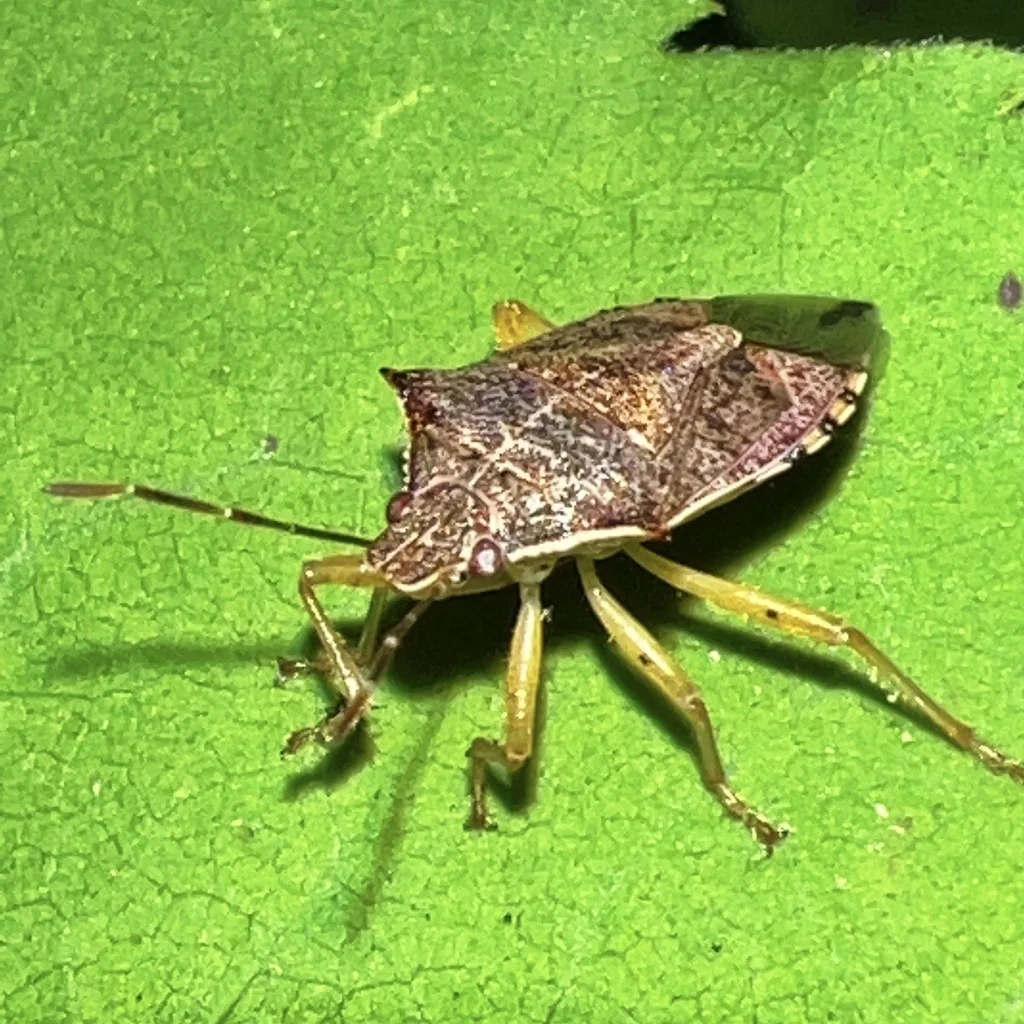
How to identify it
- Adults are shield-shaped, pale brown to tan, and about 2/5 inch (8.5 to 13 mm) long.[1][2]
- The shoulders just behind the head end in sharp points, unlike the plant-feeding stink bugs it resembles.[1][2]
- Each forewing tip has a dark line, which may form one streak where the wing tips overlap.[2][1]
- When feeding, it extends its beak forward in front of the body; plant-feeding stink bugs point theirs downward.[1]
- Young nymphs are round and red and black; older nymphs add yellow-orange and cream bands and patches.[2][1]
Look-alikes
| Look-alike | How to tell them apart |
|---|---|
| Plant-feeding stink bugs | Pest stink bugs lack the sharply pointed shoulders and the dark line on each wing tip.[1][2] |
Where it lives
Found on almost any crop, garden, landscape or wildland plant, from potatoes, tomatoes and sweet corn to cabbage-family crops, beans and apples.[1][2]
Biology and life cycle
Eggs are barrel-shaped with a ring of spines on top, laid in clusters of about 20 to 30 or more on leaves and twigs.[1][2]
Eggs hatch in about a week, and first-stage nymphs stay clustered by the shells and feed little or not at all.[1][2]
Nymphs mature in about three weeks of warm weather, so egg to adult takes about a month.[1]
Adults live 2 to 3 months, and a mated female can lay several hundred eggs when prey is plentiful.[1][2]
Where winters are cold, adults overwinter under bark and in ground litter; in mild areas they can stay active all year.[1]
Damage and signs
Health risk
Spined soldier bugs prey on insects; UC IPM and Cornell describe no health risk to people from them.[1][2]
Control
Prevention
Before spraying stink bugs, look for pointed shoulders and the wing-tip line so you don't kill this predator by mistake.[1][2]
Biological control
Control ants, grow flowering plants for adult natural enemies, reduce dust, and avoid broad-spectrum, persistent insecticides.[1]
Spined soldier bugs and an attractant pheromone are sold; large releases cut Colorado potato beetle by up to half in Washington potato fields, but results against Mexican bean beetle are unproven.[2]
Common questions
- Is this stink bug good or bad?
- If its shoulders are sharply pointed and each wing tip carries a dark line, it's the predatory spined soldier bug.[1][2]
- How much can one eat?
- One spined soldier bug has been recorded eating more than 100 late-stage fall armyworm larvae over a season.[2]
- Are insecticides hard on them?
- Research found them more susceptible than their caterpillar prey to organophosphates and carbamates, and imidacloprid and pyriproxyfen caused significant mortality.[2]
Sources
- University of California Statewide IPM Program, “Spined Soldier Bug (Natural Enemies Gallery).” ipm.ucanr.edu/natural-enemies/spined-soldier-bug/ (accessed 2026-10-06)
- Cornell University College of Agriculture and Life Sciences, “Biological Control: A Guide to Natural Enemies in North America: Podisus maculiventris (Spined Soldier Bug).” biocontrol.entomology.cornell.edu/predators/Podisus.php (accessed 2026-10-06)
- iNaturalist, “Podisus maculiventris taxon page (order and family).” www.inaturalist.org/taxa/142277 (accessed 2026-10-06)