On this page
How to identify it
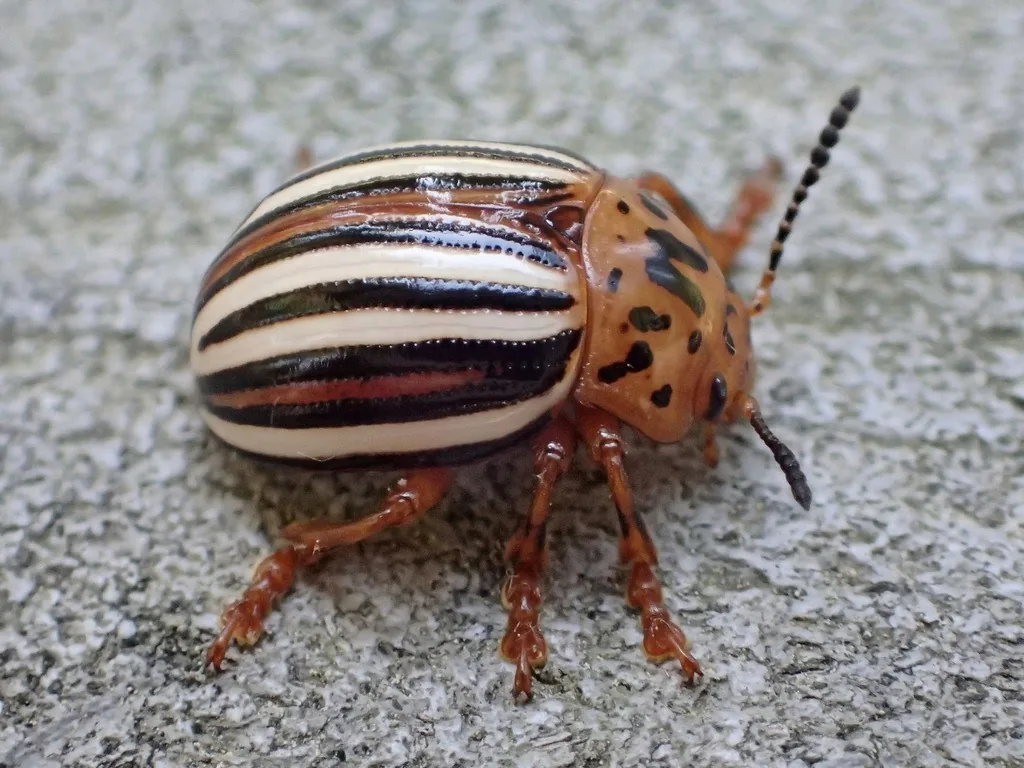
- Adults are striped beetles very similar to the Colorado potato beetle in color pattern, shape and size. Each pale yellow wing cover carries five black stripes.[1][2]
- Counting from the middle of the back outward, the third and fourth black stripes join at the tip of the wing cover; on the Colorado potato beetle those two stripes do not merge.[1][2]
- Kentucky entomologists give a field mark as well: the third light-colored stripe is orange on the false potato beetle and white on the Colorado potato beetle.[2]
- The punctures on the wing covers are coarse and line up in very regular, straight rows along each stripe; on the Colorado potato beetle they are scattered.[1][2]
- The legs are mostly orangish, with a distinct black spot on the outer edge of each femur; the Colorado potato beetle has no black spot on its legs.[1]
- Larvae are hump-backed like Colorado potato beetle larvae but paler, almost white, with a single row of black spots along each side instead of two rows.[1][2]
Look-alikes
| Look-alike | How to tell them apart |
|---|---|
| Colorado potato beetle | Colorado potato beetle adults have scattered punctures, third and fourth black stripes that do not merge, a white third light stripe and no black spot on the legs. Their larvae are reddish with two rows of black spots on each side, while false potato beetle larvae are nearly white with one row.[1][2] |
Where it lives
It is found primarily in the eastern United States, from northern Florida west to eastern Texas, north to Missouri, southern Illinois and Indiana, and east to Maryland, West Virginia and Virginia. It also occurs in Kentucky.[1][2]
Biology and life cycle
Its main host is horsenettle (Carolina horsenettle, Solanum carolinense), a weed of field crops, grass pastures and hay fields. It also feeds on other nightshade-family plants, including black nightshade and other Solanum species and ground cherries (Physalis).[1][2]
Its life cycle resembles that of the Colorado potato beetle. Eggs hatch in four to five days, and the larvae feed on the leaves of the host plant through four stages lasting about 21 days.[1]
Full-grown larvae drop to the soil to pupate, and the pupal stage lasts 10 to 15 days.[1]
Its eggs are slightly larger than those of the Colorado potato beetle, and fewer are laid in each cluster.[1]
In a Kentucky forage field in 2023, false potato beetle larvae were found on 9 percent of horsenettle plants, with 1 to 8 larvae per plant.[2]
Damage and signs
Health risk
It is a leaf-feeding beetle; neither the EDIS publication nor Kentucky Pest News describes any risk to people.[1][2]
Control
Prevention
Identify the beetle before treating potatoes. Differences in adults, larvae and host plants separate the two species, and the false potato beetle mostly stays on weeds such as horsenettle, black nightshade and ground cherry, while the Colorado potato beetle is a severe pest of potato that also feeds on tomato and eggplant.[2][1]
Common questions
- How can I tell a false potato beetle from a Colorado potato beetle?
- Look at the wing covers. On the false potato beetle the third and fourth black stripes, counted from the middle, join at the tip, the third light-colored stripe is orange rather than white, and the punctures form straight rows. It also has a black spot on each femur, which the Colorado potato beetle lacks.[2][1]
- Will false potato beetles eat my potatoes?
- They can feed on potato, but they cannot complete their life cycle on it and mostly live on horsenettle and other weedy nightshades. In Kentucky, though, they can be a significant pest of eggplant.[2]
- What do false potato beetle larvae look like?
- They are hump-backed grubs, paler than Colorado potato beetle larvae and almost white, with one row of black spots along each side.[1][2]
Sources
- University of Florida IFAS Extension (EDIS, Featured Creatures), “Colorado Potato Beetle, Leptinotarsa decemlineata (Say) and False Potato Beetle, Leptinotarsa juncta (Germar), EENY146 (R. L. Jacques Jr. and T. R. Fasulo; archival copy).” journals.flvc.org/edis/article/download/118180/116127 (accessed 2026-11-09)
- University of Kentucky Cooperative Extension (Kentucky Pest News), “Identification of the False Potato Beetle and the Colorado Potato Beetle, Kentucky Pest News (A. Falcon-Brindis, R. T. Villanueva and A. Ritchey, July 3, 2023).” kentuckypestnews.wordpress.com/2023/07/03/identification-of-the-false-potato-beetle-and-the-colorado-potato-beetle/ (accessed 2026-11-09)
- iNaturalist, “Leptinotarsa juncta taxon page (order and family).” www.inaturalist.org/taxa/84188 (accessed 2026-11-09)