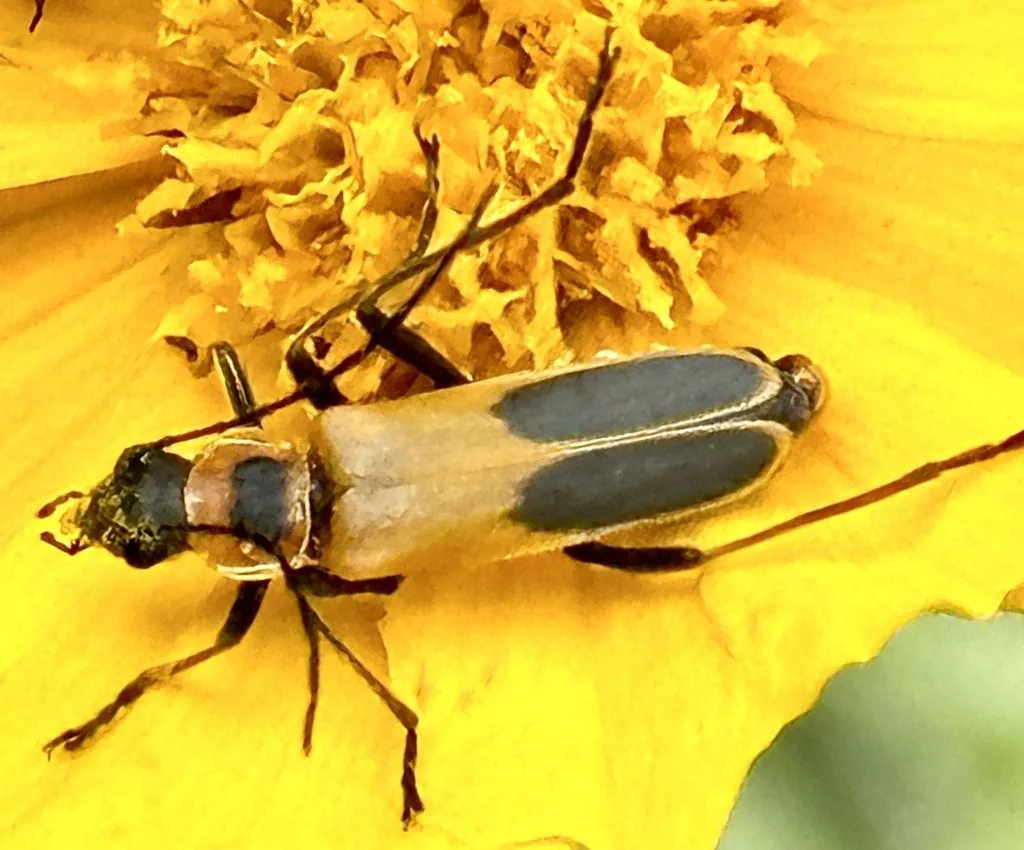
How to identify it
- Adults are elongate, soft-bodied and about 1/2 inch long, with soft, flexible wing covers that give them the name leatherwings.[2][1]
- Colors run from yellow to red with brown or black; the goldenrod soldier beetle is yellow-orange with an oval black spot on each wing cover.[2][3]
- They're related to fireflies but have no light-producing organs.[3][2]
- Larvae are dark, velvety and bristly, look like small alligators, and grow up to 3/4 inch long.[2][3]
Look-alikes
| Look-alike | How to tell them apart |
|---|---|
| Blister beetles | Blister beetles have a square head and a visible neck, because the thorax is narrower than the head and abdomen.[2] |
| Fireflies | Fireflies have light-producing organs; soldier beetles don't.[3][2] |
Where it lives
Common in gardens in states such as Kentucky and Minnesota; goldenrod soldier beetle adults are active from late July into September, especially on yellow flowers.[2][3]
Biology and life cycle
Females lay eggs in clusters in soil or organic litter, and the eggs hatch in about a week.[2][1]
Most of the life cycle is spent as ground-dwelling larvae, which overwinter in soil and debris.[1][3]
The goldenrod soldier beetle has one generation a year.[3]
Adults secrete defensive chemicals, and their yellowish color is thought to warn predators that they taste bad.[3]
Damage and signs
- They don't damage foliage. Adults eat caterpillars, insect eggs, aphids and other soft insects or feed on pollen and nectar; occasional feeding on raspberries and cherries is uncommon.[2]
Health risk
Soldier beetles don't damage plants and are harmless to people.[3]
Control
Prevention
No control is needed. Ignore them and they'll leave on their own.[3]
Keep them out
If larvae wander indoors in fall looking for winter shelter, weather-stripping and caulking will keep them out.[2]
Traps and physical control
A vacuum cleaner safely removes any that get inside.[2]
Common questions
Sources
- University of California Statewide IPM Program, “Soldier Beetles (Natural Enemies Gallery).” ipm.ucanr.edu/natural-enemies/soldier-beetles/ (accessed 2026-10-06)
- University of Kentucky Entomology Extension, “Soldier Beetles, ENTFACT-707.” entomology.mgcafe.uky.edu/ef707 (accessed 2026-10-06)
- University of Minnesota Extension, “Soldier beetles.” extension.umn.edu/yard-and-garden-insects/soldier-beetles (accessed 2026-10-06)
- iNaturalist, “Chauliognathus pensylvanicus taxon page (order and family).” www.inaturalist.org/taxa/216649 (accessed 2026-10-06)