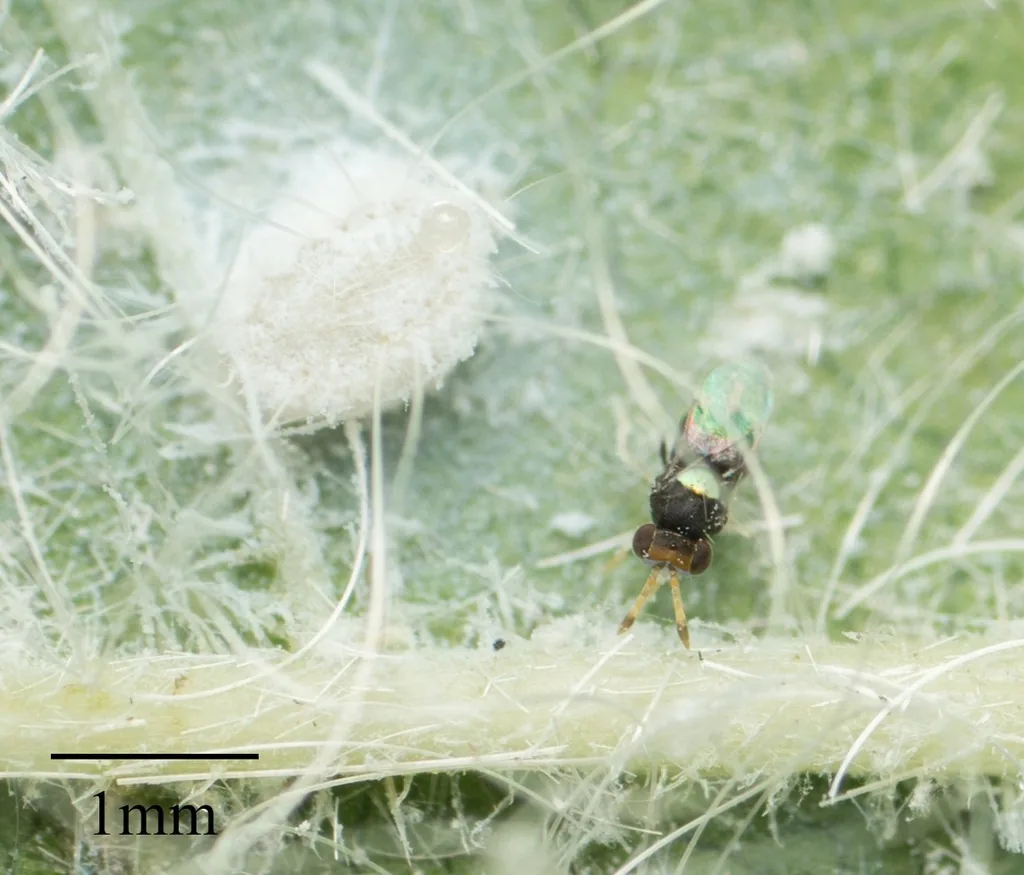
How to identify it
- Greenhouse whitefly pupae parasitized by E. formosa turn black, and the wasp leaves a round exit hole in the dark case.[1]
- An unparasitized whitefly leaves a ragged or T-shaped slit in a clear to whitish, empty case.[1]
- E. formosa females have a black head and thorax and a yellow abdomen and are about 0.4 to 0.6 mm long; males are rare and dark.[1][2]
Look-alikes
| Look-alike | How to tell them apart |
|---|---|
| Whiteflies hit by other Encarsia | Hosts of E. pergandiella turn yellow then brown, and after that wasp leaves the empty case is pale, not black.[1] |
| Normal whitefly pupal cases | A whitefly that emerged on its own leaves a T-shaped slit in a clear, empty case.[1] |
Where it lives
E. formosa occurs naturally outdoors wherever greenhouse whitefly does, and releases have spread it worldwide. At least 30 Encarsia species live in California.[1][2]
Biology and life cycle
Females lay one egg per whitefly, preferring third and fourth instar nymphs.[1]
The larva feeds inside for about 10 days, turns the host black at the pupal stage, then pupates and chews out.[1]
Over a two-week life a female parasitizes about five whiteflies a day and kills about three more by feeding on them.[1]
Damage and signs
- E. formosa attacks at least 27 whitefly species, including greenhouse, silverleaf and sweetpotato whiteflies.[1]
Health risk
They're whitefly parasites, and parasitoid wasps do not sting people.[3]
Control
Biological control
Releases work best when started while whiteflies are still scarce, a few per plant.[1]
It's used mainly on greenhouse tomato and cucumber, and also on poinsettia, gerbera and strawberry.[2]
Control ants and avoid broad-spectrum, persistent insecticides, which kill the wasps.[1]
Common questions
- Why are some whitefly pupae turning black?
- Black greenhouse whitefly pupae usually mean Encarsia formosa is developing inside.[1]
- Can I buy Encarsia?
- Yes. E. formosa is reared commercially and released against whiteflies on ornamentals, tomatoes and strawberries.[1]
- Will they sting?
- No. Parasitoid wasps are harmless to people.[3]
Sources
- University of California Statewide IPM Program, “Whitefly Encarsia formosa Parasitoid (Natural Enemies Gallery).” ipm.ucanr.edu/natural-enemies/whitefly-encarsia-formosa-parasitoid/ (accessed 2026-10-06)
- Cornell University College of Agriculture and Life Sciences, “Biological Control: A Guide to Natural Enemies in North America: Encarsia formosa.” biocontrol.entomology.cornell.edu/parasitoids/encarsia.php (accessed 2026-10-06)
- University of Maryland Extension, “Parasitoid wasps.” extension.umd.edu/resource/parasitoid-wasps (accessed 2026-10-06)
- iNaturalist, “Encarsia taxon page (order and family).” www.inaturalist.org/taxa/250144 (accessed 2026-10-06)