The short answer
- Seal the house before they arrive. Minnesota Extension says to finish repairs before the end of August: fix screens, caulk cracks around windows, doors, siding and utility lines, and add door sweeps.[4][5][1][7][8]
- Knock down outdoor clusters with a hard spray from the hose, or with soapy water sprayed straight onto the bugs. Soap only kills bugs it actually hits.[6][2][1][7][9]
- Inside, vacuum or sweep them up and empty the vacuum right away. Don't spray insecticides indoors; UC IPM says not to, and Minnesota says the bugs live only a few days once they're out in the house.[1][4][6][8]
- Clear leaves, boards, rocks and boxelder seeds from around the foundation. UC IPM suggests a 6- to 10-foot strip, especially on the south and west sides.[1][7]
- Female, seed-bearing boxelder trees are the source. UC IPM, Colorado State and Montana State call removing them the most effective, most permanent or best fix, but Minnesota says it isn't a good approach because the bugs can fly in from up to a couple of miles away.[1][2][9][4]
- They are a nuisance, not a danger. Boxelder bugs don't damage the structure, and every bug you see indoors in winter or spring got in the previous fall.[5][4][3]
Boxelder bugs and look-alikes
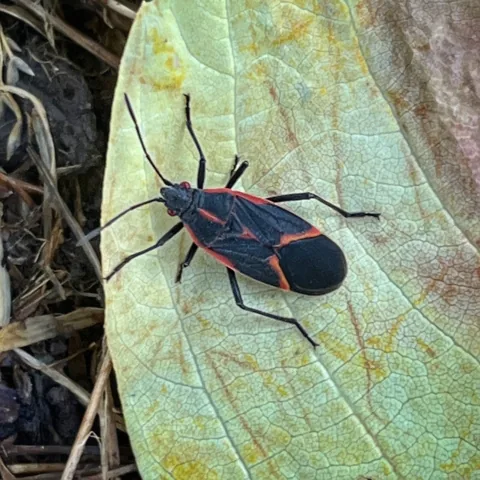 Boxelder Bug
Boisea trivittata
Boxelder bugs feed mainly on the seeds of female boxelder trees and become a nuisance in fall, when large numbers gather on and around homes looking for a place to spend the winter. Indoors they can stain fabrics and smell when crushed, but they don't damage the structure and don't breed inside.
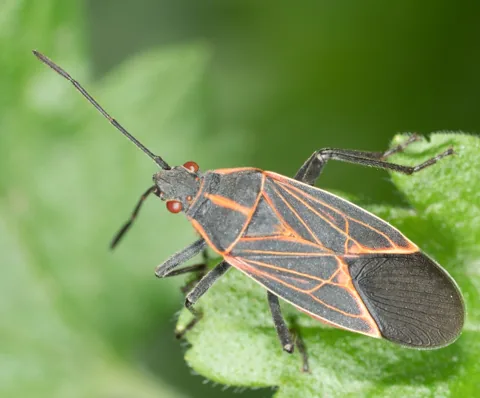 Western boxelder bug
Boisea rubrolineata
The western boxelder bug is a black-and-red true bug that feeds mostly on the leaves, flowers and seedpods of female box elder trees. It does little harm to plants. The trouble starts when clusters form on outside walls and then move into the house in fall and spring. Colorado State, writing about boxelder bugs in general, says they are a nuisance in and around homes from fall through early spring.
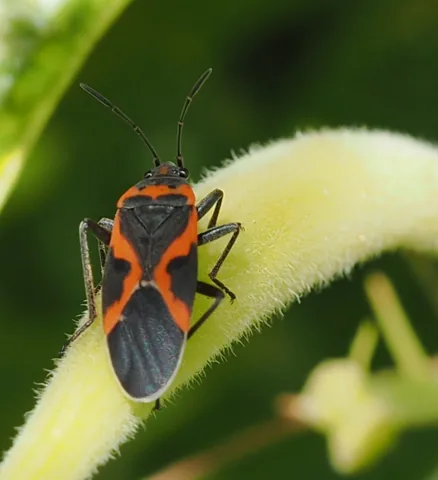 Small Milkweed Bug
Lygaeus kalmii
The small milkweed bug is a half-inch black bug with a reddish-orange X across its back and a reddish-orange band behind the head. It is one of the most common bugs on garden milkweeds.
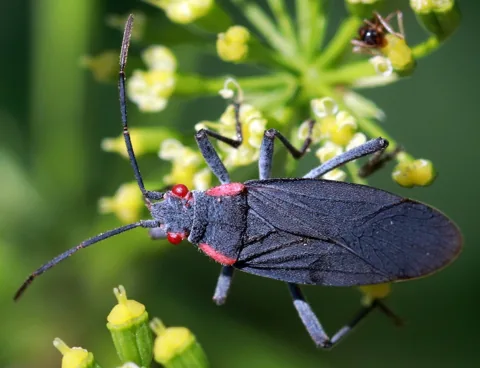 Red-shouldered bug (Jadera bug)
Jadera haematoloma
Red-shouldered bugs are seed-feeding true bugs that gather, sometimes by the hundreds or thousands, on the trunks of goldenrain trees and other soapberry-family hosts and on the fallen seeds beneath them. They are a nuisance, not a threat to the tree.
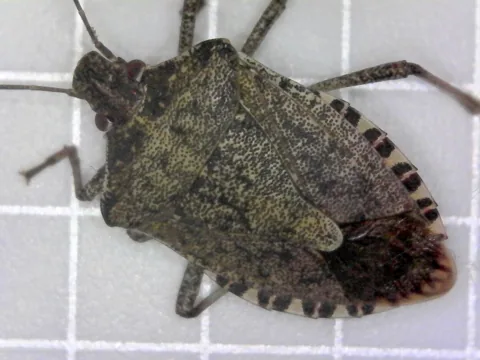 Brown Marmorated Stink Bug
Halyomorpha halys
The brown marmorated stink bug is an invasive insect from east Asia that damages fruit and vegetable crops and invades homes in fall looking for overwintering sites. Minnesota Extension says it feeds on about 200 plant species and, unlike the native stink bugs there, prefers to spend the winter in homes. Clemson notes that the bugs gather on outside walls before they move in.
Make sure they're boxelder bugs
Adults are black with three red lines on the area just behind the head, red lines on the wings and a red abdomen. That set of three lengthwise red lines is what separates them from look-alikes, according to UC IPM. The boxelder bug profile has photos and full biology.[1][2][4][7][10]
- Size: UC IPM, Colorado State, Clemson and Illinois give about 1/2 inch, as does the Pacific Northwest handbook for the western species; Kentucky says adults grow up to half an inch, and Penn State gives about 12 mm. Wisconsin's sheet says about 3/4 inch.[1][2][7][8][10][3][5][6]
- Nymphs: bright red when they hatch, picking up black as they grow. Penn State says first-stage nymphs are about 1.3 mm long, with black legs and antennae.[1][4][5][7][10]
- Wings lie flat and cross over each other to form an X on the back, Minnesota notes.[4][1]
- Look-alikes: UC IPM lists squash bugs, the bordered plant bug, the small milkweed bug, leaffooted bugs and the red-shouldered bug; Colorado State adds the goldenrain tree bug. Kentucky says milkweed bugs are mostly orange-red with broad black bands, while boxelder bugs are mostly black with thin red stripes.[1][2][3]
- Two species. The eastern boxelder bug, Boisea trivittata, is found through much of the eastern United States; Penn State says its range runs west to Nevada. In California and the West, UC IPM covers the western boxelder bug, Boisea rubrolineata.[3][5][1][10]
- Minnesota notes that boxelder bugs are true bugs related to stink bugs, and like stink bugs they give off a bad odor when crushed. If you have brown marmorated stink bugs instead, the stink bug guide covers them.[4][3]
Why they pick your house
Boxelder bugs feed mainly on the seeds of female boxelder trees, and sometimes on maple and ash. Colorado State says they seldom reach nuisance numbers unless a female boxelder tree is in the neighborhood. As fall approaches, Penn State and Clemson say they gather in large numbers on the south sides of trees, buildings and rocks, then try to get into cracks to spend the winter.[2][3][5][4][7]
- Sun and height. Minnesota and Illinois say they're drawn to buildings with a large southern or western exposure, and Illinois says that's because those walls are warmer than their surroundings. Minnesota adds buildings that stand taller than those around them or alone on flat ground, and says the color of the building doesn't matter.[4][8][9]
- Weather. Minnesota says they're most abundant in hot, dry summers that follow warm springs, and that they aren't a serious problem every year. Wisconsin says numbers are highest after dry spells and that wet weather promotes a fungal disease that helps keep them down.[4][6]
- Distance. UC IPM says winged adults can fly several blocks; Minnesota says they may travel as far as two miles. A tree a few houses away can supply your bugs.[1][4]
- Siding. Minnesota says older houses with vinyl siding may have too many gaps to keep them out completely, and that in newer homes they may settle between the siding and the house wrap. The Pacific Northwest handbook also lists the space under siding as a winter shelter.[4][10]
- Seed supply. Montana State says infestations often track how many boxelder seeds are available. Clemson lists other food plants, including other maples, buckeye, ash, spirea, strawberry, honeysuckle, plum, cherry, peach, grape and apple, and Kentucky adds reports from silver and sycamore maples, apple, pear and plum.[9][7][3]
The boxelder bug year
Timing matters more than products with this insect. Sources describe the same yearly cycle, with small differences by region.[1][4][5][7]
- Spring: overwintered adults leave their shelters about when boxelder buds open. Penn State puts this at late April to early May in Pennsylvania. Females lay eggs in bark crevices and on leaves and branches of female boxelder trees.[5][2][3][1][10]
- Egg hatch: sources give different times. Penn State says 10 to 14 days, Wisconsin 11 to 14 days, Clemson about 2 weeks and Kentucky around 11 to 19 days. UC IPM says nymphs hatch in a few days. Kentucky says hatching begins in late May.[5][6][7][3][1]
- Summer: nymphs feed on seeds and leaves and become adults. Clemson says they're adults by July and lay eggs for a second generation before fall, and Penn State says one to two generations a year in Pennsylvania. For the western boxelder bug the sources split: UC IPM describes a second generation in California, while the Pacific Northwest handbook says there is only one a year. In Minnesota, adults move to female trees to lay eggs starting in mid-July.[7][5][6][1][10][4]
- Fall: second-generation bugs gather on the outsides of homes on sunny days in September and October, Wisconsin says, then move indoors into attics and wall voids. Minnesota says nymphs may still be around in fall but only full-grown adults survive the winter, and that late summer and early fall, when they first cluster, is the time for any outdoor treatment; sealing should already be done.[6][4][1]
- Winter shelter: sources describe different spots. UC IPM lists hollow tree trunks, the undersides of rocks, boards and other debris, cracks in walls, door and window casings, foundations and the inside of houses. The Pacific Northwest handbook names cracks, crevices and the space under siding. Kentucky says they typically overwinter in leaf litter and only occasionally end up on siding or inside buildings.[1][10][3]
- Winter: bugs in the walls stay mostly inactive, but on mild, sunny days some warm up and follow the heat into living areas, heading for windows.[4][6][2][10]
- Late spring: Colorado State says indoor nuisance problems should be over by late May, once the bugs have died or gone back to the trees.[2]
Seal the house before late summer
Penn State calls mechanical exclusion the best way to keep boxelder bugs out, Illinois calls exclusion the best strategy for fall invaders, and Minnesota says the best management is keeping them from getting in at all. Minnesota's deadline is the end of August. The pest-proofing guide covers sealing for other pests too.[5][8][4][1][3][7]
- Screens: repair or replace damaged window and door screens, plus the screens in roof and soffit vents and bathroom and kitchen fans.[4][5][1][7][9]
- Vents: Clemson says to cover vent openings into crawl spaces, attics and similar spaces with screening of at least 16 mesh.[7]
- Gaps: on stucco, plaster, stone or brick, Minnesota says to seal openings 1/8 inch or larger. Check where different materials meet, such as brick and wood siding, and where vertical surfaces meet horizontal ones.[4]
- Where to look: cracks around windows, doors, siding, utility pipes, behind chimneys and under the wood fascia, per Penn State; Minnesota adds cables, phone lines, outdoor faucets and dryer vents. Clemson also names fascia boards and the places cables and pipes come in, and Montana State dryer vents and utility wires.[5][4][7][9]
- Materials: Penn State recommends good-quality silicone or silicone-latex caulk. Minnesota suggests silicone, elastomeric latex or silicone/acrylic caulk for cracks, and expandable foam or copper mesh for larger spaces.[5][4][1]
- Doors: install door sweeps or thresholds on exterior doors and a rubber seal along the bottom of the garage door.[4][9]
- Don't seal weep holes. The small openings at the bottom of brick or stone veneer walls must stay open; Minnesota suggests ventilation plugs for them instead.[4]
- Expect fewer, not zero. Minnesota says sealing won't keep out every bug but can greatly cut the number that get in.[4]
Female boxelder trees and the yard
Boxelder seed pods grow only on female boxelder trees. Kentucky and Minnesota say the bugs are rarely found on male trees, and Penn State says they have been reported to prefer developing on female trees. UC IPM says they can also live on male trees, though large numbers usually occur only on females. Whether to cut the female trees down is where sources disagree.[2][3][4][5][1]
- For removal: UC IPM calls removing female, pod-bearing trees the most effective control, Colorado State the most permanent solution (though it may not be practical or desirable), and Montana State the best solution for female trees close to the home. Wisconsin says removing all boxelder trees in an area prevents breeding. Kentucky says cutting nearby boxelder trees may help if the bugs are an ongoing problem.[1][2][9][6][3]
- Against removal: Minnesota says removing or spraying boxelder trees in your yard is not a good way to manage the bugs, since adults can fly up to a couple of miles. It adds that boxelder, maple and ash trees are common landscape trees whose benefits outweigh the problem of occasional infestations.[4]
- Middle ground: UC IPM says removing trees won't always solve the problem because bugs fly in from neighbors' trees, and Clemson and Montana State make the same point about other boxelders nearby. Montana State says removal can still cut the numbers at a single house. UC IPM suggests not planting new boxelder trees.[1][7][9]
- If the tree stays, clear fallen seeds from under and near it. UC IPM suggests a broom or shop vacuum on patios and driveways; a shop vacuum also picks most seeds out of grass.[1]
- Clean up the foundation strip. Rake leaves and remove weeds, grass, rock piles, boards and debris from a 6- to 10-foot strip around the foundation, especially on the south and west sides. UC IPM says a clean strip tends to reduce how many bugs gather there, and Clemson says removing piles of wood, rocks and leaves cuts both their hiding places and their numbers.[1][7]
- Don't spray the tree in bloom. Kentucky says insecticides should not be applied to boxelder trees while they're flowering because they can harm pollinators and other beneficial insects.[3]
- Penn State gives one tree option: a registered insecticide for non-edible ornamental trees, aimed at the foliage in early summer while nymphs are out feeding on seeds and soft growth. It names removing seed-bearing trees near the home as the alternative.[5]
Soap, detergent and water on outdoor clusters
When bugs are bunched on a wall or tree trunk, a direct spray is the simplest way to cut numbers. Wisconsin and Colorado State add the same catch: soap kills only the bugs it soaks.[6][2][1][9]
- Soap mix: Wisconsin suggests a 3 to 4% soap-and-water mix by volume sprayed directly on the bugs.[6]
- Laundry detergent: Colorado State says laundry detergent and water mixes are safe and effective when sprayed directly on boxelder bugs, but they kill only on contact and may damage plants.[2]
- Insecticidal soap: UC IPM says insecticidal soap applied in a forceful spray of water may reduce numbers on tree trunks, and Montana State lists soapy mixtures or insecticidal soap for bugs gathered on the outside of the home.[1][9]
- Plain water: UC IPM says boxelder bugs drown easily, so a forceful stream from the hose can wash them off walls and trunks. Clemson also suggests a hard spray of water from the hose.[1][7]
- Hot water: Clemson says water between 165 and 180 °F kills them, but warns that it can kill grass and plants and can burn you.[7]
- Shop vacuum: for clusters outside, Clemson suggests a wet-dry shop vacuum with water and a few drops of dish detergent in the tank to drown them, emptied as soon as possible. It advises against the household vacuum for this, because the odor is hard to get out of the hose.[7]
- Spring clusters are leaving, not arriving. Minnesota says bugs on the outside of the house in spring are moving away from the building, so spraying them is unnecessary and doesn't change how many show up the next fall.[4]
Exterior insecticide: sources disagree
Some extension services treat a fall perimeter spray as a useful backup to sealing; others say it is rarely worth it. Sealing comes first either way.[4][5][1][2][9][8]
- Minnesota: if you have large numbers or a history of invasions, a treatment around the outside of the home can supplement sealing. Spray in late summer and early fall when the bugs first cluster, at doors and around windows, using a product whose label allows use on building exteriors.[4]
- Penn State: exterior pyrethroid applications may give some relief where sealing is difficult or impossible, applied by a licensed pest control operator in fall just before the bugs gather. It lists deltamethrin, cyfluthrin, lambda-cyhalothrin, cypermethrin, sumithrin and tralomethrin.[5]
- Short-lived residue: Penn State says sunlight breaks these insecticides down, so they may not kill much beyond several days or a week. Wisconsin notes some insecticides don't work well at cool temperatures.[5][6]
- Colorado State: most insecticides registered for building exteriors are not very effective against boxelder bugs. Montana State says the same and adds that the bugs are resistant to many insecticides, though it says spot treatments with contact insecticides along windows and other entry cracks can help.[2][9]
- Illinois: insecticides can be applied around the outside of buildings, but because these insects move around so much, good control is hard to get.[8]
- Wisconsin: a professional can apply insecticide to the sides of the house; it lists insecticidal soap and sprays containing permethrin, cyfluthrin or esfenvalerate as effective.[6]
- Clemson: if needed, spray the outside of the home around windows, doors and other suspected entry points, and read the label first.[7]
- UC IPM: sprays are generally not recommended. They are often no more effective than vacuuming and hosing and may need repeating; if needed, foundation treatments are best done by a professional. Keep runoff out of storm drains, which lead to creeks and rivers.[1]
- Kentucky: because boxelder bugs don't pose a real risk, it's usually enough not to treat them outdoors at all.[3]
- If you do treat, Minnesota says to pick a product whose directions for use allow the outside of buildings and to follow the label, and that a professional pest control service may be the best option for the worst infestations. The perimeter spray guide covers the details.[4]
Once they're inside
Minnesota says that once boxelder bugs are indoors, the only practical control is physical removal. They don't reproduce inside, and Minnesota says active bugs live only a few days indoors.[4][1][5][3]
- Vacuum or sweep. Wisconsin suggests the hose attachment to avoid staining fabric, and says to empty the vacuum right away or the bugs can crawl out. Clemson says to take vacuumed bugs outside right away, and Illinois suggests putting them into soapy water before throwing them out.[6][4][1][7][8]
- Don't crush them on fabric. Their droppings can stain curtains, walls and furniture, and crushed bugs give off a bad smell.[1][3][2][4][7][9]
- Find where they come out. Penn State says they usually emerge from cracks under or behind baseboards, around window and door trim, and around ceiling exhaust fans and lights. Caulk those openings.[5]
- Houseplants: Minnesota says they may gather around houseplants looking for water, and Colorado State says they may try to feed on them but don't cause damage.[4][2]
Why indoor sprays and wall dusting backfire
UC IPM says not to use sprays for boxelder bugs inside the house, Minnesota says insecticides aren't recommended once they're out in the living space, and Illinois says indoor insecticides are generally not recommended. Treating the walls they hide in causes its own problems.[1][4][8][5]
- Wall voids: Minnesota says treating wall voids and other hiding places isn't practical. Penn State says dusting the voids may kill thousands of bugs, but carpet beetles can then feed on the dead ones and move on to wool, stored dry goods and other natural products.[4][5]
- Foggers: Penn State says pyrethrum foggers kill bugs on ceilings and walls, but more emerge soon after the room is aired out.[5]
- Crack sprays: Penn State says spraying into cracks and crevices won't stop the bugs from emerging and isn't recommended.[5]
- Direct sprays: Colorado State says household aerosols and many household spray cleaners kill bugs they hit directly, but give only temporary relief; more keep coming out on warm days through early spring.[2]
Common questions
- Do boxelder bugs bite?
- Not as a rule. Kentucky says they don't bite or sting people or animals, and UC IPM says they don't injure people or pets. Colorado State and Montana State note rare reports of bites, and Clemson says bugs that are handled occasionally bite, which has been known to irritate the skin and sometimes cause a small ulcer-like sore. Kentucky says there's no evidence they carry disease.[3][1][2][9][7]
- Will boxelder bugs lay eggs in my house?
- No. They don't reproduce indoors, because females need boxelder trees to lay eggs. Minnesota says every boxelder bug you see inside in winter and spring entered the previous fall.[1][4][3][5][9]
- Why are boxelder bugs showing up in January?
- Bugs hiding in the walls or attic warm up on mild, sunny days and follow the heat into the house, heading for windows. Vacuum them up; they don't live long once they're active indoors.[4][2][6][10]
- Does soapy water kill boxelder bugs?
- Yes, if it hits them. Wisconsin suggests a 3 to 4% soap-and-water mix and Colorado State a laundry detergent and water mix, both sprayed directly on the bugs. It has no lasting effect, and Colorado State warns detergent sprays may damage plants.[6][2][9]
- Should I cut down my boxelder tree?
- Sources split. UC IPM, Colorado State and Montana State say removing female, seed-bearing trees is the most effective, most permanent or best fix. Minnesota says it isn't a good approach because bugs can fly in from up to a couple of miles away, and Clemson and Montana State note the problem may stay if neighbors have boxelders. Male trees rarely host them.[1][2][9][4][7][3]
- Do boxelder bugs damage trees or gardens?
- Not much. UC IPM says they do little damage to ornamental trees, though their feeding can deform fruit such as apples, pears, plums and grapes, and the Pacific Northwest handbook says they feed on developing apples, pears, grapes, peaches, plums and cherries when numbers are high. Penn State says heavy feeding can distort or yellow new boxelder leaves. Clemson says their feeding rarely causes significant damage.[1][10][5][7]
- How long do boxelder bugs live inside the house?
- Not long once they're active. Minnesota says individuals live a few days up to a week, and Kentucky says they won't reproduce or live long indoors, which is why it calls pesticides usually unnecessary.[4][3]
Photo credits
- Boxelder Bug: (c) Alfonso Benítez-Mora, some rights reserved (CC BY) — via iNaturalist, CC BY 4.0
- Western boxelder bug: Jesse Rorabaugh, public domain (CC0), via iNaturalist
- Small Milkweed Bug: mefisher, public domain (CC0), via iNaturalist
- Red-shouldered bug (Jadera bug): (c) Catherine C. Galley, some rights reserved (CC BY) — via iNaturalist, CC BY 4.0
- Brown Marmorated Stink Bug: (c) Stan Rullman, some rights reserved (CC BY) — via iNaturalist, CC BY 4.0
Sources
- University of California Statewide IPM Program, “Pest Notes: Boxelder Bug (Publication 74114).” ipm.ucanr.edu/home-and-landscape/boxelder-bug/ (accessed 2026-11-11)
- Colorado State University Extension, “Boxelder Bugs (Fact Sheet).” extension.colostate.edu/resource/boxelder-bug/ (accessed 2026-11-11)
- University of Kentucky Entomology, “Boxelder Bugs (ENTFACT-444).” entomology.mgcafe.uky.edu/ef444 (accessed 2026-11-11)
- University of Minnesota Extension, “Boxelder bugs.” extension.umn.edu/nuisance-insects/boxelder-bugs (accessed 2026-11-11)
- Penn State Extension, “Boxelder Bug.” extension.psu.edu/boxelder-bug (accessed 2026-11-11)
- University of Wisconsin-Madison Division of Extension, Wisconsin Horticulture, “Boxelder Bugs.” hort.extension.wisc.edu/articles/boxelder-bugs/ (accessed 2026-11-11)
- Clemson Cooperative Extension, Home & Garden Information Center, “Boxelder Bugs (HGIC 2409, 2010).” hgic.clemson.edu/factsheet/boxelder-bugs/ (accessed 2026-11-11)
- University of Illinois Extension, “Fall house guests (news release, September 23, 2019).” extension.illinois.edu/news-releases/fall-house-guests (accessed 2026-11-11)
- Montana State University Extension, “Fall Home Invaders (LILA, Fall 2023).” www.montana.edu/extension/lila_extn/lila_fall_23/FallHomeInvaders.html (accessed 2026-11-11)
- Pacific Northwest Pest Management Handbooks (Oregon State University, Washington State University and University of Idaho Extension), “Boxelder (Acer negundo)-Western boxelder bug (Pacific Northwest Insect Management Handbook).” pnwhandbooks.org/insect/hort/landscape/hosts-pests-landscape-plants/boxelder-acer-negundo-western-boxelder-bug (accessed 2026-11-11)