On this page
How to identify it
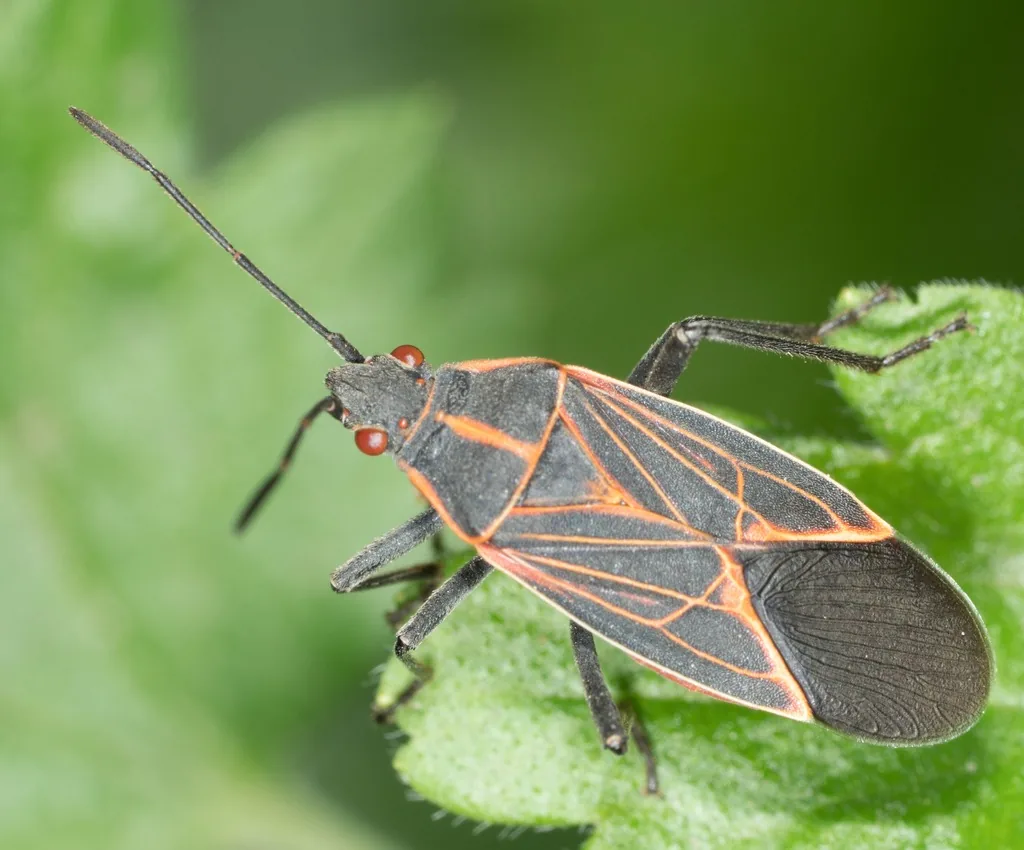
- Full-grown adults are flat and elongate, about 1/2 inch long and one-third as wide. Colorado State also gives about 1/2 inch for boxelder bug adults.[2][1][5]
- Adults are mostly black, with three red lines on the pronotum (one down the middle and one along each edge), several fine red lines on each wing, and a red abdomen.[2]
- At rest the wings lie flat on the back.[2]
- Nymphs are bright red and wingless; close to adulthood they pick up black markings and black wing pads.[2][1]
- UC IPM describes the eggs as yellow when first laid, turning red as the nymphs develop inside; the Pacific Northwest handbook calls them red. Colorado State also calls them small and red.[2][1][5]
Look-alikes
| Look-alike | How to tell them apart |
|---|---|
| Boxelder bug (eastern) | The boxelder bug of the East is a separate species, Boisea trivittata, present through much of the eastern United States.[3] |
| Red-shouldered bug | The red-shouldered bug (Jadera haematoloma) belongs to the same family, but it lacks the three lengthwise red lines on the pronotum that set boxelder bugs apart.[2] |
| Small milkweed bug and squash bugs | UC IPM notes that boxelder bugs get confused with the small milkweed bug, squash bugs, leaffooted bugs and the bordered plant bug; only the boxelder bug has three red stripes running lengthwise behind the head. Colorado State adds the goldenrain tree bug to the list of bugs mistaken for boxelder bugs.[2][5] |
| Western conifer seed bug | Another fall invader with a similar body shape, but Montana State says it has a brown body, a distinctive pattern and thick hind legs, and it feeds on trees and shrubs, especially pines.[6] |
Where it lives
UC IPM's Pest Notes treat the western boxelder bug as a frequent nuisance in and around homes, and the Pacific Northwest handbook lists it as a landscape pest of box elder.[2][1]
Biology and life cycle
Adults spend the winter in sheltered places: cracks and crevices in walls, under house siding, in hollow tree trunks, under rocks, boards and debris, in door and window casings, around foundations and inside houses.[2][1][5]
On sunny or warm days in winter and early spring they may come out and rest on light-painted outside walls on the south and west sides of the house. Colorado State and Montana State, writing about boxelder bugs in general, also point to south and west exposures, where heat is retained.[2][1][5][6]
In spring the overwintered females lay eggs in bark crevices of the host tree, and the nymphs hatch within a few days.[2][1]
Adults and nymphs feed on leaves, flowers, fruit and small twigs before moving on to the seeds. Big numbers build up mostly on female, seed-bearing box elders; male trees, maples and ash carry fewer. A lab study of the western boxelder bug found that adults and nymphs follow scent to pollen-bearing male trees early in the season and to female trees with ripening seed pods in midseason; one plant compound, phenylacetonitrile, attracted them as well as a five-part blend did.[1][2][7]
The Pacific Northwest handbook lists one generation a year, while UC IPM describes a second generation whose nymphs mostly reach full size in August and September.[1][2]
At times adults and nymphs move in large groups that cover tree trunks, the ground, fences and the sides of houses, and winged adults can fly for several blocks.[2]
Colorado State says nuisance infestations should be over by late May, when the bugs have either died or gone back to their host trees.[5]
Damage and signs
- Plant damage is minor: seeds they feed on are shed later in the season anyway, and ornamental trees suffer little.[1][2]
- When numbers are high they feed on developing fruit, including almonds, apples, cherries, peaches, pears, plums and grapes, and the feeding punctures can deform it. In pear or kiwi orchards this occasionally shows as puckered fruit, rarely a significant problem.[2][1]
- Indoors they are a nuisance. Their droppings can spot curtains, furnishings and clothing, and a crushed bug smells bad. They do not breed inside, and bugs trapped in a basement or house eventually die. Colorado State notes that they may try to feed on house plants but do no damage.[2][5][6]
Health risk
UC IPM states that boxelder bugs do not injure people or pets; the problems indoors are spotting from their droppings and the odor of crushed bugs. Colorado State and Montana State, writing about boxelder bugs in general, say that on rare occasions they have been reported to bite people.[2][5][6]
Control
Prevention
Removing female, seed-bearing box elder trees is the most effective step, and new box elders should not be planted. Bugs can still fly in from a neighbor's tree, so if removal isn't an option, clear fallen seeds with a broom or shop vacuum. Montana State says infestations often track how many seeds are available, and Colorado State says the bugs seldom build up to nuisance numbers unless a female box elder grows nearby.[2][6][5]
Keep them out
Seal the ways in before fall: repair torn screens and close cracks around doors, windows and attic or basement vents with caulk, weatherstripping, fine-mesh screen, steel wool or expanding foam. Montana State adds door sweeps and sealing around dryer vents and utility wires.[2][1][6]
Sanitation
Remove hiding places near the house, such as piles of rocks, boards and leaves. Keep a 6- to 10-foot strip around the foundation free of leaves, weeds and grass, especially on the south and west sides, and sweep up box elder seeds.[2]
Traps and physical control
Vacuum or hand-pick bugs that get indoors, and repeat as needed. Outside, a forceful stream of water knocks them off walls and trunks, and they drown easily.[2][5]
Pesticides
Insecticides are rarely justified, since sprays often work no better than vacuuming and hosing. Insecticidal soap in a forceful spray may reduce numbers on tree trunks. Do not spray for them inside the house. Montana State says boxelder bugs are resistant to many insecticides and that most insecticides for home exteriors don't work well on them, and Colorado State agrees. Colorado State says laundry detergent and water kills the bugs it hits directly but may damage plants, and Montana State mentions soapy mixtures or insecticidal soap on bugs gathered outside.[2][6][5]
When to call a professional
Pyrethroid insecticides can be applied to foundation walls around a building; UC IPM says this is best left to a professional, with care to keep runoff out of storm drains.[2]
Common questions
- Will western boxelder bugs breed in my house?
- No. UC IPM says they do not breed indoors, and bugs trapped in a house or basement eventually die.[2]
- Why do they show up on the south and west walls in winter?
- On warm days in winter and early spring the bugs leave their shelters to rest in the sun, often on light-painted surfaces on the south and west sides of a house.[2][6]
- Will cutting down my box elder tree end the problem?
- Removing female, seed-bearing trees is the most effective control, but it may not end the problem: winged adults can fly several blocks from a neighbor's tree.[2][6]
- Do western boxelder bugs bite?
- Rarely, if ever. UC IPM says they do not injure people or pets, while Colorado State and Montana State say bites on people have been reported on rare occasions.[2][5][6]
- When will the boxelder bugs be gone?
- Colorado State says nuisance infestations should be over by late May, when the bugs have died or moved back to box elder trees. Until then they may keep turning up on warm days through fall, winter and early spring.[5]
Sources
- Pacific Northwest Pest Management Handbooks (Oregon State University, Washington State University and University of Idaho Extension), “Boxelder (Acer negundo)-Western boxelder bug (Pacific Northwest Insect Management Handbook).” pnwhandbooks.org/insect/hort/landscape/hosts-pests-landscape-plants/boxelder-acer-negundo-western-boxelder-bug (accessed 2026-11-11)
- University of California Statewide IPM Program, “Pest Notes: Boxelder Bug (UC ANR Publication 74114).” ipm.ucanr.edu/home-and-landscape/boxelder-bug/ (accessed 2026-11-11)
- University of Kentucky Entomology, “Boxelder Bugs (Entfact 444).” entomology.mgcafe.uky.edu/ef444 (accessed 2026-11-11)
- iNaturalist, “Boisea rubrolineata taxon page (order and family).” www.inaturalist.org/taxa/53226 (accessed 2026-11-11)
- Colorado State University Extension, “Boxelder Bugs (Fact Sheet 5.522).” extension.colostate.edu/resource/boxelder-bugs/ (accessed 2026-11-11)
- Montana State University Extension, “Fall Home Invaders (LILA Extension newsletter, Fall 2023).” www.montana.edu/extension/lila_extn/lila_fall_23/FallHomeInvaders.html (accessed 2026-11-11)
- Journal of Chemical Ecology, via PubMed, “Schwarz et al. (2009), Phenology of semiochemical-mediated host foraging by the western boxelder bug, Boisea rubrolineata, an aposematic seed predator, J Chem Ecol 35(1):58-70.” pubmed.ncbi.nlm.nih.gov/19123035/ (accessed 2026-11-11)