On this page
How to identify it
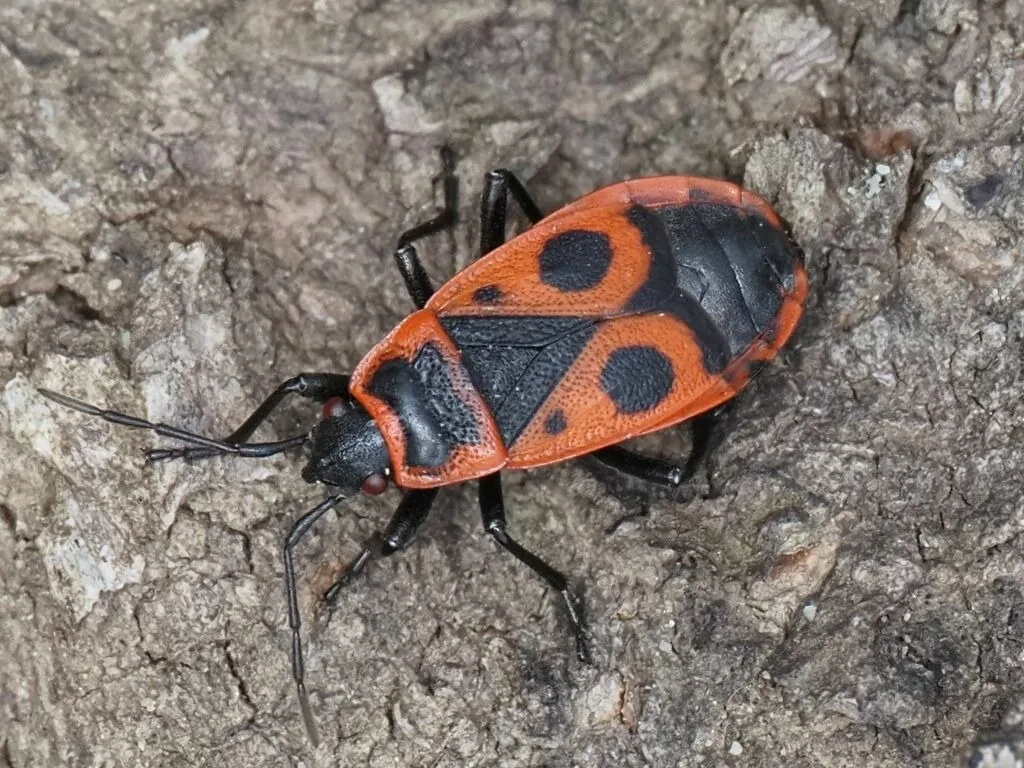
- Adults are 1/4 to 1/2 inch (6.5 to 12 mm) long, about the size of a boxelder bug; females run slightly larger.[1][2]
- The usual pattern is red with two pairs of black spots on the forewings, which lie flat on the back at rest.[1]
- Most adults have short wings that leave part of the abdomen exposed; some have no forewings and a smaller share are fully winged.[1][3][2]
- The eyes stick out so far they seem to come from the 'shoulders', and the four-segmented antennae, slightly thickened at the tip, are usually at least half as long as the body.[2][4]
- Nymphs typically show a line of three black dots down the middle of the back; older nymphs are nearly adult size but have wing pads instead of wings.[1]
Look-alikes
| Look-alike | How to tell them apart |
|---|---|
| Boxelder bugs | Young firebug nymphs are easily confused with boxelder bug nymphs. Adult firebugs stand apart with a red body marked by black spots, eyes that seem to sprout from the shoulders, and, in most, short wings.[1][4] |
| Mediterranean red bug (Scantius aegyptius) | California's pest rating notes that the firebug is somewhat similar to this other red-and-black member of its family, which is common in California.[3] |
Where it lives
Native to Europe and parts of Asia. In North America it is known from Ontario, Utah, Idaho and California: it has spread across Utah and into southern Idaho since 2008 and was found on landscape plants in San Bruno, San Mateo County, California, in November 2023, where it is considered established.[3][1]
Biology and life cycle
It feeds mostly on dry, ripe seeds, using its piercing-sucking beak. The mallow family is its most common host group, and suitable hosts in Utah landscapes include common mallow, globe mallow, checker-mallow, hollyhock, hibiscus and linden trees. It also gathers on black locust and spruce.[1]
It also eats seeds from many other plant families, feeds on fallen seeds under linden trees, and will feed on dead and living insects; cannibalism has been reported when food runs short.[3][1]
There is typically one generation a year, though some adults live up to two years. Overwintered females lay 40 to 80 eggs in their lifetime, starting in April and May; California's rating notes the eggs go into the soil.[1][3]
Eggs hatch in 10 to 14 days, and the nymphs pass through five stages in 17 to 24 days. Adults mate within a week of emerging, often staying joined from 12 hours to 7 days, but females don't lay eggs until the following year.[1]
Adults go into a resting state (diapause) for the winter once days are shorter than 12 hours.[1]
Firebugs avoid direct sun and rest in shade, often on buildings. In late fall they form large groups near plants, and that is when they are most likely to get into homes looking for a place to spend the winter.[1][3]
A Natural History Museum of Utah citizen-science project tracked its spread: by 2017 it had been reported north to Ogden, south to Provo, east of the Wasatch at Soldier Summit, and west in Tooele, Grantsville and Cedar Fort.[4]
Damage and signs
- Feeding damage to plants is minimal and does not call for control. California's 2024 pest rating judged economic harm there highly unlikely and gave it a C rating.[1][3]
- It is mainly an urban nuisance, crowding onto homes, buildings and nearby plants. Disturbed or crushed bugs release a foul odor and can bring up offensive-smelling fluid, and crushed bugs may permanently stain carpets and fabrics.[1]
- It can travel with goods: California inspectors intercepted it on firewood from Utah in 2015.[3]
Health risk
Red firebugs cannot bite or sting people or pets, and they don't eat stored food. The problems are odor and stains.[1][2][4]
Control
Keep them out
Keeping them out works best. Caulk or seal openings, foundation cracks, windows and gaps around plumbing, gas and electrical lines; weather-strip doors and windows; and keep window screens repaired.[1][2]
Sanitation
Keep a strip 1 to 2 feet wide around the outside of the house free of plants and weeds; less habitat next to the walls means fewer bugs getting in.[1]
Traps and physical control
Spray groups of firebugs with a strong stream from a garden hose; true bugs, especially nymphs, drown easily. Indoors, vacuum them up through a knee-high nylon stocking held inside the hose, then knot the stocking and throw it out, which avoids odor and stains.[1]
Pesticides
A spray of dish soap and water applied directly to the bugs can replace synthetic insecticides; it kills only the bugs it hits and leaves no residue once dry.[1][2]
Insecticides are rarely justified. The bugs tolerate them, so chemical control often fails, and as of 2023 no insecticide was registered for this insect in Utah.[1]
Common questions
- Are red firebugs dangerous or harmful to my garden?
- No. They cannot bite or sting people or pets, and they feed mainly on seeds, causing so little plant damage that control isn't warranted.[1][4]
- How did firebugs get to Utah?
- Nobody knows for sure. They were first found in southeastern Salt Lake City in 2008 and probably arrived on plant material from Europe or Asia.[1]
- Why are firebugs piling up on my house in fall?
- They gather in large groups near host plants in late fall and look for sheltered places to spend the winter, which is when they are most likely to get inside. During the day they also seek shade on walls.[1]
Sources
- Utah State University Extension, “Red Firebug (Pyrrhocoris apterus), August 2023 (K. Richardson and E. Hodgson).” extension.usu.edu/planthealth/research/red-firebug (accessed 2026-11-09)
- Utah State University Extension and Utah Plant Pest Diagnostic Laboratory, “Red fire bugs, ENT-126-08 (E. W. Hodgson, July 2008).” extension.usu.edu/planthealth/uppdl/files/factsheet/red-fire-bug08.pdf (accessed 2026-11-09)
- California Department of Food and Agriculture, “California Pest Rating Proposal: Pyrrhocoris apterus (L.), European firebug (Pest Rating C), 2024.” blogs.cdfa.ca.gov/Section3162/wp-content/uploads/2024/06/Pyrrhocoris-apterus.pdf (accessed 2026-11-09)
- Natural History Museum of Utah, University of Utah, “European Firebug Spreads in Utah (L. Thompson, October 6, 2017).” nhmu.utah.edu/blog/firebug (accessed 2026-11-09)
- iNaturalist, “Pyrrhocoris apterus taxon page (order and family).” www.inaturalist.org/taxa/55610 (accessed 2026-11-09)