The short answer
- The stink bug most people find indoors in fall is the brown marmorated stink bug: mottled brown, about 5/8 inch long, with white bands on its antennae. Missouri Department of Conservation says it moves into homes and other buildings, sometimes in large numbers, to overwinter.[2][9]
- In the garden, the usual plant feeders are the brown, green, southern green, consperse, Say and harlequin stink bugs. They feed on fruit, seeds, beans and tomatoes, and harlequin bugs feed on cabbage-family plants.[1][14][16]
- Some stink bugs are predators, including the spined soldier bug, the rough stink bugs, the twospotted stink bug and the anchor bug. NC State says predatory stink bugs have a beak at least twice as thick as their antennae, while plant-feeding stink bugs have a beak about as thin as the antennae.[1][3][17][18]
- UC IPM says insecticides are generally not recommended for stink bugs in gardens and landscapes; handpicking bugs and egg clusters and clearing weeds in early spring come first. The stink bug removal guide covers bugs in the house.[1]
Stink bug profiles
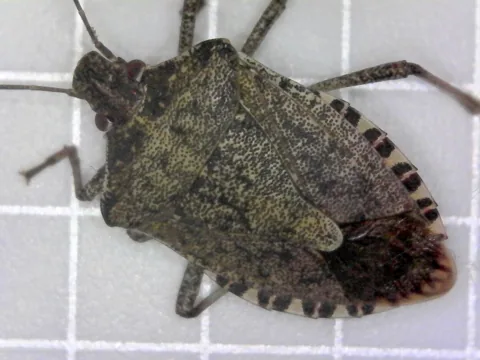 Brown Marmorated Stink Bug
Halyomorpha halys
The brown marmorated stink bug is an invasive insect from east Asia that damages fruit and vegetable crops and invades homes in fall looking for overwintering sites. Minnesota Extension says it feeds on about 200 plant species and, unlike the native stink bugs there, prefers to spend the winter in homes. Clemson notes that the bugs gather on outside walls before they move in.
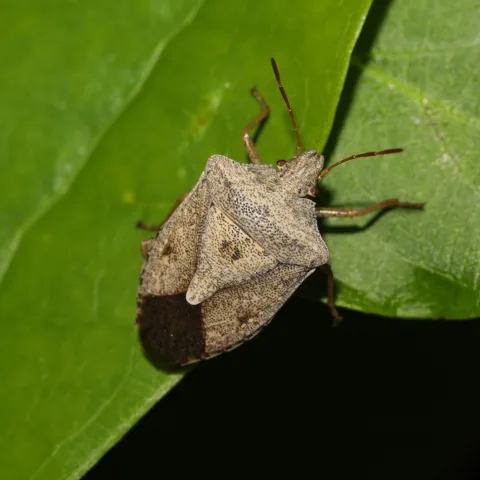 Brown Stink Bug
Euschistus servus
The brown stink bug is a native stink bug and often the first one to show up in Southern vegetable gardens, where it feeds on tomatoes, green beans and other crops. On farms it is a damaging pest of corn, cotton and soybeans, especially in the southeastern United States.
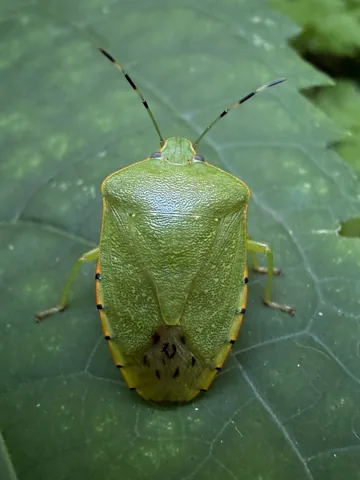 Green Stink Bugs
Chinavia hilaris (green stink bug) and Nezara viridula (southern green stink bug)
Two bright green stink bugs damage gardens and orchards in the U.S.: the green stink bug, a native of North America that feeds on a wide range of crops, and the southern green stink bug, one of the three most abundant stink bug pests in a North Florida tomato study. Both suck juices from developing fruit, seeds and shoots.
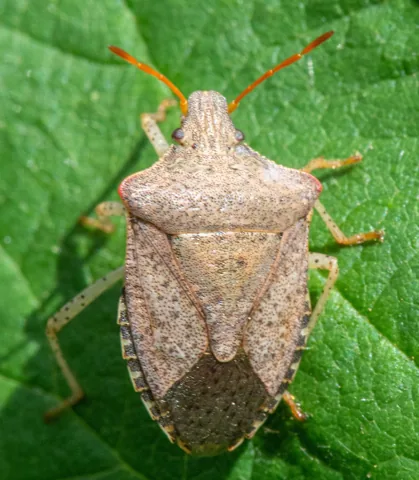 Consperse stink bug
Euschistus conspersus
The consperse stink bug is a native, shield-shaped stink bug about half an inch long that is the most common stink bug on California tomatoes and a pest of apples in the Pacific Northwest. Its feeding leaves pinprick spots on tomatoes and dimpled, corky patches on apples.
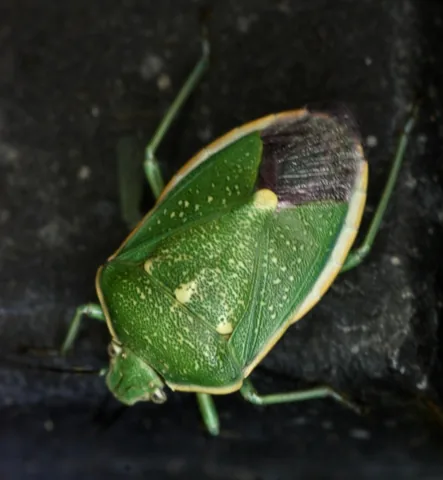 Say stink bug
Chlorochroa sayi
The Say stink bug is a California field and orchard stink bug that, together with Uhler's stink bug, is the most prevalent stink bug on the west side of California's San Joaquin Valley. Like the other stink bugs that feed on tomatoes, it punctures developing fruit and leaves pinpricks and corky spots, and it is one of the species that researchers in California's Central Valley have studied for pheromone-based monitoring.
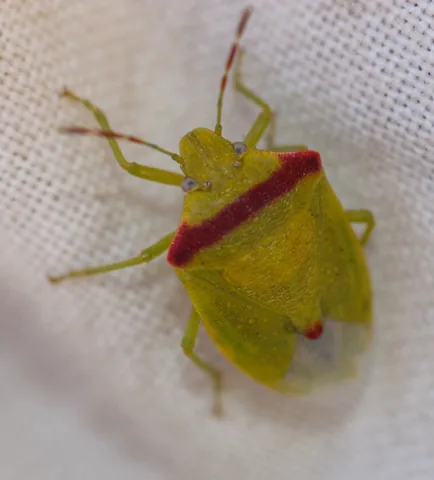 Redshouldered stink bug
Thyanta pallidovirens
The redshouldered stink bug is a native California stink bug that feeds on pistachios and tomatoes. It is the most prevalent stink bug in tomatoes in the southern San Joaquin Valley, and in pistachios its late-season feeding blackens kernels and can let fungal blights into the nuts.
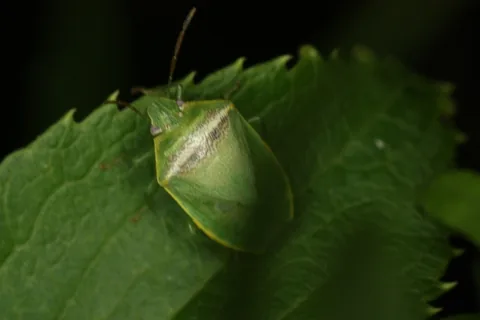 Redbanded stink bug
Piezodorus guildinii
The redbanded stink bug is a small, glossy green stink bug with a colored band across its shoulders. It came from the American tropics, is now established in the southern United States, and feeds on soybeans and other legumes. It is more mobile, more damaging per bug and harder to kill with insecticides than the stink bugs growers are used to, so it has to be recognized early.
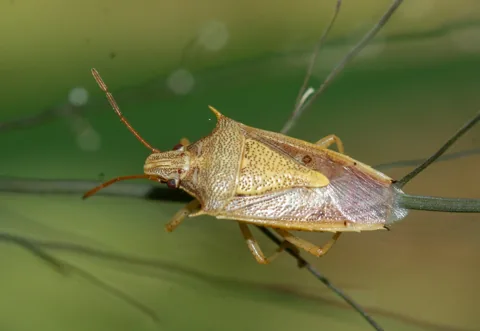 Rice stink bug
Oebalus pugnax
The rice stink bug is a narrow, yellowish-brown stink bug that feeds on developing grass seed and grain. It was first reported as a rice pest in the 1880s and is the most abundant stink bug in Florida rice, where its feeding empties heads and leaves spotted, easily broken kernels known as pecky rice.
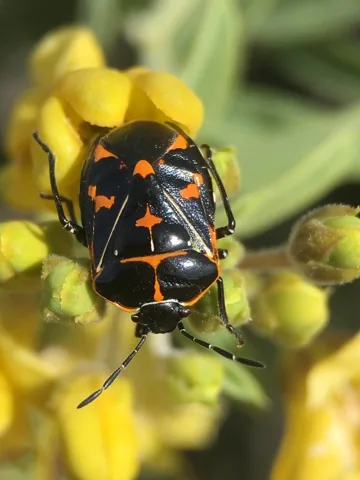 Harlequin Bug
Murgantia histrionica
The harlequin bug is a brightly colored stink bug that attacks cabbage, collards, kale, mustard and other cole crops. It sucks plant juices, and heavy infestations can wilt, brown and kill young plants or even whole fields.
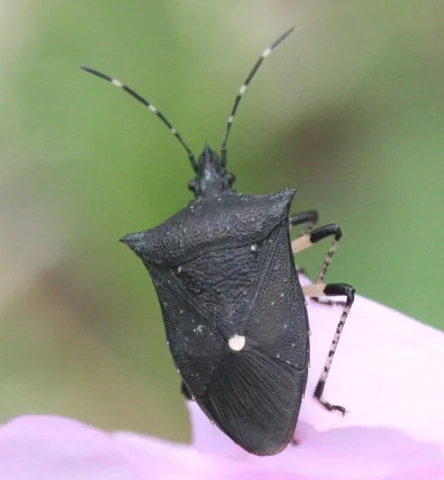 Black stink bug
Proxys punctulatus
The black stink bug is an all-black stink bug with pointed shoulders and a small yellow spot at the tip of its back. It feeds mostly on plant juices but will also attack insect larvae, and although it turns up in crop fields and along woodland edges in the South, it never becomes numerous enough to do real damage.
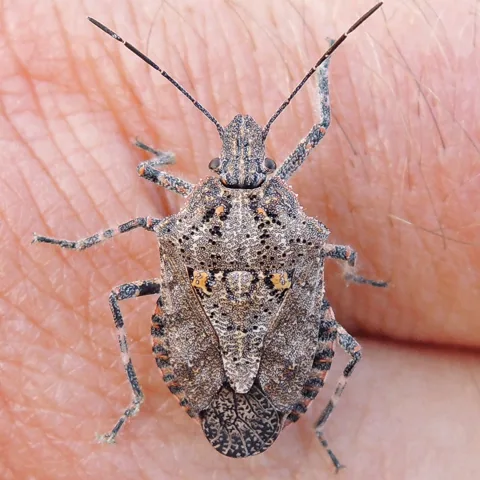 Rough Stink Bugs
Brochymena species
Rough stink bugs are commonly mistaken for the invasive brown marmorated stink bug, but they are partly predatory and aren't tied to significant plant damage.
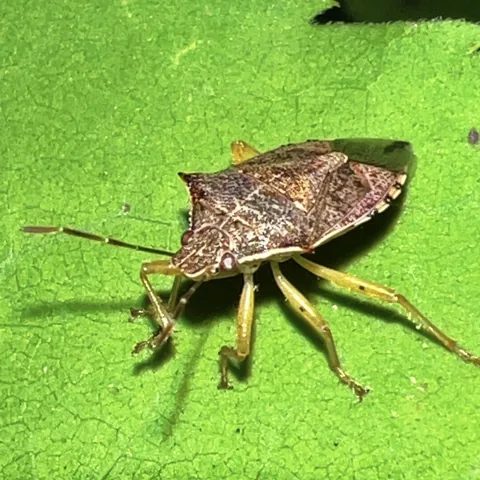 Spined Soldier Bug
Podisus maculiventris
The spined soldier bug is a predatory stink bug. It resembles the plant-feeding stink bugs gardeners fight, but it hunts caterpillars, beetle larvae and over 100 other pest species.
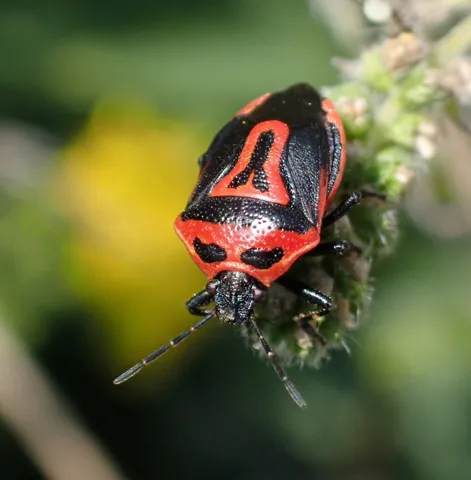 Twospotted Stink Bug
Perillus bioculatus
The twospotted stink bug is a predator, not a plant pest; a single nymph can eat 300 to 400 leaf beetle eggs as it grows.
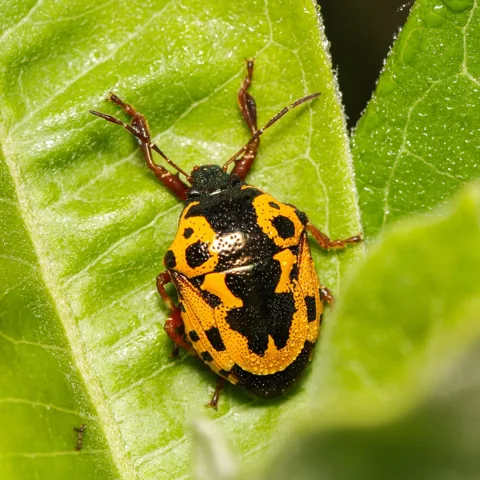 Anchor stink bug
Stiretrus anchorago
The anchor stink bug is a native predatory stink bug of eastern North America that hunts beetle larvae and caterpillars, including Mexican bean beetle and alfalfa weevil larvae. Its colors vary from metallic blue to orange or red with black, often with an anchor-shaped mark on top of the abdomen. It is easily mistaken for the harlequin bug, a pest.
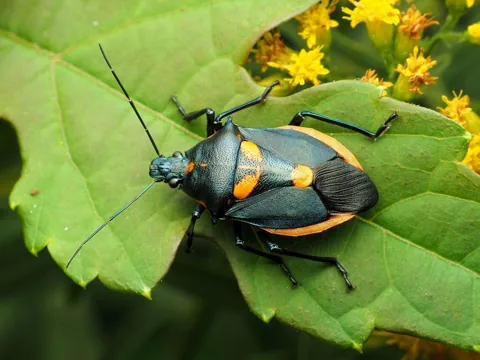 Florida Predatory Stink Bug
Euthyrhynchus floridanus
Unlike most stink bugs, the Florida predatory stink bug hunts other insects. Most of its prey are plant-damaging bugs, beetles and caterpillars, and extension entomologists count it as a beneficial insect.
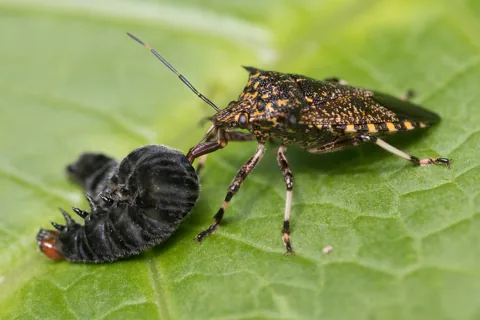 Giant Strong-Nosed Stink Bug
Alcaeorrhynchus grandis
The giant strong-nosed stink bug is a large, speckled brown predatory stink bug. It hunts other insects, especially moth caterpillars, and is generally considered beneficial.
How to recognize a stink bug
UC IPM says adult stink bugs are distinguished from other insects by a large triangle with a rounded rear end (the scutellum) on top of the back, and that they are wider for their length than most insects. Missouri Department of Conservation adds that the folded wings often form an X on the back, the antennae have 5 segments, and the bugs reach about 3/4 inch long depending on the species.[1][9]
Eggs are the easiest stage to spot on a leaf. UC IPM says stink bug eggs are barrel shaped with circular caps and are laid in a group, commonly on leaves, and that the newly hatched nymphs stay close together at first and scatter as they grow. Nymph colors often differ from the adults and change between molts, so the adult is the stage to identify.[1]
Pest or predator? The beak test
Color alone won't sort the helpful stink bugs from the harmful ones, because some predators look a lot like pests. Check the beak instead. NC State says predatory stink bugs have beaks at least twice as thick as their antennae, whereas plant-feeding stink bugs have beaks as thin as antennae.[17][18]
- How they feed: UC IPM says the spined soldier bug extends its tubular mouthparts forward in front of the body to feed on prey, while plant-feeding stink bugs point their mouthparts downward when feeding. Both kinds fold the beak backward under the body when resting.[4]
- Shoulders: UC IPM says the spined soldier bug's shoulders are sharply pointed, unlike the plant feeders it resembles. Rough stink bugs have a rough, toothed front edge on the thorax, according to UC IPM.[4][3]
- Antennae and legs: UC IPM says brown marmorated stink bugs have white bands on their antennae and one white band on the hind legs, rough stink bugs have no antenna bands and two white bands on the hind legs, and consperse stink bugs have no white bands on the legs at all.[1][3]
Brown marmorated stink bug
This is the invasive one, and the one that ends up on walls and windows in fall. Penn State says it was accidentally introduced from east Asia into eastern Pennsylvania, and Missouri Department of Conservation says it reached the United States in the 1990s.[7][8]
- Size: UC IPM gives about 5/8 inch, Penn State about 17 mm (0.66 inch), and Missouri Department of Conservation 1/2 to 3/4 inch.[2][7][8]
- Markings: UC IPM says the antennae have two white bands, the front edge of the head is blunt, the shoulder margin is smooth, the legs are marbled brown with faint white bands, and a banded edge of the abdomen shows beside the wings. The Pacific Northwest handbook adds red eyes and a coal-colored base color on the antennae and legs.[2][11]
- Eggs: Penn State describes light yellow to yellow-red eggs laid side by side on the undersides of leaves in masses of 20 to 30; UC IPM gives clusters of 20 to 28.[7][2]
- In homes: UC IPM says adults gather on the sides of buildings in fall and then move into protected places to overwinter, and that they don't bite, sting, suck blood, spread mammalian diseases or bore into wood. Missouri Department of Conservation says they emit a stinky odor when crushed, frightened or sucked into a vacuum cleaner.[2][8]
- Generations: Missouri Department of Conservation says there are probably one or two generations a year in Missouri and up to five in southern states.[8]
Brown stink bug
The brown stink bug (Euschistus servus) is a native look-alike that NC State lists among the bugs mistaken for the brown marmorated stink bug. Clemson describes adults as dull grayish-yellow and 1/2 to 5/8 inch long, and says the nymphs are light green.[15][13]
- Mississippi State Extension says brown stink bugs are often one of the first species to appear in vegetable gardens and tend to be the most common species during the first half of the season, and that they can be especially problematic on tomatoes and green beans early on.[14]
- Mississippi State says stink bug numbers can climb late in the season as bugs breed in the garden and move in from maturing farm crops, and that heavy damage to peas, beans, okra and tomatoes can follow.[14]
Green, southern green and Say stink bugs
Three bright green stink bugs turn up in gardens, and two of them are hard to tell apart without a close look.[10][1]
- Green stink bug (Chinavia hilaris): Kansas State gives a light green adult 1/2 to 3/4 inch (13 to 19 mm) long; Clemson gives 9/16 to 3/4 inch with a narrow orange-yellow line bordering the body regions. Kansas State says eggs are laid in clusters of 30 to 40, that the young nymphs have a black abdomen with white stripes, and that there is one generation a year in Kansas. Missouri Department of Conservation says green stink bugs are some of the first insects active in early spring.[12][13][10]
- Southern green stink bug (Nezara viridula): UC IPM describes bright green adults about 1/2 inch long, with pale yellow early nymphs and green later ones. To separate it from the green stink bug, Missouri Department of Conservation says to look for a small black dot in each lower corner of the scutellum, mostly reddish outer antenna segments, and an all-green abdominal edge without the dark dots and yellow of the green stink bug.[1][10]
- Say stink bug (Chlorochroa sayi): UC IPM says adults and nymphs are bluish green with a paler green or whitish margin on the abdomen and thorax, and adults are 2/5 to 2/3 inch long.[1][5]
Consperse stink bug
The consperse stink bug (Euschistus conspersus) is a native stink bug. UC IPM's tomato guidelines call it the most common stink bug on tomatoes statewide in California, and the Pacific Northwest handbook lists it as a native pest of apples.[6][11]
- Looks: UC IPM gives about 1/2 inch, grayish brown to green, with grayish legs speckled black. The Pacific Northwest handbook describes the adult as pale brown, yellow underneath, with red antennae.[1][11]
- Telling it from the brown marmorated stink bug: UC IPM says it has banded abdomen edges like the invasive species but no bands on its antennae, legs with distinct dark spots rather than white bands, and is a little smaller at about 1/2 inch.[2]
Harlequin bug
Harlequin bugs (Murgantia histrionica) are the gaudy black-and-red or black-and-yellow stink bugs on cabbage-family crops and mustards. NC State says they attack nearly all crucifers, including wild mustard and other weeds of the family, and turn to squash, corn, beans, okra and tomatoes when infestations are heavy.[16][5]
- Size: UC IPM's harlequin page gives 3/8 inch, its stink bug page says 1/3 inch or longer, and NC State gives 1/4 to 3/8 inch.[5][1][16]
- Eggs: NC State says they are pale with two black bands and usually laid in double rows of 10 to 13 on mustard-family leaves; UC IPM describes them as grayish yellow with two black bands.[16][1]
- Damage: UC IPM says feeding leaves yellow or white blotches on leaves, and heavy infestations can make plants wilt, turn brown and die. NC State says young plants may die while older plants are only stunted, and that North Carolina has two to four generations a year.[5][16]
- Look-alikes: UC IPM says the invasive Bagrada bug is smaller, about 1/4 inch, and has white markings that the harlequin bug lacks. NC State says the anchor bug, a predator, is easily confused with harlequin bugs; it has a mark on the back shaped like a ship's anchor and a thick beak.[1][18]
Rough stink bugs
Rough stink bugs (Brochymena species) are mottled gray and black and blend into tree bark. UC IPM says the brown marmorated stink bug is commonly mistaken for them, and Colorado State says they are most often noticed when they come into homes in fall for shelter or are carried in on firewood.[2][19]
- Size: UC IPM gives 7/16 to 3/4 inch (11 to 18 mm); Colorado State gives 13 to 22 mm.[3][19]
- How to tell them from the brown marmorated stink bug: UC IPM says rough stink bugs have two white bands on the hind legs, no bands on the antennae, points on the face, and a rough or toothed edge on the shoulders.[3][2]
- Diet: the sources lean different ways. UC IPM lists them as predators of caterpillars, leaf beetle and sawfly larvae and other soft-bodied insects that also feed harmlessly on leaves and seeds. Colorado State says they feed mainly on the leaves and developing seeds of trees without causing significant injury, and are only occasional predators of caterpillars and leaf beetle larvae. Either way, they aren't a pest worth controlling.[3][19]
- Life cycle: Colorado State says females lay pearly white eggs in masses of 10 to 20 and there is one generation a year in Colorado. UC IPM says adults overwinter in protected places such as inside buildings and under loose bark where winters are cold.[19][3]
Spined soldier bug and other predatory stink bugs
The spined soldier bug (Podisus maculiventris) is the predatory stink bug gardeners are most likely to meet. UC IPM says it has been recorded feeding on over 100 species of pest insects, mainly caterpillars and soft-bodied larvae of beetles and sawflies, and NC State says it can subdue prey many times its own size.[4][17]
- Looks: UC IPM describes adults as pale brown to grayish or tan, about 2/5 inch (10 mm) long, with sharply pointed shoulders and a dark line on the membranous tip of each forewing. NC State says the spines point straight out from the body and that the abdomen edges have alternating orange and black markings.[4][17]
- Nymphs: UC IPM says first, second and fourth instars are oval to round with a black head and thorax and a mostly red abdomen.[4]
- Life cycle: UC IPM says egg to adult takes about a month in the growing season, there are several generations a year, and each mated female can lay several hundred eggs if prey is abundant. NC State says it is native throughout eastern North America and is sold commercially.[4][17]
- Other predators: UC IPM names the twospotted stink bug (Perillus bioculatus) as another common predatory stink bug. NC State describes the anchor bug (Stiretrus anchorago) as a native generalist predator in eastern North America that is somewhat uncommon and not sold commercially.[4][18]
- Keeping them around: UC IPM suggests controlling ants, growing flowering plants that feed adult natural enemies, and avoiding broad-spectrum, persistent insecticides, which are toxic to natural enemies.[4][3]
What to do about the pest species
Damage often shows up after the bugs are gone. UC IPM says feeding leaves dark pinpricks and blemishes on fruit, and tissue under the spots turns pithy and white or brown and stays firm as the fruit ripens. It adds that lygus bugs and other true bugs cause nearly the same damage, so you can't be sure stink bugs caused it unless you saw them feeding.[1]
- Handpick and clear weeds: UC IPM says to handpick bugs and eggs from small plants and remove weeds and groundcovers in early spring, and for harlequin bugs to destroy old cabbage-family plants and mustards. Kansas State suggests dropping handpicked bugs into soapy water. Mississippi State says diligent handpicking before adults lay eggs can delay heavy buildup in small gardens.[1][5][12][14]
- Insecticides: the sources differ. UC IPM says they are generally not recommended in gardens and landscapes, partly because damage often isn't visible until the bugs have left. Clemson lists contact insecticides such as bifenthrin and permethrin as effective on stink bugs on tomatoes, and Mississippi State calls pyrethroids the most effective home-garden treatment while noting pyrethroids work somewhat less well on brown stink bugs than on green species. Follow the label and its pre-harvest interval.[1][13][14]
- Natural enemies: UC IPM says parasites and general predators help control some stink bug species if they aren't killed off by broad-spectrum insecticides. Kansas State says that in grapes, lacewings, spiders and egg parasitoids don't kill enough green stink bugs to prevent damage on their own.[1][12]
- Indoors: the brown marmorated stink bug and the rough stink bugs come inside to overwinter. Sealing, vacuuming and what does and doesn't work are in the stink bug removal guide.[2][19]
Bugs mistaken for stink bugs
Kissing bugs are the look-alike that matters for health. Texas A&M says adults are about 1/2 to 1 inch long, most have a band around the edge of the body striped with orange or red, and they feed on blood, mostly at night. CDC says Chagas disease usually spreads through contact with triatomine (kissing) bugs. If a shield-shaped bug turns up in a bed or near pets, see the kissing bug guide before handling it.[20][21]
Clemson's tomato pest page covers leaf-footed bugs alongside stink bugs and describes them as about 13/16 inch long, with dark brown bodies and flattened, leaf-like hind legs. Boxelder bugs and other fall invaders are covered in their own guides.[13]
Common questions
- Which stink bugs are beneficial?
- The predatory ones: the spined soldier bug, the twospotted stink bug, the anchor bug and the rough stink bugs. NC State says predatory stink bugs have beaks at least twice as thick as their antennae. UC IPM says spined soldier bugs feed mainly on caterpillars and the larvae of beetles and sawflies.[17][4][1]
- How do I tell a brown marmorated stink bug from a native brown stink bug?
- Look at the antennae. UC IPM says the brown marmorated stink bug has two white bands on each antenna and a banded abdomen edge. The native brown stink bug, which Clemson describes as dull grayish-yellow and 1/2 to 5/8 inch long, lacks the white antenna bands.[2][13]
- Do stink bugs bite people?
- UC IPM says brown marmorated stink bugs don't bite, sting or suck blood, and Missouri Department of Conservation says they don't bite humans or animals. Predatory stink bugs feed on insects. Kissing bugs, which do bite, are a different family; Texas A&M describes them as about 1/2 to 1 inch long with orange or red stripes around the body edge.[2][8][20]
- Why do stink bugs smell?
- Missouri Department of Conservation says most stink bugs release a foul odor when harassed or crushed as a defense against predators. Penn State says the smell comes from scent glands on the top of the abdomen and the underside of the thorax.[9][7]
Photo credits
- Brown Marmorated Stink Bug: (c) Stan Rullman, some rights reserved (CC BY) — via iNaturalist, CC BY 4.0
- Brown Stink Bug: (c) Adrienne van den Beemt, some rights reserved (CC BY) — via iNaturalist, CC BY 4.0
- Green Stink Bugs: (c) Marc-Olivier Beausoleil, some rights reserved (CC BY) — via iNaturalist, CC BY 4.0
- Consperse stink bug: (c) Don Loarie, some rights reserved (CC BY) — via iNaturalist, CC BY 4.0
- Say stink bug: (c) Andrew Meeds, some rights reserved (CC BY) — via iNaturalist, CC BY 4.0
- Redshouldered stink bug: (c) Andrew Meeds, some rights reserved (CC BY) — via iNaturalist, CC BY 4.0
- Redbanded stink bug: (c) Andrew Meeds, some rights reserved (CC BY) — via iNaturalist, CC BY 4.0
- Rice stink bug: (c) Andrew Meeds, some rights reserved (CC BY) — via iNaturalist, CC BY 4.0
- Harlequin Bug: (c) Matt Berger, some rights reserved (CC BY) — via iNaturalist, CC BY 4.0
- Black stink bug: Scott Loarie, public domain (CC0), via iNaturalist
- Rough Stink Bugs: (c) Bill Keim, some rights reserved (CC BY) — via iNaturalist, CC BY 4.0
- Spined Soldier Bug: (c) Healthy Yards, some rights reserved (CC BY) — via iNaturalist, CC BY 4.0
- Twospotted Stink Bug: (c) Jan Ebr & Ivana Ebrová, some rights reserved (CC BY) — via iNaturalist, CC BY 4.0
- Anchor stink bug: (c) Adrienne van den Beemt, some rights reserved (CC BY) — via iNaturalist, CC BY 4.0
- Florida Predatory Stink Bug: (c) Katja Schulz, some rights reserved (CC BY) — via iNaturalist, CC BY 4.0
- Giant Strong-Nosed Stink Bug: Frank Thomas Sautter, public domain (CC0), via iNaturalist
Sources
- UC Statewide Integrated Pest Management Program, “Stink Bugs (Home and Landscape).” ipm.ucanr.edu/home-and-landscape/stink-bugs/ (accessed 2026-11-10)
- UC Statewide Integrated Pest Management Program, “Pest Notes: Brown Marmorated Stink Bug.” ipm.ucanr.edu/home-and-landscape/brown-marmorated-stink-bug/ (accessed 2026-11-10)
- UC Statewide Integrated Pest Management Program, “Rough Stink Bugs (Natural Enemies Gallery).” ipm.ucanr.edu/natural-enemies/rough-stink-bugs/ (accessed 2026-11-10)
- UC Statewide Integrated Pest Management Program, “Spined Soldier Bug (Natural Enemies Gallery).” ipm.ucanr.edu/natural-enemies/spined-soldier-bug/ (accessed 2026-11-10)
- UC Statewide Integrated Pest Management Program, “Harlequin Bug.” ipm.ucanr.edu/home-and-landscape/harlequin-bug/ (accessed 2026-11-10)
- UC Statewide Integrated Pest Management Program, “Tomato Pest Management Guidelines: Stink Bugs.” ipm.ucanr.edu/agriculture/tomato/stink-bugs/ (accessed 2026-11-10)
- Penn State Extension, “Brown Marmorated Stink Bug.” extension.psu.edu/brown-marmorated-stink-bug (accessed 2026-11-10)
- Missouri Department of Conservation, “Brown Marmorated Stink Bug (Field Guide).” mdc.mo.gov/discover-nature/field-guide/brown-marmorated-stink-bug (accessed 2026-11-10)
- Missouri Department of Conservation, “Stink Bugs (Field Guide).” mdc.mo.gov/discover-nature/field-guide/stink-bugs (accessed 2026-11-10)
- Missouri Department of Conservation, “Green Stink Bug (Field Guide).” mdc.mo.gov/discover-nature/field-guide/green-stink-bug (accessed 2026-11-10)
- Pacific Northwest Pest Management Handbooks, “Apple: Stink bug.” pnwhandbooks.org/insect/tree-fruit/apple/apple-stink-bug (accessed 2026-11-10)
- K-State Research and Extension, “Green Stink Bug: Insect Pest of Grapes, MF3606 (R. Cloyd, 2022).” bookstore.ksre.ksu.edu/pubs/MF3606.pdf (accessed 2026-11-10)
- Clemson Cooperative Extension Home & Garden Information Center, “Tomato Insect Pests (HGIC).” hgic.clemson.edu/factsheet/tomato-insect-pests/ (accessed 2026-11-10)
- Mississippi State University Extension Service, “Brown Stink Bug, Bug's Eye View Vol. 5 No. 11.” extension.msstate.edu/newsletters/bugs-eye-view/2019/brown-stink-bug-vol-5-no-11 (accessed 2026-11-10)
- NC State Extension, Department of Entomology, “FAQs: Brown Marmorated Stink Bug.” entomology.ces.ncsu.edu/faqs-brown-marmorated-stink-bug (accessed 2026-11-10)
- NC State Extension, “Harlequin Bug (PDIC factsheet).” content.ces.ncsu.edu/harlequin-bug (accessed 2026-11-10)
- NC State Extension, Biological Control Information Center, “Spined Soldier Bug.” entomology.ces.ncsu.edu/biological-control-information-center/beneficial-predators/spined-soldier-bug/ (accessed 2026-11-10)
- NC State Extension, Biological Control Information Center, “Anchor Bug.” entomology.ces.ncsu.edu/biological-control-information-center/beneficial-predators/anchor-bug/ (accessed 2026-11-10)
- Colorado State University Extension, “Rough Stink Bugs (Colorado Insect of Interest).” webdoc.agsci.colostate.edu/bspm/Hexapoda%20(Insects)/Rough%20Stink%20Bugs.pdf (accessed 2026-11-10)
- Texas A&M University Kissing Bug Community Science Program, “Frequently Asked Questions.” kissingbug.tamu.edu/faq/ (accessed 2026-11-10)
- Centers for Disease Control and Prevention, “About Chagas Disease.” www.cdc.gov/chagas/about/index.html (accessed 2026-11-10)