On this page
How to identify it
- Adults are about 7 to 9 mm long (roughly 1/3 inch); females are a little larger than males.[1]
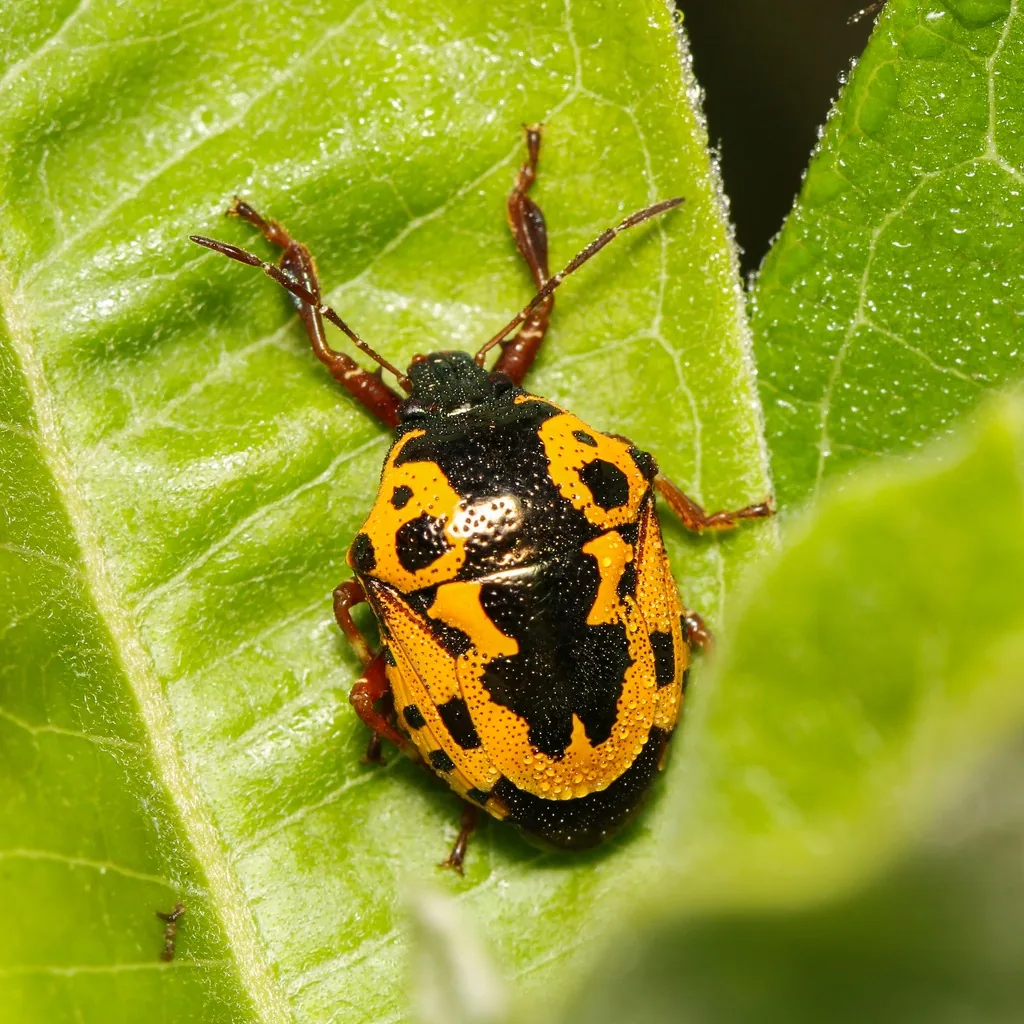
- Color is highly variable and unrelated to sex: some are solid iridescent blue, green or purple, while others are yellow, orange or red with black markings, or cream in a northern form once called Stiretrus fimbriatus.[1][2]
- Adults have a marking on top of the abdomen that looks like a ship's anchor, and the two spots on the thorax are set wide apart by a large black area.[2]
- The shoulders are rounded rather than spined, and the scutellum, the shield on the back, is enlarged, long and broadly oval.[2][1]
- Like other predatory stink bugs, it has a beak at least twice as thick as its antennae.[2]
- Nymphs are round and wingless, purple-black to blackish blue with orange legs; older nymphs may show red on the thorax.[2][1]
Look-alikes
| Look-alike | How to tell them apart |
|---|---|
| Harlequin bug | The harlequin bug is a plant-feeding pest with similar coloring; the anchor stink bug's thick predator's beak, at least twice the width of its antennae, and its anchor mark set it apart.[2] |
| Twospotted stink bug (Perillus) | In Perillus the two spots on the thorax are not split apart by a large black marking the way they are on the anchor stink bug.[2] |
| Spined soldier bug (Podisus) | The spined soldier bug has spines on its shoulders; the anchor stink bug's shoulders are rounded.[2] |
Where it lives
Native throughout eastern North America. In Florida it has been collected in every month, though it is commoner in the warmer months.[2][1]
Biology and life cycle
It is a generalist predator. It swings its beak forward, stabs the prey, injects digestive enzymes that soon immobilize it, and then sucks up the digested contents.[2]
Prey includes larvae of the Mexican bean beetle and alfalfa weevil and at least one caterpillar species; in the lab it has been raised on Mexican bean beetle larvae, cabbage loopers and soybean loopers.[1]
It turns up on soybeans, pole beans, potatoes, peanuts, alfalfa, corn and other row and truck crops where beetle larvae and caterpillars are plentiful.[1]
Blackish eggs about 1 mm across are laid in two rows of a few to nearly 30. At 26 to 27 degrees C (about 80 degrees F), development from egg to adult took 25 to 35 days, with the egg stage lasting six to seven days.[1]
Newly hatched nymphs are red but soon turn black and look like tiny black beetles; they don't feed but need water. Nymphs begin hunting in the second stage and may occasionally feed on plant tissue.[1]
Damage and signs
Health risk
UF/IFAS and NC State describe it only as a predator of plant-feeding insects and mention no risk to people.[1][2]
Control
Prevention
No control is needed. It is a native natural enemy of plant-feeding insects such as Mexican bean beetle and alfalfa weevil larvae.[2][1]
Before treating harlequin bugs, check the beak: a beak at least twice as thick as the antennae marks a predatory stink bug like this one.[2]
Biological control
It is not sold commercially, and because it is somewhat uncommon, NC State expects it contributes less to pest control than more abundant predators such as the spined soldier bug.[2]
Common questions
- Is the anchor stink bug a garden pest?
- No. It is a predatory stink bug that hunts beetle larvae and caterpillars; nymphs may only occasionally feed on plant tissue.[1][2]
- How do I tell an anchor stink bug from a harlequin bug?
- Look for the thick beak, at least twice as wide as the antennae, and the anchor-shaped mark on top of the abdomen. Harlequin bugs are plant feeders with similar colors.[2]
- Can I buy anchor stink bugs for pest control?
- No. NC State notes they are not sold commercially.[2]
Sources
- University of Florida IFAS Extension (Featured Creatures), “Predatory Stink Bug, Stiretrus anchorago (Fabricius), EENY-230/IN386 (D. B. Richman and F. W. Mead, 2001; archival copy).” journals.flvc.org/edis/article/view/108572 (accessed 2026-11-09)
- NC State Extension, “Anchor Bug (Biological Control Information Center, D. Orr, 2018).” entomology.ces.ncsu.edu/biological-control-information-center/beneficial-predators/anchor-bug/ (accessed 2026-11-09)
- iNaturalist, “Stiretrus anchorago taxon page (order and family).” www.inaturalist.org/taxa/261458 (accessed 2026-11-09)