How to identify it
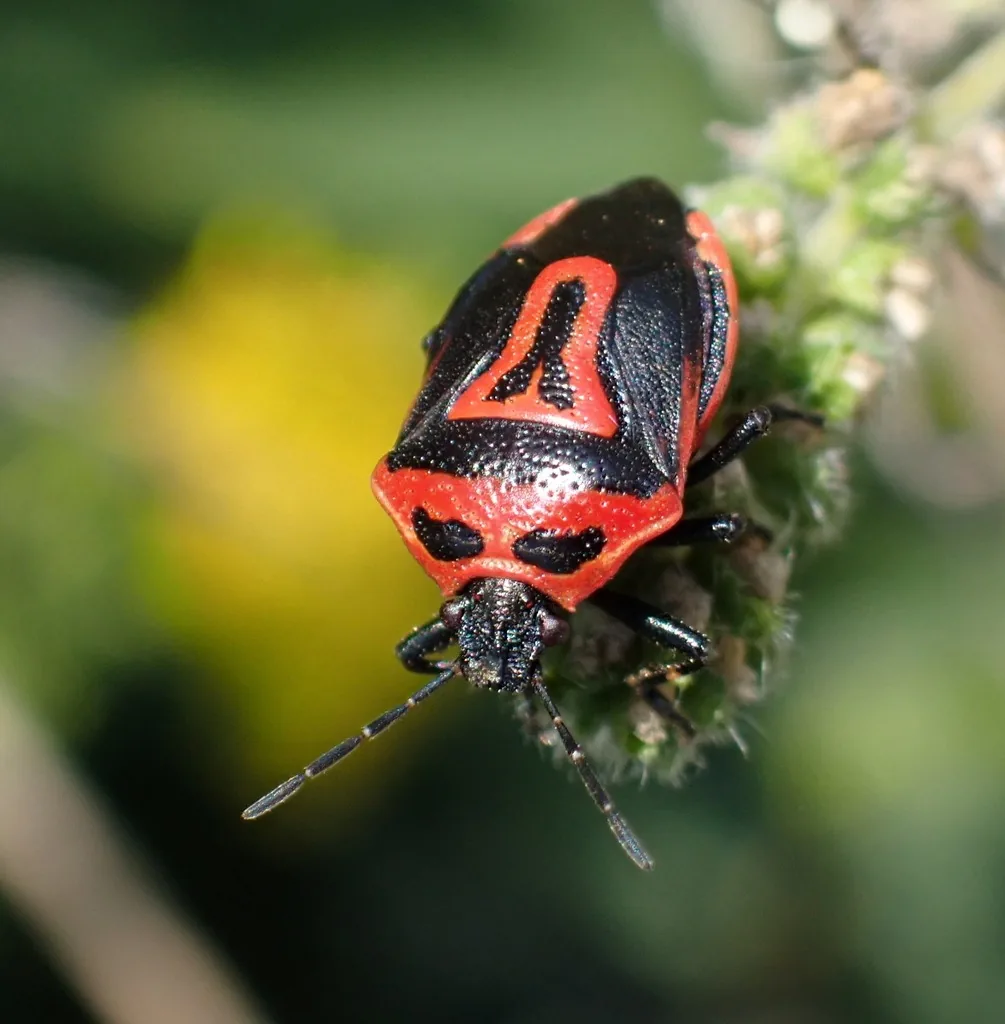
- Adults are shield shaped, about 2/5 inch long and black with a contrasting color, usually red-orange, pale green, white or yellowish.[1]
- Two black marks on the segment just behind the head give the species its name.[1]
- Eggs are barrel shaped, green turning blackish, with a ring of short spines around the top.[1]
- Older nymphs are black with white and orange, red or yellow; the youngest have a black head and thorax and a mostly red abdomen.[1]
Look-alikes
| Look-alike | How to tell them apart |
|---|---|
| Spined soldier bug | Its eggs have longer spines around the rim, and its first nymphs look much like those of the twospotted stink bug.[1] |
| Plant-feeding stink bugs | Predatory stink bugs hold the beak forward to feed; plant feeders point it downward.[1] |
Where it lives
Adults and nymphs turn up in almost any crop and in gardens, landscapes and wildlands.[1]
Biology and life cycle
A female lays about 200 eggs, which hatch in about a week.[1]
The first nymphs stay by their egg shells and suck plant juices; later nymphs hunt.[1]
Egg to adult takes about a month, with several generations a year in California; adults overwinter in bark crevices or ground litter where winters are cold.[1]
Damage and signs
Health risk
UC IPM describes it only as a predator of insect pests and gives no indication of any risk to people.[1]
Control
Prevention
Skip persistent, broad-spectrum insecticides, which are toxic to predators like this one.[1]
Biological control
Leave it be: several may feed together on one prey, and it attacks leaf beetle eggs and larvae.[1]
Grow flowering plants for adults and control ants, which attack natural enemies.[1]
Common questions
Sources
- University of California Statewide IPM Program, “Twospotted Stink Bug (Natural Enemies Gallery).” ipm.ucanr.edu/natural-enemies/twospotted-stink-bug/ (accessed 2026-10-06)
- iNaturalist, “Perillus bioculatus taxon page (order and family).” www.inaturalist.org/taxa/143548 (accessed 2026-10-06)