On this page
How to identify it
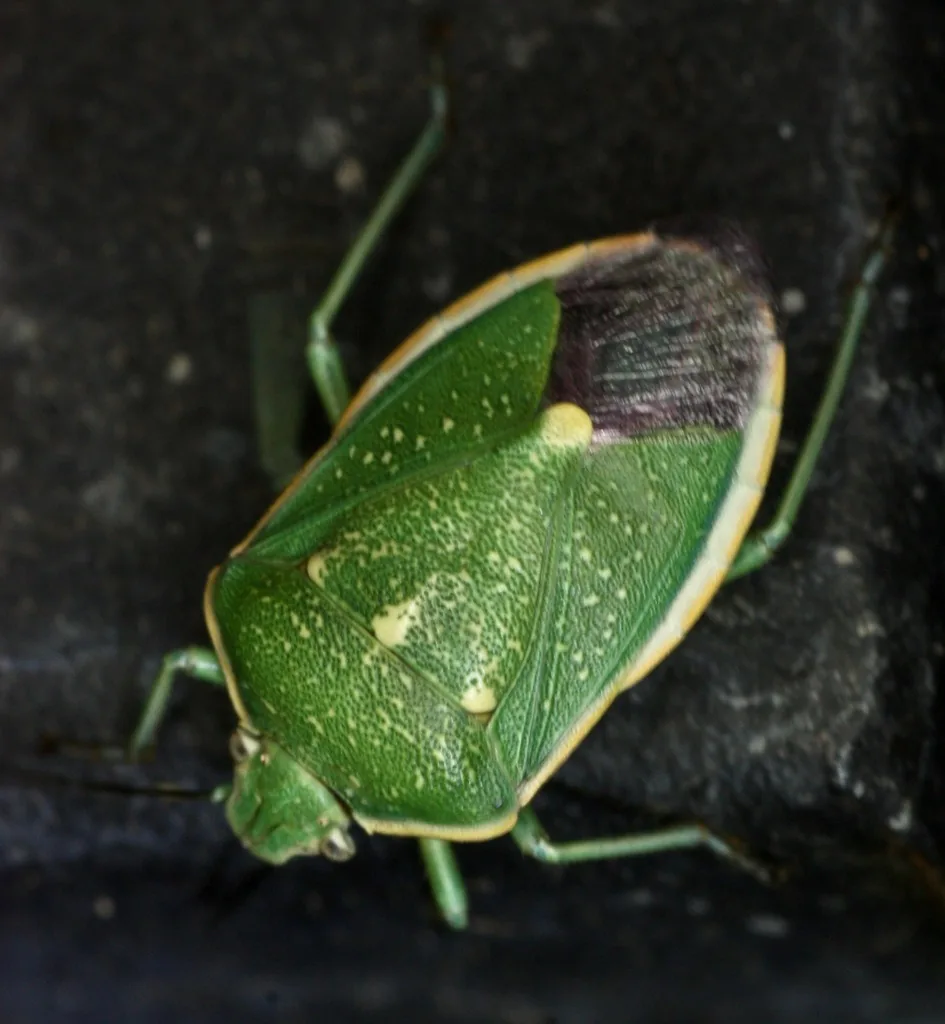
- Adults and nymphs are bluish green with a paler green or whitish margin running around the edge of the thorax and abdomen. Adults are 2/5 to 2/3 inch long.[1]
- Like other stink bugs it is shield shaped and wide for its length, with a large triangle (the scutellum) on its back covering the rear of the thorax and front of the abdomen.[1][2]
- Eggs are barrel or drum shaped with circular caps and are laid in clusters on foliage or ground litter. Nymphs are nearly round at first and go through five instars, developing wing pads before the adult emerges.[1][2]
- UC lists it as one of two Chlorochroa species that look much like the green stink bug (Chinavia hilaris), so check the pale edging and bluish cast.[3][1]
Look-alikes
| Look-alike | How to tell them apart |
|---|---|
| Green stink bug (Chinavia hilaris) | Dull to bright green, 2/5 to 3/5 inch, with the whole side margin lined in yellow or orange. UC names Say stink bug and Uhler's stink bug as the two species similar to it; Say stink bug is bluish green with a paler green or whitish border.[3][1] |
| Uhler's stink bug (Chlorochroa uhleri) | The other Chlorochroa species that shares the west side of the San Joaquin Valley with Say stink bug and resembles the green stink bug. Both are attracted to their own male-produced pheromones, and mixing the two species' pheromones in one trap lowers catches.[2][3][5] |
| Consperse stink bug | Grayish brown to green with black-speckled gray legs and about 1/2 inch long; the most common stink bug on California tomatoes statewide. A commercial pheromone trap exists for it but not for Say stink bug.[1][2] |
| Redshouldered stink bug | Predominantly green, somewhat triangular and about 1/3 inch long, usually with a narrow red band across the shoulders; it is the prevalent species in the southern San Joaquin Valley.[3][2] |
Where it lives
In California it and Uhler's stink bug are the most prevalent stink bugs on the west side of the San Joaquin Valley, and it has been collected in pistachios and adjacent vegetation in the Central Valley.[2][6]
Biology and life cycle
Stink bugs overwinter as adults on the ground in litter, in protected spots such as orchard woodpiles, in legume crops, in blackberries or on weeds such as Russian thistle, mustards and little mallow. They become active in March and April and begin laying eggs; infestations often start when adults fly in from weedy areas along creeks and sloughs.[2][1]
Eggs are laid in clusters on foliage. Nymphs stay close together at first, then scatter as they grow through five instars. Wet springs with late weed growth tend to produce more stink bugs and wider damage.[1]
In laboratory studies, adults took about ten days to mature sexually. Males produce a three-component sex pheromone, detected 9 to 12 days after the final molt, that attracts females; most matings begin in late afternoon or evening when pheromone output peaks, copulations last about 40 minutes, and both sexes mate repeatedly.[4]
Say stink bug occurs alongside Uhler's stink bug and the consperse stink bug in the same fields. Its pheromone components were tested as trap lures in California field trials.[5]
Damage and signs
- Stink bugs feed through straw-like mouthparts on fruits, nuts and vegetables, from beans and tomatoes to apples and stone fruit. Feeding leaves blemishes, dark pinpricks and discoloration; the tissue beneath turns pithy and white or brown and stays firm as the fruit ripens, and fruit fed on early can grow distorted.[1]
- On green tomatoes the damage shows as dark pinpricks surrounded by a light area that stays light green or turns yellow on ripe fruit, with corky fissures below the surface. Stink bugs can also carry yeasts and other pathogens that cause fruit decay.[2][1]
- Established woody plants are not seriously harmed apart from their fruit and nuts. Because lygus bugs cause virtually the same injury, the culprit cannot be confirmed unless the bugs are seen feeding.[1]
Health risk
The sources treat the Say stink bug only as a crop pest and mention no bites or other risk to people or pets.[1][2]
Control
Prevention
Pheromone traps are commercially available only for the consperse stink bug, not for Say stink bug, so monitoring for this species relies on shake sampling.[2]
Sanitation
Remove weeds that shelter overwintering adults, such as legumes, blackberries, Russian thistle, mustards and little mallow, around fields to be planted to tomatoes, and clear groundcovers and weeds in gardens in early spring before stink bugs build up and move to crops.[2][1]
Traps and physical control
On small plants, handpick the bugs and their egg clusters. In fields, check for stink bugs by shaking plants over a tray and looking on the ground and between soil clods; brown liquid frass that dries into small spots on leaves and fruit also gives them away.[1][2]
Biological control
Predators and parasitic wasps attack stink bug egg masses, and a large complex of native parasites attacks the native species, sometimes exceeding 80 percent parasitism late in the season. Parasitized eggs turn dark; flowering plants such as alyssum near the crop can raise parasitism over short distances. Avoid persistent broad-spectrum insecticides that destroy these natural enemies.[2][1]
Pesticides
UC does not generally recommend insecticides for stink bugs in gardens and landscapes, since damage usually shows after the bugs have gone. In commercial tomatoes the threshold is roughly one-third to one-half bug per tray shake, and sprays need good canopy penetration from ground equipment because most bugs sit low or on the soil. Kaolin clay and insecticidal soap are acceptable in organic production.[1][2]
Common questions
- How do I tell Say stink bug from the green stink bug?
- Say stink bug is bluish green with a paler green or whitish border around the body, while the green stink bug is dull to bright green with its side margin lined in yellow or orange.[1][3]
- Where in California is Say stink bug the main stink bug?
- UC IPM says it and Uhler's stink bug are the most prevalent species on the west side of the San Joaquin Valley; consperse stink bug dominates statewide and redshouldered stink bug in the southern valley.[2]
- Is there a trap for it?
- Researchers identified its male-produced pheromone and tested lures in the field, but UC notes that pheromone traps are only commercially available for the consperse stink bug.[4][5][2]
Sources
- University of California Statewide IPM Program, “Pest Notes: Stink Bugs (UC IPM Home and Landscape).” ipm.ucanr.edu/home-and-landscape/stink-bugs/ (accessed 2026-11-10)
- University of California Statewide IPM Program, “Stink Bugs (Tomato Pest Management Guidelines).” ipm.ucanr.edu/agriculture/tomato/stink-bugs/ (accessed 2026-11-10)
- University of California Statewide IPM Program, “Stink Bugs (Pistachio Pest Management Guidelines).” ipm.ucanr.edu/agriculture/pistachio/stink-bugs/ (accessed 2026-11-10)
- Springer (Journal of Chemical Ecology), “Identification and synthesis of a male-produced sex pheromone from the stink bug Chlorochroa sayi (Ho and Millar 2001, Journal of Chemical Ecology 27:1177-1201).” doi.org/10.1023/a:1010368013235 (accessed 2026-11-10)
- Entomological Society of America (Journal of Economic Entomology), “Field trials of aggregation pheromones for the stink bugs Chlorochroa uhleri and Chlorochroa sayi (Millar, McBrien and McElfresh 2010, Journal of Economic Entomology 103:1603-1612).” doi.org/10.1603/ec10095 (accessed 2026-11-10)
- Entomological Society of America (Journal of Economic Entomology), “Assessing genetic diversity in four stink bug species, Chinavia hilaris, Chlorochroa uhleri, Chlorochroa sayi, and Thyanta pallidovirens, using DNA barcodes (Barman et al. 2017, Journal of Economic Entomology 110:2590-2598).” doi.org/10.1093/jee/tox227 (accessed 2026-11-10)
- iNaturalist, “Chlorochroa sayi taxon page (order and family).” www.inaturalist.org/taxa/84093 (accessed 2026-11-10)