On this page
How to identify it
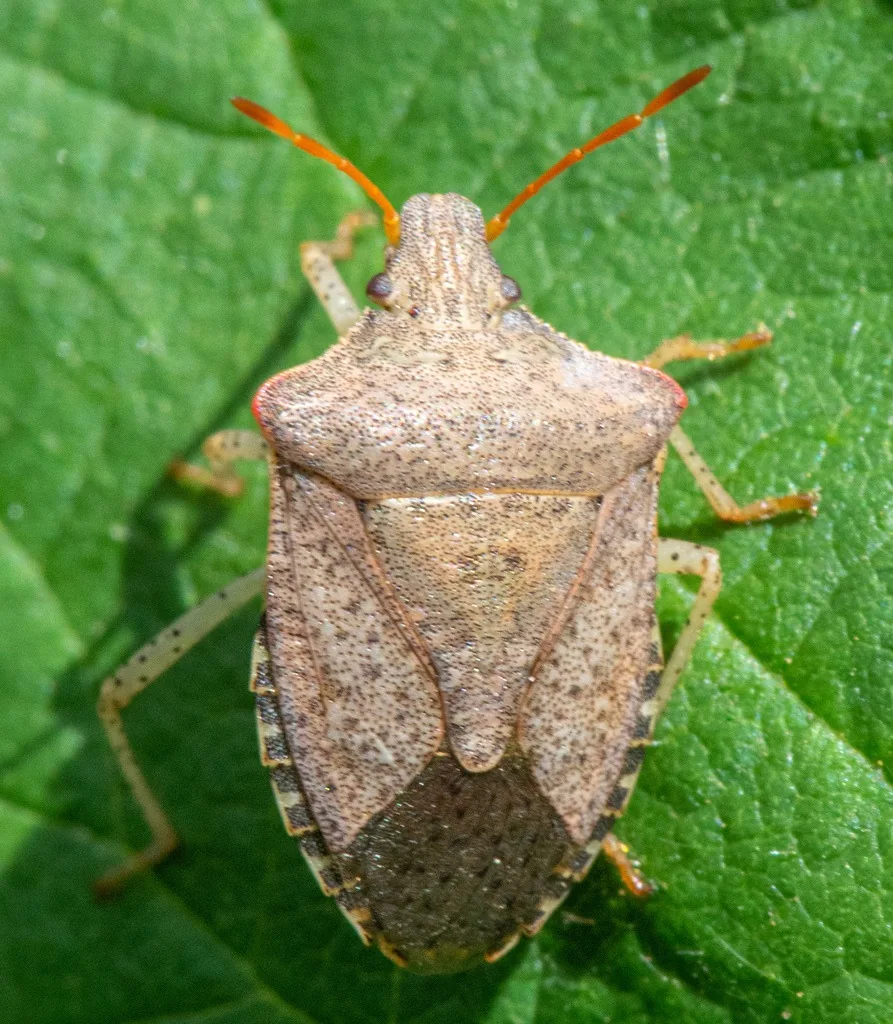
- Adults are shield-shaped and about 1/2 inch long. UC IPM describes them as grayish brown to green; the Pacific Northwest handbook calls them pale brown and yellow underneath.[3][2]
- The legs are grayish with black speckles and have no white bands.[3]
- The PNW handbook describes the antennae as red.[2]
- Eggs are drum-shaped with round lids and are laid in clusters on leaves; the nymphs look like smaller, wingless adults.[1]
- Egg masses that turn dark have been parasitized. Wasps chew out through irregular, rough-edged holes, while hatching nymphs push off the round egg caps.[1][4]
Look-alikes
| Look-alike | How to tell them apart |
|---|---|
| Brown marmorated stink bug | Has one white band on each hind leg and white bands on its dark antennae; the consperse stink bug has speckled gray legs with no white bands.[3] |
| Rough stink bugs | Brochymena sulcata, a beneficial predator, has two white bands on its otherwise blackish hind legs and no bands on the antennae.[3] |
Where it lives
A native pest in the West: it is the most common stink bug on tomatoes statewide in California, most important in the Sacramento and northern San Joaquin valleys, and a native pest of apples in the Pacific Northwest. GBIF holds about 230 U.S. records since 1990, most from California, Oregon and Washington, and a few from Canada.[1][2][5][6]
Biology and life cycle
Adults spend the winter on the ground under leaves and in groundcover, woodpiles, legume crops, blackberries and weeds such as Russian thistle, mustards and little mallow.[1][2]
They become active in March and April and begin laying eggs. Early in the season they feed on weeds, moving into crops and fruit trees later, and damage is worst in dry summers when their weedy hosts dry up.[1][2]
Males release an aggregation pheromone that draws both sexes. In Washington field tests, bugs gathered on pheromone-baited mullein plants within 24 to 48 hours, but very few were caught inside tube-type traps, and both sexes mated repeatedly within these aggregations on successive nights with different partners.[7][8]
A large complex of native parasites attacks its eggs, sometimes parasitizing more than 80 percent late in the season. Parasitized eggs turn dark. Tachinid flies also attack nymphs and adults.[1][2]
The same pheromone compound is the main volatile on the bug's eggs, and two native egg parasitoid wasps were attracted to it in lab tests.[9]
Damage and signs
- On green tomatoes, feeding leaves dark pinpricks surrounded by a light area that turns yellow or stays light green as the fruit ripens, with corky tissue below the surface. Yeast and other microbes carried on the bug's mouthparts can also cause fruit decay.[1]
- The yeast it carries can cause serious losses. In 1998 a fruit rot caused by the yeast Eremothecium coryli, linked to consperse stink bug feeding, caused extensive losses in the Sacramento Valley, and parts of several fields with more than 30% rot were abandoned at harvest. UC IPM notes that this damage is scored as mold by state graders.[10][1]
- On apples, early-season feeding causes cat-facing. Late-season feeding leaves corky spots just under the skin that turn brown and can worsen in storage; they look like the disorder bitter pit, but stink bug damage stays within about 0.4 inch of the fruit surface.[2]
- Its dried brown liquid droppings leave small spots, about 0.06 to 0.12 inch across, on leaves and fruit where it has been feeding.[1]
Health risk
Like other stink bugs it gives off a strong odor when disturbed; the sources describe it only as a plant pest.[2][3]
Control
Prevention
Commercial tomato growers monitor this species with double-cone traps baited with an aggregation pheromone and use a degree-day model, starting from the first trap catch, to predict when most nymphs will be present.[1]
In UC's degree-day model, the lower development threshold is 53.6°F (12°C), and most nymphs are present at about 558 degree-days (°F) after the first trap catch, which is the time to shake-sample.[1]
Keep them out
Home orchardists can protect apples by enclosing fruit in mesh or paper bags.[2]
Sanitation
Destroy or manage weeds that shelter overwintering adults, especially blackberry, mustards, radish, legumes, Russian thistle and little mallow, in and around fields and orchards. Don't mow cover crops or weeds while stink bugs are in them, since that drives the bugs into fruit trees.[1][2]
Traps and physical control
Shake or beat plants over a tray to find the bugs, and hand-remove bugs and egg masses from home trees.[1][2]
Biological control
Before treating, check egg masses: dark eggs are parasitized, and if parasitized masses are common, treatment for newly hatched nymphs may not be needed. Flowering nectar plants such as alyssum that bloom early (April to June) can boost parasitism nearby.[1]
The samurai wasp, an Asian egg parasitoid of the brown marmorated stink bug, is establishing in the Pacific Northwest, but in a Washington field test it successfully parasitized only 0.4 to 8% of eggs of three native stink bugs, including this one, against 77% of brown marmorated stink bug eggs. Its likely impact on native species is minimal.[2][11]
Pesticides
Kaolin clay sprays protect the fruit surface from feeding, though the white coating must be washed off, and insecticidal soap is acceptable on organic produce. Newly hatched nymphs are the easiest stage to control.[1]
The Pacific Northwest handbook warns that chemical controls tend to be very disruptive to orchard natural enemies, so weigh that before spraying fruit trees.[2]
Common questions
- How do I tell a consperse stink bug from a brown marmorated stink bug?
- Look at the legs and antennae. The brown marmorated stink bug has white bands on its hind legs and antennae; the consperse stink bug has gray, black-speckled legs with no white bands.[3]
- What are the corky spots in my apples?
- They may be stink bug feeding. Unlike bitter pit, stink bug damage stays within about 0.4 inch of the surface.[2]
- Where do consperse stink bugs spend the winter?
- As adults on the ground under leaves and in groundcover, woodpiles, blackberries and weeds near fields and orchards.[1][2]
- Will the samurai wasp control consperse stink bugs?
- Probably not much. In field tests it parasitized only a small share of consperse stink bug eggs; it mainly attacks the brown marmorated stink bug, while native egg parasitoids and tachinid flies attack the consperse stink bug.[11][2][1]
Sources
- University of California Statewide IPM Program, “Stink Bugs, UC IPM Pest Management Guidelines: Tomato.” ipm.ucanr.edu/agriculture/tomato/stink-bugs/ (accessed 2026-11-11)
- Pacific Northwest Pest Management Handbooks (Oregon State University, Washington State University and University of Idaho Extension), “Apple-Stink bug, Pacific Northwest Insect Management Handbook.” pnwhandbooks.org/insect/tree-fruit/apple/apple-stink-bug (accessed 2026-11-11)
- University of California Statewide IPM Program, “Stink Bugs, UC IPM Pest Notes (Home and Landscape).” ipm.ucanr.edu/home-and-landscape/stink-bugs/ (accessed 2026-11-11)
- University of California Statewide IPM Program, “Stink Bug Trissolcus Parasitoids (Natural Enemies Gallery).” ipm.ucanr.edu/natural-enemies/stink-bug-trissolcus-parasitoids/ (accessed 2026-11-11)
- Global Biodiversity Information Facility (GBIF), “Euschistus conspersus: U.S. occurrence records since 1990 by state (GBIF occurrence search).” api.gbif.org/v1/occurrence/search?taxonKey=2079067&country=US&hasGeospatialIssue=false&occurrenceStatus=PRESENT&year=1990%2C2026&facet=stateProvince&facetLimit=400&limit=0 (accessed 2026-11-11). Exact count at access: 232 U.S. records since 1990 (California 114; Oregon 55; Washington 31; Idaho 14).
- Global Biodiversity Information Facility (GBIF), “Euschistus conspersus: occurrence records since 1990 by country (GBIF occurrence search).” api.gbif.org/v1/occurrence/search?taxonKey=2079067&hasGeospatialIssue=false&occurrenceStatus=PRESENT&year=1990%2C2026&facet=country&limit=0 (accessed 2026-11-11). Exact counts at access: 250 records since 1990; United States 232, Canada 17.
- Journal of Economic Entomology, via PubMed, “Field attraction of the stink bug Euschistus conspersus to synthetic pheromone-baited host plants (Krupke et al. 2001, Washington State University).” pubmed.ncbi.nlm.nih.gov/11777055/ (accessed 2026-11-11)
- Journal of Insect Science, via PubMed, “Evaluating aggregation membership and copulatory success in the stink bug, Euschistus conspersus, using field and laboratory experiments (Krupke et al. 2011).” pubmed.ncbi.nlm.nih.gov/21521144/ (accessed 2026-11-11)
- Journal of Chemical Ecology, via PubMed, “Volatiles mediating parasitism of Euschistus conspersus and Halyomorpha halys eggs by Telenomus podisi and Trissolcus erugatus (Tognon et al. 2016).” pubmed.ncbi.nlm.nih.gov/27631523/ (accessed 2026-11-11)
- Plant Disease, via PubMed, “Outbreak of Eremothecium coryli fruit rot of tomato in California (Miyao et al.).” pubmed.ncbi.nlm.nih.gov/30841364/ (accessed 2026-11-11)
- Journal of Insect Science, via PubMed, “Trissolcus japonicus causes low levels of parasitism in three North American pentatomids under field conditions (Milnes and Beers 2019).” pubmed.ncbi.nlm.nih.gov/31393980/ (accessed 2026-11-11)
- iNaturalist, “Euschistus conspersus taxon page (order and family).” www.inaturalist.org/taxa/243759 (accessed 2026-11-09)