On this page
How to identify it
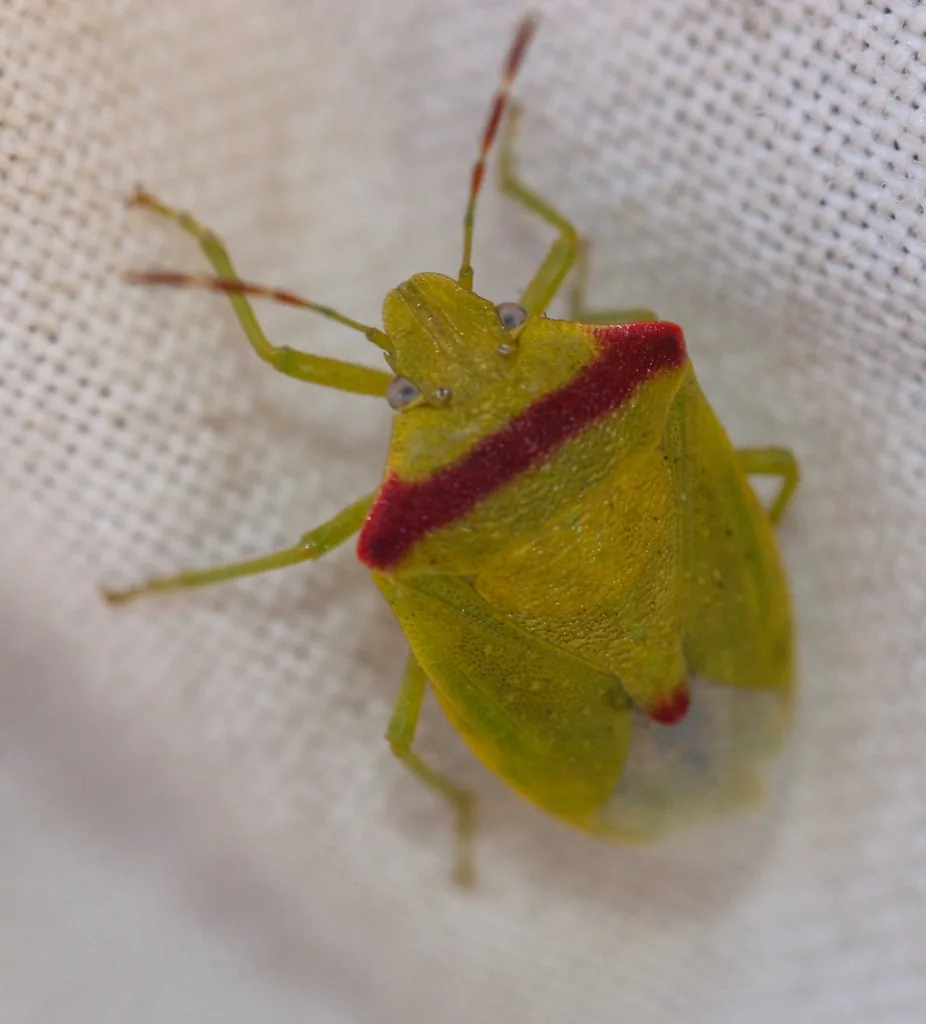
- Adults are somewhat triangular and about 1/3 inch (8.3 mm) long. They are mostly green with a narrow red band across the shoulders, though the band is sometimes missing.[1]
- There is also a brown color phase, usually seen in overwintering bugs.[1]
- Eggs are laid in clusters; they are barrel shaped with concentric dark rings at the top. Nymphs vary widely in color, often marked with red, yellow, green and black or brown, and they look different from adults and change as they grow.[1]
- Stink bugs leave brown liquid droppings that dry into small spots, about 0.06 to 0.12 inch across, on leaves and fruit where they feed.[2]
Look-alikes
| Look-alike | How to tell them apart |
|---|---|
| Green stink bug (Chinavia hilaris) | Slightly larger, 2/5 to 3/5 inch, dull to bright green with the entire side margin lined in yellow or orange. In pistachios it is less common than the redshouldered stink bug.[1] |
| Rough stink bug (Brochymena) | A predator, speckled white and gray rather than green, that is common in pistachio orchards all year. Its nymphs are red, white and blue.[1] |
| Consperse stink bug | The most common stink bug in California tomatoes statewide and the most important one in the Sacramento and northern San Joaquin valleys, while the redshouldered stink bug is the most prevalent species in the southern San Joaquin Valley.[2] |
Where it lives
It is a native stink bug in California, where it is a pest of pistachios and is considered the most prevalent stink bug in tomatoes in the southern San Joaquin Valley.[4][2]
Biology and life cycle
Stink bugs often develop in weeds or field crops and then move into pistachio orchards.[1]
In California tomato areas, stink bug adults overwinter on the ground under leaves, in woodpiles, in legume crops and blackberries, and on weeds such as Russian thistle, mustards and little mallow. They become active in March and April and start laying eggs then.[2]
Development depends on temperature. In laboratory tests no nymphs completed development at 15 °C (59 °F) or 35 °C (95 °F), egg-to-adult development took about 370 degree-days, and the mean generation time was about 40 days.[4]
Males produce a sex pheromone that attracts females. Synthetic lures drew females in a field cage, but traps in field trials caught them only in relatively low numbers.[3]
Newly hatched nymphs cluster together, and in laboratory dishes they readily formed mixed groups with nymphs of other stink bug species.[6]
Damage and signs
- In pistachios before the shells harden, feeding causes epicarp lesions with white netting inside the nut, and many damaged nuts drop. Damage this early rarely causes an economic loss.[1]
- After shell hardening in July, feeding causes kernel necrosis: the nutmeat darkens, often develops a sunken dead area and tastes off. From the outside the only sign is a brown pinpoint mark.[1]
- Stink bugs can transmit pistachio diseases such as Stigmatomycosis and Botryosphaeria panicle and shoot blight. In caged tests, redshouldered stink bugs on fruit clusters sprayed with blight spores led to significantly more infected fruit than clusters without bugs, and more bugs meant more punctures and more disease.[1][5]
- On green tomatoes, stink bug feeding leaves dark pinpricks surrounded by a light area that turns yellow or stays light green as the fruit ripens, with corky tissue beneath. The bugs can also carry yeasts that rot fruit.[2]
Health risk
The sources treat it only as a crop pest; none mentions bites or any risk to people or pets.[1][2]
Control
Sanitation
Destroy weeds that shelter overwintering stink bugs, such as legumes, blackberries, Russian thistle, mustards and little mallow, around fields that will be planted to tomatoes.[2]
Traps and physical control
In pistachios, monitor weekly from April. Spend about 30 minutes looking for adults moving in from overwintering sites, working from the orchard edge inward, sweep cover crops and nearby vegetation, and use a beating tray in the morning, when bugs are slower. Cut open small blackened nuts to confirm bug damage.[1]
Biological control
A large group of native parasites attacks the eggs of native stink bugs, and parasitism can exceed 80% late in the season. Parasitized eggs are dark. Nectar plants such as alyssum can raise parasitism a short distance around them if they start flowering early, April to June.[2]
Pesticides
In pistachios, time any insecticide after most eggs have hatched and nymphs are easy to find. Broad-spectrum sprays already used against small plant bugs, leaffooted bug or navel orangeworm often control stink bugs as well.[1]
For organic tomatoes, UC lists conserving natural enemies, weed management, kaolin clay and insecticidal soap sprays as acceptable.[2]
Common questions
- How do I tell a redshouldered stink bug from a green stink bug?
- The redshouldered stink bug is smaller, about 1/3 inch, with a narrow red band across the shoulders (sometimes missing). The green stink bug is 2/5 to 3/5 inch and has a yellow or orange edge along its whole side.[1]
- Why are some redshouldered stink bugs brown?
- A brown color phase occurs, usually in bugs that are overwintering.[1]
- Can pheromone traps monitor this species?
- Researchers identified its sex pheromone, but field traps caught females only in relatively low numbers, and UC notes that pheromones are not commercially available for stink bugs other than consperse and brown marmorated stink bugs.[3][2]
Sources
- University of California Statewide IPM Program, “Stink Bugs (Pistachio Pest Management Guidelines).” ipm.ucanr.edu/agriculture/pistachio/stink-bugs/ (accessed 2026-11-09)
- University of California Statewide IPM Program, “Stink Bugs (Tomato Pest Management Guidelines).” ipm.ucanr.edu/agriculture/tomato/stink-bugs/ (accessed 2026-11-09)
- Springer (Journal of Chemical Ecology), “Sex attractant pheromone of the red-shouldered stink bug Thyanta pallidovirens: a pheromone blend with multiple redundant components (McBrien et al. 2002, Journal of Chemical Ecology 28:1797-1818).” doi.org/10.1023/a:1020513218454 (accessed 2026-11-09)
- Entomological Society of America / Oxford University Press (Environmental Entomology), “Comparative Life History Parameters of Three Stink Bug Pest Species (Daane et al. 2022, Environmental Entomology 51:430-439).” doi.org/10.1093/ee/nvac012 (accessed 2026-11-09)
- American Phytopathological Society (Plant Disease), “Association of Botryosphaeria Panicle and Shoot Blight of Pistachio with Injuries of Fruit Caused by Hemiptera Insects and Birds (Michailides and Morgan 2016, Plant Disease 100:1405-1413).” doi.org/10.1094/PDIS-09-15-1077-RE (accessed 2026-11-09)
- Springer (Journal of Chemical Ecology), “Chemical and physical signals mediating conspecific and heterospecific aggregation behavior of first instar stink bugs (Fucarino et al. 2004, Journal of Chemical Ecology 30:1257-1269).” doi.org/10.1023/b:joec.0000030276.32665.cb (accessed 2026-11-09)
- iNaturalist, “Thyanta pallidovirens taxon page (order and family).” www.inaturalist.org/taxa/211001 (accessed 2026-11-09)