The short answer
- 1. Seal the house in summer, before the bugs look for winter shelter in late summer and fall. Caulk cracks around windows, doors, siding, pipes and fascia, fix screens, screen attic vents, and fill gaps around window air conditioners. Adults can squeeze through an opening as small as about 3 x 7 mm.[5][1][3][6][12]
- 2. Don't seal in fall, winter or early spring, when bugs may already be inside the walls. NC State says to let them leave in spring and seal them out before they return in late August.[5]
- 3. For bugs that get in, vacuum them (a stocking inside the hose keeps the smell out of the bag) or knock them into a cup of soapy water. Freezing them in a sealed bag or jar also works. Avoid crushing them.[3][5][2][1]
- 4. Skip indoor sprays, foggers and dusts. More bugs keep coming out of the walls, and dead bugs left in voids can feed carpet beetles.[1][5][3][6]
- 5. A pan of soapy water under a lamp is the trap extension sources suggest for indoors. Pheromone traps caught only 8 to 20% of the bugs known to be in buildings in a USDA-led study.[3][6][14]
Stink bugs and look-alikes
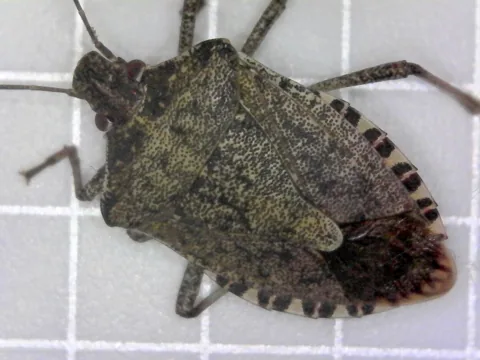 Brown Marmorated Stink Bug
Halyomorpha halys
The brown marmorated stink bug is an invasive insect from east Asia that damages fruit and vegetable crops and invades homes in fall looking for overwintering sites. Minnesota Extension says it feeds on about 200 plant species and, unlike the native stink bugs there, prefers to spend the winter in homes. Clemson notes that the bugs gather on outside walls before they move in.
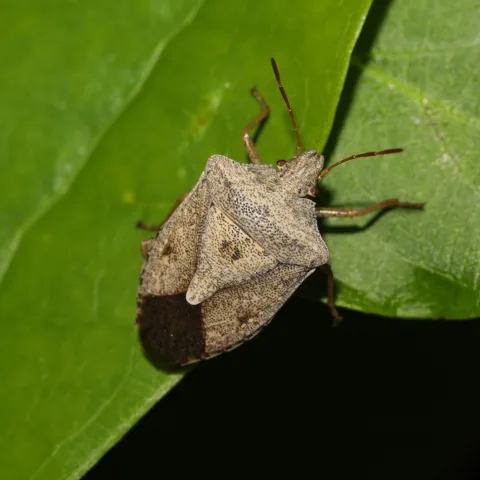 Brown Stink Bug
Euschistus servus
The brown stink bug is a native stink bug and often the first one to show up in Southern vegetable gardens, where it feeds on tomatoes, green beans and other crops. On farms it is a damaging pest of corn, cotton and soybeans, especially in the southeastern United States.
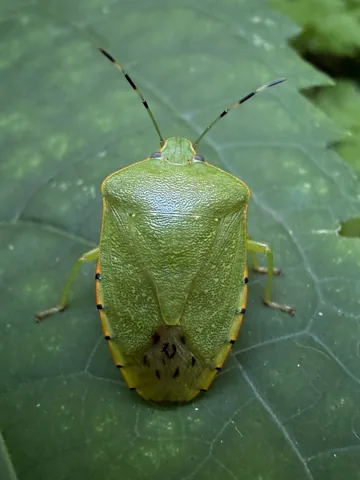 Green Stink Bugs
Chinavia hilaris (green stink bug) and Nezara viridula (southern green stink bug)
Two bright green stink bugs damage gardens and orchards in the U.S.: the green stink bug, a native of North America that feeds on a wide range of crops, and the southern green stink bug, one of the three most abundant stink bug pests in a North Florida tomato study. Both suck juices from developing fruit, seeds and shoots.
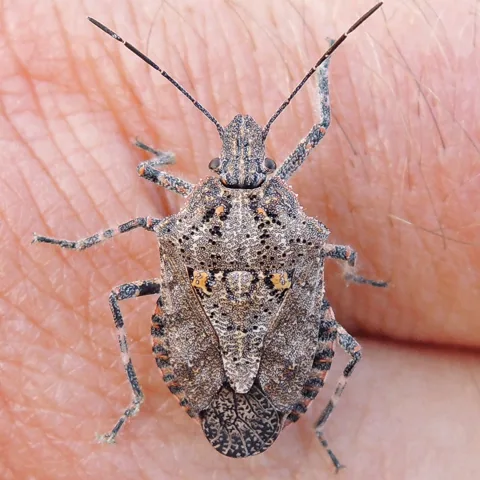 Rough Stink Bugs
Brochymena species
Rough stink bugs are commonly mistaken for the invasive brown marmorated stink bug, but they are partly predatory and aren't tied to significant plant damage.
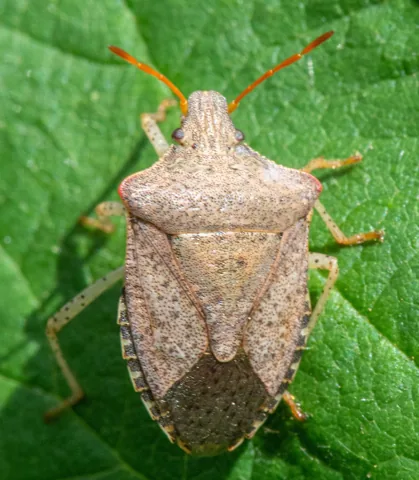 Consperse stink bug
Euschistus conspersus
The consperse stink bug is a native, shield-shaped stink bug about half an inch long that is the most common stink bug on California tomatoes and a pest of apples in the Pacific Northwest. Its feeding leaves pinprick spots on tomatoes and dimpled, corky patches on apples.
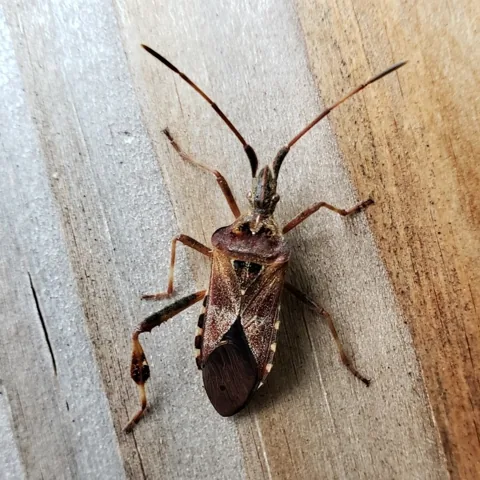 Western Conifer Seed Bug
Leptoglossus occidentalis
The western conifer seed bug is a leaf-footed bug that feeds on the seeds and cones of pines and other conifers. In fall, adults look for sheltered places to spend the winter, and many end up inside houses, where they are a nuisance but harmless.
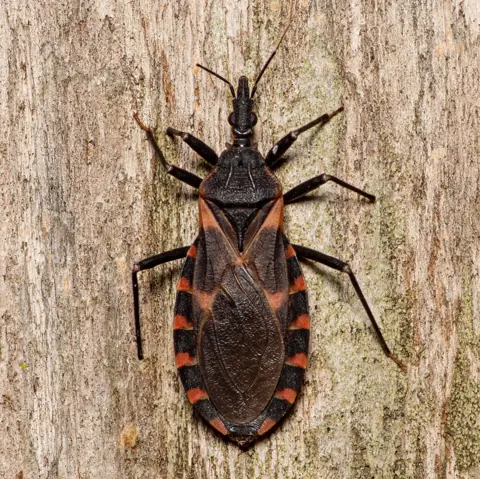 Eastern Bloodsucking Conenose
Triatoma spp. (shown: T. sanguisuga)
Kissing bugs are blood-feeding insects, active mostly at night, that can carry Trypanosoma cruzi, the parasite that causes Chagas disease. They have been found in 29 U.S. states, and studies of bugs collected in the United States have found the parasite in roughly one in six to nearly two in three of those tested, depending on the place.
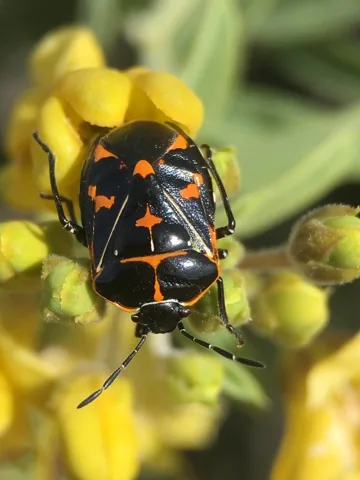 Harlequin Bug
Murgantia histrionica
The harlequin bug is a brightly colored stink bug that attacks cabbage, collards, kale, mustard and other cole crops. It sucks plant juices, and heavy infestations can wilt, brown and kill young plants or even whole fields.
Is it a brown marmorated stink bug?
Adults are shield-shaped, mottled brown and about 5/8 inch long (Penn State gives about 17 mm, or 0.66 inch). Several native stink bugs look similar, so check the marks that set this one apart: light bands on the antennae, dark bands at the tips of the wings where they overlap, a smooth, rounded shoulder edge, and alternating light and dark bands along the edge of the abdomen that you can see beside the folded wings.[3][1][2][4][6]
- Antennae: two white bands on each antenna (UC IPM). Clemson calls them distinct black and white bands.[3][4][1]
- Head and shoulders: the front of the head is blunt and the shoulder margin is smooth. Penn State also points to patches of coppery or bluish-metallic pits on the head and pronotum.[3][4][1]
- UC IPM says BMSB is most often mistaken for the rough stink bug. Rough stink bugs have a rough shoulder edge, a head that comes to two points, and no white bands on the antennae.[3]
- The consperse stink bug has a banded abdomen edge like BMSB but no bands on its antennae, and its legs have distinct dark spots. At about 1/2 inch it is a little smaller.[3]
- In the East, NC State's look-alike list includes the brown stink bug, the dusky stink bug and the green stink bug, all native species kept in check by native natural enemies.[5]
- Nymphs are wingless. Newly hatched ones have an orange or yellow-red abdomen; older ones are darker, with white bands on the legs and antennae and red eyes.[3][2][1]
Two look-alikes that also come indoors: seed bugs and kissing bugs
Two other bugs that get mistaken for stink bugs also turn up indoors. One is a harmless fall invader; the other feeds on blood, so it is worth a close look.[8][10][9]
- Western conifer seed bug: about 3/4 inch long, reddish-brown to dark brown, often with a thin, jagged white line across the back. Its hind legs have flat, leaf-like expansions, and it makes a loud buzz in flight. It also moves into homes in fall and is not a threat; Penn State knows of only one recorded bite worldwide. Our fall home invaders guide covers it in more detail.[8]
- Kissing bugs (also called cone-nose bugs): 1/2 to 1 inch long, with long thin legs with no thickened or leaf-like parts, and in most U.S. species a band of orange or red stripes around the edge of the body. The straight mouthparts are usually tucked under the body. They feed on blood at night and can carry the parasite that causes Chagas disease.[10][9]
- If you think you have a kissing bug, don't touch it with bare hands. Texas A&M says to catch it with a glove or small plastic bag, keep it in a closed container, clean the surface with a bleach solution, freeze it to kill it, and write down where and when it was found. Texas A&M's community science program accepts photos and specimens for identification.[10]
- Kissing bugs have been found in 29 states, most often in Texas, New Mexico and Arizona, and Texas A&M estimates about half are infected with the parasite. CDC estimates about 280,000 people in the United States have Chagas disease.[9][11]
Why stink bugs come into houses
In the wild, brown marmorated stink bugs spend the winter as adults in tight crevices, such as under the peeling bark of old or dead trees. Houses offer the same kind of shelter: gaps around windows and baseboards, attics and almost any void space. Cooler fall weather sets them looking, and they gather on the sunny sides of buildings on warm days before working their way in.[3][4][2][1]
Numbers build because the bugs release an aggregation pheromone that draws others to the same place. Missouri notes this scent is a different chemical from the one that makes them stink, and that BMSB is the only stink bug known to congregate inside houses in fall. Minnesota also notes that, unlike its native stink bugs, BMSB prefers to overwinter in homes.[6][2]
- Timing: Penn State says adults start searching for overwintering sites in September through October; UC IPM says late summer and early fall; Minnesota sees its highest numbers from mid-August through October.[1][3][2]
- Favorite spaces: in lab tests, overwintering adults settled where a gap narrowed to 4.5 to 5.5 mm and tended to face the entrance.[13]
- Indoors they prefer high, cool locations and hide in cracks behind baseboards, window and door trim, and around exhaust fans and ceiling lights.[3][1][4]
- Winter: they are in diapause, a resting state. They don't feed (or barely do), mate or lay eggs, but some wake up and wander out on warm days or when the heat is turned up.[6][3][2]
- Spring: survivors leave the house for host plants. In Pennsylvania adults emerge from late April to mid-May.[3][1]
- Scale: the StopBMSB project cites one house invaded by 25,000 of them.[7]
Are they harmful?
Not to people, pets or the house. UC IPM and Missouri say they don't bite, sting, suck blood, spread disease, or eat or bore into wood, and they won't reproduce indoors. NC State notes dogs, cats and chickens have eaten them with no ill effects.[3][6][5][1]
- Allergies: Penn State says the defensive chemicals can act as an airborne allergen, causing a runny nose or eye irritation in sensitive people, and crushing bugs on bare skin can cause dermatitis in a small percentage of people.[1]
- Equipment: in very high numbers they can get into small engines, heat pumps and other equipment and make them malfunction.[5]
- Noise: they fly clumsily and noisily around lights indoors.[3]
Seal them out before fall
Extension sources put exclusion first. Penn State calls it the best way to keep stink bugs out of homes, and UC IPM calls sealing much more effective than spraying. Do it in summer, after the bugs have left and before they come back. NC State warns that bug-proofing in fall, winter or early spring is likely to trap bugs inside.[1][3][5][4][6]
Size matters. In a Virginia Tech and USDA study, only one of the overwintering adults tested got through 7 mm holes and none got through 3 mm slits. The authors concluded that most will be kept out by slits smaller than 3 mm and holes smaller than 7 mm.[12][5]
- Caulk cracks around windows, doors, siding, utility pipes, behind chimneys and under wood fascia with good-quality silicone or silicone-latex caulk; use foam for larger gaps.[1][3][7]
- Repair or replace damaged window and door screens and make sure they fit tightly in the frame.[1][3][4][7]
- Install weather stripping around door frames and a tight sweep or threshold at the bottom of each exterior door.[3][4][7]
- Window air conditioners are a major way in. Missouri suggests removing them; UC IPM says to fill gaps around the edges and cover them with screen if needed.[6][3][7]
- Put screening on attic, gable and foundation vents, and screen the chimney or check that the damper closes tightly.[3][4][7][8]
- Seal where cable, phone, electrical lines, faucets and pipes pass through the walls.[4][2][5]
- The StopBMSB project passes on a tip to pay special attention to the side of the house facing the sunset.[7]
- Turn off unnecessary outdoor lights, since the bugs fly to lights at night. When you go in and out, UC IPM suggests keeping outdoor lights on away from the entrance and indoor lights off near it.[3][4]
- If they are already coming into living areas, find where they emerge (baseboards, window and door trim, ceiling fixtures and fans) and caulk those gaps too.[1]
Vacuuming and removal without the stink
Physical removal is the main indoor control. The smell comes from a defensive chemical released when a bug is alarmed or crushed; an undisturbed stink bug usually won't stink. So handle them gently and don't squash them.[5][2][4]
- Vacuum: a wet or dry vacuum collects them quickly, but the canister or bag and the machine will smell for a while. Some people keep a vacuum just for stink bugs. UC IPM's trick is to push a nylon stocking into the hose and fold the end over the outside with a rubber band, so the bugs collect in the stocking.[3][1]
- Shop vac: Minnesota suggests a shop vac emptied into a bucket of soapy water for bugs gathered on walls.[2]
- Soapy water: brush single bugs into a cut-off plastic bottle with an inch of soapy water, where they drown quickly. Fastened to a pole or broom handle, it reaches high spots.[3][5]
- Freezer: put live bugs in a sealable bag or jar and freeze them. UC IPM says 2 days; the StopBMSB project relays a University of Maryland tip of a couple of days.[3][7][5]
- Don't flush them (it wastes water), and don't throw live bugs in the trash. NC State advises against releasing them outside, since they are likely to come back in.[3][7][5]
- Outdoors, on cool days when they won't fly, bugs clustered on walls can be swept into a container. A hose will knock them off, but they will likely return.[3]
Light and pheromone traps: what the evidence says
Indoor light trap: UC IPM calls a light-and-water trap the most effective and inexpensive way to trap bugs that are already inside. Fill a foil roasting pan with water and a few drops of dish soap, point a lamp at it and leave it in a dark room. Bugs fly to the light, fall in and drown. Missouri describes the same trap, developed by Virginia Tech researchers.[3][6]
Pheromone traps indoors: the evidence is weak. A two-year USDA-led study of heated and unheated buildings found overwintering bugs did not respond reliably to pheromone-baited traps until days in spring were longer than about 13.5 hours. The traps caught only 8 to 20% of the adults known to be present and were not an effective indoor management tool.[14]
Pheromone traps in gardens: UC IPM says they are useful for monitoring (whether bugs are present, when they emerge, when numbers are high) but probably do little to prevent crop damage. In a Maryland home-garden study, tomatoes in gardens with a trap had significantly more stink bug injury than those in gardens without one, and plants near the trap held more bugs.[3][15]
- If you use an outdoor pheromone trap, UC IPM suggests placing it well away from the garden, though the best distance isn't known.[3]
- Clemson's 2014 fact sheet listed light and pheromone traps as research tools that might later help monitor or reduce populations; the 2017 study above later found pheromone traps fall short indoors.[4][14]
Why indoor sprays don't work
Penn State, UC IPM, Missouri and Minnesota all advise against insecticides indoors. The problem is where the bugs are: deep in wall voids and attics, with more emerging after any treatment.[1][3][6][2]
- Foggers: an aerosol pyrethrum fogger will kill bugs clustered on walls and ceilings, but more come out soon after the room is aired out, so Penn State doesn't consider it a long-term answer.[1]
- Crack-and-crevice sprays: Penn State says they won't stop bugs from emerging and are not a recommended treatment.[1]
- Dusts in wall voids: these may kill hundreds of bugs, but carpet beetles can feed on the dead ones and then move on to woolens and stored food. NC State gives the same warning about dead bugs left in attics, walls or crawl spaces.[1][5]
- NC State adds that sprays struggle because the bugs move around, new ones keep arriving from outside, and it is hard to treat without contaminating living areas.[5]
Exterior insecticide treatment
Outside spraying is a backup for houses that can't be fully sealed, and its effect is short. Penn State says it may offer some minor relief and should be done by a licensed pest control operator in fall, just before the bugs congregate. Sunlight breaks the insecticide down, so the residual may not last much beyond several days or a week. UC IPM says sprays around entry points may deter the bugs temporarily but often break down within days.[1][3][4]
Clemson says that if outdoor numbers are high, a product labeled for the site can be focused on entry points and the cracks and crevices where bugs hide, and that spraying around lighted areas may help, but unless the treatment is well placed, sun and moisture break it down quickly. Follow the label exactly, and see our guide to perimeter sprays for placement.[4]
Stink bugs in the garden
Brown marmorated stink bugs feed on more than 200 kinds of plants. In gardens they go after tomatoes, peppers, okra, beans, corn, Swiss chard and fruit such as peaches and apples, and their piercing mouthparts leave discolored, pithy or rotting spots rather than chewed holes. UC IPM notes that some backyard gardeners in the mid-Atlantic have lost all their susceptible crops, while Minnesota hasn't had reports of garden damage. Other garden stink bugs, such as the native green and brown stink bugs and the harlequin bug, have their own profiles, and our vegetable garden insects guide covers them alongside other crop pests.[2][5][3][1]
- Row covers keep stink bugs off plants, but they also keep pollinators away from flowers.[3]
- Handpick bugs or knock them into soapy water, use a hand-held vacuum regularly, and destroy egg masses on the undersides of leaves.[3][2]
- A small spot of damage can be cut out of a fruit without affecting eating quality.[3]
- Insecticides help little against adults, and new bugs move in. NC State lists bifenthrin, cyfluthrin and lambda-cyhalothrin as the most effective options but says they also kill beneficial insects and should be used only for severe infestations.[3][5]
- Trap crops such as sunflowers planted around the garden have given mixed results.[5]
Common questions
- What kills stink bugs instantly?
- Dropping them into soapy water drowns them quickly, and vacuuming removes them fast. Freezing live bugs in a sealed bag or jar also kills them. Indoor sprays and foggers aren't recommended because more bugs keep coming out of the walls.[3][5][1]
- Why do I keep finding stink bugs in winter?
- They moved into wall voids and the attic in fall. On warm days, or when the heat goes up, some become active and wander into rooms. They won't breed indoors; seal the gaps next summer so fewer get in.[2][1][3]
- Do stink bug traps work?
- A pan of soapy water under a lamp catches bugs indoors. Pheromone traps did poorly in buildings in a USDA-led study, catching 8 to 20% of the bugs present, and a garden trap was linked to more tomato damage nearby.[3][14][15]
- How do I get rid of the stink bug smell?
- Avoid crushing or agitating them, since the odor is a defense released when they are disturbed. Use a stocking inside the vacuum hose or a dedicated vacuum so the smell stays out of your main one.[5][3]
- Can stink bugs hurt my dog or cat?
- No. Brown marmorated stink bugs don't bite or sting, and NC State notes pets have eaten them with no ill effects. If a bug has long thin legs and orange or red stripes around the edge of its body, though, check whether it is a kissing bug.[5][3][10]
- When should I seal my house against stink bugs?
- In summer, once the bugs have gone outdoors, and before they return in late August and fall. Sealing in winter or early spring can trap bugs inside.[5][1]
Photo credits
- Brown Marmorated Stink Bug: (c) Stan Rullman, some rights reserved (CC BY) — via iNaturalist, CC BY 4.0
- Brown Stink Bug: (c) Adrienne van den Beemt, some rights reserved (CC BY) — via iNaturalist, CC BY 4.0
- Green Stink Bugs: (c) Marc-Olivier Beausoleil, some rights reserved (CC BY) — via iNaturalist, CC BY 4.0
- Rough Stink Bugs: (c) Bill Keim, some rights reserved (CC BY) — via iNaturalist, CC BY 4.0
- Consperse stink bug: (c) Don Loarie, some rights reserved (CC BY) — via iNaturalist, CC BY 4.0
- Western Conifer Seed Bug: (c) Gavin Slater, some rights reserved (CC BY) — via iNaturalist, CC BY 4.0
- Eastern Bloodsucking Conenose: (c) Justin Williams, some rights reserved (CC BY) — via iNaturalist, CC BY 4.0
- Harlequin Bug: (c) Matt Berger, some rights reserved (CC BY) — via iNaturalist, CC BY 4.0
Sources
- Penn State Extension, “Brown Marmorated Stink Bug (S. Jacobs; rev. M. Skvarla).” extension.psu.edu/brown-marmorated-stink-bug (accessed 2026-11-10)
- University of Minnesota Extension, “Brown marmorated stink bug.” extension.umn.edu/garden-and-home/yard-and-garden/yard-and-garden-insects/brown-marmorated-stink-bug (accessed 2026-11-10)
- University of California Statewide IPM Program, “Pest Notes: Brown Marmorated Stink Bug.” ipm.ucanr.edu/home-and-landscape/brown-marmorated-stink-bug/ (accessed 2026-11-10)
- Clemson Cooperative Extension Home & Garden Information Center, “Brown Marmorated Stink Bug in Structures (HGIC 2404).” hgic.clemson.edu/factsheet/brown-marmorated-stink-bug/ (accessed 2026-11-10)
- NC State Extension, Department of Entomology, “FAQs: Brown Marmorated Stink Bug.” entomology.ces.ncsu.edu/faqs-brown-marmorated-stink-bug (accessed 2026-11-10)
- University of Missouri Integrated Pest Management, “Brown Marmorated Stink Bugs in Homes (J. Pinero, R. Houseman).” ipm.missouri.edu/MEG/2016/10/Brown_Marmorated_Stink_Bugs_in_homes/ (accessed 2026-11-10)
- StopBMSB.org (Northeastern IPM Center, USDA NIFA Specialty Crop Research Initiative project), “Keeping Stink Bugs Out of Your House, and Your Island Nation.” www.stopbmsb.org/stink-bug-bulletin/keeping-stink-bugs-out-of-your-house-and-your-island-nation/ (accessed 2026-11-10)
- Penn State Extension, “Western Conifer Seed Bug.” extension.psu.edu/western-conifer-seed-bug (accessed 2026-11-10)
- Texas A&M University Kissing Bug Community Science Program, “Kissing Bugs & Chagas Disease in the United States.” kissingbug.tamu.edu/ (accessed 2026-11-10)
- Texas A&M University Kissing Bug Community Science Program, “Frequently Asked Questions.” kissingbug.tamu.edu/faq/ (accessed 2026-11-10)
- Centers for Disease Control and Prevention, “About Chagas Disease.” www.cdc.gov/chagas/about/index.html (accessed 2026-11-10)
- Journal of Economic Entomology, via PubMed, “Chambers et al. (2019), Size restrictions on the passage of overwintering Halyomorpha halys through openings, J. Econ. Entomol. 112(3):1343-1347.” pubmed.ncbi.nlm.nih.gov/30759241/ (accessed 2026-11-10)
- Journal of Economic Entomology, via PubMed, “Chambers et al. (2020), Cavity tightness preferences of overwintering Halyomorpha halys, J. Econ. Entomol. 113(3):1572-1575.” pubmed.ncbi.nlm.nih.gov/32161945/ (accessed 2026-11-10)
- Journal of Economic Entomology, via PubMed, “Morrison et al. (2017), Behavioral response of the brown marmorated stink bug to semiochemicals deployed inside and outside anthropogenic structures during the overwintering period, J. Econ. Entomol. 110(3):1002-1009.” pubmed.ncbi.nlm.nih.gov/28430975/ (accessed 2026-11-10)
- Environmental Entomology, via PubMed, “Sargent, Martinson and Raupp (2014), Traps and trap placement may affect location of brown marmorated stink bug and increase injury to tomato fruits in home gardens, Environ. Entomol. 43(2):432-438.” pubmed.ncbi.nlm.nih.gov/24517877/ (accessed 2026-11-10)