The short answer
- A kissing bug is 1/2 to 1 inch long, mostly black or very dark brown, with a narrow cone-shaped head, thin antennae, long thin legs with no thickened parts, and in most species red, orange or yellow stripes around the edge of the body.[9][10]
- Many harmless bugs look similar, including wheel bugs, western corsairs and leaf-footed bugs. CDC says these do not carry the Chagas parasite.[2][10]
- Chagas disease does not spread through the bite itself. The parasite is in the bug's droppings and gets in when they are rubbed into the bite, another break in the skin, the eyes or the mouth.[2][5][9]
- Locally acquired Chagas disease is rare in the U.S.: CDC researchers counted fewer than 30 documented cases. Allergic reactions to bites, which can be severe, are a bigger concern in the Southwest.[14][18][7]
- Don't touch a kissing bug with bare hands. Catch it with a glove or plastic bag, seal it in a container, and kill it in the freezer. In Texas, bugs involved in a human exposure can be sent to the state health department for free testing.[9][7][6]
- Keep them out by sealing gaps and screening windows and doors, cutting back outdoor lights near the house, clearing brush, wood and rock piles, and having pets sleep indoors.[3][5][8][11]
Kissing bugs and look-alikes
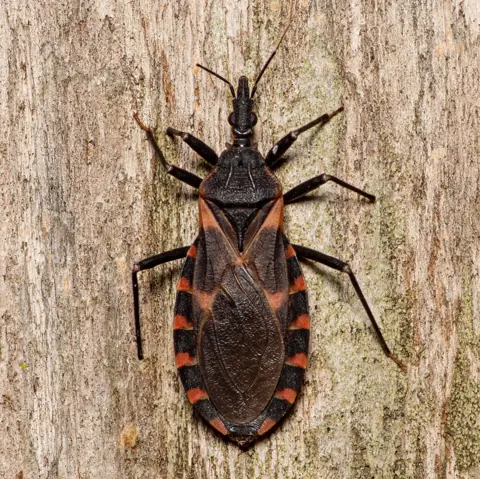 Eastern Bloodsucking Conenose
Triatoma spp. (shown: T. sanguisuga)
Kissing bugs are blood-feeding insects, active mostly at night, that can carry Trypanosoma cruzi, the parasite that causes Chagas disease. They have been found in 29 U.S. states, and studies of bugs collected in the United States have found the parasite in roughly one in six to nearly two in three of those tested, depending on the place.
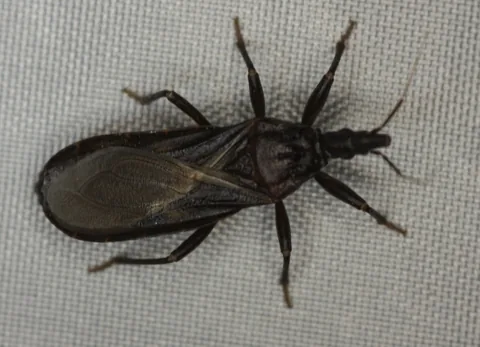 Western bloodsucking conenose
Hospesneotomae protracta
The western bloodsucking conenose (Hospesneotomae protracta, formerly Triatoma protracta) is the most important kissing bug in California and one of the three species most often found around homes in Arizona. It normally lives in the nests of wood rats (pack rats) and other wildlife, but adults fly to lights at night, get into houses and may feed on sleeping people. The bite is painless, yet it can leave itchy, swollen welts, and in people who become allergic it can trigger anaphylaxis.
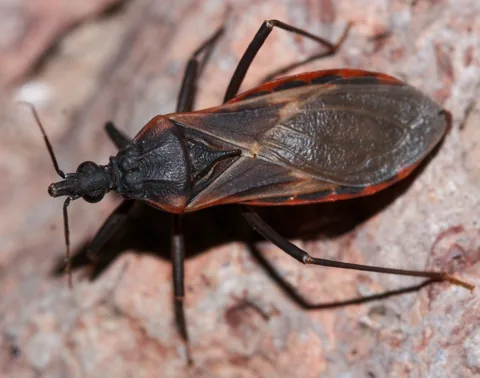 Triatoma rubida (Arizona's most abundant kissing bug)
Triatoma rubida
Triatoma rubida is the kissing bug most people in Arizona actually meet: the most abundant species in the state, most prevalent in the foothills around Phoenix and Tucson, and one of the three species that cause the most trouble around homes. It is a large, dark true bug with reddish or brownish-red markings along the sides of the abdomen, living mainly in pack rat nests but flying to porch lights on warm, calm evenings from May through July. Its bites are painless at first and then raise welts, repeated bites can sensitize people to dangerous allergic reactions, and a high share of bugs carry the Chagas parasite, though transmission to people in the United States is rare. Sealing the house and managing lights and rodent nests are the defenses.
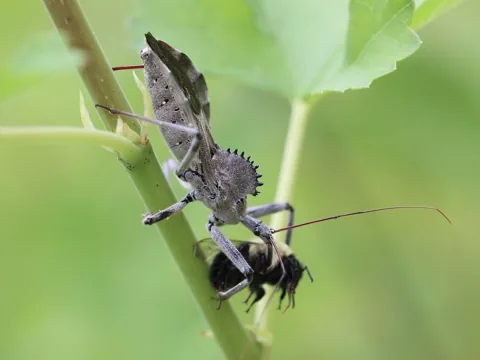 Wheel Bug
Arilus cristatus
The wheel bug is the largest assassin bug in North America, named for the toothed crest on its back. It hunts caterpillars and other insects, but it gives an immediately painful bite if handled carelessly.
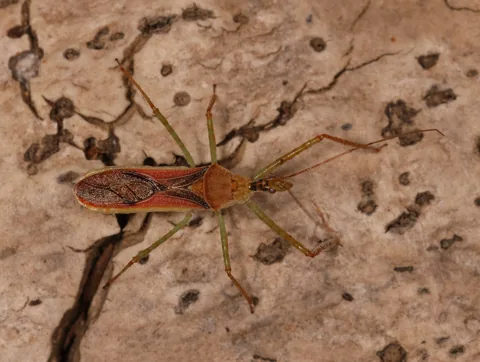 Assassin Bugs
Zelus and Sinea species (shown: Zelus renardii)
Assassin bugs are stalking and ambushing predators with a needlelike beak. They kill caterpillars, other bugs and bees alike, and they can deliver a painful bite if handled.
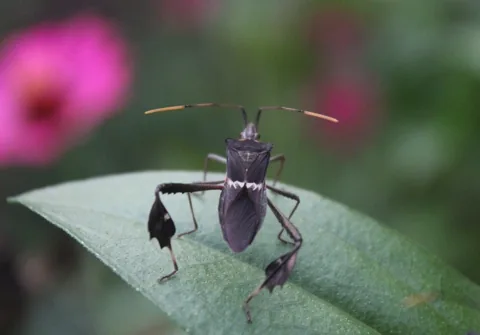 Leaffooted Bug
Leptoglossus zonatus
Leaffooted bugs are medium to large sap-feeding bugs named for the small leaf-like flaps on their hind legs. They pierce fruits, vegetables and nuts to feed, especially on the seeds, and gardeners most often find them on tomatoes and pomegranates.
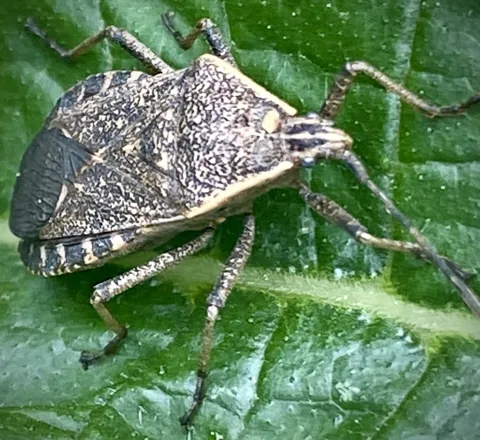 Squash Bug
Anasa tristis
The squash bug is a common vegetable garden pest that sucks sap from squash, pumpkins, melons and other cucurbits. Heavy feeding makes plants wilt and can kill young plants outright.
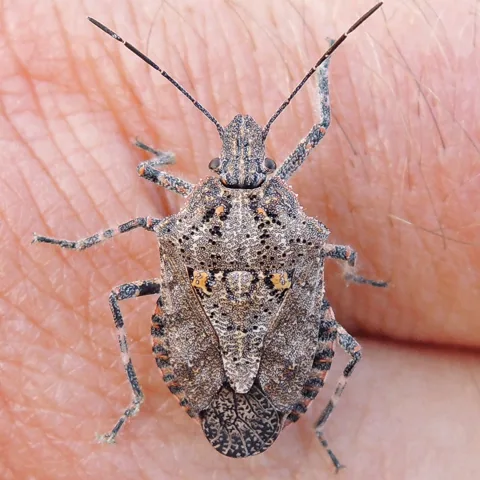 Rough Stink Bugs
Brochymena species
Rough stink bugs are commonly mistaken for the invasive brown marmorated stink bug, but they are partly predatory and aren't tied to significant plant damage.
What kissing bugs are
Kissing bugs belong to the assassin bug family, Reduviidae. Most members of that family hunt other insects, but kissing bugs (Triatoma and related genera) feed on the blood of people, pets and wild animals instead. They are also called conenose bugs, triatomine bugs and chinches, and in Arizona Hualapai tigers. The name comes from the old idea that they bite mostly around the mouth or eyes; Texas A&M points out they bite anywhere they can reach.[11][9][12]
All life stages feed on blood. Kissing bugs hatch from small oval eggs and go through five wingless nymph stages before becoming winged adults, and each stage needs a blood meal before molting. They feed at night, taking several minutes or more per meal; UC IPM gives 10 to 30 minutes. They do not stay attached like ticks, and the bite usually doesn't hurt while they feed. Texas A&M says some kinds can live up to two years.[8][9][11][12]
Outdoors, kissing bugs live where their hosts sleep. CDC lists spaces beneath porches, rock structures and cement, rock, wood and brush piles, under bark, rodent nests and burrows, outdoor dog houses and kennels, and chicken coops. In the Southwest they are closely tied to woodrat (pack rat) nests.[2][11][12]
Adults fly and are drawn to lights after dark. University of Arizona Extension says adults are most often seen during their dispersal season, May through July, and UC IPM says bites usually happen in late spring to early summer.[12][11]
How to recognize a kissing bug
Texas A&M's kissing bug program, which identifies bugs from photos, lists these marks. Check all of them, because no single feature is enough.[9][10]
- Size: adults are about 1/2 to 1 inch long, measured from the tip of the 'nose' to the end of the body. University of Arizona Extension gives 0.5 to over 1 inch (13.0 to 33.0 mm) across species.[9][12]
- Head: long, narrow and cone-shaped, with thin antennae.[10][11]
- Beak: thin and straight, usually tucked back under the body. Texas A&M compares it to a tiny needle. Predatory assassin bugs and plant-feeding bugs have thicker beaks.[9][11]
- Legs: all six are long and thin, with no thickened or leaf-like sections.[9]
- Color: U.S. species are mainly black or very dark brown with red, orange or yellow stripes around the flat outer edge of the abdomen. The western species Triatoma protracta is the exception: its edge may have a single light-brown band or no markings at all.[10][9][11]
- Wings: adults hold them flat over the back. Nymphs look like small adults without wings; wing pads show only in the last stage.[11][9]
Bugs that get mistaken for kissing bugs
Many insects found on porches and walls look like kissing bugs. Texas A&M says no insect other than kissing bugs is known to carry the Chagas parasite, but some look-alikes have thick beaks and can give a painful bite if handled. If you aren't sure, photograph the bug and send the picture to an identification service before worrying about it (see below).[10][2]
Bed bugs, which are in the same insect order as kissing bugs and also feed on blood, and brown marmorated stink bugs, which wander indoors in fall, are two other common mix-ups. Our bed bug look-alikes and stink bug guides compare each with kissing bugs.[12]
- Wheel bug: a large predatory assassin bug with a cog-like crest on its back, like the blade of a circular saw. CDC and Texas A&M both list it as a common look-alike, and the Missouri Department of Conservation warns that assassin bugs can give a painful bite if handled.[2][10][13]
- Western corsair: an assassin bug drawn to porch lights in the West, shaped like a conenose bug but orange and black with an orange spot on each wing. It eats insects and, unlike a kissing bug, gives a very painful bite if picked up.[11][2]
- Leaf-footed bugs: plant feeders, most with flattened, leaf-like extensions on the hind legs. Kissing bug legs are thin all the way along. CDC and Texas A&M both show Leptoglossus species.[2][10][13][9]
- Other bugs on Texas A&M's look-alike list: squash bugs, milkweed bugs, rough stink bugs (Brochymena), bee assassins (Apiomerus), Zelus assassin bugs including the milkweed assassin bug, Microtomus assassin bugs, and even the eyed click beetle and some weevils.[10]
Kissing bugs in the United States
CDC and Texas A&M say 11 kinds of kissing bugs have been found in the United States. Texas A&M counts records from 29 states, with Texas, New Mexico and Arizona having the most species and the most finds. Kissing bugs have been recorded only a few times in Delaware, Illinois, Indiana, New Jersey, Pennsylvania and West Virginia and are probably rare there. They are not new arrivals: Texas A&M says they have been found in U.S. states since as early as the mid-1800s.[2][8][9][16]
Many U.S. kissing bugs carry the parasite, and the share varies by place and species. Texas A&M's lab has found about half infected overall, about 55% of the more than 7,000 bugs people have sent its community science program, and between 10 and 70% depending on the kind. A study of bugs collected in and around houses in Tucson found 41.5% infected, and a review for physicians said T. cruzi may infect more than 50% of sampled bugs.[8][9][19][18]
- Eastern conenose (Triatoma sanguisuga): about 1 inch long with dark red stripes; one of the most common kinds in the south-central U.S.[9]
- Triatoma gerstaeckeri: about 1 inch long with yellow-orange stripes; common in Texas.[9]
- Western bloodsucking conenose (Triatoma protracta): 1/2 to 3/4 inch, black to dark brown, edge sometimes tan. UC IPM calls it the most important species in California, where conenose bugs are most common in the foothills around the Central Valley and in the foothills and deserts of Southern California.[11][9]
- Triatoma rubida: 3/4 to 1 inch, with reddish or brownish-red markings along the edge just outside the folded wings. University of Arizona Extension calls it the most abundant kissing bug in Arizona, most common in the foothills around Phoenix and Tucson; it also occurs in California.[12][11]
- Triatoma recurva: the largest of Arizona's three common species, with a uniformly dark pronotum and strongly up-curved edges on a wide abdomen.[12]
Chagas disease: what CDC and health departments say
Chagas disease is caused by the parasite Trypanosoma cruzi. Kissing bugs pick it up by feeding on infected animals or people and pass it in their droppings. If the droppings get into the bite wound, a cut, the eyes or the mouth, usually because a sleeping person scratches or rubs them in, the parasite can infect the person. Less often it spreads from a pregnant woman to her baby, through blood transfusions or organ transplants, through food or drink contaminated with bug droppings, or in lab accidents. It does not spread from person to person like a cold or the flu, or through casual contact with infected people or animals.[2][1][5]
The disease has two phases. The acute phase covers the first weeks or months; Texas DSHS puts it at roughly the first 8 weeks. Symptoms are often mild or absent and can include fever, tiredness, body aches, headache, rash, loss of appetite, vomiting or diarrhea, and swelling where the parasite entered. The best-known sign is Romaña's sign, swelling of the eyelid on one side, which happens when droppings get into the eye or a bite near it. The chronic phase can last for life. Most people never have symptoms, but CDC and Texas DSHS say 20 to 30% develop heart problems (an enlarged heart, heart failure, abnormal rhythm or sudden death) or, less often, an enlarged esophagus or colon.[1][5][16]
Most Chagas disease in the U.S. was acquired in Latin America, and imported infections far outnumber locally acquired ones. CDC estimates about 280,000 people in the United States have it, often without knowing; Texas DSHS cites a CDC estimate of approximately 300,000, and CDC researchers writing in 2016 said at least 300,000 cases of chronic infection among people originally from countries where the disease is endemic. A 2016 study estimated 238,091 infections as of 2012, not counting undocumented immigrants who may add as many as 109,000.[1][5][14][15][16]
Infection from U.S. kissing bugs is uncommon. Fewer than 30 locally acquired human cases had been documented in the United States as of 2016, although the parasite has circulated among wildlife and kissing bugs here for at least a century. Texas DSHS says human cases acquired in Texas occur but are uncommon. A 2018 Missouri case, found when a blood donation screened positive, was reported as possibly locally acquired, and CDC's report urged health care providers to be aware of locally acquired Chagas disease in the southern United States.[14][5][17][16]
Part of the reason is housing. CDC says triatomine bugs rarely infest U.S. homes because houses are well sealed and have plastered walls. Finding them indoors, especially wingless nymphs, may mean an infestation; indoors they are often near where pets sleep, where rodents are, or around beds, under or near mattresses and nightstands.[2]
- Diagnosis: only a health care provider can diagnose Chagas disease, using a blood test.[1][4]
- Treatment: two antiparasitic drugs, benznidazole and nifurtimox, are available in the U.S. CDC says treatment works best when started early but can be used at any stage, and that most patients don't need to stay in the hospital.[4][5]
- Prevention: there is no vaccine or drug to prevent Chagas disease. The way to prevent it is to avoid contact with the bugs.[3][1]
- Blood donors: blood banks screen first-time donors for the parasite, and donors who test positive are told to see their provider for more testing.[5]
Dogs and other animals
Dogs get Chagas disease too, and they are more exposed than people. Texas DSHS says infection has been reported in dogs in Texas and several other states, including Louisiana and Oklahoma, and that outdoor dogs are at much higher risk because kennels can become infested and some dogs eat the bugs. A 1999 study in South Texas found 7.5% of stray dogs tested positive. Infection in cats has been reported but is much less common.[5]
Texas A&M says the parasite can cause heart disease in dogs, though many infected dogs show no signs, and that kissing bugs can be drawn to the heat and smells of kennels with many dogs. Wild hosts in the U.S. include woodrats, raccoons, coyotes and opossums. Birds and reptiles can't be infected, although kissing bugs feed on them. If you think your dog was exposed, talk with your veterinarian.[8][9][5]
Kissing bug bites and allergic reactions
Most people don't feel the bite while the bug feeds. Arizona's health department says bites can bring mild to severe allergic reactions, including anaphylaxis. A review written for physicians said the major concern with U.S. kissing bugs, despite the possibility of Chagas disease, is anaphylactic reactions to their bites, which lead to frequent emergency department visits, especially in the Southwest.[9][7][18]
Arizona's health department tells callers that allergic reactions to kissing bug bites are a separate health issue from Chagas disease, and that timing helps tell them apart: allergic reactions start within hours of the bites and fade within a few hours to a day, while acute Chagas symptoms appear a few days to two weeks after infection and can last up to about 3 months.[7]
You usually can't tell what bit you by looking at the bite, so keep the bug if you find it. Don't scratch a bite or rub your eyes after possible contact with a bug or its droppings, since that is how the parasite gets in. A severe allergic reaction after a bite is an emergency. For any bite you are worried about, see a health care provider; Texas DSHS notes that CDC consultation is available to providers managing Chagas disease.[9][2][18][7][5]
If you find a kissing bug
Handle it so you don't touch it. The parasite may be in the droppings and on the bug's body, so Texas A&M and the Arizona health department say not to touch it with bare hands and to try not to squish it.[9][10][7]
- Catch it with a glove or a small plastic bag and seal it in the bag, a vial or another small container.[9][7]
- To kill it, put the closed container in the freezer for a few hours or leave it outside in the sun. Freezing also preserves the DNA for testing.[9][10][7]
- If a bug got squished, pick it up with a plastic bag and consider cleaning the surface with a bleach solution, following the label on the bleach.[10][9]
- Write down the date, the time, where you found it (indoors or out) and any possible bites on people or pets.[9]
- Look over sleeping areas, pet beds and dark hiding spots nearby. Wingless nymphs indoors may mean bugs are living in the house rather than wandering in.[2][12]
Getting a bug identified or tested
Start with a photo. Texas A&M's kissing bug program can usually identify the kind of bug from a picture and takes photos and bugs from Texas and throughout the United States through a form on its website. It is a research lab and mostly tests bugs that are not associated with bites.[9][10]
Texas: the Department of State Health Services, with CDC, tests triatomine bugs for the Chagas parasite free for Texas residents, but only bugs implicated in human exposure. Email a photo to the DSHS Zoonosis Control Branch first, then fill out the Texas Triatomine Bug Submission Form, put the bug (dead or alive) in a pill vial or similar container with no alcohol or preservative, one bug per container, and mail it padded in a tube or envelope. Results usually come back in 2 to 5 weeks. Bugs found outdoors with no human exposure can go to Texas A&M instead.[6][9]
Arizona: send a photo, where the bug was found and what the exposure was to your county health department or the Arizona Department of Health Services. If the bug is confirmed as a kissing bug and approved, it goes to the Arizona State Public Health Laboratory in a crush-proof container (padded envelopes are not accepted), which forwards it to CDC. Nymphs and adults are both accepted, and results typically take a few weeks.[7]
Other states: CDC tests kissing bugs that came into contact with people when the request comes through a state health department, so contact yours for instructions.[12][7]
Do I need a Chagas test?
Not automatically. Texas DSHS cautions that contact with an infected bug does not mean the parasite was passed on, and that a bug testing negative doesn't rule out infection if other kissing bugs are living in the home. People exposed to an infected bug should discuss testing with their medical provider.[6]
Arizona's health department reassures callers who have no travel to areas where Chagas is common and no compatible symptoms that the risk in Arizona is low. A provider can still order a commercial blood test, and a positive result can be confirmed at CDC; Texas DSHS also confirms tests at its state lab. CDC advises talking with a provider about testing if you have symptoms, especially after travel to an area where Chagas disease is widespread.[7][5][1]
Keeping kissing bugs out of the house
CDC, Texas DSHS, Texas A&M and UC IPM all put exclusion and yard cleanup ahead of spraying. Kissing bugs fly in toward lights at night, crawl through gaps around doors and windows or up from crawl spaces, and move in from nests of woodrats and other wildlife near the house.[3][5][8][11][12]
- Seal cracks and gaps around windows, walls, roofs, doors and baseboards with caulk, weather stripping and door sweeps, and close off openings into attics and crawl spaces.[3][8][11][12]
- Screen windows, doors and vents, repair holes and tears, and don't leave doors or windows open without screens. Make sure pet doors are insect-proof.[3][8][11][12]
- Turn off outdoor lights at night where it's safe, or keep them away from the house. UC IPM suggests yellow bulbs or lower wattage; University of Arizona Extension suggests LED lights that give off little ultraviolet light, plus drawn curtains in lit rooms.[3][5][8][11][12]
- Remove wood, brush and rock piles, lumber, debris and heavy leaf litter near the house, and keep the area under and around it clear of trash and wild animal nests.[3][5][8][11]
- Deal with rodent nests near the house. UC IPM says to remove nests within 300 feet; University of Arizona Extension says nests within 350 feet can be removed by a professional but advises leaving more distant nests alone so the bugs have somewhere else to live. Texas DSHS also advises rodent control.[11][12][5]
- Have pets sleep indoors, especially at night, and keep pet food and water bowls inside. Clean pet resting areas, dog houses and poultry coops regularly and fill crevices where bugs could hide.[3][5][12]
- Check sleeping areas regularly from mid-spring to mid-fall. UC IPM suggests shaking out bedding before bed, keeping beds at least 1 foot from walls with bedding off the floor, and, for people with bite allergies, a mosquito net tucked in around the mattress. Vacuum up any bugs you find in cracks, drapes and bedding.[11][12][3]
What about insecticides?
CDC says no insecticides are approved specifically for triatomine bugs in the United States, that roach traps don't work on them, and that you should talk with a pest control expert before using insecticides against them. Texas DSHS suggests considering appropriate use of a long-lasting insecticide at entry points and around dog houses and poultry coops, and Texas A&M recommends working out an integrated plan with an extension agent or pest control company. If you use any pesticide, read the label and apply it only as directed.[3][5][8][9]
When traveling in rural Latin America, CDC advises staying in well-built, screened or air-conditioned lodging, sleeping under an insecticide-treated bed net, covering skin and using repellent, and avoiding salads, raw vegetables, unpeeled fruit and unpasteurized fruit juices.[3]
Common questions
- Can you get Chagas disease from a kissing bug bite?
- Not from the bite itself. The parasite is in the bug's droppings, and infection happens when droppings get into the bite, a cut, the eyes or the mouth. In the U.S., fewer than 30 locally acquired cases had been documented as of 2016.[2][9][14]
- I found a kissing bug in my house. Should I get tested?
- Finding a bug doesn't by itself mean you were infected. Texas DSHS says even contact with an infected bug doesn't mean the parasite was passed on. Save the bug, get it identified, and talk with your health care provider about testing if you were bitten, have symptoms or have lived in an area where Chagas is common.[6][7][1]
- Where can I send a kissing bug?
- Texas residents can send bugs involved in a human exposure to Texas DSHS for free testing; other bugs can go to Texas A&M's kissing bug program, which accepts photos and bugs from across the U.S. In Arizona, contact your county health department or ADHS. Elsewhere, ask your state health department about CDC testing.[6][9][7][12]
- Is it a kissing bug or a wheel bug?
- Wheel bugs are gray with a toothed crest on the back like half a cogwheel. Kissing bugs have no crest and are dark with red, orange or yellow stripes around the body's edge. CDC says wheel bugs don't carry the Chagas parasite, but they can bite painfully if handled.[2][10][9]
- Can dogs get Chagas disease?
- Yes. Texas DSHS says outdoor dogs are at much higher risk because kennels can become infested and some dogs eat the bugs. Keep pets in at night and talk with your veterinarian if you think your dog was exposed.[5][3]
Photo credits
- Eastern Bloodsucking Conenose: (c) Justin Williams, some rights reserved (CC BY) — via iNaturalist, CC BY 4.0
- Western bloodsucking conenose: (c) Andrew Meeds, some rights reserved (CC BY) — via iNaturalist, CC BY 4.0
- Triatoma rubida (Arizona's most abundant kissing bug): (c) Andrew Meeds, some rights reserved (CC BY) — via iNaturalist, CC BY 4.0
- Wheel Bug: Andy Wilson, public domain (CC0), via iNaturalist
- Assassin Bugs: (c) Joey Bom, some rights reserved (CC BY) — via iNaturalist, CC BY 4.0
- Leaffooted Bug: (c) Ricard Busquets Reverte, some rights reserved (CC BY) — via iNaturalist, CC BY 4.0
- Squash Bug: Anne P, public domain (CC0), via iNaturalist
- Rough Stink Bugs: (c) Bill Keim, some rights reserved (CC BY) — via iNaturalist, CC BY 4.0
Sources
- Centers for Disease Control and Prevention, “About Chagas Disease (2024).” www.cdc.gov/chagas/about/index.html (accessed 2026-11-10)
- Centers for Disease Control and Prevention, “How Chagas Disease Spreads.” www.cdc.gov/chagas/spreads/index.html (accessed 2026-11-10)
- Centers for Disease Control and Prevention, “Preventing Chagas Disease.” www.cdc.gov/chagas/prevention/index.html (accessed 2026-11-10)
- Centers for Disease Control and Prevention, “Treatment of Chagas Disease.” www.cdc.gov/chagas/treatment/index.html (accessed 2026-11-10)
- Texas Department of State Health Services, Zoonosis Control, “Chagas Disease.” www.dshs.texas.gov/chagas-disease (accessed 2026-11-10)
- Texas Department of State Health Services, Zoonosis Control, “Triatomine Submission and Testing.” www.dshs.texas.gov/notifiable-conditions/zoonosis-control/zoonosis-control-diseases-and-conditions/triatomine-testing (accessed 2026-11-10)
- Arizona Department of Health Services, Vector-Borne and Zoonotic Diseases, “ADHS Kissing Bug Submission Protocol (updated 2024).” www.azdhs.gov/documents/preparedness/epidemiology-disease-control/vector-borne-zoonotic-diseases/kissing-bug-testing-protocol.pdf (accessed 2026-11-10)
- Texas A&M University, Kissing Bug Community Science Program, “Kissing Bugs & Chagas Disease in the United States.” kissingbug.tamu.edu/ (accessed 2026-11-10)
- Texas A&M University, Kissing Bug Community Science Program, “Frequently Asked Questions.” kissingbug.tamu.edu/faq/ (accessed 2026-11-10)
- Texas A&M University, Kissing Bug Community Science Program, “Found a Bug?.” kissingbug.tamu.edu/found-a-bug/ (accessed 2026-11-10)
- University of California Statewide IPM Program, “Pest Notes: Conenose Bugs, UC ANR Publication 7455.” ipm.ucanr.edu/home-and-landscape/conenose-bugs/ (accessed 2026-11-10)
- University of Arizona Cooperative Extension, “What You Should Know About Kissing Bugs, AZ1992 (2022).” extension.arizona.edu/sites/default/files/pubs/az1992-2022.pdf (accessed 2026-11-10)
- Missouri Department of Conservation, “Assassin Bugs (field guide).” mdc.mo.gov/discover-nature/field-guide/assassin-bugs (accessed 2026-11-10)
- American Journal of Tropical Medicine and Hygiene (CDC authors), abstract via PubMed, “Montgomery, Parise, Dotson and Bialek 2016, What do we know about Chagas disease in the United States?.” pubmed.ncbi.nlm.nih.gov/27402515/ (accessed 2026-11-10)
- PLoS Neglected Tropical Diseases, abstract via PubMed, “Manne-Goehler, Umeh, Montgomery and Wirtz 2016, Estimating the burden of Chagas disease in the United States.” pubmed.ncbi.nlm.nih.gov/27820837/ (accessed 2026-11-10)
- Clinical Microbiology Reviews, abstract via PubMed, “Bern, Messenger, Whitman and Maguire 2019, Chagas disease in the United States: a public health approach.” pubmed.ncbi.nlm.nih.gov/31776135/ (accessed 2026-11-10)
- CDC Morbidity and Mortality Weekly Report, abstract via PubMed, “Turabelidze et al. 2020, Autochthonous Chagas disease, Missouri, 2018.” pubmed.ncbi.nlm.nih.gov/32078594/ (accessed 2026-11-10)
- Clinical Infectious Diseases, abstract via PubMed, “Klotz et al. 2010, 'Kissing bugs': potential disease vectors and cause of anaphylaxis.” pubmed.ncbi.nlm.nih.gov/20462351/ (accessed 2026-11-10)
- Emerging Infectious Diseases, abstract via PubMed, “Reisenman et al. 2010, Infection of kissing bugs with Trypanosoma cruzi, Tucson, Arizona, USA.” pubmed.ncbi.nlm.nih.gov/20202413/ (accessed 2026-11-10)