On this page
How to identify it
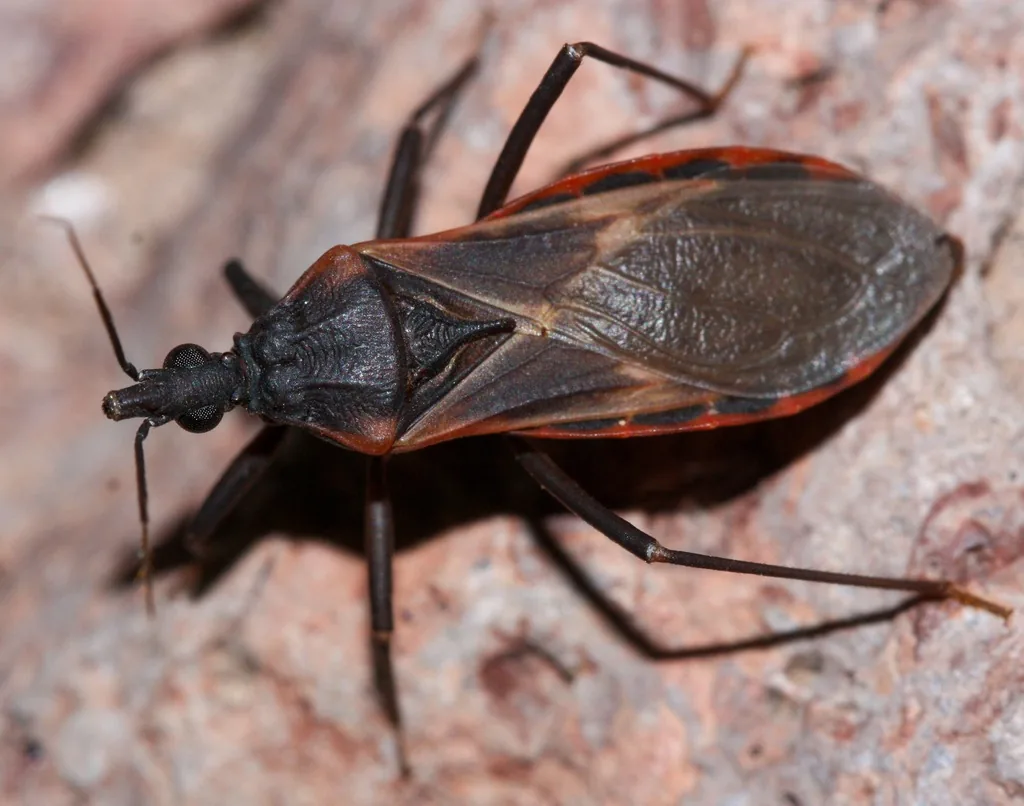
- A large, dark brown or black true bug; kissing bugs as a group run from half an inch to over an inch long (13 to 33 mm), and some species carry patterns on the abdomen.[1]
- Adult T. rubida are larger than T. protracta and are easily told from it by the reddish or brownish-red markings along the sides of the abdomen, visible just outside the folded wings.[1]
- The two species it is most often confused with in Arizona are the other common house-associated kissing bugs: T. protracta, and T. recurva, which is the largest of the three with a uniformly dark pronotum and strongly up-curved edges on its wide abdomen.[1]
- Adults fly well and come to lights after dark; immature bugs cannot fly and crawl to find a blood source. Engorged bugs are often found in bedding or drapes near the bed in the morning.[1]
Look-alikes
| Look-alike | How to tell them apart |
|---|---|
| Other kissing bugs (Triatoma species) | Seven of the 11 US kissing bug species occur in Arizona. T. rubida is separated from T. protracta by its larger size and the reddish side markings on the abdomen; T. recurva is bigger still, with a uniformly dark pronotum and up-curved abdominal edges.[1] |
| Bed bugs | Bed bugs are in the same insect order and also feed on blood, but they have a different life history; kissing bug bites can be confused with bed bug or mosquito bites because the reactions look alike.[1] |
| Western conifer seed bug and other leaf-footed bugs | Harmless plant feeders that also come to lights. Kissing bugs are blood feeders of pack rat nests whose bites raise welts; the Arizona sheet identifies the three dwelling-associated species by size and abdominal markings.[1] |
Where it lives
Found throughout Arizona and most prevalent in the foothill regions of Phoenix and Tucson, where it and T. protracta are the two most common kissing bugs of the Sonoran Desert. Infected T. rubida have also been collected in El Paso County, Texas, and southern New Mexico, including residential areas of El Paso and Las Cruces. Habitat models built from iNaturalist records point to southern Arizona and the northern Mexico border as areas of high potential human contact for this species, with rainfall in the driest quarter the best predictor of its presence.[1][3][4][5]
Biology and life cycle
Kissing bugs usually live outdoors in the nests of Neotoma wood rats (pack rats) and other wildlife, and sometimes in the bedding of doghouses and chicken coops. The Desert Museum names the wood rat as the primary host of T. rubida.[1][2]
Adults are encountered mainly during the dispersal season, May through July, when they fly toward homes attracted by lighting, typically around dusk and early evening. Around Tucson, T. rubida flights peak between 20 June and 5 July and happen mostly at temperatures of 26 to 35 C (79 to 95 F) with wind under 9 miles per hour; humidity and moonlight make little difference.[1][3]
Bugs drawn to porch lights may slip indoors at dawn through gaps around doors and window screens, up from crawlspaces, or on pets, then hide by day in and under furniture, between mattresses and in closets. They find hosts by exhaled gases, skin odors and body warmth, feed mainly at night, and move off the host afterward.[1][2]
Eggs are laid in rodent nests in summer or early fall and hatch in three to five weeks. There are five nymphal stages, each needing a full blood meal; a bug sucks blood in 10 to 30 minutes, takes one to five times its weight, and feeds every week or two when hosts and warm temperatures allow. Nymphs overwinter and molt to adults in spring, adults live into mid- or late autumn, and a female may lay several hundred eggs.[1]
In laboratory rearing on rabbit blood, nymphs generally needed multiple blood meals to molt, although most T. rubida first instars (84 percent) molted after a single meal; intervals before feeding ran from about 6 to 16 days.[6]
Damage and signs
- A blood-feeding household invader rather than a plant or structural pest: it bites sleeping people and animals, usually at night, and engorged bugs turn up in bedding and drapes.[1]
Health risk
Bites are painless at first because the saliva contains an anesthetic, then itch, swell and raise a hard welt that can last days, usually on the face, neck, arms or legs. The biggest risk is allergy: some people become sensitized after repeated bites and develop severe reactions up to anaphylaxis, and anyone with difficulty breathing, low blood pressure or a racing heart after a bite needs emergency care. Kissing bugs carry the Chagas parasite Trypanosoma cruzi in their feces, not their bite; over 40 percent of bugs around Tucson carry it, and 88.5 percent of T. rubida tested from El Paso and Las Cruces were infected, yet transmission to people in the United States is rare (28 locally acquired infections documented from 1955 to 2015) because the bugs transmit poorly and seldom colonize homes. Finding a bug or being bitten does not by itself call for a Chagas test; see a provider if symptoms develop.[1][2][4]
Control
Prevention
Because the bugs fly to light at night, keep doors closed and drapes drawn after dark, move indoor lights away from doors and windows, and switch porch lights to LEDs that emit little ultraviolet. Be most watchful on calm evenings of average temperature from May through early July, the peak flight window.[1][3]
Clean a bite with soap and water; oral antihistamines may ease itching, and severe reactions need medical treatment. Keep the bug in a container to take along; the CDC tests kissing bugs that have contacted people, arranged through the state health department.[1]
Keep them out
Seal cracks and openings as completely as possible with weather stripping, door sweeps and silicone sealant, and screen all windows, doors and vents; at dawn the bugs look for a way in through doorway gaps and torn screens.[1]
Sanitation
Remove harborage: piles of lumber, firewood and debris near the house, and check under flowerpots and outdoor furniture for hiding bugs. Have pets sleep indoors, especially at night.[1]
Traps and physical control
Vacuum up any bugs found indoors, concentrating on cracks, drapes and bedding, and check dark quiet areas, especially sleeping areas, from mid-spring to mid-fall. A bed net tucked under the mattress is the best protection for someone already sensitized to the bites.[1]
When to call a professional
Pest management professionals can remove rodent nests under, against or within about 350 feet of buildings. Leave distant pack rat nests alone so the bugs have somewhere else to live instead of migrating indoors.[1]
Common questions
- How do I know it is T. rubida and not another kissing bug?
- In Arizona the three species found around homes are T. rubida, T. protracta and T. recurva. T. rubida is larger than T. protracta and shows reddish or brownish-red markings along the sides of the abdomen just outside the folded wings; T. recurva is the largest, with a uniformly dark pronotum and up-curved abdominal edges.[1]
- Can I get Chagas disease from it?
- It is possible but rare. The parasite is passed in the bug's feces, which must be scratched into the bite or rubbed into the eyes, nose or mouth. Many Arizona bugs carry the parasite, and most T. rubida tested near El Paso were infected, but only 28 locally acquired human infections were documented in the whole continental United States between 1955 and 2015. Severe allergic reaction to the bites is the bigger danger.[1][4]
- When are they most likely to get into the house?
- During the dispersal flights of May through July, especially the peak from about 20 June to 5 July around Tucson, on evenings between roughly 79 and 95 F with little wind. Adults fly to porch lights and slip indoors at dawn.[1][3]
Sources
- University of Arizona Cooperative Extension, “What You Should Know About Kissing Bugs, az1992 (Li, Gouge, Ruberto, Nair, Fournier and Hall, March 2022).” extension.arizona.edu/sites/default/files/pubs/az1992-2022.pdf (accessed 2026-11-10)
- Arizona-Sonora Desert Museum, “Hemiptera and Homoptera, in A Natural History of the Sonoran Desert (R. Roche).” www.desertmuseum.org/books/nhsd_hemiptera.php (accessed 2026-11-10)
- Insects, abstract via PubMed, “Seasonal flight pattern of the kissing bugs Triatoma rubida and T. protracta in Tucson, Arizona (Insects 13:265, 2022; PubMed 35323563).” doi.org/10.3390/insects13030265 (accessed 2026-11-10)
- Epidemiology and Infection, abstract via PubMed, “Endemic potential of Chagas disease in the U.S. Southwest: updated surveillance of infected triatomines (Epidemiology and Infection 153:e132, 2025; PubMed 41140032).” doi.org/10.1017/S095026882510071X (accessed 2026-11-10)
- Scientific Reports, abstract via PubMed, “Using iNaturalist presence data to produce suitability maps for Triatoma protracta, T. rubida and T. recurva in the American Southwest (Scientific Reports 14:26879, 2024; PubMed 39505998).” doi.org/10.1038/s41598-024-76821-z (accessed 2026-11-10)
- Journal of Medical Entomology, abstract via PubMed, “Laboratory rearing of the kissing bugs Triatoma rubida and T. gerstaeckeri in New Mexico (Journal of Medical Entomology 63:tjag008, 2026; PubMed 41672567).” doi.org/10.1093/jme/tjag008 (accessed 2026-11-10)
- iNaturalist, “Triatoma rubida taxon page (order and family).” www.inaturalist.org/taxa/308569 (accessed 2026-11-10)