On this page
How to identify it
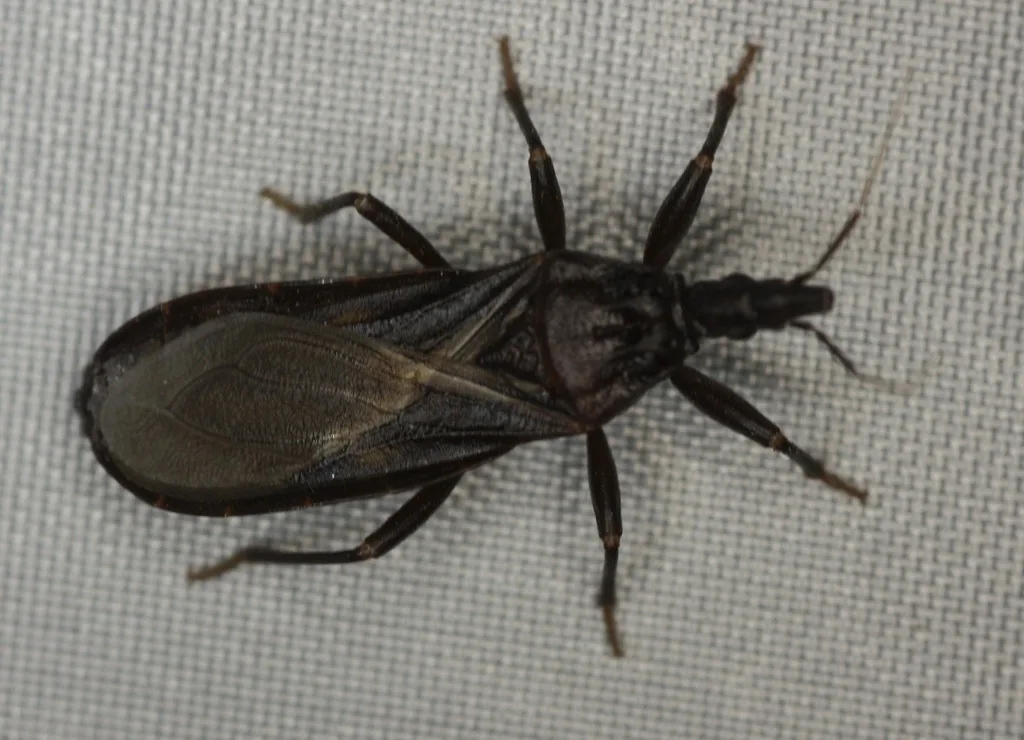
- Adult 1/2 to 3/4 inch long, black to dark brown, sometimes with a tan edge along the sides of the abdomen; the wings lie flat over the back at rest.[1]
- Long, narrow cone-shaped head with conspicuous eyes, four-segmented antennae and a straight, three-segmented beak that folds back under the body.[1]
- Nymphs look like small, wingless adults; wing pads show only in the last nymphal stage.[1]
- Smaller than Triatoma rubida, which is 3/4 to 1 inch long and has reddish or brownish-red markings along the abdomen just outside the folded wings.[1][2]
Look-alikes
| Look-alike | How to tell them apart |
|---|---|
| Triatoma rubida | Larger (3/4 to 1 inch) with reddish or brownish-red side markings on the abdomen; it is the most abundant kissing bug in Arizona, while the western bloodsucking conenose is plain black to dark brown.[1][2] |
| Western corsair (Rasahus thoracicus) | A predatory assassin bug that also comes to porch lights; it is orange and black with an orange spot on each wing, does not need blood, and gives a painful bite if picked up.[1] |
| Bed bugs | Bed bugs are smaller, brown to orange and wingless; conenose bugs are larger, darker, winged as adults and more oblong, with a pointy head.[1] |
| Other kissing bugs | Eleven triatomine species occur in the United States, seven of them in the American Southwest, so a cone-headed bloodsucking bug may be a different species depending on where it is found.[3] |
Where it lives
In California it is most prevalent in the foothills around the Central Valley and in the foothills and desert areas of Southern California. In Arizona it is common in Madera Canyon in Pima County and in Coconino County. A habitat-suitability model built from iNaturalist records found rainfall in the warmest quarter of the year the best predictor of where it occurs, and flagged coastal California, the Sierra Nevada foothills, southern Arizona and the northern Mexico border as zones of highest potential contact with people.[1][2][3]
Biology and life cycle
It lives in the nests of wood rats or pack rats (Neotoma) and other wildlife, and turns up in the bedding of doghouses and chicken coops.[1][2]
The life cycle takes a year. Eggs are laid in summer and autumn and hatch in three to five weeks; each of the five nymphal stages needs a blood meal before molting. Nymphs overwinter and become adults in spring, and adults live into mid- to late autumn.[1]
A blood meal takes 10 to 30 minutes, an engorged bug can hold one to five times its own weight in blood, and bugs feed about every one to two weeks when hosts are available and it is warm.[1]
Adults fly well and are drawn to lights after dark. They may get indoors through door gaps, cracks around window screens and crawlspaces, or by riding on pets, then hide in dark, tight places by day.[1][2]
In 2025 researchers moved the Triatoma protracta species group into a new genus, Hospesneotomae, so newer sources call it Hospesneotomae protracta.[4]
A 2021 investigation of a Mendocino County, California, home where this bug kept turning up found a pack rat infestation, a raised wooden plank floor without a concrete foundation and a dog living indoors; blood-meal tests showed the bugs had fed on people, the dog and snakes.[5]
Damage and signs
- The harm is to people and pets, not property. Bites usually come at night, in groups on the face, neck, arms and legs, mostly in late spring and early summer. They are painless at first but may itch, swell and leave a welt lasting several days.[1]
- Because the bites happen during sleep, people often don't know they were bitten; medical reviews note that allergic reactions typically start at night after a bite on uncovered skin.[6][1]
Health risk
The main medical concern in the United States is allergy rather than Chagas disease. Bites can cause local welts and whole-body reactions up to life-threatening anaphylaxis, and a 2003 review calls Triatoma bites an important cause of anaphylaxis in the western and southwestern states. The bug can carry the parasite that causes Chagas disease, but it spreads through the bug's feces, not the bite, and the CDC says Chagas is not regularly spread by triatomine bugs in the United States.[7][6][5][8][9]
Control
Prevention
White light attracts the bugs, so keep yard lights away from the house and move indoor lights away from doors and windows; UC IPM suggests yellow bulbs, lower wattage or both, especially in late spring and summer.[1][10]
Have pets sleep indoors at night and keep their resting areas clean.[10]
Keep them out
Seal cracks and gaps around windows, walls, roofs and doors with weather stripping, caulk or silicone, screen windows and vents and repair torn screens, seal entrances to attics and crawl spaces, and make pet doors insect-proof.[1][2][10]
Sanitation
Remove wood rat and other rodent nests within 300 feet of the house, and clear piles of lumber, firewood, brush and rock that give the bugs shelter.[1][10]
Traps and physical control
Check beds at night and shake out bedding before getting in; keep beds at least a foot from walls with bedding off the floor, put double-sided sticky tape on bed legs, and in severe cases use a tucked-in mosquito-net tent over the bed.[1]
Pesticides
The CDC says no insecticides are approved specifically for triatomine bugs in the United States and that roach traps don't work on them; talk with a pest control professional before using insecticides.[10]
When to call a professional
If these steps don't solve the problem, contact your local vector control agency or a pest control company.[1]
For a bite, wash the area with soap and water, use a wrapped ice pack and an anti-itch cream or antihistamine if needed. Call 911 for trouble breathing, swelling of the face or mouth, throat tightness or weakness, and use the person's epinephrine kit if they carry one.[11]
Anyone who has had a whole-body reaction should see a physician. There is no commercial skin test or allergy shot for kissing bug bites, so avoiding bites is the main protection, and doctors advise allergic patients to keep an epinephrine auto-injector on hand.[12][6]
Bite allergy
Procalin, a protein in the saliva, is the major allergen of this species. Bites have been known to cause anaphylaxis for more than a century.[6]
Most reported anaphylaxis from kissing bug bites in the United States involves this species and Triatoma rubida, according to a 2015 case report's review of the literature.[12]
In a door-to-door survey in inland Southern California, where this species and another conenose were collected around homes, 13% of people in rural Riverside County reported symptoms that fit an allergy to triatomine bites, compared with 3% in an urban area without the bugs.[13]
In Bisbee and Tucson, Arizona, 11 of 105 people bitten by kissing bugs (10.5%) had a total of 32 episodes of anaphylaxis; this species was uncommon there, and most bugs were Triatoma rubida or T. recurva.[14]
In 1984, five patients with anaphylaxis to this bug were successfully treated with an experimental immunotherapy made from it, but no commercial testing or treatment allergen is available.[15][6]
Chagas disease risk
People get Chagas disease when feces from an infected bug are scratched or rubbed into a bite wound, the eyes or the mouth. It can also spread, rarely, through blood transfusion, organ transplant, from mother to baby, or in contaminated food or drink.[8]
In the 2021 Mendocino County case, one of the bugs collected from the home carried Trypanosoma cruzi, a first for that county, but the man who had been bitten tested negative for Chagas disease. The authors note this species is a known vector of Chagas disease acquired within the United States.[5]
In Arizona studies, more than half of kissing bugs caught in some cities carried the parasite and residents reported more than 2200 bites, yet none of 116 people tested had Chagas disease.[14][16]
Where sources disagree
How much Chagas risk these bugs pose: researchers studying Arizona homes conclude there is little risk to homeowners given how the local bugs behave, while the 2021 California report stresses that this species is a known vector of locally acquired Chagas disease in the United States.[16][14][5]
Insecticides: UC IPM points people to a pest control company if home measures fail, while the CDC notes that no insecticides are approved specifically for triatomine bugs in the United States.[1][10]
Common questions
- Can one bite give me Chagas disease?
- The bite itself does not transmit it. The parasite is in the bug's feces and infects people when feces are scratched into a bite wound or rubbed into the eyes or mouth. The CDC says Chagas disease is present in the United States but not regularly spread by triatomine bugs here.[8][9]
- When are bites most likely?
- Mostly at night in late spring and early summer, when adults fly to lights and enter homes.[1]
- How do I tell it from Triatoma rubida?
- The western bloodsucking conenose is smaller (1/2 to 3/4 inch) and plain black to dark brown; T. rubida is 3/4 to 1 inch with reddish or brownish-red markings along the sides of the abdomen.[1][2]
- Can a kissing bug bite cause a serious allergic reaction?
- Yes. Bites of this species can cause anaphylaxis, often at night during sleep. Call 911 for trouble breathing or swelling of the face or mouth, and see a physician after any whole-body reaction.[5][6][11]
Sources
- University of California Statewide IPM Program, “Pest Notes: Conenose Bugs (UC ANR Publication 7455).” ipm.ucanr.edu/home-and-landscape/conenose-bugs/ (accessed 2026-11-11)
- University of Arizona Cooperative Extension, “What You Should Know About Kissing Bugs, az1992 (Li, Gouge, Ruberto, Nair, Fournier and Hall, March 2022).” extension.arizona.edu/sites/default/files/pubs/az1992-2022.pdf (accessed 2026-11-11)
- Scientific Reports, abstract via PubMed, “Using iNaturalist presence data to produce suitability maps for Triatoma protracta, T. rubida and T. recurva in the American Southwest, Texas and northern Mexico (Hill et al. 2024, Scientific Reports; PubMed 39505998).” pubmed.ncbi.nlm.nih.gov/39505998/ (accessed 2026-11-11)
- Scientific Reports, abstract via PubMed, “Hospesneotomae n. gen. of the Triatomini tribe presents a turnaround in the taxonomy of the Triatoma protracta species complex (de Paiva et al. 2025, Scientific Reports; PubMed 40059180).” doi.org/10.1038/s41598-025-91399-w (accessed 2026-11-11)
- Insects, via PubMed, “Beatty et al. (2021), Anaphylactic reactions due to Triatoma protracta and invasion into a home in northern California, USA.” pubmed.ncbi.nlm.nih.gov/34821818/ (accessed 2026-11-11)
- Annals of Allergy, Asthma and Immunology, via PubMed, “Moffitt et al. (2003), Allergic reactions to Triatoma bites.” pubmed.ncbi.nlm.nih.gov/12952105/ (accessed 2026-11-11)
- Clinical Infectious Diseases, via PubMed, “Klotz et al. (2010), "Kissing bugs": potential disease vectors and cause of anaphylaxis.” pubmed.ncbi.nlm.nih.gov/20462351/ (accessed 2026-11-11)
- Centers for Disease Control and Prevention, “How Chagas Disease Spreads (Feb. 4, 2026).” www.cdc.gov/chagas/spreads/index.html (accessed 2026-11-11)
- Centers for Disease Control and Prevention, “About Chagas Disease (Sept. 4, 2024).” www.cdc.gov/chagas/about/index.html (accessed 2026-11-11)
- Centers for Disease Control and Prevention, “Preventing Chagas Disease (Feb. 4, 2026).” www.cdc.gov/chagas/prevention/index.html (accessed 2026-11-11)
- MedlinePlus, U.S. National Library of Medicine, “Insect bites and stings (Medical Encyclopedia).” medlineplus.gov/ency/article/000033.htm (accessed 2026-11-11)
- Hawaii Journal of Medicine and Public Health, via PubMed, “Anderson and Belnap (2015), The kiss of death: a rare case of anaphylaxis to the bite of the red margined kissing bug.” pubmed.ncbi.nlm.nih.gov/26793414/ (accessed 2026-11-11)
- PLoS One, via PubMed, “Walter et al. (2012), Do bites of kissing bugs cause unexplained allergies? Results from a survey in triatomine-exposed and unexposed areas in southern California.” pubmed.ncbi.nlm.nih.gov/22937146/ (accessed 2026-11-11)
- American Journal of Medicine, via PubMed, “Behrens-Bradley et al. (2019), Kissing bugs harboring Trypanosoma cruzi frequently bite residents of the US Southwest but do not cause Chagas disease.” pubmed.ncbi.nlm.nih.gov/31295438/ (accessed 2026-11-11)
- Journal of Allergy and Clinical Immunology, via PubMed, “Rohr, Marshall and Saxon (1984), Successful immunotherapy for Triatoma protracta-induced anaphylaxis.” pubmed.ncbi.nlm.nih.gov/6366033/ (accessed 2026-11-11)
- Insects, via PubMed, “Klotz, Smith and Schmidt (2021), Kissing bug intrusions into homes in the Southwest United States.” pubmed.ncbi.nlm.nih.gov/34357314/ (accessed 2026-11-11)
- iNaturalist, “Hospesneotomae protracta taxon page (order and family).” www.inaturalist.org/taxa/1613183 (accessed 2026-11-10)