The short answer
- Most assassin bugs are predators, not pests. The wheel bug, the largest North American species, is gray with a cog-shaped crest on its back. Texas A&M AgriLife Extension and Missouri Department of Conservation both call assassin bugs beneficial, and Texas A&M says they don't need insecticide sprays.[2][6][5]
- They bite only when handled, slapped or pinned against skin. Mississippi State says some assassin bug bites hurt as much as or more than a bee or wasp sting. Missouri Department of Conservation says to brush one off rather than crush it.[3][5][6]
- A wheel bug, masked hunter or western corsair is not a kissing bug. CDC lists the wheel bug and western corsair as common look-alikes that do not carry the Chagas parasite, and Texas A&M's kissing bug program says no insects other than kissing bugs are known to carry it. A painful bite also points away from a kissing bug, whose bites are generally painless.[14][16][18]
- For a bite, MedlinePlus advice for most insect bites applies: wash with soap and water, use a wrapped ice pack, and watch for infection. Call 911 for trouble breathing or swelling of the face, mouth or throat.[17]
Related profiles
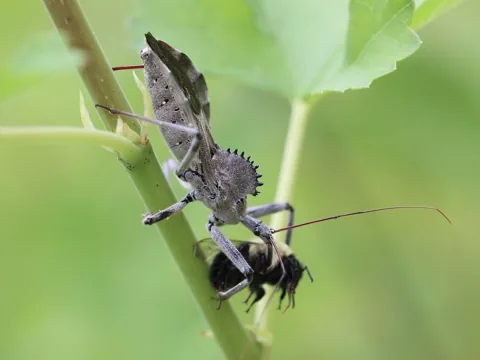 Wheel Bug
Arilus cristatus
The wheel bug is the largest assassin bug in North America, named for the toothed crest on its back. It hunts caterpillars and other insects, but it gives an immediately painful bite if handled carelessly.
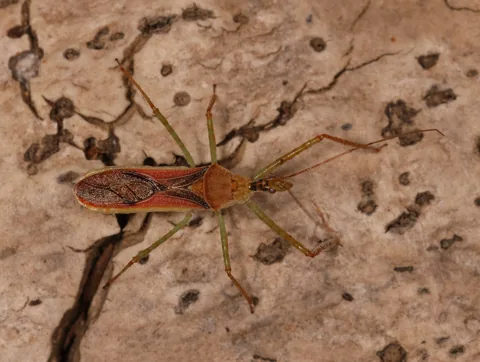 Assassin Bugs
Zelus and Sinea species (shown: Zelus renardii)
Assassin bugs are stalking and ambushing predators with a needlelike beak. They kill caterpillars, other bugs and bees alike, and they can deliver a painful bite if handled.
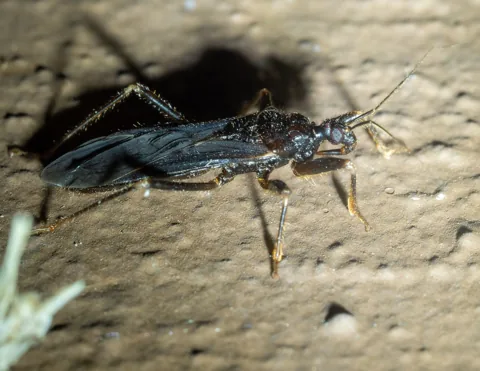 Masked Hunter
Reduvius personatus
The masked hunter is a predatory assassin bug that often lives inside homes and hunts other insects at night. It doesn't feed on blood, but it gives a painful bite if it is handled or pressed against skin.
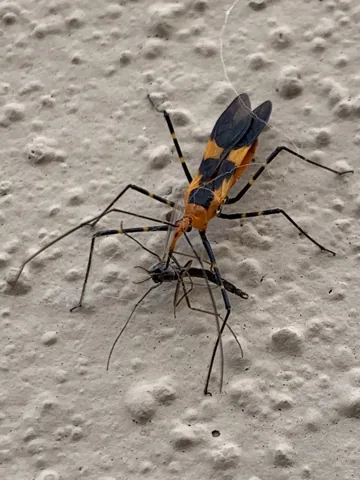 Milkweed assassin bug
Zelus longipes
The milkweed assassin bug is a long-legged, orange and black predator of gardens and fields. Some color forms may mimic the milkweed bug. It is a beneficial insect, but like other assassin bugs it can give a painful bite if handled carelessly.
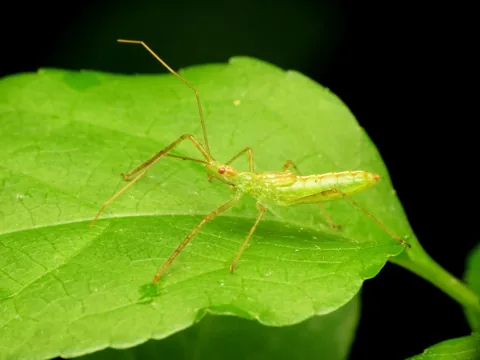 Pale Green Assassin Bug
Zelus luridus
The pale green assassin bug is a slender, long-legged green bug that hunts other insects on the leaves of trees and shrubs. It is a beneficial predator, but like other assassin bugs it can bite if handled carelessly.
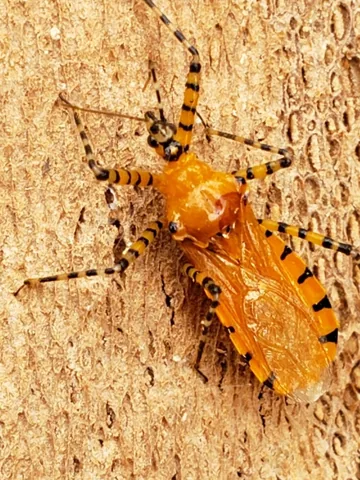 Orange assassin bug
Pselliopus barberi
The orange assassin bug, also called the sycamore assassin bug, is a half-inch, golden-orange predator with black-banded legs and antennae. It hunts other insects on wildflowers and woodland plants, then spends the winter as an adult in groups under loose bark, sometimes more than 100 together.
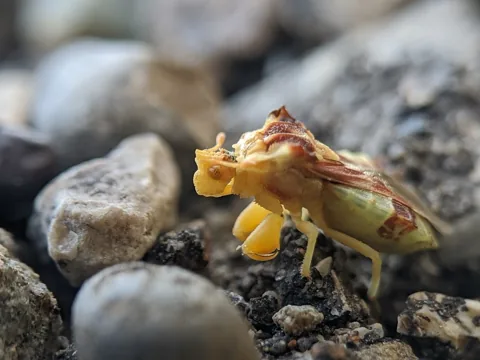 Ambush Bugs
Phymata species (jagged ambush bugs)
Ambush bugs are stout little relatives of assassin bugs that wait, perfectly camouflaged, inside flower heads for a pollinator to land within reach.
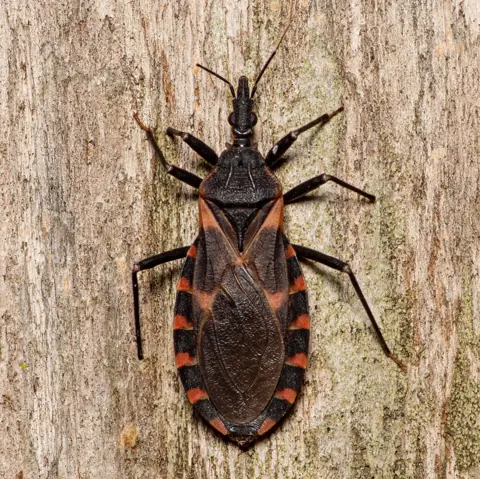 Eastern Bloodsucking Conenose
Triatoma spp. (shown: T. sanguisuga)
Kissing bugs are blood-feeding insects, active mostly at night, that can carry Trypanosoma cruzi, the parasite that causes Chagas disease. They have been found in 29 U.S. states, and studies of bugs collected in the United States have found the parasite in roughly one in six to nearly two in three of those tested, depending on the place.
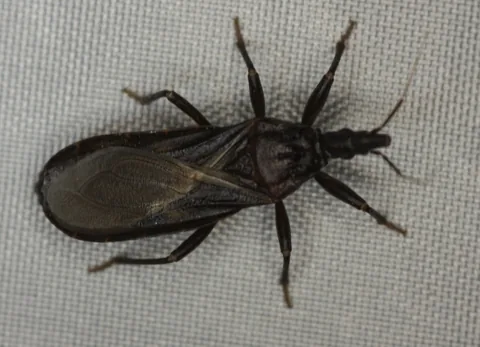 Western bloodsucking conenose
Hospesneotomae protracta
The western bloodsucking conenose (Hospesneotomae protracta, formerly Triatoma protracta) is the most important kissing bug in California and one of the three species most often found around homes in Arizona. It normally lives in the nests of wood rats (pack rats) and other wildlife, but adults fly to lights at night, get into houses and may feed on sleeping people. The bite is painless, yet it can leave itchy, swollen welts, and in people who become allergic it can trigger anaphylaxis.
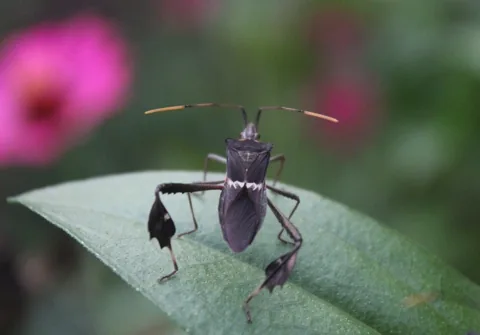 Leaffooted Bug
Leptoglossus zonatus
Leaffooted bugs are medium to large sap-feeding bugs named for the small leaf-like flaps on their hind legs. They pierce fruits, vegetables and nuts to feed, especially on the seeds, and gardeners most often find them on tomatoes and pomegranates.
What assassin bugs are
Missouri Department of Conservation counts nearly 200 assassin bug species in North America north of Mexico, Clemson Extension gives about 160, and Texas A&M about 150; UC IPM puts the world total at about 7,000. They share a narrow head, long legs and a three-segmented beak that folds into a groove under the body when not in use.[5][4][2][1]
Most are black, gray or brown, though some are orange, red or green. UC IPM gives adult lengths of about 1/5 to 1-1/4 inches (5 to 30 mm), depending on species, and Missouri Department of Conservation says up to 1½ inches.[5][2][1]
Like other true bugs they have no pupal stage. Eggs hatch into wingless nymphs that pass through five nymphal stages before becoming winged adults, according to UC IPM and Clemson. Clemson says the eggs are laid in rows or clusters of 10-70 on bark or leaves, glued down standing upright and shaped like little flasks with a stopper. Most species have one or two generations a year.[1][4]
Assassin bugs you're likely to see
The family has many shapes. These are the ones that most often turn up in gardens, on porches or indoors.[5][1]
- Wheel bug (Arilus cristatus): gray to brownish, about 1¼ to 1½ inches long, with a cog-like crest on top of the thorax that Missouri Department of Conservation compares to the blade of a circular saw. See the next section.[2][6][5]
- Zelus assassin bugs, including the leafhopper assassin bug (Zelus renardii) and the milkweed assassin bug (Zelus longipes): slender, long-legged bugs on plants. Mississippi State says Zelus species have sticky hairs on their front legs for holding small prey such as flies and leafhoppers, and Texas A&M calls the orange-and-black milkweed assassin bug the most distinctive species.[1][3][2]
- Spined assassin bugs (Sinea): spiny-legged bugs about ½ inch long, according to Missouri Department of Conservation. UC IPM says their abdomen widens toward the rear, unlike the parallel-sided abdomen of Zelus, and their egg caps open into a fringed umbrella shape.[7][1]
- Bee assassins (Apiomerus): Galveston County Master Gardeners (Texas A&M AgriLife) describe them as usually dark with yellow or red markings along the sides of the abdomen, with sticky hairs on the front legs, and as better fliers than most assassin bugs. Researchers at UC Riverside say the group has more than 108 species and catches prey with plant resin that they gather on their front legs.[8][20][21]
- Masked hunter (Reduvius personatus): a dark brown to black bug that lives indoors and hunts other household insects. Its nymphs coat themselves in dust and lint. See the section on assassin bugs indoors.[9][10]
- Western corsair (Rasahus thoracicus): UC IPM describes an orange and black assassin bug with an orange spot on each wing that is attracted to lights around homes. It is shaped somewhat like a conenose bug but eats insects, and UC IPM says it can give a most painful bite if picked up.[13]
- Ambush bugs: Texas A&M and Missouri Department of Conservation describe small, well-camouflaged assassin bugs that wait on flowers for prey.[2][5]
Wheel bugs up close
Texas A&M calls the wheel bug the largest of the roughly 150 assassin bugs known from North America, at about 3 cm (1¼ inches) long; Missouri Department of Conservation gives up to 1½ inches and Clemson gives 1 to 1.5 inches. Adults are gray or brownish. Only adults have the crest, Missouri Department of Conservation says.[2][6][4]
Missouri Department of Conservation describes one brood a year. Adults mate in autumn and females lay six-sided clusters of brown, cylinder-shaped eggs on trees and other solid objects. The nymphs hatch in spring, are red with black legs and can look like ants or spiders, and reach adulthood around midsummer.[6]
Wheel bugs tackle bigger prey. Texas A&M lists grasshoppers and large caterpillars, and Missouri Department of Conservation mentions Japanese beetles. Missouri Department of Conservation says wheel bugs fly noisily and clumsily, are secretive, and bite only when mishandled.[2][6]
Assassin bug or kissing bug?
Kissing bugs (Triatoma) belong to the same family but feed on blood and can carry the parasite that causes Chagas disease. The kissing bug guide covers them in detail; these are the quickest checks.[1][14]
- Crest: Texas A&M says kissing bugs have the same long head as a wheel bug but no crest.[2]
- Body edge: Texas A&M's kissing bug program says all U.S. kissing bugs are mainly black or very dark brown with red, orange or yellow stripes around the edge of the body.[16][2]
- Beak: kissing bugs have a straight beak tucked under the body, according to Texas A&M and UC IPM. Predatory assassin bugs have the stout, curved beak Texas A&M describes on the wheel bug.[15][13][2]
- Legs: Texas A&M says kissing bug legs are all thin and long with no thicker parts. Missouri Department of Conservation says most assassin bugs have a thickened first segment on the front legs.[15][5]
- Bite: a 2023 dermatology review in Cutis says wheel bug bites are painful while kissing bug bites are painless. Texas A&M likewise says kissing bug bites are generally not painful because the bugs try to feed unnoticed.[18][16]
- Still unsure: Texas A&M asks people to send photos of suspected kissing bugs, and its look-alike gallery includes wheel bugs, bee assassins (Apiomerus), Zelus and Microtomus assassin bugs.[16]
What an assassin bug bite feels like
Texas A&M says the wheel bug bite is immediately and intensely painful. Mississippi State says some assassin bug bites are as painful as a bee or wasp sting or worse, because of the saliva they inject, and that bites happen when a bug is mishandled or trapped between skin and clothing. Galveston County Master Gardeners say most bites come from accidental contact while gardening or working outdoors, and describe intense burning followed by a small, itchy lump that may last several days.[2][3][8]
Masked hunter bites are similar. Penn State Extension says the bite is about as painful as a honey bee sting and takes up to a week to heal, and University of Minnesota Extension describes a bee-sting feeling followed by numbness and swelling.[9][10]
- Skin reaction: the 2023 Cutis review says bites from wheel bugs and kissing bugs commonly show up as a red, itchy bump that can turn into a hive-like welt, and that treatment ranges from creams for a local reaction to systemic drugs if anaphylaxis occurs.[18]
- How long it lasts: in a 2019 case report, a man bitten by a Zelus assassin bug hidden in his boot had sharp pain, local swelling and itching for 15 days, and recovered fully after 21 days.[19]
- Allergy: Penn State says it found no reports in the medical literature of allergic reactions or anaphylaxis from masked hunter bites. As with any insect bite, MedlinePlus says some people can have a severe whole-body reaction.[9][17]
- Disease: University of Minnesota says masked hunters do not transmit any disease, and CDC says the wheel bug and western corsair do not carry the Chagas parasite.[10][14]
Caring for a bite
University of Minnesota says a masked hunter bite generally does not need medical attention. MedlinePlus gives these general steps for most insect bites and stings.[10][17]
- Wash the bite well with soap and water.[17]
- Put ice wrapped in a washcloth on the spot for 10 minutes, then off for 10 minutes, and repeat.[17]
- If needed, take an antihistamine or use a cream that reduces itching.[17]
- Over the next several days, watch for signs of infection such as increasing redness, swelling or pain.[17]
- Pain relievers: MedlinePlus says not to give aspirin or other pain medicine unless a health care provider prescribes it. Ask a doctor or pharmacist what is safe for you.[17]
- Call 911 if the person has trouble breathing, wheezing, swelling of the face or mouth, throat tightness or trouble swallowing, feels weak or turns blue. If they carry an epinephrine kit for insect allergies, MedlinePlus says to use it.[17]
Assassin bugs indoors
A few assassin bugs come inside. UC IPM says Zelus adults often overwinter and may be seen on walls and windows in fall as they look for shelter, and Texas A&M says at least one Zelus species has been reported as a household invader in fall and winter. UC IPM says the western corsair is attracted to lights around homes.[1][2][13]
The masked hunter is the one that lives indoors. Penn State says it hides by day under heat registers and cabinets, in wall voids and in attics, and hunts at night for silverfish, booklice, house centipedes, carpet beetles, bed bugs, overwintering lady beetles and cluster flies. University of Minnesota says both adults and nymphs are drawn to lights and can wander in, and that usually only one or a few are seen in a home.[9][10]
- Size and look: Penn State and University of Wisconsin give 17-22 mm long; Minnesota says about 3/4 inch and Utah State says 9/10 inch. Adults are dark brown to black and somewhat glossy. Nymphs are lighter but hidden under dust and lint glued to their bodies, so they look like moving dust balls.[9][11][10][12]
- Lifespan: Penn State says adults typically live 65–90 days but have been recorded living as long as 217 days, so a few turn up in winter. University of Wisconsin says adults are most common in midsummer.[9][11]
- Removal: University of Minnesota suggests catching one in a jar and releasing it outdoors, and gently brushing one away if it lands on you.[10]
- Long-term fix: Penn State and University of Wisconsin both say the way to get rid of masked hunters is to get rid of the insects they eat. Wisconsin adds sealing and screening openings, vacuuming cracks and crevices and setting sticky traps in corners and under furniture. Utah State suggests door sweeps on doors to the outside or into a garage.[9][11][12]
- Spraying: the sources differ. University of Minnesota says insecticides should not be necessary. Penn State says broad-spectrum insecticides used against the underlying pest may also cut masked hunter numbers, and Wisconsin says most indoor sprays kill both.[10][9][11]
Do they help the garden?
Some, but how much depends on whom you ask.[2][1]
- The case for: Texas A&M says assassin bugs are of great benefit to gardeners, and Clemson lists fall webworms, tent caterpillars, Mexican bean beetles and June beetles among their prey. Mississippi State cites a study in which the leafhopper assassin bug consumed 72 to 99 percent of the body weight of tobacco budworm caterpillars it attacked.[2][4][3]
- The case against: UC IPM says assassin bugs are not considered important in biological control, unlike bigeyed bugs and minute pirate bugs, because they are general predators that also eat bees, lacewings, lady beetles and other beneficial insects. Mississippi State says they are rarely numerous enough to make a big dent in pests, though they will feed on caterpillars during heavy infestations.[1][3]
- Bee assassins and honey bees: Galveston County Master Gardeners say bee assassins are often said to threaten honey bee populations but that they have not seen research-based findings to support or dispute it, and that in their demonstration gardens the bugs are mostly seen on leaves and stems that honey bees are unlikely to visit.[8]
- Spraying: Texas A&M says control is not recommended because assassin bugs are generally not abundant and don't require insecticide sprays.[2]
Living with them without getting bitten
Missouri Department of Conservation says it is easy to avoid getting bitten.[5]
- Don't pick them up. Texas A&M says the wheel bug in particular bites if picked up and handled carelessly.[2]
- Brush, don't slap. Missouri Department of Conservation says assassin bugs sometimes land on people and can be brushed off easily, and that crushing or slapping them generally makes them bite.[5][6]
- Watch where they hide. Mississippi State says bites happen when a bug is trapped between skin and clothing, Penn State mentions masked hunters squished inside a shoe, and the 2019 case report involved a bug hidden in a boot.[3][9][19]
- Leave them be outdoors. Clemson's advice is simple: treat them with respect and don't smash them.[4]
Common questions
- Is a wheel bug dangerous?
- Not unless you handle it. Texas A&M says the bite is immediately and intensely painful, and Missouri Department of Conservation says wheel bugs bite only when mishandled. CDC says wheel bugs do not carry the parasite that causes Chagas disease.[2][6][14]
- Can an assassin bug bite give you Chagas disease?
- Predatory assassin bugs are not known to. Texas A&M's kissing bug program says no insects other than kissing bugs are known to carry the Chagas parasite, and CDC lists the wheel bug and western corsair as look-alikes that do not carry it.[16][14]
- How long does an assassin bug bite hurt?
- Galveston County Master Gardeners describe an intense burning that is often followed by a small, itchy lump lasting several days. Penn State says a masked hunter bite takes up to a week to heal, and in one 2019 case report a Zelus bite itched for 15 days before clearing up fully by day 21.[8][9][19]
- Should I kill assassin bugs in my garden?
- Texas A&M and Clemson say no: they are predators and don't need spraying. UC IPM notes they also eat beneficial insects, so don't expect them to control pests on their own.[2][4][1]
Photo credits
- Wheel Bug: Andy Wilson, public domain (CC0), via iNaturalist
- Assassin Bugs: (c) Joey Bom, some rights reserved (CC BY) — via iNaturalist, CC BY 4.0
- Masked Hunter: (c) Forest Botial-Jarvis, some rights reserved (CC BY) — via iNaturalist, CC BY 4.0
- Milkweed assassin bug: (c) Sandra H Statner, some rights reserved (CC BY) — via iNaturalist, CC BY 4.0
- Pale Green Assassin Bug: (c) Katja Schulz, some rights reserved (CC BY) — via iNaturalist, CC BY 4.0
- Orange assassin bug: (c) Mark Richman, some rights reserved (CC BY) — via iNaturalist, CC BY 4.0
- Ambush Bugs: Alex Heyman, public domain (CC0), via iNaturalist
- Eastern Bloodsucking Conenose: (c) Justin Williams, some rights reserved (CC BY) — via iNaturalist, CC BY 4.0
- Western bloodsucking conenose: (c) Andrew Meeds, some rights reserved (CC BY) — via iNaturalist, CC BY 4.0
- Leaffooted Bug: (c) Ricard Busquets Reverte, some rights reserved (CC BY) — via iNaturalist, CC BY 4.0
Sources
- UC Statewide IPM Program, “Assassin Bugs (Natural Enemies Gallery).” ipm.ucanr.edu/natural-enemies/assassin-bugs/ (accessed 2026-11-10)
- Texas A&M AgriLife Extension, Insects in the City, “Wheel bugs and other assassin bugs, ENT-1003.” citybugs.tamu.edu/factsheets/landscape/others/ent-1003/ (accessed 2026-11-10)
- Mississippi State University Extension Service, “Assassin Bug, Bug's Eye View No. 18.” extension.msstate.edu/newsletters/bugs-eye-view/2015/assassin-bug-no-18 (accessed 2026-11-10)
- Clemson Cooperative Extension Home & Garden Information Center, “Assassin Bugs, HGIC 2472.” hgic.clemson.edu/factsheet/assassin-bugs/ (accessed 2026-11-10)
- Missouri Department of Conservation, “Assassin Bugs (Field Guide).” mdc.mo.gov/discover-nature/field-guide/assassin-bugs (accessed 2026-11-10)
- Missouri Department of Conservation, “Wheel Bug (Field Guide).” mdc.mo.gov/discover-nature/field-guide/wheel-bug (accessed 2026-11-10)
- Missouri Department of Conservation, “Spiny Assassin Bug (Field Guide).” mdc.mo.gov/discover-nature/field-guide/spiny-assassin-bug (accessed 2026-11-10)
- Galveston County Master Gardeners, Texas A&M AgriLife Extension, “Bee Killer Assassin Bug (Beneficials in the Garden and Landscape).” txmg.org/galveston/beneficials-in-the-garden-and-landscape/bee-killer-assassin-bug (accessed 2026-11-10)
- Penn State Extension, “Masked Hunter.” extension.psu.edu/masked-hunter (accessed 2026-11-10)
- University of Minnesota Extension, “Masked hunters.” extension.umn.edu/household-insects/masked-hunters (accessed 2026-11-10)
- University of Wisconsin-Madison Division of Extension, Wisconsin Horticulture, “Masked Hunter Bug.” hort.extension.wisc.edu/articles/masked-hunter-bug/ (accessed 2026-11-10)
- Utah State University Extension, “Masked Hunter.” extension.usu.edu/planthealth/ipm/notes_nuisance/masked-hunter (accessed 2026-11-10)
- UC Statewide IPM Program, “Conenose Bugs, Pest Notes.” ipm.ucanr.edu/home-and-landscape/conenose-bugs/ (accessed 2026-11-10)
- Centers for Disease Control and Prevention, “How Chagas Disease Spreads.” www.cdc.gov/chagas/spreads/index.html (accessed 2026-11-10)
- Texas A&M University, Kissing Bugs & Chagas Disease program, “Kissing Bugs and Chagas Disease: Frequently Asked Questions.” kissingbug.tamu.edu/faq/ (accessed 2026-11-10)
- Texas A&M University, Kissing Bugs & Chagas Disease program, “Found a Bug?.” kissingbug.tamu.edu/found-a-bug/ (accessed 2026-11-10)
- MedlinePlus, U.S. National Library of Medicine, “Insect bites and stings (Medical Encyclopedia).” medlineplus.gov/ency/article/000033.htm (accessed 2026-11-10)
- Cutis, via PubMed, “Boswell and Elston (2023), What's Eating You? Triatoma and Arilus cristatus Bugs, Cutis 111(6):289-291.” pubmed.ncbi.nlm.nih.gov/37487132/ (accessed 2026-11-10)
- Wilderness & Environmental Medicine, via PubMed, “Pereira dos Santos et al. (2019), Bite Caused by the Assassin Bug Zelus in a Human, Wilderness Environ Med 30(1):63-65.” pubmed.ncbi.nlm.nih.gov/30638665/ (accessed 2026-11-10)
- Molecular Phylogenetics and Evolution, via PubMed, “Forero, Berniker and Weirauch (2013), Phylogeny and character evolution in the bee-assassins, Mol Phylogenet Evol 66(1):283-302.” pubmed.ncbi.nlm.nih.gov/23079616/ (accessed 2026-11-10)
- Journal of Morphology, via PubMed, “Forero, Choe and Weirauch (2011), Resin gathering in neotropical resin bugs, J Morphol 272(2):204-229.” pubmed.ncbi.nlm.nih.gov/21210491/ (accessed 2026-11-10)