How to identify it
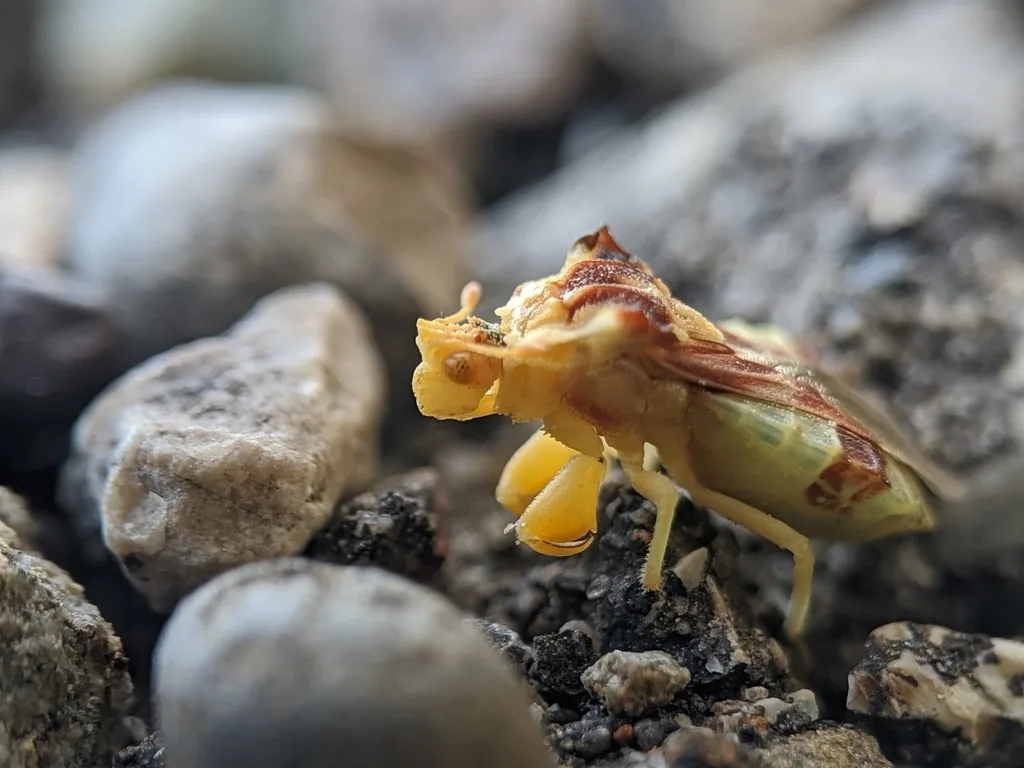
- Adults are up to about 3/5 inch long and broader and stouter than assassin bugs, with a short head and no distinct neck.[1]
- The front legs are thick and shaped for grabbing, a little like a praying mantis's.[1][2]
- Many are cream, bright yellow, red or green with patterns that blend into the flowers where they hide.[1]
- Nymphs look like small, wingless adults.[1]
Look-alikes
| Look-alike | How to tell them apart |
|---|---|
| Assassin bugs | Assassin bugs are longer and slimmer with a narrow head and a visible neck, and they stalk prey rather than waiting in one spot.[1] |
| Praying mantids | Both grab prey with raptorial front legs, but mantids chew their prey while ambush bugs pierce it and suck out the fluids.[2] |
Where it lives
Look for them on flowers and wildflowers, especially yellow and white blooms. They become more numerous as the season goes on and are especially common on goldenrod.[1]
Biology and life cycle
About 300 species are known, and most spend the winter as adults.[1]
When an insect comes close, the bug seizes it with its front legs and stabs it with its beak.[1]
Venomous saliva paralyzes the prey and liquefies its insides, which the bug then sucks out.[2]
Young ambush bugs live on other parts of the plant and feed on small soft-bodied insects and mites.[3]
Damage and signs
Health risk
They don't seek people out, but they can give a painful little bite if mishandled, so look without touching.[2]
Control
Prevention
No control is needed; Washington State recommends no chemical management for them.[3]
Biological control
Flowering plants give them hunting grounds, and avoiding broad-spectrum insecticides helps keep them around.[1]
Adults mostly catch flower visitors, while the nymphs contribute more to garden pest control by eating small soft-bodied insects and mites.[3]
Common questions
- Do ambush bugs kill bees?
- Yes. Bees are among the flower visitors they catch, along with flies, wasps and butterflies.[1][3]
- Can an ambush bug bite?
- It can give a painful little bite if you handle it, so warn children to look and not touch.[2]
- Where should I look for one?
- Search goldenrod and other yellow or white flower heads late in the season, where their colors blend in.[1]
Sources
- University of Maryland Extension, “Ambush bugs.” www.extension.umd.edu/resource/ambush-bugs (accessed 2026-10-06)
- Mississippi State University Extension Service, “Bug's Eye View: Ambush Bug, Vol. 3, No. 29.” extension.msstate.edu/newsletters/bugs-eye-view/2017/ambush-bug-vol-3-no-29 (accessed 2026-10-06)
- Washington State University Extension, “Predatory Bugs: Ambush bugs (HortSense).” hortsense.cahnrs.wsu.edu/fact-sheet/predatory-bugs-ambush-bugs/ (accessed 2026-10-06)
- iNaturalist, “Phymata taxon page (order and family).” www.inaturalist.org/taxa/119535 (accessed 2026-10-06)