On this page
How to identify it
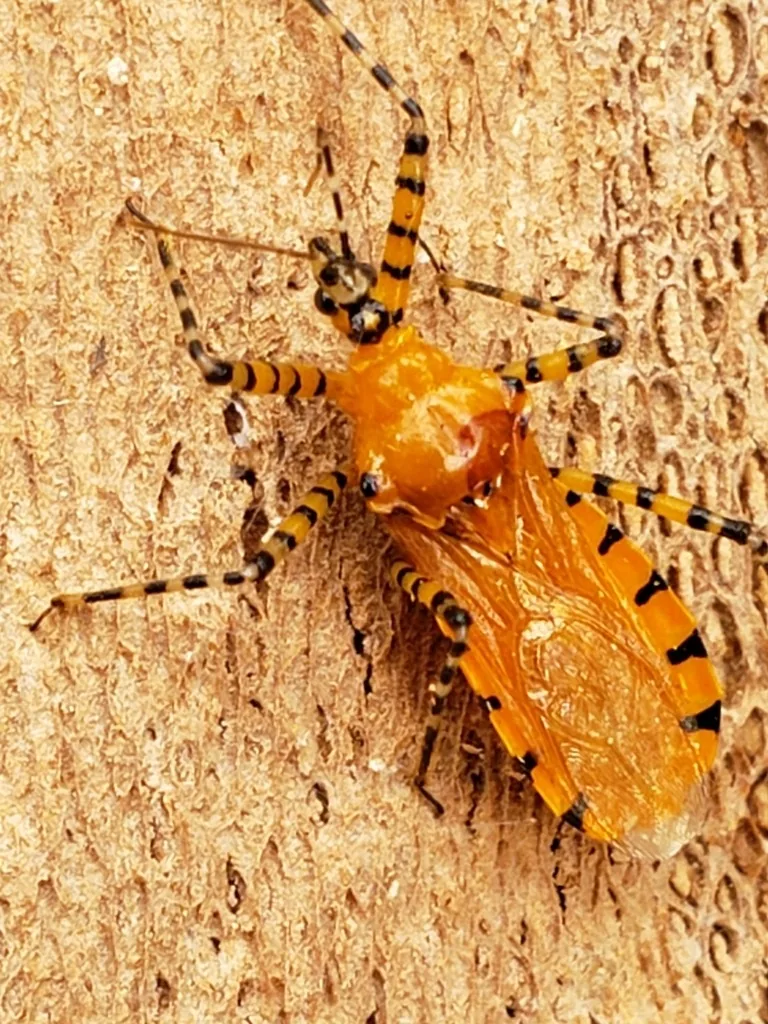
- Adults are up to about 1/2 inch long and golden orange, and they tend to be brighter orange than their close relatives in the same genus.[1][2]
- The legs and antennae are ringed with black (black and white, in the museum's description of the genus), and a row of black marks runs along the outer edge of the abdomen.[1][2]
- Many specimens show white streaks on each side of the scutellum and white dots along the sides of the body. These are fluffy secretions whose origin and purpose are unknown.[2]
Look-alikes
| Look-alike | How to tell them apart |
|---|---|
| Pselliopus cinctus | This close relative has very similar patterning but is usually more brownish or tan and less orange, and it differs in several subtle markings.[1][2] |
| Pselliopus latifasciatus | Another colorful Pselliopus commonly collected in Arkansas; the orange assassin bug tends to have a brighter orange background color.[2] |
Where it lives
It occurs from southern Pennsylvania to northern Florida and west to Missouri, Kansas, Oklahoma and Texas, and is found statewide in Missouri.[2][1]
Biology and life cycle
It is a generalist predator of other insects. In summer, adults hunt on plants such as wildflowers in open areas; in spring and fall they are often seen on tree trunks in wooded areas.[2][1]
It lives in woodlands and along woodland edges on many kinds of plants, including plum, oak, elm and sycamore trees.[2]
Adults spend the winter in groups under loose bark, rocks, logs and leaves. Large numbers have been found in curled sycamore leaves and rolled sycamore bark, and one aggregation held more than 100 bugs. Despite the name sycamore assassin bug, it isn't known whether it has any special preference for sycamores.[1][2]
There is one generation a year. Adults mate in spring, nymphs are the main stage in summer, and most adults are collected in September and October.[2][1]
Like other assassin bugs, it develops through five nymphal stages before becoming an adult.[3]
Damage and signs
Health risk
MDC tags it as venomous. Assassin bugs can give a painful bite if handled carelessly; the pain comes from the toxic saliva they inject to subdue their insect prey.[1][3]
Control
Prevention
Leave it alone. Clemson describes assassin bugs as beneficial predators that should be treated with respect, since they can bite if handled carelessly.[3]
Common questions
- Why is there a cluster of orange bugs under the bark of my tree?
- Orange assassin bugs spend the winter as adults packed together under loose bark and in tree crevices. More than 100 have been recorded in a single group.[1][2]
- Does the orange assassin bug bite?
- It can. Clemson warns that assassin bugs can deliver a painful bite if handled carelessly, caused by the toxic saliva they inject, and MDC tags this species as venomous.[3][1]
- What are the white marks on its sides?
- They are fluffy (flocculent) secretions, white streaks beside the scutellum and white dots along the sides of the body. Their origin and purpose are not known.[2]
Sources
- Missouri Department of Conservation, “Orange Assassin Bug (Field Guide).” mdc.mo.gov/discover-nature/field-guide/orange-assassin-bug (accessed 2026-11-09)
- University of Arkansas Arthropod Museum, “Sycamore assassin bug, Pselliopus barberi (Arthropod Museum species page).” arthropod.uark.edu/?p=27449 (accessed 2026-11-09)
- Clemson Cooperative Extension, Home & Garden Information Center, “Assassin Bugs, HGIC 2472 (A. Hagerty, P. Zungoli and E. Benson).” hgic.clemson.edu/factsheet/assassin-bugs/ (accessed 2026-11-09)
- iNaturalist, “Pselliopus barberi taxon page (order and family).” www.inaturalist.org/taxa/82026 (accessed 2026-11-09)