On this page
How to identify it
- Adults are elongate, about 14-16 mm, yellow-green to reddish brown with tan or brown wings, a narrow head and a pair of spines on the back corners of the shoulder plate.[1][2]
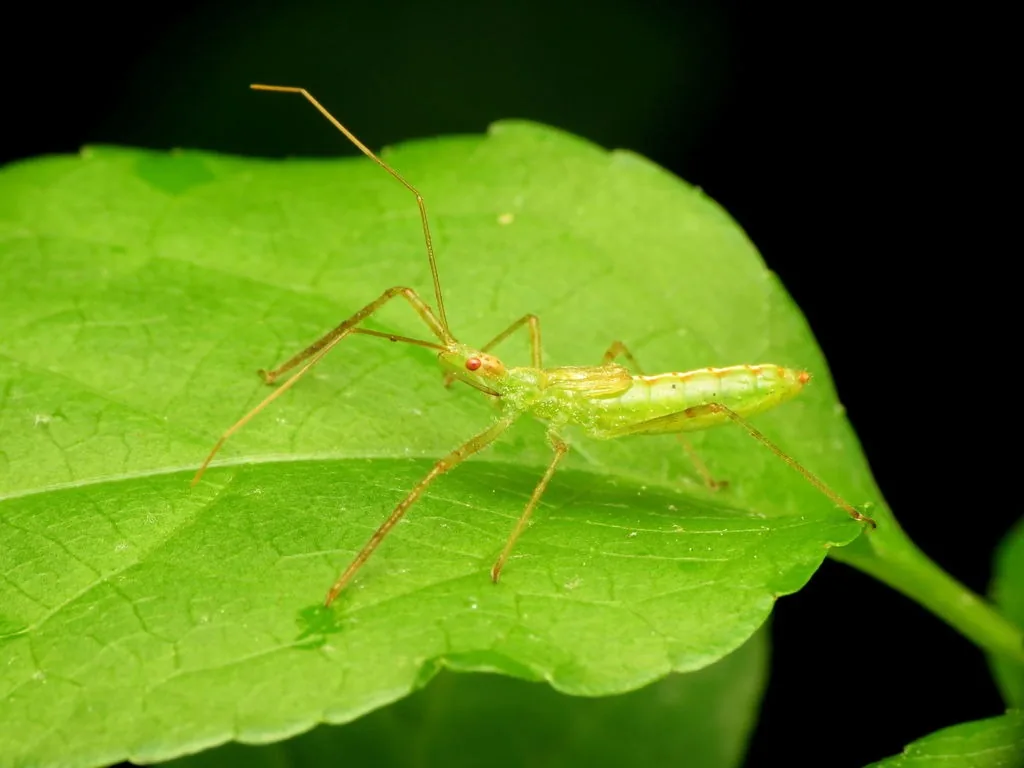
- Nymphs are narrower, wingless and green.[1]
- Egg masses of a couple dozen eggs glued together stand upright on leaves in a cone with a flat top, and are the stage most often noticed.[1]
Where it lives
Associated with deciduous trees and shrubs in woods and yards; CSU reports it along Colorado's Front Range and MDC in Missouri.[1][2]
Biology and life cycle
It overwinters as a late-stage nymph in fallen leaves; adults appear in late spring and females lay a series of egg masses.[1]
It ambushes prey from leaves or hunts actively, taking small flies, wasps, sawflies and caterpillars.[1]
Damage and signs
- It does no plant damage; it preys on other insects.[1]
Health risk
Control
Prevention
No control is needed; it is a natural enemy of plant-feeding insects.[1]
Common questions
Sources
- Colorado State University Extension (Colorado Insects of Interest, W. Cranshaw), “Zelus luridus, A Common Assassin Bug (Colorado Insect of Interest).” wci.extension.colostate.edu/wp-content/uploads/sites/14/2017/04/Zelus.luridus-1.pdf (accessed 2026-10-15)
- Missouri Department of Conservation, “Pale Green Assassin Bug (Field Guide).” mdc.mo.gov/discover-nature/field-guide/pale-green-assassin-bug (accessed 2026-10-15)
- iNaturalist, “Zelus luridus taxon page (order and family).” www.inaturalist.org/taxa/1580611 (accessed 2026-10-06)