On this page
How to identify it
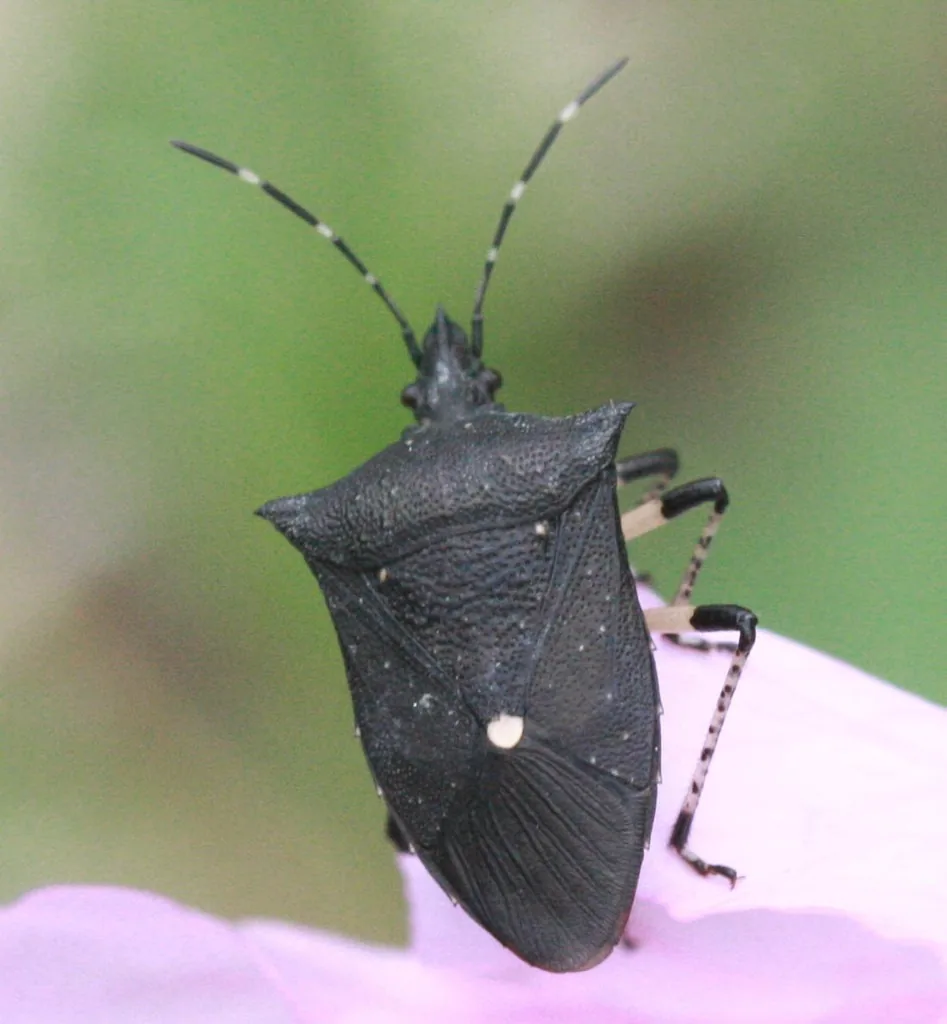
- Adults are black, about 11 to 13 mm long, with black and cream legs.[1]
- The corners of the pronotum (the shoulders) end in sharp spines that point straight out to the sides, and the head is pointed.[1]
- A small yellow spot sits at the tip of the scutellum, the triangular plate in the middle of the back.[1]
- Nymphs start out a light, see-through brown and darken to black as they grow through five stages.[1]
- Eggs are white, slightly oval and about 1 mm long, laid one at a time or in pairs. All other North American stink bugs lay their eggs in clusters.[1]
Look-alikes
| Look-alike | How to tell them apart |
|---|---|
| Brown stink bug and other pest stink bugs | UF/IFAS separates the black stink bug from other stink bugs by its black body with a yellow spot at the tip of the scutellum, its sideways-pointing shoulder spines and its pointed head. In Florida field surveys, the brown stink bug and other Euschistus species were more abundant than the black stink bug.[1][3][2] |
Where it lives
It ranges through Central America, Brazil and the Caribbean. In the United States it occurs from North Carolina to southern Florida and west through southern Indiana and southern Illinois to Oklahoma and Texas.[1]
Biology and life cycle
Adults spend the winter in forest leaf litter around and under logs. They come out in June and begin laying eggs one to two weeks later; one full life cycle takes about 54 days. It is not known whether there are one or two generations a year.[1]
Adults feed and mate on the flower clusters and leaves of plants growing along the edges of lowland woods. They have been linked to dayflowers (Commelina).[1]
It is a plant feeder that can also be predatory, and it has been found attacking insect larvae in cotton.[1]
It has been collected in cotton, soybean and citrus, in a Florida blackberry survey, and in both the tomato crop and the sorghum border rows of an organic tomato field in North Florida.[1][3][2]
Damage and signs
Health risk
It is a plant-sap feeder and occasional predator of insect larvae; none of the sources describe any risk to people or pets.[1]
Control
Prevention
No control is needed. UF/IFAS reports that black stink bugs never reach high numbers and their damage to plants is usually insignificant.[1]
Common questions
- What is the black bug with sharp spines on its shoulders?
- Likely the black stink bug: black, about half an inch long, with sideways-pointing shoulder spines and a small yellow spot at the tip of its back.[1]
- Is the black stink bug a garden pest?
- Not usually. It sips plant juices and can disfigure leaves, but it never becomes common enough to cause real damage, and it also eats some insect larvae.[1]
Sources
- University of Florida IFAS Extension (EDIS), “Black Stink Bug, Proxys punctulatus (Palisot) (EENY-432/IN795).” journals.flvc.org/edis/article/view/117722 (accessed 2026-11-09)
- Entomological Society of America (Journal of Economic Entomology), “Leppla NC, Stacey KJ, Rooney LM, Lennon KM, Hodges AC. Stink bug (Hemiptera: Pentatomidae) occurrence, reproduction, and injury to fruit in an organic tomato crop bordered by sorghum. Journal of Economic Entomology 116(1):144-152 (2023) (abstract).” doi.org/10.1093/jee/toac194 (accessed 2026-11-09)
- Entomological Society of America (Journal of Economic Entomology), “Brennan SA, Liburd OE, Eger JE, Rhodes EM. Species composition, monitoring, and feeding injury of stink bugs (Heteroptera: Pentatomidae) in blackberry. Journal of Economic Entomology 106(2):912-923 (2013) (abstract).” doi.org/10.1603/ec12415 (accessed 2026-11-09)
- iNaturalist, “Proxys punctulatus taxon page (order and family).” www.inaturalist.org/taxa/55262 (accessed 2026-11-09)