The short answer
- Find the source. Check stored woolens, furs, felt hats, rugs (edges and undersides), upholstered furniture, vents with pet hair and lint, and old bird or rodent nests in the attic.[4][5]
- Wash what you can for 20 to 30 minutes in water of at least 120°F, or have it dry-cleaned. Either kills eggs and larvae.[1][2][5]
- Freeze what you can't wash: sealed in plastic, at 0°F or colder for at least a week (UKY), or below 18°F for several days to 2 weeks (UC IPM).[4][1][2]
- Vacuum carpet edges, baseboards, closet floors, under furniture and inside vents, then empty the vacuum outside or promptly.[1][6][5]
- Store clean items in airtight containers. Cedar alone is unreliable, and mothballs only work sealed inside an airtight container, never scattered in an open closet.[2][4][9]
- Use pheromone traps to detect clothes moths and track progress. They catch males only and don't replace cleaning.[1][4]
- Don't spray clothing or bedding. Limited spot treatments of carpet edges and closet floors are a supplement to cleaning, not a substitute.[2][4]
Fabric pest profiles
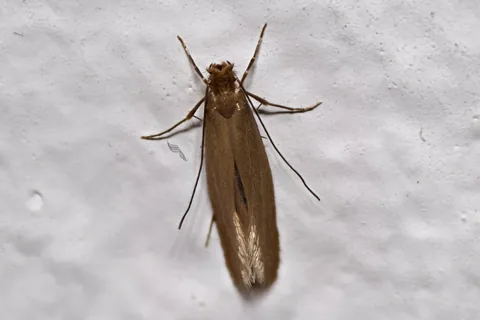 Webbing Clothes Moth
Tineola bisselliella
The webbing clothes moth is probably the most commonly encountered clothes moth in the United States. Its larvae feed on wool, fur, feathers and other animal fibers in hidden spots, and the moths are seldom seen because they avoid light.
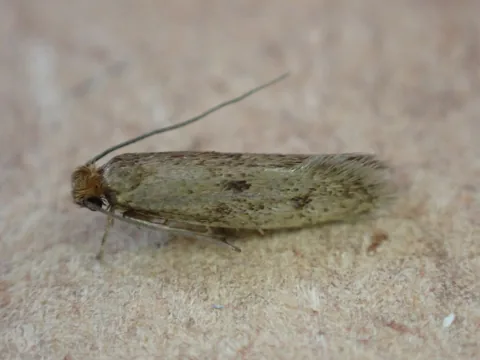 Casemaking Clothes Moth
Tinea pellionella
The casemaking clothes moth is a small fabric pest whose larvae feed on wool, fur, feathers and other animal fibers. Each larva lives inside a portable silk tube that takes on the color of whatever it has been eating.
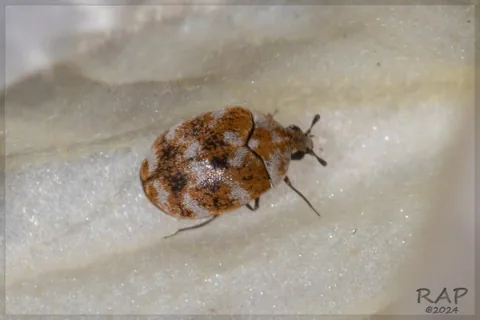 Varied Carpet Beetle
Anthrenus verbasci
Carpet beetles are small beetles whose larvae damage wool, silk, fur, feathers, leather and other animal products; the adults feed on pollen outdoors and often fly in through windows.
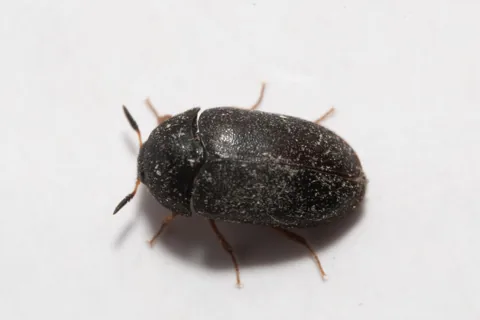 Black Carpet Beetle
Attagenus unicolor
The black carpet beetle is a shiny black carpet beetle whose larvae feed on wool, fur, feathers and other animal products, plus grains and other stored foods. In dry areas such as California, it is more often a pantry pest than a fabric pest. Colorado State Extension calls it one of the most common dermestid beetles.
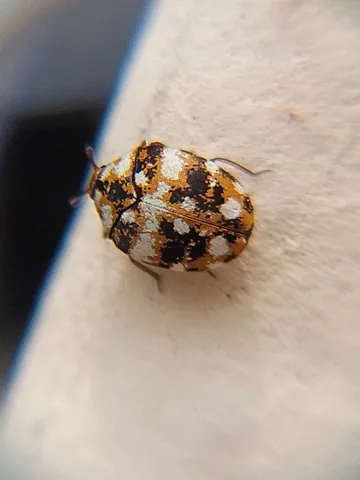 Furniture Carpet Beetle
Anthrenus flavipes
The furniture carpet beetle is a small, round dermestid beetle whose hairy larvae chew upholstery, carpets, fur and other animal-fiber items.
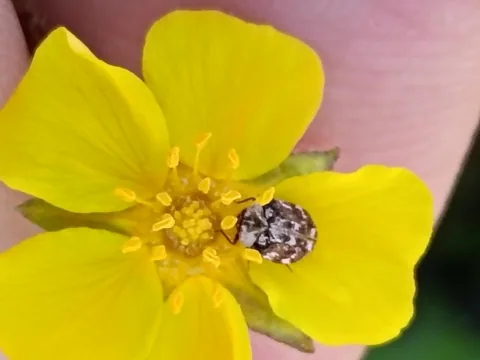 Common Carpet Beetle
Anthrenus scrophulariae
The common carpet beetle is a small, nearly round dermestid beetle whose larvae eat wool, carpets, fur and other animal products.
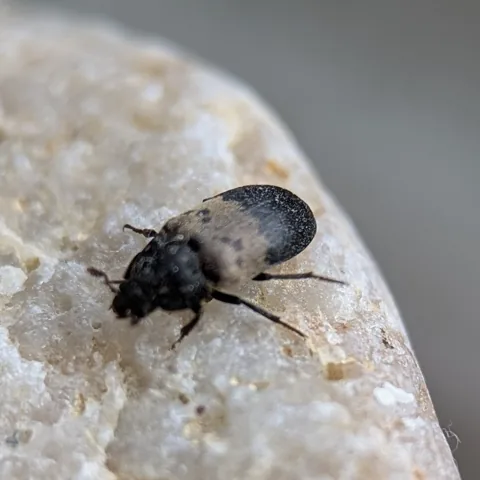 Larder Beetle
Dermestes lardarius
The larder beetle is a dermestid beetle named for its old attraction to larders and cured meats. Home curing is rare now, and it is more often found in dry pet food or feeding on dead insects trapped in attics and wall voids.
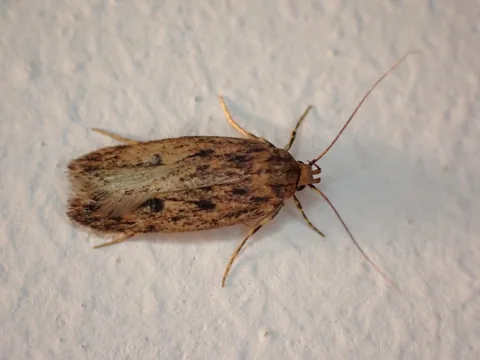 Brown House Moth
Hofmannophila pseudospretella
The brown house moth is an omnivorous household scavenger that usually breeds in bird nests and dry debris in attics and roof spaces. Its wandering larvae occasionally damage carpets and other woolens, and it is also a minor pest of stored food.
Clothes moth, carpet beetle or pantry moth?
The adults you notice are rarely the problem. Adult clothes moths don't feed, and adult carpet beetles eat pollen outdoors. The damage comes from their larvae.[4][5][6]
- Webbing clothes moth (Tineola bisselliella): the most common fabric moth in the United States. Adults are buff or gold, with a tuft of reddish-golden hairs on top of the head and fringed, narrow wings. UC IPM gives a wingspan of about 1/2 inch and a length at rest of about 1/4 inch.[1][4]
- Casemaking clothes moth (Tinea pellionella): similar size, but browner wings with faint dark spots and lighter hairs on the head. It's less common than the webbing clothes moth.[1][4]
- Clothes moth larvae: shiny, creamy-white caterpillars with a dark head. Clemson gives about 1/3 inch when full grown; UKY says up to 1/2 inch.[1][6][4]
- Webbing larvae leave silk tubes and patches of webbing mixed with tiny fecal pellets and fibers, then abandon them as they move on. Casemaking larvae carry an open-ended silk case everywhere, about 3/8 inch long when full grown, which takes on the color of the fabric they're eating.[1][4]
- Carpet beetle adults: small, round beetles, about 1/16 to 1/8 inch per UKY (UC IPM gives about 1/10 to 1/8 inch), solid black or mottled white, brown, yellow and orange. They come to windows because they're attracted to light, and they're often seen on sills in spring.[5][2][6]
- Carpet beetle larvae: slow, bristly, tan to brown larvae, about 1/8 to 1/4 inch per UKY (Clemson says 1/4 to 1/2 inch). Varied carpet beetle larvae are striped and broader at the rear; black carpet beetle larvae are shiny and smooth and taper to a tuft of long hairs, up to 5/16 inch. Clemson describes carpet beetle larvae as often carrot-shaped.[5][6][2]
- Pantry moths: the Indianmeal moth, the most common moth on food in the home, has reddish-brown forewings with a coppery sheen on the outer two-thirds. UC IPM says food moths are about twice as long as clothes moths at rest, fly in a direct, steady line, and lack the head tuft. UKY says similar moths seen in kitchens and other well-lit rooms are possibly grain moths; see the pantry pests guide.[3][1][4]
Reading the damage
You can't always tell from a hole which pest made it, but a few clues help.[2]
- Webbing, silk tubes or carried cases point to clothes moths.[1]
- Brown, bristly shed skins and no webbing point to carpet beetles. Their fecal pellets are about the size of a grain of salt.[2]
- Pattern: UC IPM says carpet beetles more often damage one large area of a garment or carpet, while moth damage tends to be scattered holes.[2]
- Grazing: both leave threadbare spots where fibers are cut at the base. On fur and taxidermy, hairs are clipped at the base and come away in clumps, exposing hide.[4][1][5]
- Hidden spots: damage usually shows under collars and cuffs, in seams and folds, in upholstery crevices, and on carpet under furniture.[1][4]
What they eat
Both pests feed on animal fibers: wool, silk, fur, feathers, felt and leather. Items at risk include sweaters, scarves, coats, blankets, rugs, down pillows and comforters, upholstery, toys and taxidermy mounts, plus natural-bristle brushes and the wool felts in pianos.[4][5][1][2]
Cotton and synthetics such as polyester and rayon are rarely attacked unless they're blended with wool or heavily soiled with food stains or body oils. Food, perspiration and urine stains make any fabric more attractive, which is why cleaning before storage matters.[4][5][1]
Carpet beetles eat more than fabric. Larvae also feed on lint, pet hair and dead insects, and some kinds infest cereals, seeds, pet food and bird seed. UC IPM notes the black carpet beetle is more of a stored-product pest than a fabric pest in arid areas.[5][2][6]
Clothes and blankets in regular use, and rugs that are walked on and vacuumed, are seldom attacked. Stored items left undisturbed for long periods take most of the damage.[4][5][6]
How fast they build up
Clothes moths: females lay about 40 to 50 eggs according to UC IPM and UKY (Clemson gives 100 to 150), glued to fabric threads. Eggs hatch in 4 to 10 days in warm weather. The larval stage lasts anywhere from 35 days to 2 1/2 years depending on temperature and food, and there are usually two generations a year. Heated buildings let them keep developing through winter.[1][4][6]
Carpet beetles: females lay about 50 to 100 eggs per UKY (UC IPM gives about 40 for the varied carpet beetle, 60 for the furniture carpet beetle and 90 for the black carpet beetle). Eggs hatch in about 2 weeks indoors, and varied carpet beetle larvae can feed for 220 to 630 days before pupating.[5][2]
Clothes moth larvae molt 5 to 45 times. Long larval stages explain why infestations develop unnoticed, and Clemson notes that the many shed skins can make an infestation look larger than it is.[1][4][6]
Step 1: Find every infested item
Control fails when one source is missed. UKY says the main source may be a single wool scarf or felt hat at the back of a closet, an old rug in the basement, or an abandoned bird or squirrel nest in the attic.[4][5]
- Closets, chests and storage boxes: unfold woolens and furs that haven't moved in a long time and check seams, cuffs, collars and pockets.[4][6]
- Rugs and carpet: look under heavy furniture and along edges. UKY suggests lifting the edge of wall-to-wall carpet off the tack strip with needle-nose pliers.[4][1]
- Upholstered furniture: check crevices, and underneath and inside where possible.[4][5]
- Vents, ducts and baseboards: pet hair and lint that collect here feed larvae of both pests. UC IPM adds inside and behind heaters.[4][5][1]
- Attics, chimneys and wall voids: old bird or rodent nests, animal carcasses and piles of dead cluster flies or lady beetles can all breed carpet beetles. Outdoors, carpet beetles also breed in spider webs and bee, wasp and bird nests.[5][2]
- Kitchen and basement: for carpet beetles, check cereals, pet food and bird seed, including food cached by mice.[5]
- Windowsills: adult carpet beetles collect there. A few adults indoors aren't a cause for alarm, and UC IPM says treatment is only needed when you find larvae developing in fabrics or elsewhere in the home. Adults also come in on cut flowers.[2]
Step 2: Clean, launder or discard
Cleaning is the main treatment. Clemson calls the vacuum your best weapon, and UC IPM calls hot laundering or dry cleaning the most important method for washable articles.[6][2]
- Launder washable items for 20 to 30 minutes in water of at least 120°F. UC IPM says this kills all stages of clothes moths; UKY adds that dryer heat is effective too.[1][4][5]
- Dry-clean woolens and other items that can't take hot water. Dry cleaning kills eggs and larvae and removes the perspiration odors that attract these pests.[1][4]
- Discard badly infested items, bagging them first so they don't spread the pests on the way out.[4][2]
- Vacuum along and under carpet edges, baseboards, under furniture and stored items, closet floors and inside heating vents. Empty the bag or canister promptly, outdoors if possible, since it can hold eggs, larvae and adults.[5][1][6]
- Empty an infested closet completely: clean everything that was in it, and vacuum and wash the inside of the closet, especially cracks, before putting cleaned clothes back.[1]
- Brush and air stored woolens in the sun, paying attention to seams, folds and pockets. Brushing destroys eggs, and the larvae avoid bright light and drop off.[1][2]
- Area rugs can go to a dry cleaner who handles rugs, or be hung in the sun and then vacuumed.[1][2]
- Remove lint, hair and dead insects, old spider webs and abandoned nests that carpet beetles can feed on.[2]
Step 3: Freeze or heat what you can't wash
Freezing works well for items that can't be laundered, but sources give different times and temperatures. Use the colder, longer end if your freezer allows. Before freezing or heating anything, consider whether cold or heat will damage it.[4][1]
- UKY: hold items at 0°F or colder for at least one week. A freezer that reaches -20°F kills all life stages within 72 hours.[4][5]
- UC IPM: below 18°F for several days for clothes moths, or for 2 weeks for carpet beetles. It suggests freezing mounted animal specimens for 10 to 14 days. Clemson says one week in a freezer.[1][2][6]
- Wrap first: seal items in plastic bags or polyethylene sheeting so frost doesn't form on them. Afterward, let them return to room temperature, about 24 hours, before unwrapping, since some items are brittle when cold.[4][5]
- Heat: UC IPM says heating an item in an oven for at least 30 minutes at 120°F or more kills clothes moths and carpet beetles.[1][2]
- Dry ice (clothes moths): put the item and the dry ice in a thick 4-mil plastic bag. For a 30-gallon bag, UC IPM says a 1/2- to 1-pound piece is enough. Leave the bag loosely closed until the ice has vaporized so it doesn't burst, then seal it and leave it 3 or 4 days. Don't touch dry ice with bare hands.[1]
- Fragile items: UC IPM describes sealing them in an oxygen-impermeable bag with oxygen absorbers; keeping oxygen below 0.1 to 0.5% for 8 to 21 days kills carpet beetles at all stages, but it takes specialized materials.[2]
- None of these protects an item afterward. Store it clean and sealed or it can be reinfested.[1][2]
Step 4: Store fabrics so pests can't get in
Most damage happens to items stored for a long time. Clean them first, then seal them.[4][6]
- Clean before storing: dry-clean or launder woolens before putting them away for a season.[4][5]
- Seal them: pack items in tight-fitting plastic bags or airtight containers. A trunk, chest, box or garment bag works if you seal holes and tape a loose lid.[4][2][1]
- Closets aren't airtight and get opened too often to hold vapors. UC IPM suggests making a pest-free storage closet by sealing cracks around the door, walls and ceiling.[2]
- Keep humidity low. UC IPM says a dry building and fewer tiny cracks mean fewer clothes moth problems.[1]
- Furs: commercial cold storage vaults, offered by some furriers, protect valuable furs, and UC IPM notes you can insure furs stored that way. Protective sprays on furs aren't recommended.[4][1]
- Check stored items at least once a year and air them in the sun.[2]
Pheromone and sticky traps: detection, not a cure
Clothes moth pheromone traps are sticky traps baited with a copy of the female's sex attractant, so they catch males only. They're best at revealing an infestation early, when it's hard to find by looking.[4][1]
- Match the trap to the moth: webbing and casemaking clothes moths each respond to their own pheromone, and pantry-moth traps won't catch clothes moths.[4][1]
- Placement: put traps in closets, on shelves and wherever woolens are stored. In a large space, a grid of traps shows where catches are highest, which tends to be nearest the infested items.[1][4]
- Limits: UC IPM says trapped males can't mate, which gives some control, but you still need to launder or dry-clean exposed clothes.[1]
- Carpet beetles: species-specific pheromone traps attract adult males. Plain sticky traps on windowsills catch adults flying to the light. UC IPM says to check traps once or twice a week and use them to see whether control is working.[2]
Cedar, herbal sachets and mothballs
Cedar: aromatic eastern red cedar oil can kill small larvae but doesn't affect large ones, and cedar loses this oil as it ages. UKY says cedar closets and chests are seldom effective because they don't seal well enough to hold the oil at useful levels; Clemson calls them marginally effective, and only for items that were pest-free to begin with. A tight chest matters more than the wood.[1][2][4][6]
Herbal oils: Clemson says lavender, rosemary and mint oils lose strength over time, and UC IPM says little is known about how well herbal repellents work.[6][1]
How mothballs work: balls, flakes and crystals of naphthalene or paradichlorobenzene (1,4-dichlorobenzene) slowly turn to vapor. The vapor only reaches a level that kills insects inside an airtight container. In an ordinary closet it only somewhat repels adults, and larvae already on the clothes keep feeding.[1][4][7]
What the labels require: the EPA-stamped labels for a paradichlorobenzene moth cake and naphthalene mothballs allow use only in clean, airtight containers such as chests, trunks, garment bags and storage closets, keeping the product sealed in for at least 7 days. They say not to use dry cleaning bags, garbage bags or other containers that let vapor escape into occupied rooms, and that if you can still smell the product after sealing, the container isn't airtight. Using a pesticide in a way its label doesn't allow violates federal law.[9][10]
Never scatter them in open closets or anywhere children or pets can reach. Small children and pets may eat mothballs because they look like candy.[4][7][9]
Naphthalene hazards (NPIC): breathing the vapor has caused headaches, nausea, dizziness and vomiting. Eating a naphthalene mothball, or breathing enough vapor, can cause hemolytic anemia, where red blood cells break apart. Infants have developed anemia from clothes or blankets stored in mothballs and not washed afterward, and people with an inherited enzyme deficiency are at much greater risk. EPA classifies naphthalene as a possible human carcinogen.[7]
Paradichlorobenzene hazards: ATSDR says high exposures irritate the eyes and nose and can cause trouble breathing and an upset stomach, and extremely high exposures can cause dizziness, headaches and liver problems. The U.S. Department of Health and Human Services has determined it may reasonably be anticipated to be a carcinogen, though there's no direct evidence it causes cancer in people. The product label warns it is harmful if swallowed or inhaled.[8][9]
Other drawbacks: they leave an odor on fabric and can soften plastic buttons, hangers and garment bags so the plastic melts into the cloth. Don't use them where unwrapped food is stored. Wash items stored with mothballs before infants use them.[1][2][7]
If someone swallows a mothball or is exposed, follow the label's first aid and call Poison Control at 800-222-1222. NPIC (800-858-7378) answers pesticide questions.[7]
Insecticide sprays and their limits
Sprays play a small part. UC IPM says insecticides may not be needed at all if food sources are removed and the area is kept clean, and UKY says sprays are of limited use because the larvae are inside materials where sprays can't reach. Clemson adds that sprays don't work as a preventive and should only be used when an infestation exists.[2][4][6]
- Clothing and bedding: UKY and UC IPM's carpet beetle guidance say not to treat them with insecticides, and Clemson says never to spray fabrics. UC IPM's clothes moth page is the exception: for items that can't be cleaned, heated or frozen, it allows pyrethrin sprays labeled for clothes moths that the label permits on fabric. Read the label first.[4][2][6][1]
- Where to spot-treat: carpet edges, floor and wall junctions, under rugs and furniture, closet floors and walls, storage shelves and cracks where lint collects. UKY says flea-control sprays or products listing fabric pests on the label are effective there.[2][4]
- Carpet: if live larvae are found, UC IPM says to spray both sides where possible, lightly on the top, plus a wool or animal-hair rug pad. Let it dry before walking on it. For expensive or Oriental rugs, use an experienced professional or rug cleaner instead.[2][1]
- Staining: oil-based sprays can stain silk, rayon and other delicate fabrics. Test a small hidden spot first, and keep sprays away from open flames, sparks and electrical circuits.[1][2]
- Attics and wall voids: a dust labeled for carpet beetles (UC IPM names silica aerogel) can be used. Avoid breathing it, especially if you have respiratory problems.[2]
- Dichlorvos (DDVP) strips: the resin strips for treating items in airtight containers are for licensed professionals. Consumer DDVP products aren't for areas people occupy more than four hours a day. EPA classifies dichlorvos as a probable human carcinogen.[2]
When to call a pro
- The infestation is widespread, heavy or keeps coming back after cleaning.[1][4]
- Stuffed furniture, mattresses or pillows filled with hair or feathers are infested. Spraying the outside won't reach the pests; the fix is fumigation in a vault by a pest control, dry cleaning or storage firm, and only licensed operators can buy and use fumigants.[2][1]
- Valuable rugs or furs are involved: UC IPM suggests an experienced pest professional or rug cleaner for expensive rugs, and furs in commercial cold storage get professional care.[2][4]
- Piano felts and hammers are damaged: a piano technician may recommend synthetic replacement felts.[1][2]
Common questions
- How do I know if it's clothes moths or carpet beetles?
- Look at the evidence near the damage. Silk webbing, tubes or small cases carried by the larvae mean clothes moths. Brown, bristly shed skins with no webbing mean carpet beetles, which also tend to eat one larger area rather than scattered holes.[1][2]
- Why are there small moths in my kitchen?
- Most likely they're pantry moths such as the Indianmeal moth, not clothes moths. Clothes moths avoid light and stay near the infested fabric, while food moths are larger and fly steadily around the house. Check stored grains, cereal, nuts and dried fruit.[4][1][3]
- Does freezing kill clothes moths?
- Yes. UKY says a week at 0°F or colder kills them, or 72 hours at -20°F. Seal items in plastic first and let them warm up for about a day before unwrapping.[4]
- Do cedar chests keep moths away?
- Not reliably. Cedar oil can kill small larvae but not large ones, it fades as the wood ages, and most chests and closets don't seal tightly enough. Store only clean items, and rely on a tight seal more than the wood.[1][4][2]
- Are mothballs safe to use in a closet?
- Not in an open closet. The labels allow them only in sealed, airtight containers, out of reach of children and pets. Naphthalene can cause hemolytic anemia, and children and pets may swallow mothballs because they look like candy.[9][10][7][4]
- Do pheromone traps get rid of clothes moths?
- They help you find and track them, but they catch only males. You still need to find and clean or freeze the infested items.[4][1]
Photo credits
- Webbing Clothes Moth: (c) David Kleuker, some rights reserved (CC BY) — via iNaturalist, CC BY 4.0
- Casemaking Clothes Moth: Stephen James McWilliam, public domain (CC0), via iNaturalist
- Varied Carpet Beetle: (c) RAP, some rights reserved (CC BY) — via iNaturalist, CC BY 4.0
- Black Carpet Beetle: (c) Поляков Александр, some rights reserved (CC BY) — via iNaturalist, CC BY 4.0
- Furniture Carpet Beetle: (c) Rodolfo Salinas Villarreal, some rights reserved (CC BY) — via iNaturalist, CC BY 4.0
- Common Carpet Beetle: (c) Alexander Petrunin-Suharev, some rights reserved (CC BY) — via iNaturalist, CC BY 4.0
- Larder Beetle: (c) Nelson Chu Pavlosky, some rights reserved (CC BY) — via iNaturalist, CC BY 4.0
- Brown House Moth: (c) Gabriele Vaudano, some rights reserved (CC BY) — via iNaturalist, CC BY 4.0
Sources
- University of California Statewide IPM Program, “Pest Notes: Clothes Moths (Home and Landscape).” ipm.ucanr.edu/home-and-landscape/clothes-moths/ (accessed 2026-11-10)
- University of California Statewide IPM Program, “Pest Notes: Carpet Beetles (Home and Landscape).” ipm.ucanr.edu/home-and-landscape/carpet-beetles/ (accessed 2026-11-10)
- University of California Statewide IPM Program, “Pest Notes: Pantry Pests (Home and Landscape).” ipm.ucanr.edu/home-and-landscape/pantry-pests/ (accessed 2026-11-10)
- University of Kentucky Entomology, “ENTFACT-609: Clothes Moths.” entomology.ca.uky.edu/ef609 (accessed 2026-11-10)
- University of Kentucky Entomology, “ENTFACT-601: Carpet Beetles.” entomology.mgcafe.uky.edu/ef601 (accessed 2026-11-10)
- Clemson Cooperative Extension Home & Garden Information Center, “Fabric Pest Control (HGIC 2416).” hgic.clemson.edu/factsheet/controlling-fabric-pests/ (accessed 2026-11-10)
- National Pesticide Information Center, “Naphthalene General Fact Sheet.” npic.orst.edu/factsheets/naphgen.html (accessed 2026-11-10)
- Agency for Toxic Substances and Disease Registry (CDC), “ToxFAQs: Dichlorobenzenes.” wwwn.cdc.gov/TSP/ToxFAQs/ToxFAQsDetails.aspx?faqid=703&toxid=126 (accessed 2026-11-10)
- U.S. EPA Pesticide Product Label System, “Enoz Moth Cake master label, EPA Reg. No. 1475-7 (EPA-stamped, Mar. 3, 2026).” www3.epa.gov/pesticides/chem_search/ppls/001475-00007-20260303.pdf (accessed 2026-11-10)
- U.S. EPA Pesticide Product Label System, “Enoz Old Fashioned Moth Balls master label, EPA Reg. No. 1475-74 (EPA-stamped, Mar. 16, 2026).” www3.epa.gov/pesticides/chem_search/ppls/001475-00074-20260316.pdf (accessed 2026-11-10)