On this page
How to identify it
Look-alikes
| Look-alike | How to tell them apart |
|---|---|
| Varied carpet beetle | Colorado State lists it as the most common Anthrenus in homes, ahead of the furniture and common carpet beetles.[2] |
| Furniture carpet beetle | Another Anthrenus species of homes; UF/IFAS notes their larvae are hard to tell apart.[2] |
Where it lives
Found worldwide; in the United States it is most common in the North.[1]
Biology and life cycle
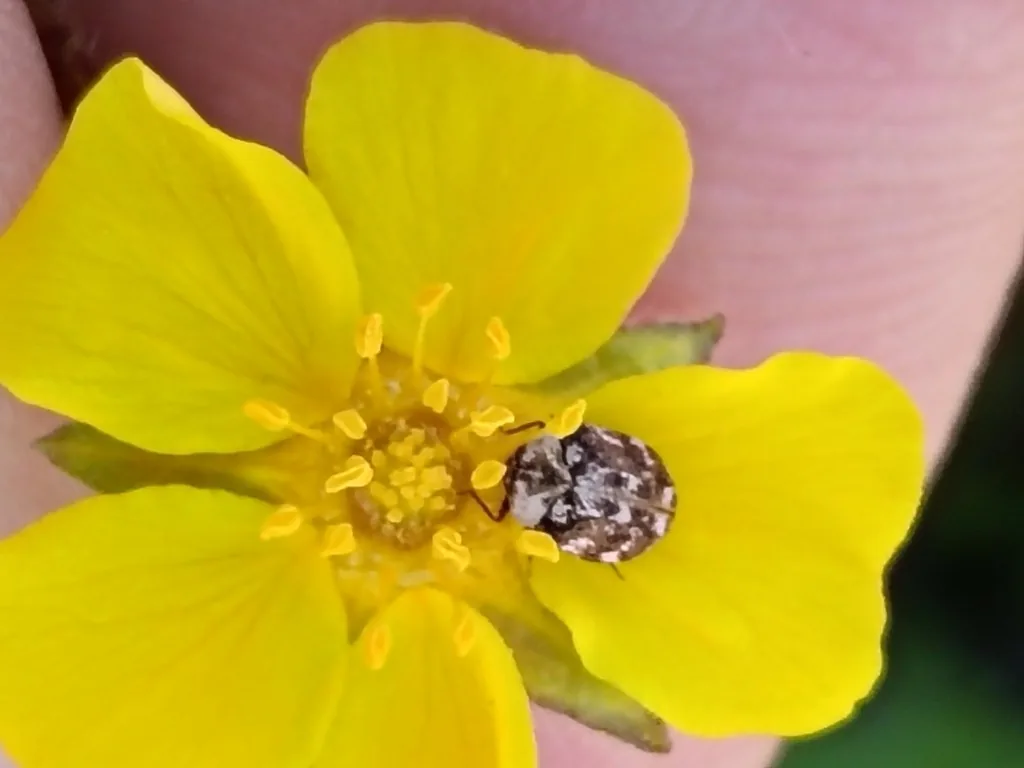
Adults live outdoors on flower pollen and nectar and may lay eggs in animal nests, beehives or on dead animals as well as on indoor textiles.[1][3]
Females lay 30 to 60 eggs that hatch in 10 to 20 days; larvae need about 66 to 70 days to develop.[1]
Damage and signs
Health risk
Control
Sanitation
Dust and vacuum regularly and wash or dry-clean clothes; store woolens and collections in tightly closed containers.[1]
Traps and physical control
Kill larvae in infested items by bagging and freezing them at -20 degrees F for three hours or heating above 105 degrees F for four hours.[1]
Pesticides
Where cleaning can't reach, such as wall voids and ducts, insecticidal dusts or sprays may be needed.[1]
Common questions
Sources
- University of Florida IFAS Extension (EDIS, Featured Creatures), “Common Carpet Beetle, Anthrenus scrophulariae (EENY-482).” ask.ifas.ufl.edu/publication/IN873 (accessed 2026-10-16)
- Colorado State University Extension, “Dermestid Beetles (Carpet Beetles) (Fact Sheet 5.593).” extension.colostate.edu/resource/dermestid-beetles-carpet-beetles/ (accessed 2026-10-16)
- University of Maryland Extension (Home and Garden Information Center), “Carpet Beetles.” extension.umd.edu/resource/carpet-beetles (accessed 2026-10-16)
- iNaturalist, “Anthrenus scrophulariae taxon page (order and family).” www.inaturalist.org/taxa/1571453 (accessed 2026-10-06)