On this page
How to identify it
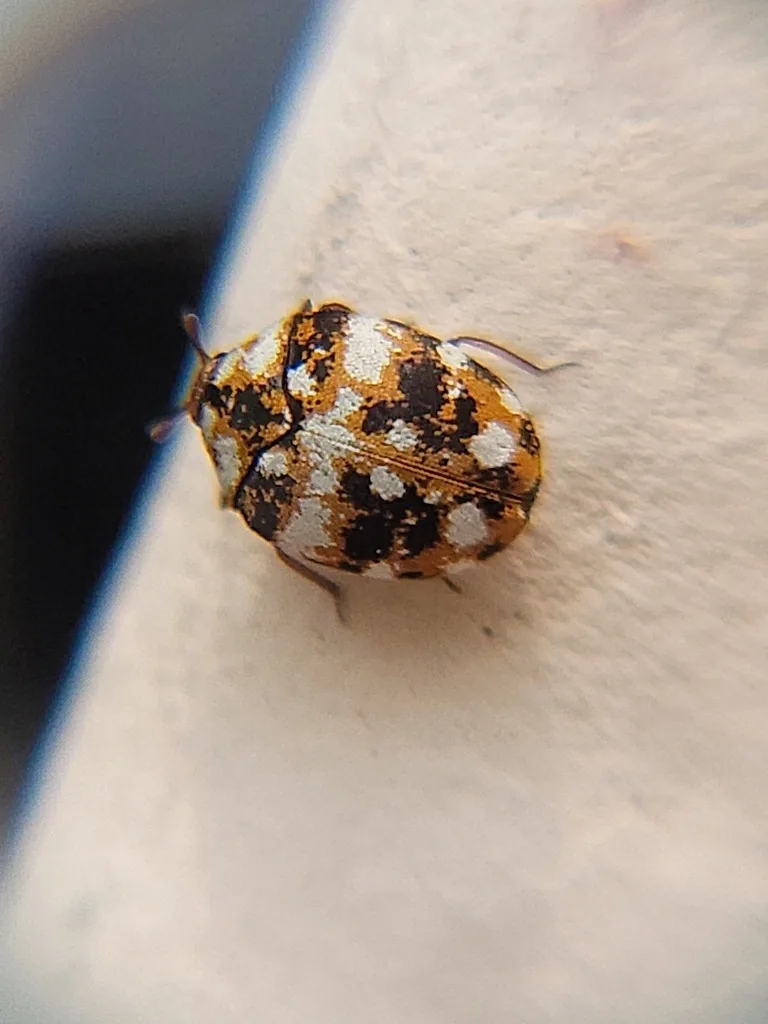
- Adults are round and 2 to 3.5 mm long, black with mottled yellow and white scales on the back and thick yellow scales on the legs.[1]
- Worn adults can look solid black because the scales rub off; the underside is white.[2]
- Larvae are about 5 mm long, oval and covered with brown hairs; a long tuft of hairs at the rear end keeps vibrating.[1]
- Seen from above, adults are slightly larger and rounder than varied carpet beetles, and the larvae are broader in front and narrower at the rear.[2]
Look-alikes
| Look-alike | How to tell them apart |
|---|---|
| Varied carpet beetle | Very similar; UC IPM notes the furniture carpet beetle is slightly larger and rounder, with larvae broader at the front end.[2] |
| Black carpet beetle | Adults are shiny black and dark brown, and the larvae are distinctly different, up to 5/16 inch long and light brown to almost black.[2] |
Where it lives
Found worldwide; in the United States it is mainly a pest in the southern states but also turns up in heated buildings farther north.[1]
Biology and life cycle
The full life cycle takes four to 12 months depending on temperature.[1]
Females lay their eggs in cracks near the larval food: UF/IFAS gives 35 to 100 eggs, and UC IPM says about 60, hatching in 9 to 16 days.[1][2]
Larvae feed for 70 to 94 days and pupate inside their last larval skin; adults live about 4 to 8 weeks and may feed on flower pollen outdoors.[1][2]
Damage and signs
- Larvae digest keratin, so they eat hair, feathers, wool, fur, horn and silk, and can destroy both the padding and the covering of upholstered furniture.[1]
- Cotton, linen and rayon are attacked when stained with body oils or other animal residues.[1]
- Damage often goes unnoticed until it is serious, so check corners, under furniture and stored wool and silk that has not been moved in a long time.[1][3]
Health risk
They do not bite, but people in close contact with infested items can have allergic reactions to beetle fragments, cast skins and dust.[1]
Control
Sanitation
Vacuum often along edges, under furniture and wherever lint and pet hair collect, and empty the vacuum contents outdoors.[2][3]
Traps and physical control
Steam cleaning kills all stages; dry-clean infested clothes and furs, or freeze items that cannot be cleaned for about a week.[1][3]
Pesticides
For heavy infestations, vacuum first, then treat cracks and carpet edges with a dust such as diatomaceous earth or silica aerogel; do not spray clothing or bedding.[1][2]
When to call a professional
Furniture stuffed with hair or feathers cannot be treated by spraying the outside; vault fumigation by a licensed operator kills all stages.[2]
Common questions
- Do mothballs keep furniture carpet beetles away?
- UF/IFAS reports that paradichlorobenzene and naphthalene mothballs give little protection against this species.[1]
- Where do the beetles come from?
- Adults feed on flower pollen and may be seen emerging in warm summer months; larvae develop on animal-fiber items indoors.[1]
- Is the damage from a moth or a beetle?
- Both clothes moths and carpet beetles eat fabric; look for hairy larvae or their cast skins near the damage.[1][3]
Sources
- University of Florida IFAS Extension (EDIS, Featured Creatures), “Furniture Carpet Beetle, Anthrenus flavipes (EENY-019).” ask.ifas.ufl.edu/publication/IN145 (accessed 2026-10-16)
- University of California Statewide IPM Program, “Carpet Beetles (Pest Notes, home and landscape).” ipm.ucanr.edu/home-and-landscape/carpet-beetles/ (accessed 2026-10-16)
- Clemson Cooperative Extension Home & Garden Information Center, “Fabric Pest Control (HGIC factsheet).” hgic.clemson.edu/factsheet/controlling-fabric-pests/ (accessed 2026-10-16)
- iNaturalist, “Anthrenus flavipes taxon page (order and family).” www.inaturalist.org/taxa/1614783 (accessed 2026-10-06)