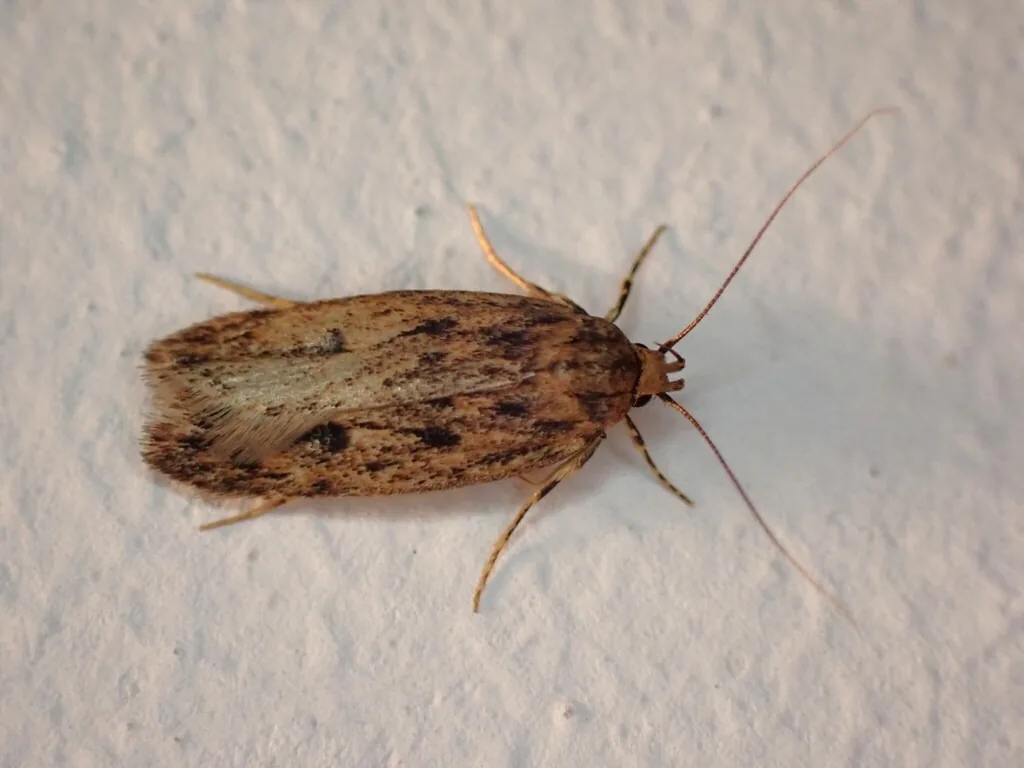
How to identify it
- Adults have dark brown forewings crossed by several rows of darker brown spots.[1]
- The hind wings are fringed with long hairs, and adults measure about 8 to 15 millimeters, roughly 1/3 to 7/12 inch.[1]
- Larvae are white with a tan head and reach about 3/4 inch when fully grown.[1]
- Larvae spin their cocoons right into the material they are feeding on, which helps camouflage an infestation.[1]
Look-alikes
| Look-alike | How to tell them apart |
|---|---|
| Webbing clothes moth | Smaller, about 1/4 inch at rest, and plain gold with reddish-golden hairs on the head, with no dark wing spots.[5] |
| Casemaking clothes moth | Also small, about 1/4 inch, with brownish wings and only faint dark spots; its larvae carry a portable silk case.[5] |
Where it lives
Documented in the United States, Europe, India, Australia and New Zealand, and very widespread and common in Britain.[1][3]
Biology and life cycle
Infestations can start outdoors in forests and mulch and work their way into houses; adults are most active in summer and fall in the Northern Hemisphere.[1]
Larvae can digest keratin, the protein in wool and feathers, and were reared in the lab on a wide range of plant and animal foods.[3][2]
In laboratory studies, larvae failed to mature below 80 percent relative humidity, and full-grown larvae often entered a long resting stage that resisted drying.[2]
The life cycle took about 12 months under field conditions, though the larval stage alone varied from 71 to 145 days with temperature.[2][1]
Damage and signs
- Larvae feed on clothing, carpets, upholstery, furs, skins, cereals and grains, book bindings, paper, dried plants and even wine corks.[1]
- Damage to home textiles, mainly carpets, is thought to come mostly from mature larvae wandering away from where they fed.[3]
- English Heritage notes larvae sometimes attack damp wool, fur, feathers and skins in historic houses.[4]
Health risk
A textile and stored-product nuisance; the cited sources describe damage to materials, not harm to people.[1][3]
Control
Prevention
Keep stored woolens and textiles dry; English Heritage flags damp materials as the ones at risk, and larvae in lab studies needed high humidity to mature.[4][2]
Sanitation
Because it breeds in bird nests and dry organic debris in attics and roof spaces, those are key places to look for the source.[3]
For fabric moths, UC IPM recommends regular vacuuming of closets, baseboards and under furniture, plus laundering, dry cleaning, freezing or heating infested items.[5]
Traps and physical control
Standard methods used for other fabric pests generally control it, according to museum pest specialists.[1]
Clothes-moth pheromone traps won't attract other moth species, but sex pheromone lures made for the brown house moth exist for monitoring.[5][1]
Common questions
- Is the brown house moth a clothes moth?
- It is often grouped with the secondary clothes moths, ranked behind the webbing and casemaking clothes moths in importance, though it feeds on a far wider range of materials.[1]
- Where do brown house moths come from?
- They commonly breed in bird nests and dry debris in attics and roof spaces, and infestations can also start outdoors in forests and mulch before moving indoors.[3][1]
Sources
- Museum Pests Working Group (MuseumPests.net), “Fact Sheet: Brown House Moth (information current as of April 19, 2010).” museumpests.net/wp-content/uploads/2014/03/brown-house-moth.pdf (accessed 2026-10-06)
- G. E. Woodroffe, Pest Infestation Laboratory (Cambridge University Press), “A Life-history Study of the Brown House Moth, Hofmannophila pseudospretella (Staint.) (Lep., Oecophoridae). Bulletin of Entomological Research 41(3), February 1951.” www.cambridge.org/core/journals/bulletin-of-entomological-research/article/lifehistory-study-of-the-brown-house-moth-hofmannophila-pseudospretella-staint-lep-oecophoridae/2C923C1CD3FEA99CDBCBA18AA8016DA2 (accessed 2026-10-06)
- J. H. Cole (Cambridge University Press), “Hofmannophila pseudospretella (Stnt.) (Lep., Oecophoridae), its status as a pest of woollen textiles. Bulletin of Entomological Research 53(1):83-89, May 1962.” www.cambridge.org/core/journals/bulletin-of-entomological-research/article/hofmannophila-pseudospretella-stnt-lep-oecophoridae-its-status-as-a-pest-of-woollen-textiles-its-laboratory-culture-and-susceptibility-to-mothproofers/EC1EDC7DEF931451366EC8C3EFFB885E (accessed 2026-10-06)
- English Heritage, “Insect Pests Found in Historic Houses and Museums (wall chart).” english-heritage.org.uk/link/9b8e8c2785a6492eafc01991a992ab49.aspx (accessed 2026-10-06)
- University of California Statewide IPM Program, “Pest Notes: Clothes Moths, Publication 7435.” ipm.ucanr.edu/home-and-landscape/clothes-moths/ (accessed 2026-10-06)
- iNaturalist, “Hofmannophila pseudospretella taxon page (order and family).” www.inaturalist.org/taxa/129570 (accessed 2026-10-06)