The short answer
- Use a freezer that holds 0°F or colder, and check it with a thermometer; many refrigerator freezers aren't cold enough.[2][1]
- Seal items in plastic bags with the air pressed out, and leave them sealed while they warm back up, so moisture condenses on the bag instead of the item.[11][12][14]
- Times depend on the pest and the temperature, and sources differ. For clothes moths and carpet beetles, UC IPM gives several days (moths) or 2 weeks (carpet beetles) below 18°F, while Kentucky gives at least one week at 0°F, or 72 hours in a freezer that reaches -20°F. For pantry pests such as larder beetles, Penn State gives 3 to 4 days at 0°F and Kentucky 4 days at 0°F.[6][7][12][13][10][9]
- For bed bugs, EPA gives below 0°F for at least 4 days, but Cornell's NYS IPM Program doesn't recommend household freezers for bed bugs because results are inconsistent. Heat is usually the better tool.[1][4][5]
Pests freezing is used on
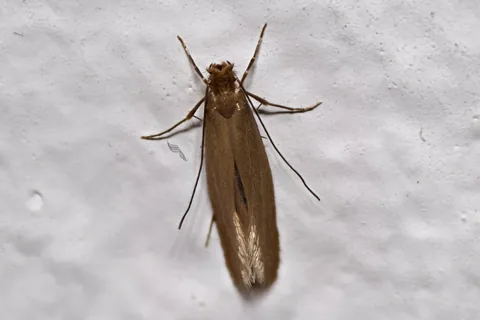 Webbing Clothes Moth
Tineola bisselliella
The webbing clothes moth is probably the most commonly encountered clothes moth in the United States. Its larvae feed on wool, fur, feathers and other animal fibers in hidden spots, and the moths are seldom seen because they avoid light.
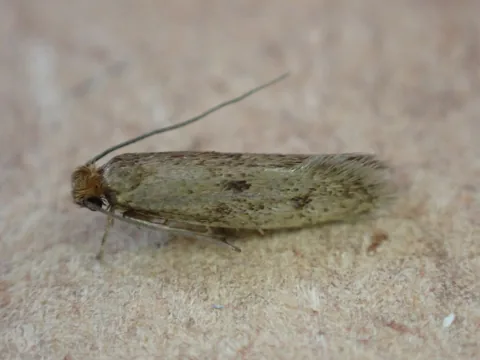 Casemaking Clothes Moth
Tinea pellionella
The casemaking clothes moth is a small fabric pest whose larvae feed on wool, fur, feathers and other animal fibers. Each larva lives inside a portable silk tube that takes on the color of whatever it has been eating.
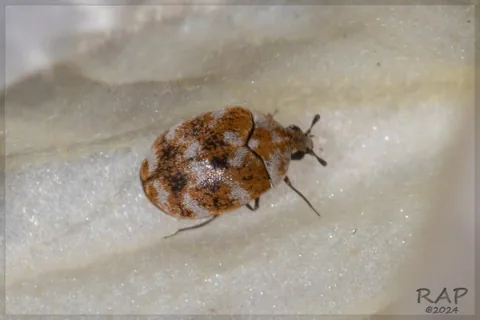 Varied Carpet Beetle
Anthrenus verbasci
Carpet beetles are small beetles whose larvae damage wool, silk, fur, feathers, leather and other animal products; the adults feed on pollen outdoors and often fly in through windows.
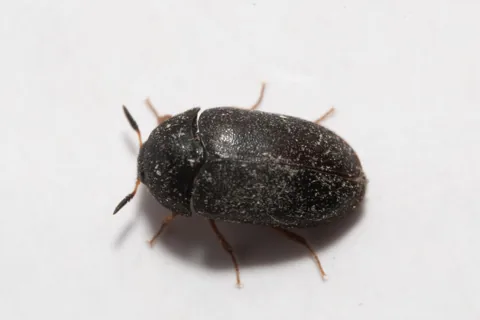 Black Carpet Beetle
Attagenus unicolor
The black carpet beetle is a shiny black carpet beetle whose larvae feed on wool, fur, feathers and other animal products, plus grains and other stored foods. In dry areas such as California, it is more often a pantry pest than a fabric pest. Colorado State Extension calls it one of the most common dermestid beetles.
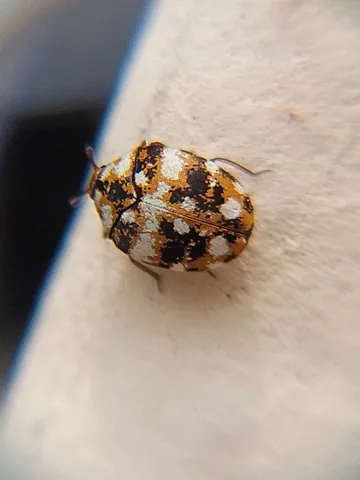 Furniture Carpet Beetle
Anthrenus flavipes
The furniture carpet beetle is a small, round dermestid beetle whose hairy larvae chew upholstery, carpets, fur and other animal-fiber items.
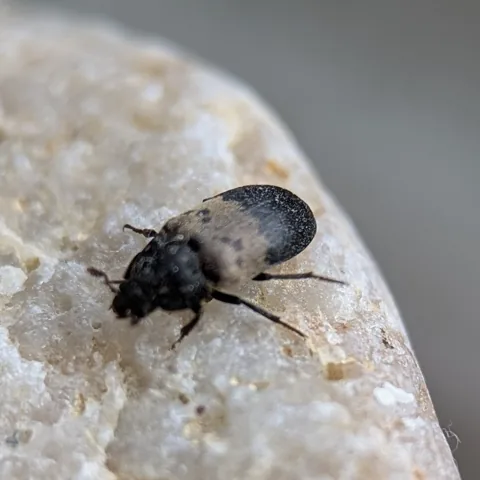 Larder Beetle
Dermestes lardarius
The larder beetle is a dermestid beetle named for its old attraction to larders and cured meats. Home curing is rare now, and it is more often found in dry pet food or feeding on dead insects trapped in attics and wall voids.
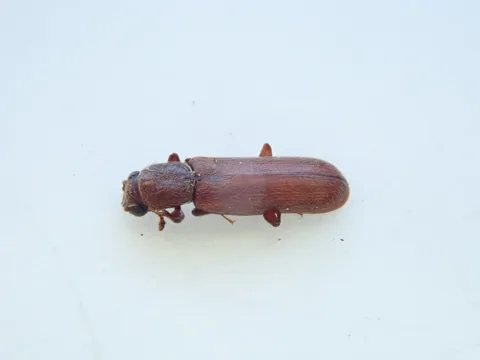 Powderpost Beetles
Lyctinae (e.g., Lyctus brunneus, Lyctus planicollis)
Powderpost beetles are small brown beetles whose larvae tunnel through dry, seasoned hardwood. Often the first clues are tiny round exit holes and little piles of flour-fine dust on floors, furniture or paneling.
How freezing kills insects
Freezing works on the insects, not the object: in dry materials no ice forms in the object itself, only in living insects that contain body water. Most museum pests, including dermestid beetles and the webbing clothes moth, can't survive being frozen.[11]
Kentucky Entomology explains that insects can't tolerate sudden, unexpected extremes of cold, and that museums, furriers and the food processing industry have used chilling to deinfest items for years.[14]
The colder the freezer, the shorter the time needed, and well-insulated items need longer.[1][11][12]
Sources agree that bigger or bulkier items need longer. Colorado State notes that large items need longer freezing, and Kentucky says larger items can take up to 24 hours just to warm back up afterward.[18][14]
Insects can harden to cold. Cornell notes that one hour at 32°F improves bed bugs' ability to survive at 6.8°F and 3.2°F, and that freezing is less likely to work if the insects are already cold to begin with.[4]
Getting the freezer right
- Aim for 0°F or below and confirm it with a thermometer, since home freezers aren't always set that cold.[2]
- How cold home freezers run is where sources differ. EPA says many home refrigerator freezers are not cold enough to kill bed bugs; Cornell's bed bug guide calls 0°F the temperature of most household freezers; and Kentucky's guide to thermal deinfestation says many home freezers can reach -4°F. A thermometer settles it for your own freezer.[2][4][14]
- Put the thermometer's sensor inside the freezer right next to the items, ideally between layers, with a lead thin enough to pass the door gasket.[11]
- Avoid frost-free (self-defrosting) freezers if you can. They warm up periodically to melt ice, which lets the items warm up too; Kentucky specifies a non-self-defrosting freezer, and the National Park Service uses a chest freezer without a frost-free cycle, using a frost-free one only in an emergency.[9][11]
- The National Park Service's procedure for museum collections uses -20°C (-5°F) or colder. It notes that domestic chest freezers can reach about -25°C (-13°F).[11]
- Items too big for a home freezer can go to a commercial freezer or cold-storage locker, Kentucky suggests.[14]
Bagging, freezing and thawing
- Seal items in clear polyethylene bags, such as zip-top bags, in the same room where they were kept, and squeeze or vacuum out as much air as possible before closing them.[11][12][14]
- Kentucky's method for furniture and other wood items wraps the item in a cloth bed sheet first, then seals it in a large polyethylene bag, such as a trash or dry-cleaning bag, or wraps it in polyethylene and tapes the seams.[14]
- For bulky items or anything with metal parts, add something absorbent inside the bag, such as a cotton towel.[11]
- Place the bags in a freezer that is already cold, with room around each bag so air can circulate and cool it quickly; don't stack items in a way that could crush them.[11]
- Leave the sealed bag to warm to room temperature before you open it: the National Park Service says 24 hours, and Kentucky says about 24 hours, or up to 24 hours for larger items. Condensation then forms on the outside of the bag, not on the item.[11][12][13][14]
- Handle fragile items gently until they have fully warmed. Kentucky notes that some items become brittle at low temperatures, which is one reason to let them warm up before unwrapping.[12][14]
- The museum procedure runs two cycles: at least 48 hours frozen, 24 hours warming in the bag, then at least another 48 hours frozen and a final warm-up.[11]
- Afterward, brush or vacuum off insect remains, and store cleaned items sealed in a bag or container so they aren't reinfested.[11][7]
How long, by pest
- Clothes moths: bag the item and freeze it for several days at temperatures lower than 18°F. Laundering for 20 to 30 minutes in water of at least 120°F kills all stages; for woolens that can't take hot water, dry cleaning may be the only suitable option.[6]
- Clothes moths, Kentucky's numbers: hold items at 0°F or colder for at least one week; a freezer that reaches -20°F kills all life stages within 72 hours. Clemson suggests a week in the freezer for fabric items that can't be discarded or cleaned well.[12][15]
- Carpet beetles: bag the item and freeze it for 2 weeks below 18°F. Mounted animal specimens and game trophies can go in a freezer for 10 to 14 days now and then.[7]
- Carpet beetles, Kentucky's numbers: the same as for clothes moths, at least one week at 0°F, or 72 hours at -20°F.[13]
- Dermestid beetles in general (the family that includes carpet and larder beetles): Colorado State gives a deep freezer below 0°F for three days or more for woolens and lightly infested food that can't be thrown out.[18]
- Larder beetles: Penn State gives 0°F for 3 to 4 days for valuable infested materials. Pantry pests in decorations: Kentucky gives 4 days at 0°F in a non-self-defrosting freezer for decorative items such as Indian corn, dried flower arrangements and birdseed.[10][9]
- Other pantry pests: Clemson suggests keeping foods frozen at 0°F, and freezing grain products for 3 days after purchase as a habit. Illinois Extension gives 27°F or colder for at least 3 to 7 days, and says colder and longer are better.[16][17][19]
- Wood items with powderpost or other wood-boring beetles: Kentucky gives seven days at -4°F (-20°C).[14]
- Museum pests in general: the National Park Service cites a survey of the research finding 6 to 10 days at -20°C enough for most of them.[11]
- Illinois Extension's rule for pantry items is that colder is better and longer is better.[19]
- Before freezing anything, think about whether cold will damage it.[6][7][12]
Wooden items, crafts and trophies
Kentucky Entomology calls cold treatment especially useful for chairs, dressers, picture frames and other wood items with powderpost or other wood-boring beetles, since sprays rarely reach insects living deep inside an item. Wrap the item in a sheet, seal it in polyethylene with as much air forced out as possible, hold it at -4°F for seven days, and let it warm to room temperature before unwrapping.[14]
Kentucky says this generally kills all life stages, including eggs, and seldom harms furniture, veneers or finishes, though wood inlays or mother-of-pearl may be affected. The National Park Service is stricter for museum pieces and says never to freeze painted, inlaid or finished wooden objects. For anything valuable or old, the cautious rule is the safer one.[14][11]
The same chilling works on rugs, woolens, fabrics, pet food and animal trophies with negligible adverse effects, according to Kentucky, and on bulk bags of birdseed or pet food infested with grain beetles or meal moths.[14]
Infested food and the pantry
Freezing makes sense for things worth saving, such as decorations or valuable items. For infested food, Kentucky calls throwing it out the best way to eliminate the problem, followed by a thorough vacuuming of shelves and their cracks.[9][10]
Not every source says to throw infested food out. Illinois Extension says heavily infested items should go out in a tightly sealed bag, but food that isn't badly infested can be thrown away or salvaged by freezing; Colorado State likewise lists minimally infested food among things that can be frozen.[19][18]
Clemson's advice is the same in spirit: identify every infested item and either discard it or treat it by freezing. Check stored decorations too, since dried straw flowers can start a cigarette beetle infestation.[16][17]
Freezers help prevent the next infestation: keep rarely used flour, spices and grains in the freezer, and for several months after a cleanout keep susceptible foods in airtight containers, the refrigerator or the freezer.[8][16][17]
Freezing and bed bugs
EPA's integrated pest management page advises below 0°F for at least 4 days for bed bugs; its do-it-yourself page gives three days at 0°F in a sealed bag. Cornell's guide, citing freezer research, says 0°F for 4 or more days is needed to kill all stages, including eggs.[1][2][4]
Cornell adds that colder is faster: two days at -4°F, and immediately lethal at -6 to -22.5°F, temperatures it calls impractical for most situations. Kentucky gives a slower figure: bed bugs die below 32°F, but the cold must last much longer, such as one to two weeks.[4][5]
A freezer study led by University of Minnesota entomologists (Olson and colleagues, 2013) estimated that bed bugs could survive temperatures above -12°C even after a week of continuous exposure, and that survivors of a sublethal chill still went on to feed.[21]
Even so, Cornell's NYS IPM Program does not recommend treating items for bed bugs in a household freezer, because freezing kills them inconsistently.[4]
Cornell's own bed bug FAQ is less strict for travel: after a trip, it says to put things that can't go in a hot dryer into a freezer for two weeks.[20]
Chilled bed bugs can go dormant and look dead for days, then become active again once they warm up.[3][4]
Kentucky Entomology points out that cold has to be kept up much longer than heat, so heating tends to be the better option.[5]
Professionals can freeze bed bugs on contact with liquid carbon dioxide or liquid nitrogen. It suits some items that heat would damage, but it doesn't penetrate mattress seams and pleats, and the blast can blow bugs off a surface before they're killed.[4][5]
What shouldn't go in the freezer
The National Park Service limits freezing to dry objects made entirely of textile, leather, wood or paper, and dry natural history specimens. It says never to freeze wet objects or anything in unstable condition.[11]
- Canvas and wood-panel paintings, and painted, inlaid, lacquered or finished wooden furniture and objects.[11]
- Objects containing ivory or teeth, and objects under tension, such as drums.[11]
- Items combining materials such as glass, ceramic or metal with other parts, and items with glues or sensitive finishes, because the materials react differently to cold.[11]
- Kentucky also flags wood inlays and mother-of-pearl as materials that may be affected by freezing.[14]
- Before freezing museum objects, the National Park Service has a conservator evaluate the potential for damage.[11]
- Items too fragile for heat or cold can be sealed in an oxygen-proof bag with oxygen absorbers. Carpet beetles die when oxygen stays below 0.1 to 0.5% for 8 to 21 days, but the method takes specialized materials and a well-sealed enclosure.[7]
Common questions
- Does a frost-free freezer work?
- It's not ideal. A frost-free freezer warms up periodically to clear ice, and the items warm with it, which undermines the treatment. Use a non-self-defrosting or chest freezer if you can.[11][9]
- Is freezing or heat better for bed bugs?
- Heat, usually. Freezing has to last days at 0°F or colder, household freezers often aren't cold enough, and Cornell's IPM program doesn't recommend them for bed bugs. A clothes dryer on high heat handles most washable items.[1][2][4][5]
- Why leave the bag closed while it thaws?
- So the moisture that condenses as cold items warm up collects on the outside of the bag rather than on the item.[11][12][14]
- How long should I freeze wool clothes for moths?
- It depends on how cold your freezer gets. Kentucky says at least one week at 0°F, or 72 hours if the freezer reaches -20°F. UC IPM gives several days below 18°F, and Clemson a week. A week at 0°F or colder meets the longer of these.[12][6][15]
- Can I freeze bugs out of flour or birdseed and keep it?
- For birdseed, pet food and decorations, yes: Kentucky and Clemson both describe freezing them. For food, sources split. Illinois and Colorado State say lightly infested food can be salvaged by freezing; Kentucky says disposal is the best way to end the problem. Throw out anything heavily infested.[9][14][17][19][18]
Photo credits
- Webbing Clothes Moth: (c) David Kleuker, some rights reserved (CC BY) — via iNaturalist, CC BY 4.0
- Casemaking Clothes Moth: Stephen James McWilliam, public domain (CC0), via iNaturalist
- Varied Carpet Beetle: (c) RAP, some rights reserved (CC BY) — via iNaturalist, CC BY 4.0
- Black Carpet Beetle: (c) Поляков Александр, some rights reserved (CC BY) — via iNaturalist, CC BY 4.0
- Furniture Carpet Beetle: (c) Rodolfo Salinas Villarreal, some rights reserved (CC BY) — via iNaturalist, CC BY 4.0
- Larder Beetle: (c) Nelson Chu Pavlosky, some rights reserved (CC BY) — via iNaturalist, CC BY 4.0
- Powderpost Beetles: Karel Schoonvaere, public domain (CC0), via iNaturalist
Sources
- U.S. Environmental Protection Agency, “Controlling Bed Bugs Using Integrated Pest Management (IPM).” www.epa.gov/bedbugs/controlling-bed-bugs-using-integrated-pest-management-ipm (accessed 2026-11-11)
- U.S. Environmental Protection Agency, “Do-it-yourself Bed Bug Control.” www.epa.gov/bedbugs/do-it-yourself-bed-bug-control (accessed 2026-11-11)
- U.S. Environmental Protection Agency, “Safety Issues in Controlling Bed Bugs.” www.epa.gov/bedbugs/safety-issues-controlling-bed-bugs (accessed 2026-11-11)
- New York State Integrated Pest Management Program, Cornell University, “How to Get Bed Bugs Out of Your Belongings, NYS IPM Publication No. 620 (February 2018).” ecommons.cornell.edu/server/api/core/bitstreams/c774cabf-16af-4c52-8aab-b20acf2807c2/content (accessed 2026-11-11)
- University of Kentucky Entomology, “ENTFACT-636: Bed Bugs (revised March 2026).” entomology.mgcafe.uky.edu/ef636 (accessed 2026-11-11)
- University of California Statewide IPM Program, “Pest Notes: Clothes Moths, UC ANR Publication 7435 (Home and Landscape).” ipm.ucanr.edu/home-and-landscape/clothes-moths/ (accessed 2026-11-11)
- University of California Statewide IPM Program, “Pest Notes: Carpet Beetles, UC ANR Publication 7436 (Home and Landscape).” ipm.ucanr.edu/home-and-landscape/carpet-beetles/ (accessed 2026-11-11)
- University of California Statewide IPM Program, “Pest Notes: Pantry Pests, UC ANR Publication 7452 (Home and Landscape).” ipm.ucanr.edu/home-and-landscape/pantry-pests/ (accessed 2026-11-11)
- University of Kentucky Entomology, “ENTFACT-612: Stored Product Pests in the Pantry (revised March 2026).” entomology.mgcafe.uky.edu/ef612 (accessed 2026-11-11)
- Penn State Extension, “Larder Beetle (updated June 24, 2026).” extension.psu.edu/larder-beetle (accessed 2026-11-11)
- National Park Service Museum Management Program, “Conserve O Gram 3/6: An Insect Pest Control Procedure: The Freezing Process (July 1994).” www.nps.gov/subjects/museums/upload/03-06_508.pdf (accessed 2026-11-11)
- University of Kentucky Entomology, “ENTFACT-609: Clothes Moths.” entomology.mgcafe.uky.edu/ef609 (accessed 2026-11-11)
- University of Kentucky Entomology, “ENTFACT-601: Carpet Beetles.” entomology.mgcafe.uky.edu/ef601 (accessed 2026-11-11)
- University of Kentucky Entomology, “ENTFACT-640: Thermal Deinfestation of Household Items (revised March 2026).” entomology.mgcafe.uky.edu/ef640 (accessed 2026-11-11)
- Clemson Cooperative Extension Home & Garden Information Center, “Fabric Pest Control (HGIC 2416).” hgic.clemson.edu/factsheet/controlling-fabric-pests/ (accessed 2026-11-11)
- Clemson Cooperative Extension Home & Garden Information Center, “Indian Meal Moth.” hgic.clemson.edu/factsheet/indian-meal-moth/ (accessed 2026-11-11)
- Clemson Cooperative Extension Home & Garden Information Center, “HGIC 2413: Cigarette Beetles.” hgic.clemson.edu/factsheet/cigarette-beetles/ (accessed 2026-11-11)
- Colorado State University, Department of Agricultural Biology, “Dermestid beetles.” agsci.colostate.edu/agbio/ipm-pests/dermestid-beetles/ (accessed 2026-11-11)
- University of Illinois Extension, “Common Pantry Pests.” extension.illinois.edu/sites/default/files/common_pantry_pests.pdf (accessed 2026-11-11)
- New York State Integrated Pest Management Program, Cornell University, “Bed Bug FAQs.” cals.cornell.edu/new-york-state-integrated-pest-management/outreach-education/whats-bugging-you/bed-bugs/bed-bug-faqs (accessed 2026-11-11)
- Journal of Economic Entomology, via PubMed, “Olson JF, Eaton M, Kells SA, Morin V, Wang C (2013), Cold tolerance of bed bugs and practical recommendations for control, J Econ Entomol 106(6):2433-2441.” pubmed.ncbi.nlm.nih.gov/24498745/ (accessed 2026-11-11). Cited from the PubMed abstract.