The short answer
- Identify the group first. The pen test (how much of a ballpoint tip fits in the exit hole) and the frass test (how the powder feels between your fingers) separate the three main groups.[1][2]
- Check whether the holes are active before spending anything: fresh powder the color of new-cut wood and holes that look newer than the surrounding wood mean beetles are still emerging. Yellowed, caked or dusty powder is usually old.[2][7][3]
- If only a few boards, trim pieces or one piece of furniture are affected, removing and replacing the wood (plus the pieces next to it) is often the simplest fix.[2][1][3]
- For beetles in joists and beams, lower the wood moisture: a plastic vapor barrier on crawl space soil, better ventilation and drainage. Anobiid powderpost beetles need damp wood.[2][7]
- Borate sprays work only on bare, unfinished wood; they won't soak through paint or varnish and go only shallowly into dry wood. Finishing bare wood keeps beetles from laying eggs in it.[1][2][5]
- Freeze or heat small items such as picture frames, carvings and some furniture. Whole-house fumigation is costly, may not kill every beetle and doesn't prevent reinfestation; it's for spread-out infestations in walls and floors that can't be reached any other way.[1][2][4][7]
Related profiles
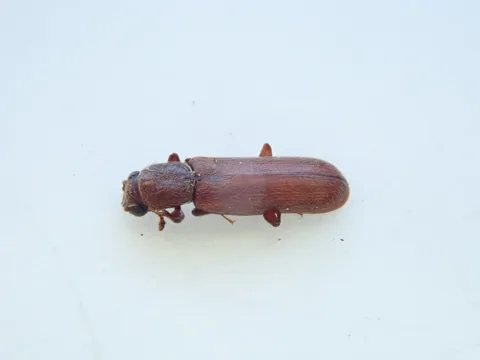 Powderpost Beetles
Lyctinae (e.g., Lyctus brunneus, Lyctus planicollis)
Powderpost beetles are small brown beetles whose larvae tunnel through dry, seasoned hardwood. Often the first clues are tiny round exit holes and little piles of flour-fine dust on floors, furniture or paneling.
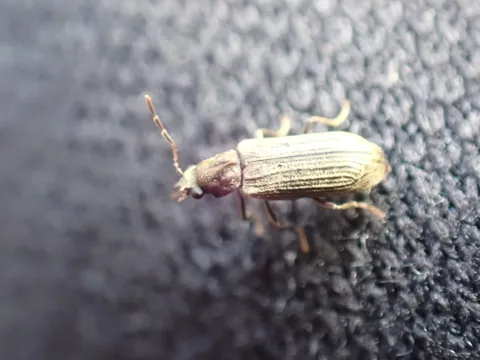 Deathwatch beetles
Anobiinae
Of the three groups of beetles that bore wood inside buildings, the deathwatch beetles are the ones a crawl space should worry about. True powderpost beetles stick to hardwood trim and furniture, but anobiids attack the spruce, pine, fir and Douglas-fir used for floor joists, studs, sills and beams, and because they digest cellulose rather than depending on the starch that fades from aging wood, they can keep reinfesting a house year after year. They need damp wood to do it, which is why Kentucky and NC State treat them as a moisture problem first and an insecticide problem second.
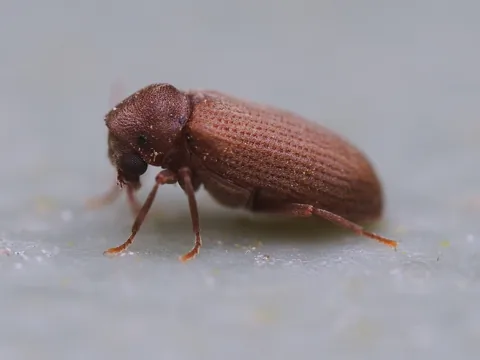 Common Furniture Beetle
Anobium punctatum
The common furniture beetle, Anobium punctatum, is a small anobiid powderpost beetle, often called woodworm. Its larvae tunnel through seasoned wood for a year or more, and despite the name it also attacks floors, framing and structural timbers.
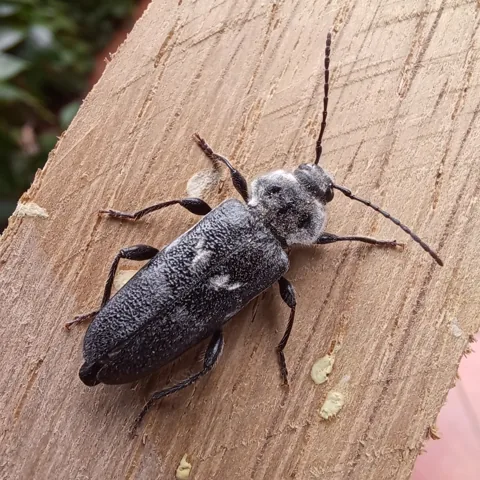 Old House Borer
Hylotrupes bajulus
Despite its name, the old house borer most often turns up in fairly new buildings. Its larvae tunnel inside pine, spruce, fir and other softwood framing for years, and damp, poorly ventilated spaces let infestations spread.
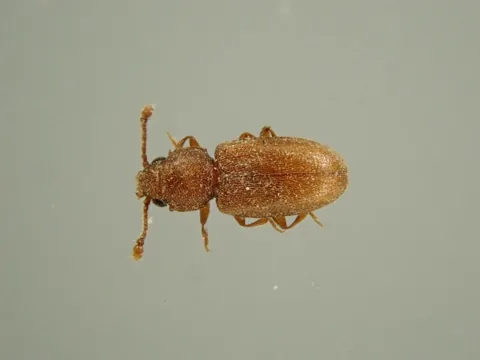 Foreign Grain Beetle
Ahasverus advena
The foreign grain beetle is a tiny, reddish-brown beetle that feeds on molds rather than sound grain. It is best known for showing up in large numbers in newly built homes in late summer, where it feeds on mold growing on damp lumber and drywall inside the walls.
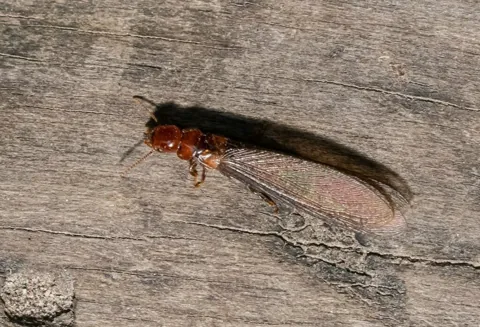 Western Drywood Termite
Incisitermes minor
Drywood termites live entirely inside wood without needing soil contact; the western drywood termite is California's second most important termite pest after subterranean termites. Clemson Extension says drywood termites get the moisture they need from humid air and are most common along humid coastal areas of South Carolina.
First, make sure it's powderpost beetles
Small round "shot holes" with fine powder in or under them are the classic sign. You'll usually see the damage before the beetles, which are small and active mostly at night, though some come to light and turn up dead on windowsills. Kentucky says a definite diagnosis usually needs an entomologist or a knowledgeable pest professional, and that mistakes here lead to treatments and repairs nobody needed. Our wood-boring beetle overview has a short version of the identification steps, and our types of beetles in the house guide covers the other beetles found indoors.[2][1]
- Foreign grain beetles: tiny brown beetles (about 1/16 inch) that show up in large numbers in new homes or around leaks. They feed on mold growing on damp new lumber and drywall, don't damage wood, and go away once the moisture problem is fixed.[2]
- Pantry beetles: flour beetles, drugstore and cigarette beetles, weevils and grain beetles live in stored food in kitchens and pantries, not in the woodwork. Drugstore and cigarette beetles are close relatives of the anobiid powderpost beetles and look similar.[2][1]
- Drywood termites: they leave larger, granular, pepper-like pellets with ridges on their sides, not flour-fine powder.[1]
- Borers from firewood: flatheaded and roundheaded borers and bark beetles can emerge from firewood or from new lumber that was infested as a tree, but UC says they can't reinfest the finished wood in a house.[1]
Which powderpost beetle? Lyctid, anobiid or bostrichid
"Powderpost beetle" covers several groups of small beetles, about 1/8 to 3/4 inch long, whose larvae turn wood to powder. The names differ by source: Kentucky calls all three groups powderpost beetles, while UC IPM calls the lyctids powderpost beetles, the anobiids deathwatch beetles and the bostrichids false powderpost beetles. The group matters because each one picks different wood and calls for a different plan.[2][1]
- Lyctids (true powderpost beetles): narrow, reddish-brown to black, 1/16 to 1/4 inch. They lay eggs only in the pores of hardwoods such as oak, ash, walnut, hickory and cherry, and in bamboo, so they turn up in flooring, paneling, molding, window and door frames and furniture, not in pine framing. Exit holes are about pinhead size. The powder feels like flour or talc. Only the tip of a pen fits in the hole.[2][1][7]
- Anobiids (deathwatch and furniture beetles): rounded, reddish to dark brown. They attack softwoods and hardwoods, including joists, beams and sills, and need damp wood, so they're worst in crawl spaces, basements, garages and unheated outbuildings. Kentucky gives exit holes of 1/16 to 1/8 inch. The powder feels gritty, and the pen tip plus part of its angled face fits in the hole. UC notes their holes can be of various sizes, unlike the other two groups.[2][1][7]
- Bostrichids (false powderpost beetles): dark brown to black, most 1/8 to 1/4 inch, with the head bent down under a hood-like front so you can't see it from above. They attack newly processed hardwoods and bamboo, often tropical wood infested before import. Holes are 1/8 to 1/4 inch; the whole pen point usually fits. The powder is coarse and meal-like and packed so tightly in the holes it's hard to dislodge.[2][1]
- Old house borer: a larger beetle (Penn State gives 5/8 to 1 inch, with long antennae) whose larvae live in pine and other softwood framing. Its exit holes are oval and larger (Kentucky gives 1/4 to 3/8 inch), the tunnels have a rippled surface, and fully grown larvae make a rasping sound you can sometimes hear through walls. See the old house borer profile; the same moisture, borate and fumigation steps below apply to it.[3][6][1]
Active holes or old damage?
Powderpost beetle infestations often die out by themselves, so Kentucky's advice is to confirm activity before doing anything.[2][3]
- Fresh signs: powder the color of freshly sawn wood sifting from holes or piled beneath them, and holes that haven't taken on the weathered look of the wood around them. On stained floors or cabinets, a new hole shows no stain inside.[2][3]
- Old signs: powder that is yellowed, caked, or covered with dust, debris or cobwebs, and holes that look as aged as the wood. NC State also treats yellow, caked frass as a sign the infestation is no longer active.[2][7][3]
- Watch for vibration: powder can fall out of old tunnels when floors or walls are bumped, so a little dust under old holes doesn't prove beetles are alive.[2]
- The mark-and-wait test: mark or seal the existing holes, vacuum up all the powder, and check later for new holes and fresh powder. Kentucky suggests waiting until spring or summer, when most beetles emerge, if you find the damage in fall or winter. NC State says the peak time to watch is usually May through August, though holes and powder can appear almost any time of year in heated buildings and crawl spaces.[2][7]
- Expect a few stragglers: in aging hardwood, lyctids develop more slowly as the starch runs out, so a few beetles can keep emerging for up to about five years. Kentucky says that comes from the wood becoming less suitable, not from a new infestation.[2]
Match the plan to the beetle
Kentucky says powderpost beetles damage wood slowly, so there's no need to act immediately over fears for the house's structure, and a wait-and-see approach often makes sense when it's unclear whether the infestation is active. Which group you have tells you how likely it is to spread.[2]
- Lyctids and bostrichids usually come in with the wood: new flooring, cabinets, trim, furniture or bamboo that held eggs or larvae when it arrived. Kentucky says they rarely reinfest after the first generation emerges indoors, because most surfaces are finished and the wood's starch and moisture keep falling, so infestations tend to fade out. Lyctid infestations often show up within a year of the wood being processed, so they're mostly seen in new homes and newly made articles.[2]
- Sources differ on how persistent lyctids are: Penn State says many keep breeding in an infested piece of wood for generations, which can eventually destroy it, and that old furniture and wood antiques are especially vulnerable.[5][2]
- Anobiids are the ones that build up. They digest the wood's cellulose and don't depend on starch, so they can attack wood of any age and reinfest year after year. Kentucky says their infestations are seldom obvious in buildings less than 10 years old and are most common in the humid Southeast and coastal states with crawl space construction; NC State names them as North Carolina's main concern.[2][7]
- Who pays: Kentucky notes that lyctid infestations in new homes almost always come from wood that was infested when brought in, so responsibility for treatment or replacement often lies with the supplier, manufacturer or installer rather than the homeowner.[2]
Dry out damp wood (anobiids and old house borers)
Damp wood is what lets anobiid beetles, and old house borers, keep reinfesting a crawl space or basement. Kentucky says centrally heated and cooled buildings seldom have enough dampness to support anobiids in living areas or attics. Kentucky says drying the wood slows the larvae and breaks the cycle of reinfestation.[2][3]
- Targets: Kentucky gives a moisture requirement of 13 to 30 percent for anobiid larvae and says wood below 14 percent in spring and summer is generally unsuitable; NC State says wood moisture needs to be closer to 13 percent to become less favorable; UC says deathwatch beetles prefer wood above 14 percent. For old house borers, Kentucky says ideally below about 10 percent.[2][7][1][3]
- Vapor barrier: cover crawl space soil with polyethylene sheeting. NC State specifies a 6 to 8 mil plastic barrier covering 70 to 80 percent of the soil.[2][7]
- Air and water: improve ventilation and drainage. NC State says a crawl space can also be enclosed (encapsulated), a bigger job that requires a dehumidifier.[2][7][3]
- Measure: moisture meters show whether the wood can still support beetles. NC State says readings should be taken on joists in several parts of the crawl space, since corners with poor airflow usually read higher and readings change with weather and season.[2][7][3]
- This doesn't work on lyctids: they can live in wood as dry as about 8 percent moisture, which is normal for heated and air-conditioned homes.[2][1]
Remove and replace infested wood
When activity is limited to a few floorboards, a piece of trim or a few framing members, Kentucky calls replacement often the most efficient fix, especially for lyctids and bostrichids. UC also recommends removing and replacing infested structural wood whenever possible.[2][1][3]
- Take out the neighbors too: replace boards directly next to infested ones as a precaution, since larvae can tunnel from one piece into the next.[2][3]
- Get rid of the old wood by burning it or taking it to a landfill rather than reusing it.[1][2]
- Clean up what stays: seal holes in wood you keep and remove all visible powder so old damage won't be mistaken for new later.[3][2]
- Structural worries: NC State says you can't tell from the surface whether damage is bad enough to need repair. Probing the wood gives some idea; for floor joists and other structural wood, they suggest a general contractor or structural engineer.[7][3]
Borate treatments on unfinished wood
Borates (sodium borate salts such as disodium octaborate tetrahydrate) are the insecticides most widely used on beetle-infested wood. They are water soluble and soak into bare wood, where they can kill larvae inside and beetles entering or leaving the surface. NC State notes they also protect against fungi. UC calls sodium borate formulations the most effective and safest materials and says a licensed pest control operator must apply them. Our disodium octaborate page covers the active ingredient.[2][1][7]
- Bare wood only: borates won't go through paint, polyurethane, varnish, wax or other water-repellent coatings. That's why they're used mostly on joists, beams, sills and studs in crawl spaces and basements, not on finished wood in living areas.[2][1][5][6]
- Depth depends on moisture: the damper the wood, the deeper borates go. UC says that below 15 percent moisture penetration may reach only the top 1/4 inch. Kentucky says that at 10 to 15 percent moisture effective amounts reach about 1/8 to 1/4 inch, still enough to kill newly hatched larvae before they tunnel deeper and break the cycle of reinfestation.[1][3][2]
- Prevention value: Penn State says borate surface sprays keep newly hatched larvae from entering the wood, and that the borates last indefinitely as long as the treated wood is kept dry so water can't leach them out.[5][6]
- Spot treatments: for small areas, Kentucky says liquids, aerosols or dusts can be injected into infested wood through holes drilled to reach as many tunnels as possible.[3]
- Safety: Kentucky describes the borate wood treatments as virtually nontoxic and odorless. NPIC says boric acid is low in toxicity if swallowed or on skin, but borax can be corrosive to the eyes and irritating to skin, and swallowing borates can cause vomiting and diarrhea. Read and follow the label.[2][8]
Paint, varnish and sealing holes
Powderpost beetles lay eggs only in bare, unfinished wood: in its pores, cracks and crevices, or in old exit holes. Kentucky and Penn State say stained, varnished, waxed or painted surfaces are generally safe from new attack, and UC recommends painting or varnishing wood to seal the pores, cracks and holes.[2][5][1][7]
- A finish doesn't kill larvae already inside. Beetles that chew out through a finish were in the wood before it was applied.[2]
- Seal exit holes in finished wood: beetles that emerge can lay eggs in their own exit holes, and sealing the holes prevents that.[2][5]
- Finishing rules out borates later: once wood is painted or sealed, a borate spray can no longer soak in.[1][2]
Furniture, frames and small wooden items
Insecticide sprays are of little use on infested items because the larvae live deep inside where sprays don't reach. Kentucky and UC instead suggest killing them with cold or heat. Sources give different times and temperatures, so both are listed. Our freezing guide covers the method for other household pests too.[4][1][2]
- Freezing, UC: 0°F for 72 hours, longer if the wood is thicker than 2 inches.[1]
- Freezing, Kentucky: 0°F for 3 to 7 days depending on wood thickness (ENTFACT-616), or -4°F for seven days (ENTFACT-640). Items too big for a home freezer can go in a commercial freezer.[2][4]
- How to freeze: wrap the item in a cloth sheet, seal it in a plastic bag with as much air pushed out as possible, freeze, then let it warm to room temperature inside the bag, which can take up to 24 hours for big items, so condensation forms on the bag and not the wood. Kentucky says freezing seldom harms furniture, veneers or finishes, but wood inlays and mother-of-pearl may be affected.[4]
- Oven heat, UC: 120° to 140°F for 6 hours, longer for wood over 2 inches thick. Not for items with fabric, pelts or paint.[1]
- Oven heat, Kentucky: the oven's lowest setting (about 150 to 170°F in most ovens, checked with a thermometer) for 45 minutes to an hour, with a pan of water on the rack below to limit drying; thick objects may need longer. Not for fabrics, glued items or oil paintings, and don't use a microwave.[4]
- Pro heat chambers: some pest control firms use heat chambers like those for bed bugs. Kentucky says temperatures of 120 to 135°F would apply, held for up to 24 hours depending on wood thickness.[2]
- Fumigation chambers: Penn State says infested furniture can be fumigated in a chamber by a licensed fumigator, which kills all stages but gives no protection afterward. Kentucky adds that portable items can be fumigated more effectively and at lower cost than a whole building.[5][2]
- Buying antiques: Penn State suggests that if you buy a piece with many holes, you ask the dealer for a receipt from the company that fumigated it. UC says to inspect furniture and other wooden objects before bringing them inside.[5][1]
Hardwood floors, trim and cabinets
Holes in new oak or other hardwood flooring, trim or cabinets are usually lyctids or bostrichids that came in with the wood. Kentucky's recommended approach is to replace the affected boards and the ones next to them rather than treat the whole floor.[2][1]
- Borates on floors: the finish has to be sanded off first. Kentucky says this is costly and disruptive and seldom necessary, since emerging lyctids and bostrichids are unlikely to reinfest, and flooring in climate-controlled homes runs around 10 percent moisture, too dry for borates to soak in far.[2]
- Refinishing: if the whole floor has to be sanded and refinished to match replaced boards, Kentucky suggests waiting at least six months in case more holes appear and more boards need replacing.[2]
- Big ones in flooring: UC says the black Polycaon, a large California false powderpost beetle, can take up to 20 years to develop and is thought to infest raw oak, ash, walnut, cherry or madrone flooring at the mill or in storage.[1]
Fumigation for severe infestations
Whole-house fumigation means tarping the building and filling it with gas; Kentucky says occupants stay out about three days. It reaches wood that sprays can't, so it's considered when beetles (usually anobiids) have spread into walls, between floors or other places where treatment or removal isn't practical. Kentucky calls it an extreme and costly option. Our fumigation prep guide covers what living through one involves, and our termite treatment options guide compares fumigation with other approaches.[2][7][1]
- Only one gas now: NC State says sulfuryl fluoride is currently the only fumigant used. Kentucky says it is less effective on wood-boring beetles than methyl bromide, which is no longer available, so de-infestation may not succeed. UC cites research showing beetle eggs need a higher dose than larvae and adults.[7][2][1]
- Sources differ on how sure it is: Penn State calls fumigation the only absolute way to eliminate old house borers in structures and says fumigants are highly effective on all stages of powderpost beetles, while Kentucky's fact sheets (revised 2026) say success isn't guaranteed and building fumigation is seldom necessary.[6][5][2][3]
- No lasting protection: UC, NC State and Penn State all say fumigation doesn't prevent a new infestation, which can start as soon as the gas is gone.[1][7][5]
When to call a professional
Freezing small items, replacing a few boards, finishing bare wood and drying out a crawl space are all things a homeowner can handle. Some steps need a licensed company or another specialist. Our guide to finding a good pest control company covers license checks and questions to ask.[2][1][7]
- Identification: Kentucky says confirming the beetle usually takes an entomologist or a knowledgeable pest management professional.[2]
- Borate treatment of structural wood: UC says a licensed pest control operator must apply it. Ask the company to measure wood moisture first, since that decides how deep borates will go.[1][2][7]
- Fumigation: of buildings or furniture, only by applicators licensed for fumigation.[5][6][1]
- Structural damage: a general contractor or structural engineer can judge whether joists or beams need repair.[7]
- Old house borer in framing or a log home: Kentucky says damage is usually minimal in dry, climate-controlled houses but can be serious over time in damp crawl spaces, attics and log homes. It also says infestations seldom persist long enough to be a big resale concern.[3]
Keeping them from coming back
UC says wood-boring beetles are hard to control once established, so prevention is the best management. Most powderpost beetles, especially lyctids and bostrichids, reach homes inside lumber or manufactured wood items.[1][2]
- Check wood before it comes in: inspect furniture, lumber and wooden decor, and don't use wood with fresh holes or powder. Kentucky says many of the worst infestations start with old barn or woodpile lumber used to panel a room or build an addition.[1][2][3]
- Kiln drying (Kentucky gives about 125 to 140°F for hours) kills beetles already in lumber, but wood can be reinfested later in storage or transit.[2][1][5]
- Firewood: bring in only what you'll burn that day, and remove dead tree limbs and scrap lumber near the house.[1]
- Storage: Penn State advises against storing valuable wooden items in barns and sheds, which are often infested.[5]
- Keep wood finished and dry, and watch windowsills and wood surfaces for new holes, fresh powder and dead beetles.[1][2][7]
Common questions
- Do powderpost beetles go away on their own?
- Often, yes, especially lyctids and bostrichids in finished hardwood, which rarely reinfest as the wood ages. Anobiids in damp wood can keep reinfesting until the wood is dried or treated.[2][7]
- How do I know if powderpost beetles are still active?
- Look for fresh powder the color of new-cut wood and holes that look newer than the wood around them. To be sure, mark the holes, vacuum the powder and check again in spring or summer for new holes and powder.[2][7]
- Can I spray borates on a varnished floor or table?
- No. Borates can't soak through paint, varnish or other finishes, so they only work on bare wood. Finished furniture is better frozen, heated or fumigated in a chamber.[2][1][5]
- Does freezing kill powderpost beetles?
- Yes, for items that fit in a freezer. UC gives 0°F for 72 hours; Kentucky gives 0°F for 3 to 7 days or -4°F for a week, longer for thick wood.[1][2][4]
- Are powderpost beetles as bad as termites?
- They are second only to termites for damaging dry, seasoned wood, but they work slowly and many infestations die out, so there's time to identify them and choose a fix.[2]
- Will tenting my house get rid of powderpost beetles?
- It can reach beetles in walls and floors, but the current fumigant is less effective on wood-boring beetles than the one it replaced, success isn't guaranteed, and it gives no protection afterward.[2][7][1]
Photo credits
- Powderpost Beetles: Karel Schoonvaere, public domain (CC0), via iNaturalist
- Deathwatch beetles: (c) Lee Cain, some rights reserved (CC BY) — via iNaturalist, CC BY 4.0
- Common Furniture Beetle: (c) Tom, some rights reserved (CC BY) — via iNaturalist, CC BY 4.0
- Old House Borer: (c) Johannes Schlagbauer, some rights reserved (CC BY) — via iNaturalist, CC BY 4.0
- Foreign Grain Beetle: Karel Schoonvaere, public domain (CC0), via iNaturalist
- Western Drywood Termite: (c) Jeremiah Degenhardt, some rights reserved (CC BY) — via iNaturalist, CC BY 4.0
Sources
- University of California Statewide IPM Program, “Pest Notes: Wood-Boring Beetles in Homes, Publication 7418 (V. R. Lewis, S. J. Seybold).” ipm.ucanr.edu/home-and-landscape/wood-boring-beetles-in-homes/ (accessed 2026-11-10)
- University of Kentucky Entomology, “Powderpost Beetles, ENTFACT-616 (revised 3/26).” entomology.mgcafe.uky.edu/ef616 (accessed 2026-11-10)
- University of Kentucky Entomology, “Old House Borer, ENTFACT-653 (revised 3/26).” entomology.mgcafe.uky.edu/ef653 (accessed 2026-11-10)
- University of Kentucky Entomology, “Thermal Deinfestation of Household Items, ENTFACT-640 (M. F. Potter).” entomology.mgcafe.uky.edu/ef640 (accessed 2026-11-10)
- Penn State Extension, “Powderpost Beetles (S. Jacobs).” extension.psu.edu/powderpost-beetles (accessed 2026-11-10)
- Penn State Extension, “Old House Borer.” extension.psu.edu/old-house-borer (accessed 2026-11-10)
- NC State Extension, “Powderpost Beetles and Wood-Inhabiting Fungi (reviewed 2023).” content.ces.ncsu.edu/powderpost-beetles-and-wood-inhabiting-fungi (accessed 2026-11-10)
- National Pesticide Information Center, “Boric Acid General Fact Sheet.” npic.orst.edu/factsheets/boricgen.html (accessed 2026-11-10)