On this page
How to identify it
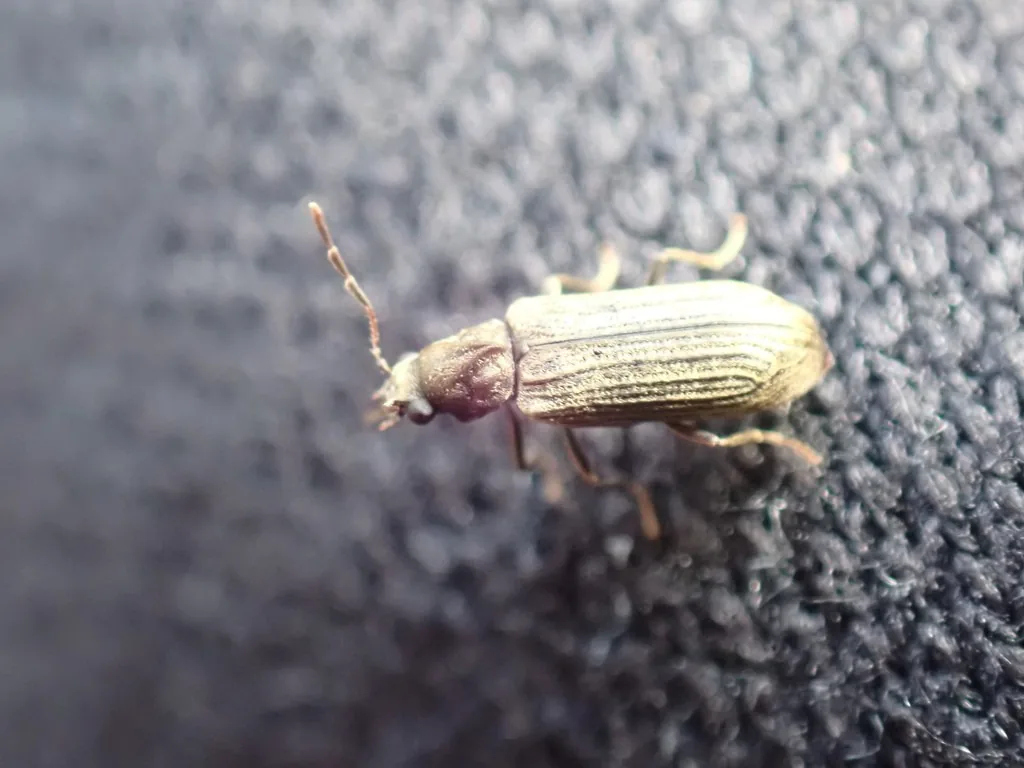
- Convex, reddish to dark brown beetles with a humpbacked look from above because the head is tucked under the hood of the thorax. They are close relatives of the drugstore and cigarette beetles of the pantry and are often confused with them.[2][1]
- Emergence holes are round, 1/16 to 1/8 inch, and come in various sizes on one piece of wood, where true and false powderpost holes are all one size. In UC IPM's ballpoint-pen test the tip and part of the angled face of a click pen fit into a deathwatch hole.[2][1]
- The frass is the field test: tiny pellets, smaller than drywood termite pellets, that feel slightly gritty between the fingers, grittier than the talc-like flour of powderpost beetles but not as coarse as the packed meal of false powderpost beetles. It stays packed in the galleries and shows only where larvae or adults push it out of exit holes.[1][2]
- Adults tap their heads against the wood, usually at night, to communicate and probably to find mates; the name is thought to come from medieval Europeans hearing the tapping while sitting up with the dying.[1]
Look-alikes
| Look-alike | How to tell them apart |
|---|---|
| Powderpost beetles (Lyctinae) | Narrow, flattened beetles whose larvae leave flour-fine frass and pinhead-sized holes in hardwoods only, such as oak flooring, paneling and furniture; they rarely touch softwood framing.[2][1] |
| False powderpost beetles (Bostrichidae) | Also hooded, but the frass is coarse and packed so tightly it is hard to dislodge, the whole pen point fits the hole, and females bore their own egg tunnels rather than laying on the surface.[1][2] |
| Furniture beetle (Anobium punctatum) | One anobiid species with its own page; the deathwatch group also includes the Pacific deathwatch beetle, Hemicoelus gibbicollis, the species most often met in California structures.[1] |
| Drugstore and cigarette beetles | Pantry anobiids that look much the same but breed in stored food, not wood.[2][1] |
| Foreign grain beetle | A tiny brown mold feeder often mistaken for a powderpost beetle in new or damp houses; it does not damage wood and leaves when the moisture is fixed.[2] |
Where it lives
Anobiid infestations occur throughout much of the country but are most common in the southeastern and coastal states, where humidity is high and crawl-space construction is abundant. NC State calls anobiids the primary powderpost concern in North Carolina, and in California the Pacific deathwatch beetle is more likely than powderpost beetles to invade from wild populations outdoors.[2][3][1]
Biology and life cycle
Adults emerge in spring and summer and lay eggs in cracks, crevices and pores of bare, unfinished wood. The larvae feed mainly in the sapwood, filling their tunnels with pellets, and a generation usually takes two years or more, longer when conditions are poor, which is why infestations are seldom obvious in a building less than ten years old. Adults are strong fliers and some come to lights; outdoors they live in dead limbs and bark-free trunk scars, and infestations start from infested lumber or firewood or from beetles flying in.[2][3][1]
Moisture sets the limits. Larvae need wood at about 13 to 30 percent moisture, and wood that stays below 14 percent through spring and summer is generally unsuitable, so damage concentrates in damp crawl spaces, basements, garages and unheated outbuildings; houses with central heating and cooling seldom have living areas or attics damp enough. UC IPM adds that they favor old or partly decayed wood, especially Douglas-fir girders, beams and foundation timbers.[2][1]
Unlike lyctid and bostrichid beetles, anobiids can digest cellulose and are less dependent on the starch that declines as wood ages, so they attack wood of any age; in Europe some species still infest buildings that are centuries old.[2]
Decay draws them in. In lab tests, egg-laying females of the European deathwatch beetle flew upwind toward the odor of wood-decay fungi and decayed oak but not toward sound oak, beech or pine, and preferred to lay eggs on paper treated with fungus extracts.[5]
Damage and signs
- These are the powderpost beetles that can seriously damage beams, joists, sills and other structural components, and the emerging adults reinfest year after year. The damage is slow, though: Kentucky says there is no need to act immediately for fear of structural collapse, and a wait-and-see approach often makes sense while you confirm the infestation is active.[2]
- An active infestation shows powder the color of freshly sawn wood sifting from holes that have not weathered and carry no stain inside; yellowed, caked or dusty powder means old damage. Mark or seal the holes, vacuum the powder and recheck later, ideally in spring or summer when adults emerge. You cannot judge the severity by looking; probe the wood, and for floor joists and other structural members NC State suggests a contractor or structural engineer.[2][3]
Health risk
A wood pest. None of the sources here describes any effect on people beyond the cost of repairs.[1][2][3][4]
Control
Prevention
Dry the wood. Take moisture readings on joists in several parts of the crawl space (corners with poor ventilation read highest), improve drainage and ventilation with foundation vents, and lay 6 to 8 mil polyethylene over 70 to 80 percent of the crawl-space soil, or encapsulate the space with a dehumidifier; wood held near 13 percent or below is unfavorable. Beetles lay eggs only in bare wood, so paint, stain or varnish seals the pores and cracks they use, and sealing old emergence holes prevents reinfestation through them.[3][2][1]
Penn State's general powderpost advice applies here too: don't store valued wooden items in barns and sheds, which are often infested, and if you buy an antique with many holes, ask the dealer for a receipt from the company that fumigated it.[4]
Sanitation
Remove dead tree limbs near buildings, destroy scrap lumber, inspect lumber and furniture before bringing it indoors, and limit firewood to what you will burn that day. Many of the worst infestations begin with old barn or woodpile lumber used for paneling or additions.[1][2]
Traps and physical control
Replace infested boards and the adjacent pieces where that is practical, and destroy them by burning or landfill. Small wooden objects can be heated at 120 to 140 F for about six hours (not items with fabric, pelts or paint) or frozen at 0 F for three to seven days, longer for thick wood; pest firms use heat chambers at 120 to 135 F for up to 24 hours for furniture.[1][2]
Pesticides
Where wood cannot be replaced, borate formulations (sodium borates such as disodium octaborate tetrahydrate) sprayed on bare wood are the most widely used treatment and the one most often applied to anobiid-infested joists, beams, sills and studs; UC IPM says a licensed operator applies them. They cannot pass paint, varnish, wax or polyurethane, and they penetrate deeper in damp wood, perhaps only the top quarter inch below 15 percent moisture.[2][1][3][4]
When to call a professional
Whole-building fumigation is the extreme, costly option, reserved for anobiid infestations that have spread into walls and between floors where surface treatment is impractical. It kills adults and larvae better than eggs, current sulfuryl fluoride fumigants are less effective on wood borers than the methyl bromide they replaced, and it does nothing to prevent reinfestation once the gas clears; portable furniture can be fumigated under tarps or in vaults or chambers for far less.[2][1][4]
Common questions
- How do I know whether it is deathwatch or powderpost damage?
- Rub the frass and probe a hole. Deathwatch frass feels gritty, the holes vary in size and a click pen's tip plus part of its face fits in; powderpost frass is like talc with pinhead holes, and false powderpost frass is packed hard with holes that swallow the whole pen point.[1][2]
- The holes are in my floor joists. Is the house about to fall down?
- No. These beetles damage wood slowly over years, so confirm the infestation is active, measure the wood moisture and get a contractor or engineer to assess structural members before deciding on treatment.[2][3]
- Why does my pest company keep talking about the crawl space?
- Because anobiid larvae need wood at roughly 13 to 30 percent moisture. Ventilation, drainage and a plastic vapor barrier over the soil take away the dampness they depend on.[2][3]
Sources
- University of California Statewide IPM Program, “Pest Notes: Wood-Boring Beetles in Homes, UC ANR Publication 7418 (Lewis and Seybold).” ipm.ucanr.edu/home-and-landscape/wood-boring-beetles-in-homes/ (accessed 2026-11-11)
- University of Kentucky Department of Entomology, “Powderpost Beetles, ENTFACT-616 (Potter; revised March 2026).” entomology.ca.uky.edu/ef616 (accessed 2026-11-11)
- NC State Extension, “Powderpost Beetles and Wood-Inhabiting Fungi (Residential, Structural and Community Pests).” content.ces.ncsu.edu/powderpost-beetles-and-wood-inhabiting-fungi (accessed 2026-11-11)
- Penn State Extension, “Powderpost Beetles.” extension.psu.edu/powderpost-beetles (accessed 2026-11-11)
- Journal of Chemical Ecology, via PubMed, “Influence of odor from wood-decaying fungi on host selection behavior of deathwatch beetle, Xestobium rufovillosum (Belmain et al. 2002).” pubmed.ncbi.nlm.nih.gov/12035923/ (accessed 2026-11-11)
- iNaturalist, “Anobiinae taxon page (order and family).” www.inaturalist.org/taxa/47495 (accessed 2026-11-11)