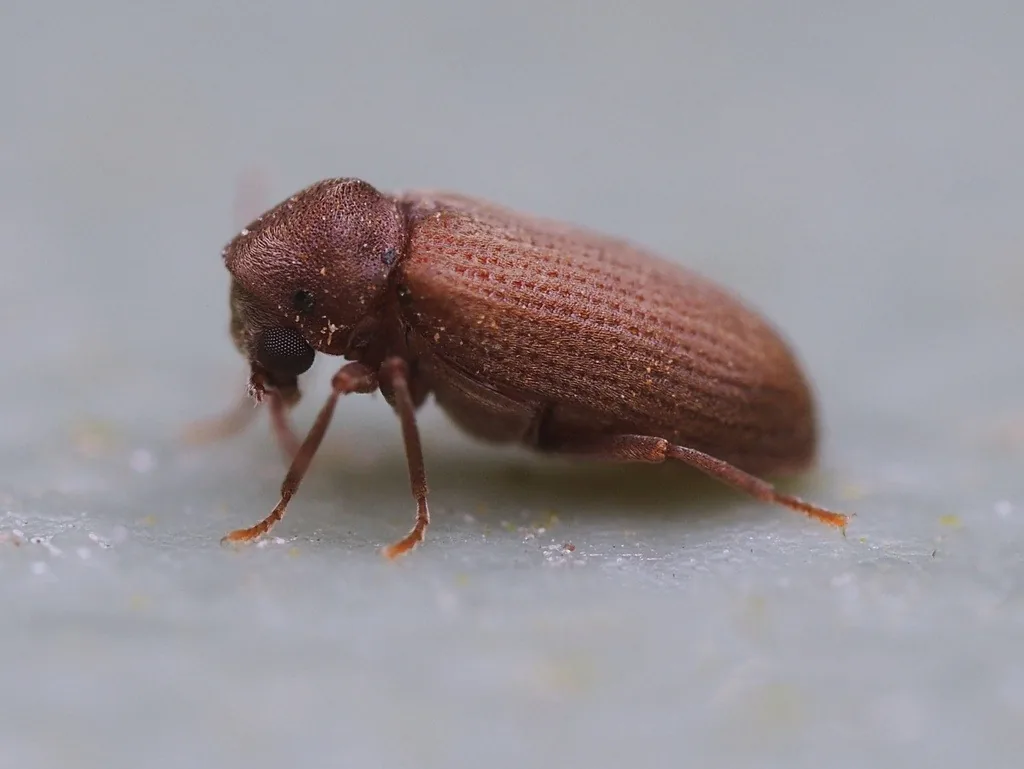
How to identify it
- Adults are 2 to 9 mm long and reddish brown to almost black, with a compact, oval or cylindrical body.[1]
- The front of the body forms a hood over the head, so the head isn't visible from above; the antennae have no club.[1]
- Exit holes are small, round and about 1/16 to 1/8 inch across, slightly larger than those of lyctid powderpost beetles.[2][1]
- Powder sifting from the holes feels coarse and gritty when rubbed between the fingers.[1][2]
- Larvae are white, C-shaped grubs with a brown head and three pairs of legs, 2 to 5 mm long.[1]
Look-alikes
| Look-alike | How to tell them apart |
|---|---|
| Lyctid powderpost beetles | Their frass feels like talcum powder rather than grit, and they attack mainly starchy hardwoods with large pores.[3] |
| Old house borer | A much larger longhorned beetle, 5/8 to 1 inch long, black to gray with long antennae, leaving oval exit holes about 1/4 inch across.[4] |
| Drugstore and cigarette beetles | Close relatives that look similar but infest stored foods such as flour, cereal, spices and pet food, usually in kitchens and pantries.[2][3] |
| Foreign grain beetles | Tiny beetles, about 1/16 inch, that feed on surface molds in damp new construction and don't damage wood.[2] |
Where it lives
Found around the world but rarely in tropical hardwoods. In the U.S., anobiid infestations are most common in southeastern and coastal states with humid weather and crawl space construction.[1][2]
Biology and life cycle
Adult females lay eggs in cracks or old exit holes; eggs hatch in 4 to 5 weeks and larvae tunnel in the wood.[1]
Larvae feed for a year or more and pupate just under the surface; the full life cycle takes one to three years, longer in drier wood.[1]
Adults don't feed; they mate within about a week of emerging, and emergence generally happens in spring and summer.[1][2]
Unlike lyctid beetles, anobiids can digest cellulose, so they can infest wood regardless of its age and reinfest the same wood for generations.[2][1]
Larvae need wood moisture of about 13 to 30 percent, so infestations concentrate in damp crawl spaces, basements, garages and outbuildings.[2]
Damage and signs
- It attacks older, seasoned hardwood and softwood, especially pine sapwood, and only rarely heartwood.[1]
- Anobiids can seriously damage beams, joists and other structural wood, although damage builds slowly and is seldom obvious in buildings under 10 years old.[2]
- Fresh, light-colored, fluffy frass and bright new holes signal an active infestation; yellowed or caked powder usually means old damage.[1][2]
Health risk
The concern is wood damage rather than health. Powderpost beetles damage wood slowly, so there's no need to act immediately out of fear for your home's structure.[2]
Control
Prevention
Confirm the infestation is active first: seal or mark old holes, vacuum the powder, and recheck in spring or summer for new holes and fresh frass.[2]
Lower wood moisture in crawl spaces with a polyethylene ground cover, better drainage and foundation vents; wood below 14 percent moisture is unsuitable for development.[2]
Traps and physical control
Remove and replace small sections of infested wood, along with adjacent pieces as a precaution.[2][3]
Small items can be frozen at 0°F for 72 hours to a week, depending on thickness, or, if they have no fabric or paint, heated in an oven at 120° to 140°F for 6 hours.[3][2]
When to call a professional
Borate sprays applied to bare, unfinished joists, beams and sills are most often used against anobiids; they won't penetrate paint or varnish.[2][3]
Fumigation is reserved for widespread infestations inside walls and floors; it doesn't prevent reinfestation, and furniture can be fumigated more cheaply in a chamber.[2][3]
Common questions
- Are the holes in my old furniture still active?
- Look for fresh, light-colored, fluffy powder and bright new holes; plugged holes can mean larvae are about to pupate. Dull holes and caked dust are usually old.[1][2]
- Why do furniture beetles show up in crawl spaces?
- Anobiid larvae need damp wood, so infestations are worst in damp crawl spaces; centrally heated and cooled living areas are seldom damp enough.[2]
- Will sealing wood stop powderpost beetles?
- Mostly. Beetles lay eggs only in bare wood, so painted, stained or varnished surfaces are generally safe, especially once old exit holes are sealed.[2]
Sources
- Integrated Pest Management Working Group (MuseumPests.net), “Fact Sheet: Furniture Beetle, Anobium punctatum (current as of January 12, 2009).” www.museumpests.net/wp-content/uploads/2014/03/Furniture-Beetle.pdf (accessed 2026-10-06)
- University of Kentucky Entomology, “ENTFACT-616: Powderpost Beetles (revised June 2018).” entomology.ca.uky.edu/files/ef616.pdf (accessed 2026-10-06)
- University of California Statewide IPM Program, “Pest Notes: Wood-Boring Beetles in Homes, Publication 7418.” ipm.ucanr.edu/home-and-landscape/wood-boring-beetles-in-homes/ (accessed 2026-10-06)
- Penn State Extension, “Old House Borer (updated May 12, 2026).” extension.psu.edu/old-house-borer (accessed 2026-10-06)
- iNaturalist, “Anobium punctatum taxon page (order and family).” www.inaturalist.org/taxa/130577 (accessed 2026-10-06)