On this page
How to identify it
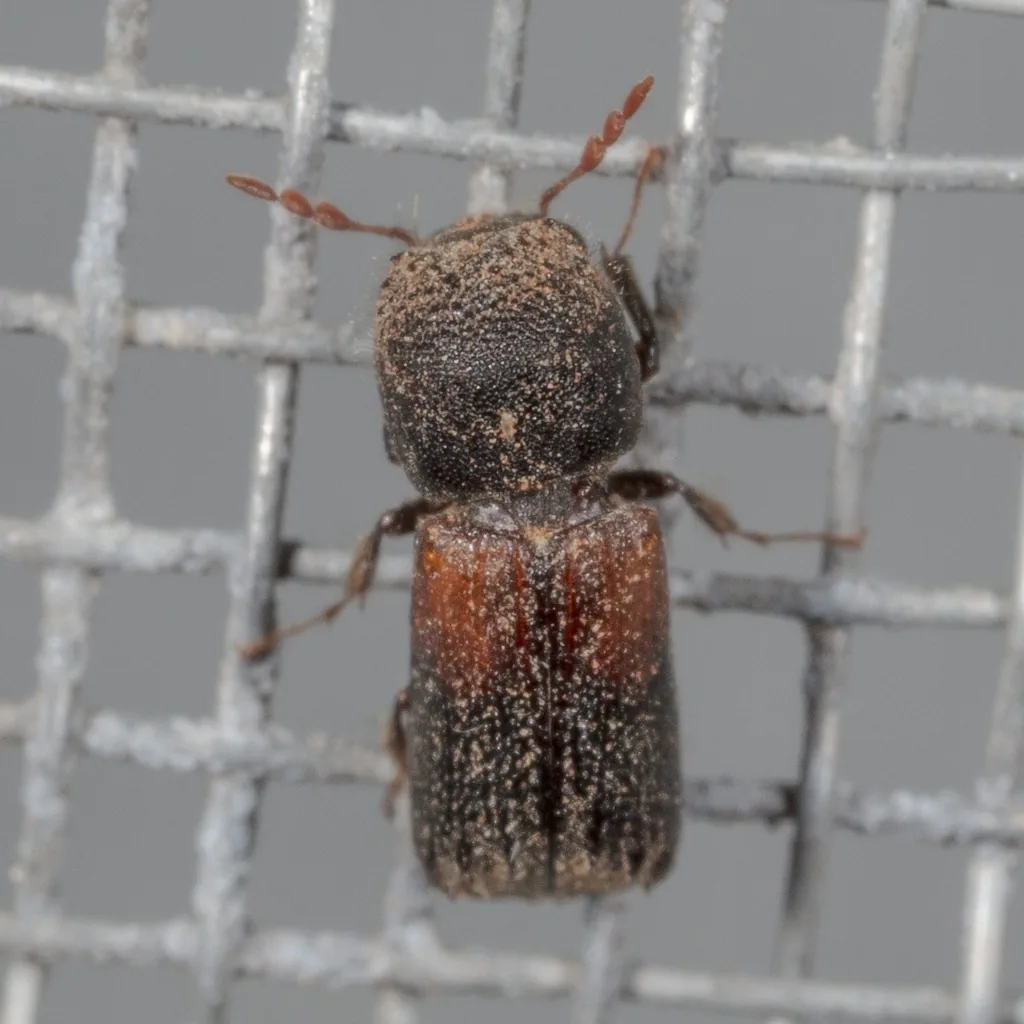
- Adults are small and cylindrical, 3.3 to 7.0 mm long (about 1/8 to 1/4 inch), brownish black to dark reddish brown, with the front half of the wing covers reddish to brownish yellow.[1]
- At the rear the wing covers slope off at an angle, and each edge of the slope carries three conspicuous teeth. The antennae, palps and feet are brownish yellow.[1]
- Larvae are yellowish white, wrinkled and C-shaped, 5 to 6 mm long, with a small round head and a greatly enlarged thorax bearing three pairs of legs.[1]
Where it lives
It occurs in the eastern half of the United States, from Florida north to New York and west to Texas and Kansas, and in southeastern Canada.[1]
Biology and life cycle
Hickory, pecan and persimmon are its favored hosts, but it uses many others, including black locust, oak, redbud, mulberry, elm, Osage-orange, apple, ash, peach, honeylocust, pear, poison sumac, poison ivy and eucalyptus, and occasionally conifers and some vines.[1]
Adults emerge in summer and fly in search of host trees. They bore through the bark and cut tunnels across the grain just beneath the surface of the sapwood, which can girdle small limbs and trunks, and the eggs are laid along the sides of these tunnels.[1]
Larvae feed mostly in the sapwood, tunneling along the grain, and spend the winter in their galleries, mostly as mature larvae. Adults often bore into healthy twigs for food and shelter and commonly spend the fall, winter and spring in galleries inside twigs and branches.[1]
A generation can develop in 1 year under good conditions, but it sometimes takes longer.[1]
In north-central Georgia it was attracted to traps baited with ethanol and syn-2,3-hexanediol, a longhorned beetle pheromone, and in later trials in the Southeast the 2,3-hexanediol lures increased catches of this beetle.[2][3]
Its recorded natural enemies are four species of parasitic wasps and an unidentified fly.[1]
Damage and signs
- Stressed, dying and recently dead trees are the most susceptible. Warning signs include branches that fail to bud in spring, flagging branches with withered brown leaves, and girdled or fallen branches.[1]
- An infested branch has a single round entrance hole, 2 to 3 mm across, next to one or more buds or leaf scars, and it breaks easily there because it has been partly or completely girdled under the bark. Emerging beetles leave many 2 to 3 mm exit holes that look like shotholes, and the wood inside is full of parallel galleries packed with very fine, powdery frass.[1]
- It may cause some twig dieback and possibly hasten the death of trees already stressed or dying from other causes, but the threat to healthy trees is minimal. Infested trees cut for wood products can be quickly ruined if they are not processed promptly.[1]
Health risk
The Forest Service account describes no risk to people. It damages twigs, branches and wood.[1]
Control
Prevention
These borers are little threat to healthy, well-kept trees, so good cultural practices that keep trees vigorous come first.[1]
Sanitation
Remove and destroy dead and dying twigs, branches and prunings promptly to eliminate sources of infestation. Dying or dead trees meant for wood products should be processed promptly, and boards should not keep bark-covered edges (wane), which encourage attack.[1]
Common questions
- How can I tell if a branch has red-shouldered bostrichid damage?
- Look for a single round hole, 2 to 3 mm across, beside a bud or leaf scar, where the branch snaps easily. Split open, the wood shows parallel galleries packed with very fine, powdery frass.[1]
- Will the red-shouldered bostrichid kill a healthy tree?
- Rarely. It mainly attacks stressed, dying and recently dead trees. It can cause some twig dieback and may hasten the decline of trees already weakened, but the threat to healthy trees is minimal.[1]
- What attracts red-shouldered bostrichids?
- Stressed, dying and recently dead trees. In trapping studies in Georgia and elsewhere in the Southeast, it also came to traps baited with ethanol and 2,3-hexanediol lures.[1][2][3]
Sources
- USDA Forest Service, “Guide to Insect Borers in North American Broadleaf Trees and Shrubs, Agriculture Handbook AH-706 (J. D. Solomon, 1995), red-shouldered bostrichid account, pp. 286-288.” research.fs.usda.gov/treesearch/22150 (accessed 2026-11-09)
- Journal of Economic Entomology (Entomological Society of America), indexed in PubMed (PMID 26453724), “Miller, Crowe, Mayo, Silk and Sweeney. Responses of Cerambycidae and Other Insects to Traps Baited With Ethanol, 2,3-Hexanediol, and 3,2-Hydroxyketone Lures in North-Central Georgia. Journal of Economic Entomology 108: 2354-2365 (2015), doi:10.1093/jee/tov220 (abstract).” doi.org/10.1093/jee/tov220 (accessed 2026-11-09)
- Environmental Entomology (Entomological Society of America), indexed in PubMed (PMID 34636848), “Miller, Crowe, Mayo, Silk and Sweeney. Interactions Between syn- and anti-2,3-Hexanediol Lures on Trap Catches of Woodboring Beetles and Associates in Southeastern United States. Environmental Entomology 51: 83-93 (2022), doi:10.1093/ee/nvab111 (abstract).” doi.org/10.1093/ee/nvab111 (accessed 2026-11-09)
- iNaturalist, “Xylobiops basilaris taxon page (order and family).” www.inaturalist.org/taxa/233843 (accessed 2026-11-09)