How to identify it
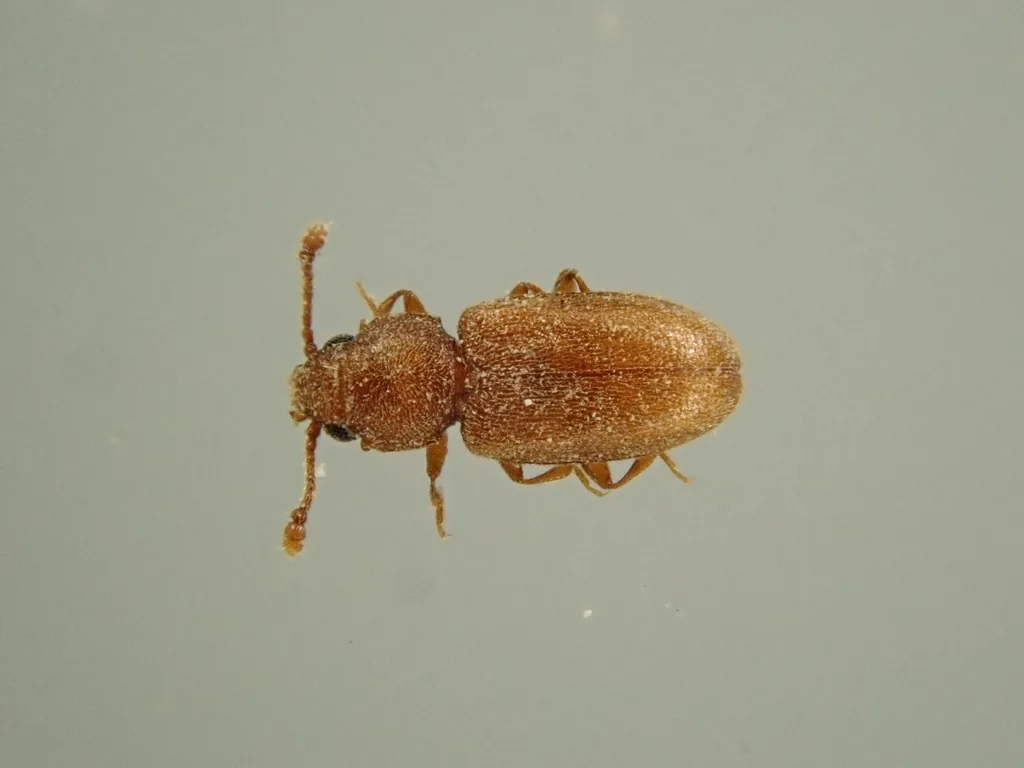
- Adults are flattened, reddish-brown beetles only about 2 to 3 mm long, roughly 1/16 to 1/12 inch.[1][2][4]
- The key feature is a small knob or peg-like projection on each front corner of the plate behind the head; you need a good hand lens or microscope to see it.[1][2][3]
- The antennae end in a three-segmented club, and the wing covers carry rows of punctures and very fine hairs.[3][4]
- They fly well and are drawn to windows and lights, so they are sometimes mistaken for fruit flies or gnats, but they have a hard shell and their wings fold under wing covers.[2][1]
Look-alikes
| Look-alike | How to tell them apart |
|---|---|
| Sawtoothed grain beetle | Similar in size and in the same family, but it has six saw-like teeth along each side of the thorax instead of a single knob at each front corner.[1][3] |
| Merchant grain beetle | Also has six tooth-like projections on each side of the thorax and is more often a true pest of stored food.[3] |
| Plaster beetles (minute brown scavenger beetles) | Other tiny mildew feeders in damp homes; their thorax is often hairy and distinctly narrower than the wing covers.[3] |
| Booklice | Also tied to high humidity and mildew, but booklice are pale insects only 1 to 2 mm long, with a bulging upper lip and a narrow thorax.[3] |
Where it lives
Found worldwide; it is a common late-summer nuisance in buildings in states such as Kentucky and Minnesota.[4][1][2]
Biology and life cycle
Adults and larvae feed on molds on damp grain, bread, flour products, poorly seasoned lumber and wet plaster or wallboard, and both can live on mold alone.[4][1][3]
Females lay 100 to 300 eggs, singly or in clusters of two or three, and the eggs hatch in four to five days.[4][3]
Egg to adult takes about three weeks under favorable conditions, around 22 days at 80 degrees F and 75 percent relative humidity.[3][4]
They need relative humidity above about 65 percent to reproduce, and they die out once humidity falls below about 60 percent.[2][3]
In new homes, beetles breed on mold in wall voids, often on construction sawdust, then exit around baseboards, outlets and light fixtures in August and September.[2][1]
Damage and signs
- They are only a nuisance: they don't bite, don't damage wood, fabric or sound food, and don't infest furniture or clothing.[1][2]
- If you find them in stored food, the food is usually old, damp or moldy.[1][2]
- Their presence signals a moisture problem, such as damp new framing, plumbing leaks, condensation or poor ventilation.[1][3]
Health risk
Foreign grain beetles are harmless to people. University of Minnesota Extension notes their presence doesn't mean the mold behind the walls is harmful to humans.[2][1]
Control
Prevention
The real fix is drying out the wood and removing the moisture source; most new homes dry out naturally within the first year or two, and the beetles disappear with the mold.[1][2]
Speed drying with fans, air conditioning, more air exchange and a dehumidifier, and run bathroom vent fans during showers.[1][2]
Sanitation
In older homes, fix leaks and condensation, check crawlspace and attic ventilation, and clean up any spilled grain or moldy food.[2][3]
Traps and physical control
Vacuum up visible beetles; this removes them as well as a spray would and is the best short-term relief.[1][2]
Pesticides
Pesticides are rarely needed. Pyrethrin aerosols give only brief relief, while residual aerosols or dusts injected into the infested wall voids last longer.[2][1][3]
Common questions
- Why are tiny brown beetles coming out of the walls of my new house?
- New lumber and drywall often hold extra moisture that grows mold inside the walls. Foreign grain beetles feed on that mold and emerge in late summer.[2][1]
- Will foreign grain beetles go away on their own?
- Usually. In new construction they are typically a problem for one to two years, until the wood dries and stops supporting mold.[2][1]
- Do foreign grain beetles mean I have toxic mold?
- Not necessarily. They show that something is damp enough to grow mold, but University of Minnesota Extension says their presence doesn't mean the mold is harmful to people.[2]
Sources
- University of Kentucky College of Agriculture, Entomology, “ENTFACT-610: Foreign Grain Beetle (revised March 2026).” entomology.mgcafe.uky.edu/ef610 (accessed 2026-10-06)
- University of Minnesota Extension, “Foreign Grain Beetles (reviewed 2024).” extension.umn.edu/nuisance-insects/foreign-grain-beetles (accessed 2026-10-06)
- Texas A&M AgriLife Extension Service, “Mildew-Feeding Insects in the Home (Insects in the City).” citybugs.tamu.edu/factsheets/household/misc-house/ent-2010/ (accessed 2026-10-06)
- University of Florida, Entomology and Nematology Department, “Foreign Grain Beetle, Ahasverus advena (stored product pests image gallery).” entnemdept.ufl.edu/projex/gallery/dl/stored_product_pests/text/foreign_grain_beetle.htm (accessed 2026-10-06)
- iNaturalist, “Ahasverus advena taxon page (order and family).” www.inaturalist.org/taxa/212915 (accessed 2026-10-06)