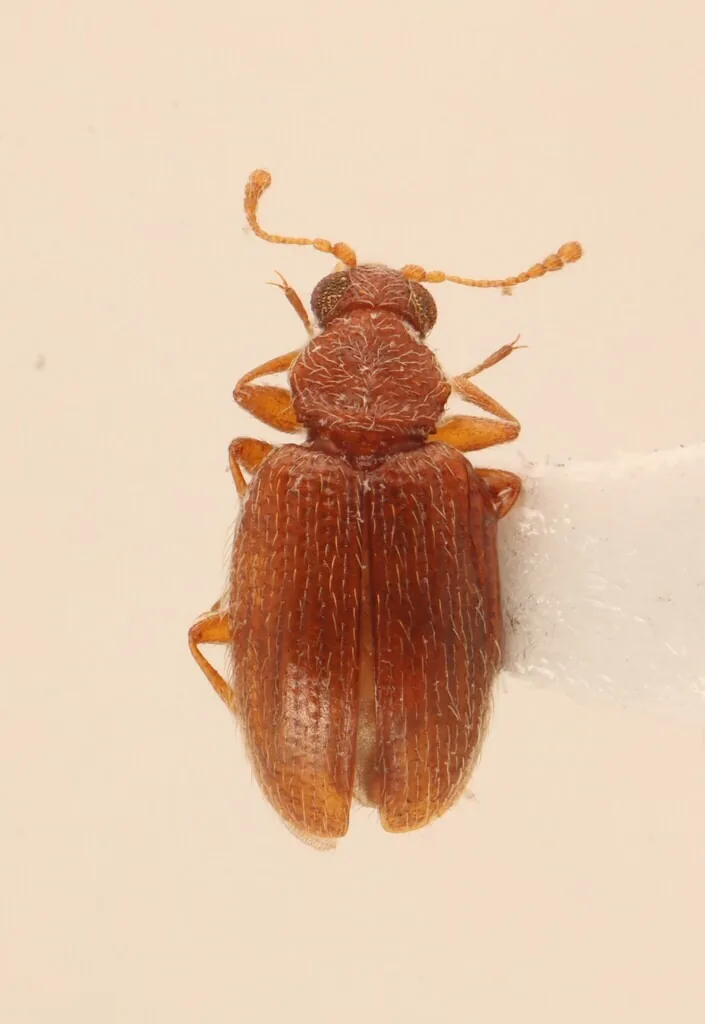
How to identify it
- They are very small, about 1 to 2 mm (around 1/16 inch) long, elongate, and brown to black.[2][3]
- The plate behind the head is often hairy and distinctly narrower than the wing covers, and the feet have three segments.[3]
- Most fungus beetles like these have punctures on the body and clubbed antennae; a good hand lens or microscope is needed to see these features.[1]
- Ohio State Extension names Melanophthalma americana as the plaster or minute brown scavenger beetle, and Texas A&M notes Dienerella species in Texas homes; the sources treat the group together.[1][3]
Look-alikes
| Look-alike | How to tell them apart |
|---|---|
| Foreign grain beetle | A slightly larger mold feeder, about 2 to 3 mm, with a knob on each front corner of the thorax.[3][1] |
| Silken fungus beetles | Similar tiny mold feeders in a different family, Cryptophagidae; their thorax lacks prominent front-corner angles and their wing-cover punctures aren't in rows.[3][2] |
| Booklice | Share the same damp, mildewy places but are pale, 1 to 2 mm insects with a bulging upper lip, a narrow thorax and swollen hind legs.[3] |
Where it lives
Reported as household nuisances from the Pacific Northwest to Ohio and Texas, wherever damp conditions allow mold to grow indoors.[2][1][3]
Biology and life cycle
Adults and larvae of most species live in moldy materials, such as damp stored food and decaying plant matter, and feed on fungal spores and threads.[2][1]
Eggs are laid on moldy material such as green lumber, wet plaster and wallboard, or moldy grain, and the larvae develop in the mold.[1]
Development speeds up with warmth: fungus beetles can go from egg to adult in 25 to 36 days at 75 degrees F but may take five months or more when it is cool.[1]
Most complaints come in late July through September, often after rainy weather. The beetles are attracted to lights and can slip through window and door screens.[1]
Suspected indoor breeding spots include mildewed bathroom grout, scum in garbage cans and organic buildup in sliding-window tracks.[2]
Damage and signs
- They are a nuisance only: they don't bite, sting, spread disease or damage wood, food or fabric.[1]
- Heavy numbers may show up trapped in tubs and sinks or around lamps and TVs, and stored food can be soiled by their cast skins and droppings.[1]
- Their presence is a clue to excess moisture, such as a leak, poor ventilation or high humidity.[3][1]
Health risk
Plaster beetles don't bite or sting and don't spread human diseases; the issue is the dampness and mold that support them.[1][3]
Control
Prevention
Dry out the damp conditions that let mold grow; most new homes dry naturally within a year or two, and the beetles fade with the mold.[1][3]
Use heating, ventilation and dehumidification to bring humidity down; Ohio State notes numbers drop when humidity stays below 60 percent.[1][3]
Keep dry foods in insect-proof glass, heavy plastic or metal containers with tight lids.[1]
Sanitation
Find and clean breeding sites, such as mildewed grout, moldy window tracks, garbage-can residue and moldy stored food.[2][1]
Traps and physical control
A strong vacuum with crevice attachments will pick up many of the beetles.[1]
Pesticides
Spraying adults gives only temporary relief because it misses the breeding sites, and foggers rarely reach the wall voids where beetles develop.[2][1][3]
When to call a professional
If cleanup and drying don't solve it, a pest control professional can apply products labeled for wall voids and other hard-to-reach spots.[1]
Common questions
- What are the tiny brown beetles on my windowsills in a new house?
- They are often plaster beetles or other fungus beetles feeding on mold growing on damp new lumber, plaster or drywall.[1][3]
- Will bug bombs get rid of plaster beetles?
- Usually not. Ohio State says total-release foggers rarely reach the wall voids where the beetles develop; drying and cleanup work better.[1]
Sources
- Ohio State University Extension, “Fungus Beetles, HYG-2084.” ohioline.osu.edu/factsheet/HYG-2084-10 (accessed 2026-10-06)
- Washington State University Puyallup Research and Extension Center, “Scavenger Beetles and Fungus Beetles, PLS-44 (updated June 2003).” wpcdn.web.wsu.edu/wp-puyallup/uploads/sites/408/2015/02/PLS-44-Scavenger-Beetles-and-Fungus-Beetles.pdf (accessed 2026-10-06)
- Texas A&M AgriLife Extension Service, “Mildew-Feeding Insects in the Home (Insects in the City).” citybugs.tamu.edu/factsheets/household/misc-house/ent-2010/ (accessed 2026-10-06)
- iNaturalist, “Melanophthalma americana taxon page (order and family).” www.inaturalist.org/taxa/177085 (accessed 2026-10-06)