The short answer
- Bugs in a real Christmas tree are outdoor insects and mites that were spending the winter on it, as eggs or dormant adults, and wake up in the warm house. They are rare, and none of them is dangerous to people, pets or the house: they can't infest furniture or houseplants and usually die within a short time indoors.[1][3][4][5]
- Shake the tree (many lots have a mechanical shaker) and look it over before it comes inside, cutting off any mantis egg cases and removing bird nests. Indoors, vacuum up anything that wanders off the tree. Don't spray the tree: aerosol insect sprays are flammable and aren't needed.[1][4][2][5]
Insects and mites found on Christmas trees
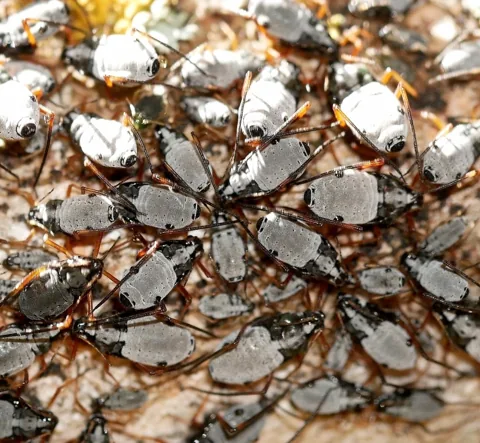 Giant Conifer Aphids
Cinara species
Giant conifer aphids are large, brownish-black aphids that cluster on fir and pine branches and produce copious honeydew that attracts yellowjackets.
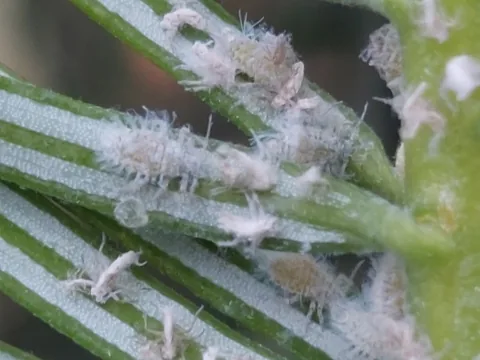 Balsam Twig Aphid
Mindarus abietinus
Balsam twig aphids are tiny, waxy aphids that feed on buds and new needles of firs and some spruces in early spring, twisting and curling the needles and coating them with sticky honeydew and sooty mold.
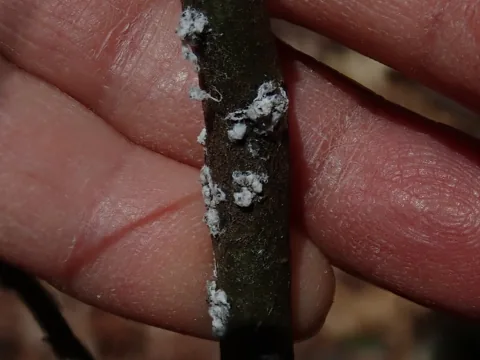 Pine Bark Adelgid
Pineus strobi
Pine bark adelgids are tiny insects that cover the bark of pines and spruce with white, cottony wax; heavy infestations look like snow on the trunk.
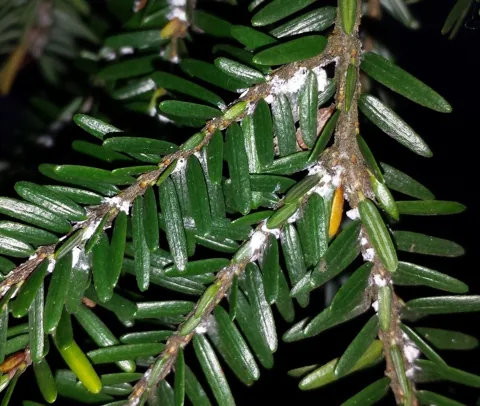 Hemlock Woolly Adelgid
Adelges tsugae
The hemlock woolly adelgid is a tiny, sap-feeding relative of aphids from Asia that lives on hemlock twigs at the base of the needles. It has killed millions of eastern and Carolina hemlocks, but landscape trees can be saved when it is found early and treated.
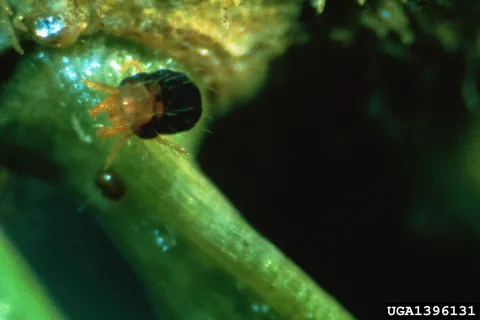 Spruce Spider Mite
Oligonychus ununguis
The spruce spider mite is one of the most destructive spider mites in the US, speckling and browning the needles of spruce, arborvitae, juniper, hemlock and other conifers.
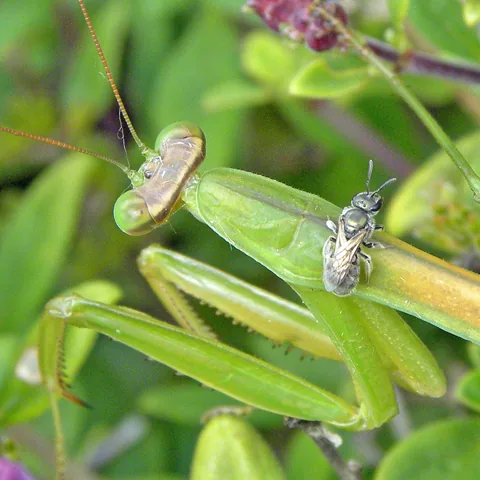 Praying Mantids
Mantidae (e.g., Tenodera sinensis, Mantis religiosa, Stagmomantis carolina)
Mantids are generalist predators. They catch pests, but they also eat bees, butterflies and other beneficial insects, and UC IPM says they're of no benefit for biological pest control.
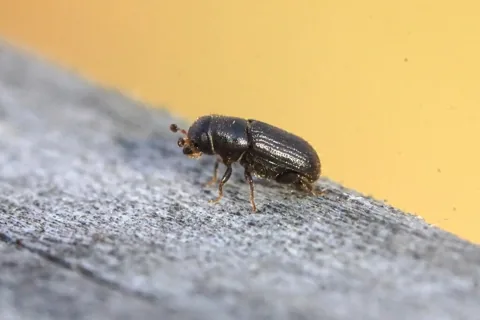 Pine Bark Beetles
Dendroctonus frontalis and Ips species (I. calligraphus, I. grandicollis, I. avulsus)
Pine bark beetles are tiny beetles that breed in the inner bark of pines. The southern pine beetle is the most destructive pine bark beetle in the southern United States, and three Ips engraver beetles also kill pines in the Southeast. Once beetles mass-attack and colonize a pine, the tree almost always dies.
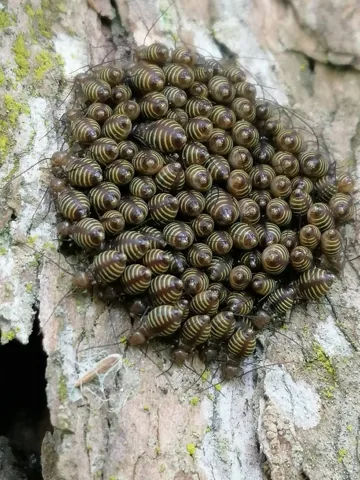 Barklice
Archipsocus nomas, Cerastipsocus venosus and other bark-dwelling psocids (order Psocodea)
Barklice are tiny, soft-bodied insects that live on tree bark. Some species blanket trunks and limbs in silky webbing or move over the bark in herds, but they feed on lichens, fungi and debris and do not harm the tree.
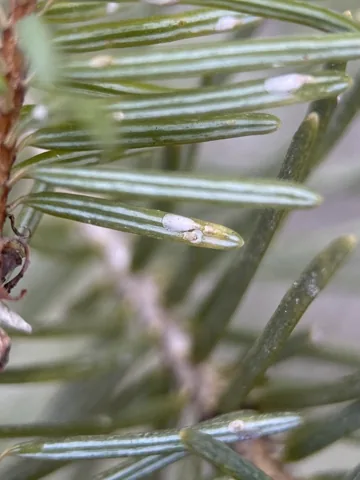 Pine Needle Scale
Chionaspis pinifoliae
White flecks lined up on pine or spruce needles are usually pine needle scale; light infestations are mostly cosmetic.
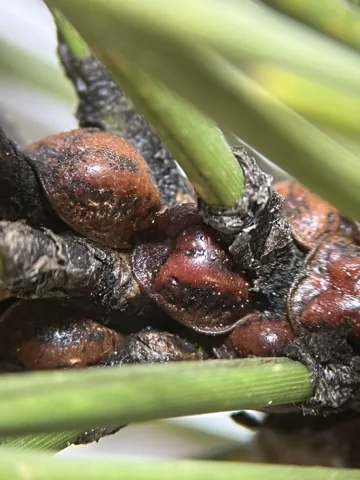 Pine Tortoise Scale
Toumeyella parvicornis
Pine tortoise scale is a soft scale insect native to North America that feeds on pine twigs and needles. Its honeydew grows black sooty mold, and it is one of the harder pests for Christmas tree growers to control.
No photo yet
Striped Pine Scale
Toumeyella pini
Striped pine scale is a soft scale (family Coccidae) that has greatly increased along Colorado's Front Range. It mainly damages Scotch pine, coating twigs and needles with sticky honeydew and sooty mold.
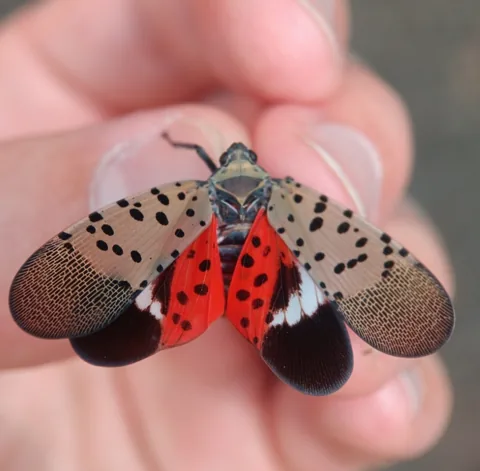 Spotted Lanternfly
Lycorma delicatula
The spotted lanternfly is an invasive planthopper from Asia that feeds on the sap of grapevines, hops, stone fruit trees, hardwoods and many landscape plants. It can't bite or sting, but it hitchhikes easily: females lay eggs on almost any hard outdoor surface, including vehicles, trailers, grills and firewood.
Why bugs appear on a Christmas tree
A Christmas tree is a living tree grown outdoors, and like any outdoor tree it can carry insects and other arthropods through the winter, mostly as eggs or adults. In the warmth of a house they behave as if spring has arrived: eggs hatch, adults become active, and some aphids start reproducing. Most stay on the tree; a few wander toward windows in the daytime or lamps at night.[1][3][4][5]
- It doesn't happen often. NC State Extension estimates that in most years perhaps one tree in 100,000 has any one of these pests, and Illinois Extension gives the same figure. They are more common when the weather is still warm at harvest, because the insects and mites are still active when the trees are cut. Growers scout for them, but sometimes only one tree in a whole field has them and nobody notices until the tree is indoors. NC State calls these hitchhikers a symptom of a fresh, recently harvested tree.[3][4][2]
Before the tree comes inside
- Shake it. Mechanical tree shakers at many retail lots and tree farms, or a vigorous shake by hand, dislodge some of the arthropods, especially adults. NC State suggests lots shake or rinse trees with water, which also removes dead needles and pollen.[1][4][3]
- Look inside the tree. With the tree lying on its side, look up into the interior from the cut end. In fall, Cinara aphid colonies are often hidden on branches down inside the tree, and mantis egg cases can be on the trunk or twigs and hard to spot.[4][2][5]
- Remove egg masses: praying mantis egg cases, spongy moth and spotted lanternfly egg masses can be scraped off the trunk or branches, and Illinois Extension also lists bagworms. For a mantis egg case, cut off the twig or branch it is attached to and leave it in a shrub or evergreen outdoors, where the young can hatch in spring when there is food for them.[1][4][2]
- Take out bird nests. Some people keep them as decorations, but nests can hold bird mites and other parasites, so remove them before the tree comes inside.[1][4]
- In and near spotted lanternfly quarantine areas, Penn State asks people to inspect the tree before transporting it.[1]
What you might find
No tree carries all of these, and most trees carry none. These are the groups extension entomologists describe on cut trees.[1][3]
- Giant conifer aphids (Cinara): large aphids up to 1/8 inch long, black, gray or brown with long legs. Penn State counts at least 152 species in North America, on most kinds of conifer. NC State says they are common on Virginia and white pine and rare on firs. Indoors they produce live young and numbers can build quickly; the first generation is wingless, but if the tree stays in long (especially a live tree with a root ball) winged ones may appear, and they move off the tree when the needles dry out.[1][2]
- Balsam twig aphids: gray-green aphids, much smaller than Cinara, mainly on true firs such as Fraser and balsam fir. They winter as eggs that normally hatch in early spring, and indoors they may hatch before the tree is taken down.[1]
- Adelgids: tiny, aphid-like sap feeders that cover themselves in white, cottony wax, so the tree looks flocked on the needles, twigs or bark. Pine bark adelgid is mainly on white pine (sometimes Scotch and Austrian pine), and hemlock woolly adelgid on eastern hemlock, which isn't usually sold as a Christmas tree but may be cut on private land. Adelgids don't move off the tree, and the insects and their wax are harmless.[1][4]
- Spruce spider mites: very small, showing as dark-red dots when shaken out of the tree; adults have eight legs under a magnifier. NC State says they are a common pest of Fraser fir that is sometimes still active in a warm, dry fall. On the cut tree they can lay eggs, cause early needle drop and leave small red stains on carpets, ornaments or furnishings. They feed only on the tree, don't bite and die out once it is removed.[2]
- Predatory mites: tiny, mostly light-colored mites that winter as adults and stay on the tree eating insect and mite eggs, usually unnoticed. A few, such as whirligig mites, are larger and brightly colored. None bite or harm people or pets.[1][4]
- Praying mantis egg cases: brown, frothy-looking masses glued to twigs and branches, described as looking like spray-foam insulation. NC State says they are occasionally found on Fraser fir. Warmed indoors, they hatch after several weeks into many small mantids. Sources differ on how many: NC State and Illinois say 200 to 400 eggs per case, Kentucky's mantid fact sheet says groups of 12-400 eggs and several dozen to hundreds of nymphs, and Kentucky Pest News says a case can contain thousands of eggs. The young don't bite or carry disease, but they eat each other and starve indoors.[1][2][4][6][5]
- Bark beetles: small, cylindrical brown beetles, 1/4 inch or less as adults. Their larvae may already be in the trunk or branches, pushing fine sawdust out of small holes, and the warmth makes the adults emerge early. They need moist wood, so they cannot attack the dry lumber, framing or furniture in a house.[1][5]
- Bark lice (psocids): small, soft-bodied, often winged gray or brown insects that feed on fungus, mold, pollen, algae and dead insects on bark and needles. Despite the name they are not lice, don't bite and die quickly in dry indoor air.[1]
- Scale insects: waxy, motionless bumps on the needles. Pine needle scale females are about 1/8 inch long under a white cover, with eggs wintering beneath it. Outdoors the tiny red crawlers come out in April, but indoors they may appear after a couple of weeks, on the tree and sometimes on nearby floors and walls. Pine tortoise scale and striped pine scale don't have time to produce crawlers indoors but may drip a little sticky honeydew.[1][5]
- Spiders: outdoor species that wintered on the tree, or spiderlings that hatched in the warmth. They usually stay on the tree; any small webs on walls, ceilings or furniture can be vacuumed or brushed away. They aren't indoor species and don't survive long.[1][5]
- Stink bugs and other adults: Kentucky Pest News notes that stink bugs may use a tree as a winter shelter and come out once it warms up.[5]
- Spotted lanternfly egg masses: unlikely, but possible in the insect's range. An egg mass brought indoors can hatch in a few weeks into black-and-white-spotted nymphs, which can't feed on a Christmas tree and soon die. They don't bite and aren't a threat to people, pets or the house.[1]
Aphids or ticks?
Large dark Cinara aphids are often mistaken for ticks; NC State says even pesticide applicators have made that mistake. It's simple to tell them apart.[2]
If they show up indoors
- Leave the ones on the tree alone. Penn State's advice is to leave insects on the tree until the tree goes out; most never leave it, and low humidity and lack of food mean the strays die within a short time.[1][4]
- Vacuum the strays. Insects, mites, spiders and baby mantids that collect on windows, walls, ceilings or the floor can be vacuumed up. Kentucky Pest News says sweeping them outside or spritzing individuals with soapy water are fine too.[1][5][2]
- Don't crush spider mites on carpet or furnishings; they leave small red stains. Wipe up scale crawlers that have left the tree with a damp towel.[2][1]
- Baby mantids can be vacuumed or caught and put outside. Penn State notes that no law protects mantises, and that hatchlings are very hard to keep alive through winter: they need a steady supply of tiny live insects, and if released in spring they are out of step with their prey.[2][1]
- If the problem is heavy, take the tree out or go back to the seller. Illinois Extension says you can return it for a refund or exchange, and NC State asks lots to tell the grower when pests turn up so steps can be taken against the pest.[4][3]
Why not to spray the tree
Penn State, Illinois and Kentucky Extension all say not to treat the tree inside. Aerosol insect sprays are often flammable and usually not labeled for indoor use, and Illinois Extension says they should never be used on a Christmas tree. Kentucky Pest News adds that bug bombs, liquid sprays and other insecticides on the tree leave residues that could be hazardous to people and probably won't control these insects anyway. The insects aren't harming the house, so there's nothing to gain.[1][4][5]
- NC State's guidance for retail lots is different, because it applies before the tree is sold: a thorough wash with water may be enough, with insecticidal soap or a household-labeled insecticide if washing doesn't work. Even then, NC State notes that no pesticide treatment is 100% effective: a few survivors are enough for the pests to reach a home.[3]
After the holidays
- Mantis egg cases you removed can go in a shrub or evergreen outside to hatch in spring. Mantids hatch in spring, feed through the summer and lay their eggs in late summer and fall.[1][4][7]
- In and around spotted lanternfly quarantine areas, Penn State asks that old trees go to a community recycling program that chips them, or be burned where that is allowed. An egg mass that didn't hatch during a short stay indoors could hatch in spring on a tree tossed outside. If lanternflies hatch from a tree outside the quarantine zone, report it to your state agriculture department.[1]
Common questions
- Are the bugs in my Christmas tree dangerous?
- No. The insects and mites that come in on cut trees live on outdoor conifers, don't bite or carry disease, and don't damage the house, its contents, pets or people. Spruce spider mites can leave small red stains if crushed.[1][2][5]
- Are those tiny black bugs ticks?
- Almost certainly not. They are usually Cinara aphids, which have six legs; ticks have eight. NC State says ticks have never been found on Christmas trees in North Carolina.[2][4]
- Will they spread to my houseplants?
- No. Most conifer aphids feed on one kind of plant only and won't feed on houseplants, and spider mites from the tree die out once it is removed because they have nothing to feed on.[1][4][2]
- Can bark beetles from the tree get into my furniture or floors?
- No. The bark and ambrosia beetles that emerge from a Christmas tree need wood with high moisture content. The dry wood in a house and its furniture is not suitable for them.[1][5]
- Should I spray the tree with bug spray?
- No. Aerosol sprays are often flammable and usually not labeled for indoor use, and residues on the tree could be hazardous. Vacuuming is enough.[1][4][5]
- Will I get bugs again next year?
- Unlikely. NC State's estimate is one tree in 100,000, so most people never see these pests twice.[3][4]
Photo credits
- Giant Conifer Aphids: (c) Toby, some rights reserved (CC BY) — via iNaturalist, CC BY 4.0
- Balsam Twig Aphid: Dr. Alan Inman, public domain (CC0), via iNaturalist
- Pine Bark Adelgid: Lynn Harper, public domain (CC0), via iNaturalist
- Hemlock Woolly Adelgid: (c) Even Dankowicz, some rights reserved (CC BY) — via iNaturalist, CC BY 4.0
- Spruce Spider Mite: USDA Forest Service - Northeastern Area, Bugwood.org (public domain), via Wikimedia Commons
- Praying Mantids: (c) M. Whitson, some rights reserved (CC BY) — via iNaturalist, CC BY 4.0
- Pine Bark Beetles: (c) Matt Pelikan, some rights reserved (CC BY) — via iNaturalist, CC BY 4.0
- Barklice: (c) Alejandro Alfredo Aguirre, some rights reserved (CC BY) — via iNaturalist, CC BY 4.0
- Pine Needle Scale: (c) Z, some rights reserved (CC BY) — via iNaturalist, CC BY 4.0
- Pine Tortoise Scale: (c) Jody, some rights reserved (CC BY) — via iNaturalist, CC BY 4.0
- Spotted Lanternfly: (c) Tyler Ekholm, some rights reserved (CC BY) — via iNaturalist, CC BY 4.0
Sources
- Penn State Extension, “Insects on Real Christmas Trees (Michael J. Skvarla, updated January 19, 2026).” extension.psu.edu/insects-on-real-christmas-trees (accessed 2026-11-10)
- NC State Extension (Christmas Trees), “Rogues' Gallery of Post-Harvest Pests.” christmastrees.ces.ncsu.edu/christmastrees-rogues-gallery-of-post-harvest-pests/ (accessed 2026-11-10)
- NC State Extension (Christmas Trees), “Post-Harvest Pests on Christmas Trees: Control on the Retail Lot (J. Sidebottom and J. Owen).” christmastrees.ces.ncsu.edu/christmastrees-post-harvest-pests-on-christmas-trees-control-on-the-retail-lot/ (accessed 2026-11-10)
- University of Illinois Extension, “Christmas tree hitchhikers (news release, December 6, 2019).” extension.illinois.edu/news-releases/christmas-tree-hitchhikers (accessed 2026-11-10)
- University of Kentucky Entomology, “Buggy Gifts Inside the Christmas Tree (Jonathan Larson, Kentucky Pest News, December 20, 2019).” kentuckypestnews.wordpress.com/2019/12/20/buggy-gifts-inside-the-christmas-tree/ (accessed 2026-11-10)
- University of Kentucky Entomology, “ENTFACT-418: Praying Mantids.” entomology.mgcafe.uky.edu/ef418 (accessed 2026-11-10)
- Missouri Department of Conservation, “Mantids (Mantises).” mdc.mo.gov/discover-nature/field-guide/mantids-mantises (accessed 2026-11-10)